
Quick summary: Illegal Logging Prohibition Act (ILPA) compliance made simple: learn how importer-led due diligence, risk verification, and digital traceability systems enable audit-ready timber sourcing and reduce legal exposure.
Illegal timber can enter your supply chain long before it reaches your warehouse, and under Illegal Logging Prohibition Act (ILPA), the legal responsibility still lands on you. Australia’s Illegal Logging Prohibition framework has shifted timber compliance from paperwork checks to structured, risk-based due diligence. For timber importers, this means proving legality across borders, suppliers, and documentation trails before products even clear customs. Understanding the Illegal Logging Prohibition Act regulatory requirements is no longer optional; it’s essential for protecting shipments, contracts, and market access.
TraceX timber compliance solutions help importers digitize supplier data collection, automate risk assessment, and maintain audit-ready due diligence workflows, making Illegal Logging Prohibition Act (ILPA) compliance faster, defensible, and scalable.
ILPA is Australia’s legal framework designed to prevent illegally harvested timber from entering its market. It places clear compliance responsibilities on businesses that import or process timber products, ensuring that wood entering Australia is legally sourced and transparently documented.
The regulation, formally known as the Illegal Logging Prohibition Act and associated Rules, was introduced to curb global illegal logging by targeting demand-side markets. Instead of relying solely on enforcement in producing countries, Illegal Logging Prohibition Act (ILPA) shifts accountability to companies placing timber on the Australian market. Importers must conduct due diligence before products enter the country, assess the risk of illegal harvesting in their supply chains, and apply mitigation measures if the risk is not negligible.
The estimated value of the global illegal logging trade is $52-157 billion annually (retail value), accounting for 15-30% of global timber trade and ranking as the third-largest transnational crime after counterfeiting and drugs.
Illegal Logging Prohibition Act (ILPA) policy intent is both environmental and commercial. Illegal logging drives deforestation, biodiversity loss, and climate impacts while also undercutting legitimate producers through unfair pricing. By enforcing legality requirements, Australia aims to promote responsible forest management, ethical trade, and sustainable sourcing practices.
The regulation applies to a broad range of regulated timber and wood-based products, including raw logs, sawn timber, pulp, paper, furniture, and engineered wood materials. Businesses covered under the law include timber importers bringing regulated products into Australia and domestic processors handling raw logs harvested within the country.
Illegal Logging Prohibition Act (ILPA) also forms part of a wider global effort to combat illegal timber trade. It aligns with similar regulatory frameworks in other major markets, reinforcing international supply chain accountability and encouraging harmonized timber legality standards across borders. For importers, compliance is therefore not just a legal requirement but a prerequisite for maintaining market access and global trade credibility.
Learn how illegal logging threatens global supply chains
Explore the hidden risks, regulatory crackdowns, and what businesses must do to prevent illegal timber exposure.
Explore the forest compliance tools modern importers rely on
See how digital systems simplify legality verification, documentation, and audit readiness.
Legal responsibility under Illegal Logging Prohibition Act (ILPA) falls primarily on timber importers and domestic processors. The regulation places accountability on businesses that introduce regulated timber products into the Australian market or process raw logs harvested within Australia. Compliance is not optional if your business handles regulated timber commercially; you are expected to follow AILPA’s due diligence framework.
All relevant timber products (100% in scope under EUDR Annex I, replacing EUTR) are covered, including fuel wood, sawn wood, panels, pulp/paper, furniture, and wood packaging, with broad CN codes for logs to joinery
Importer obligations begin before goods cross the border. Any business importing regulated timber or timber products into Australia must complete due diligence before importation. This includes collecting legality information, assessing the risk of illegal harvesting, and applying mitigation measures where risk is not negligible. Importers must also maintain records that demonstrate compliance and provide them to authorities if requested.
Domestic processors, businesses that process raw logs harvested in Australia, are also covered under the law. They must assess and manage the risk that domestically sourced timber has been illegally logged and keep records supporting their risk assessment and mitigation steps.
Illegal Logging Prohibition Act (ILPA) applies to a wide range of regulated timber and wood-based product categories, including raw logs, sawn wood, pulp, paper products, furniture, and engineered wood materials. The scope is defined through customs tariff classifications and product schedules.
The regulation primarily targets commercial activities. Businesses importing or processing timber for trade, manufacturing, or retail must comply. Non-commercial imports such as personal items not intended for sale are generally subject to lighter requirements, though certain controls may still apply depending on product type and quantity.
| Category | Regulated (Covered) | Exempt (Out of Scope) |
|---|---|---|
| Primary Chapters | Ch 44 (Wood), Ch 47 (Pulp), Ch 48 (Paper), Ch 94 (Furniture). | All other chapters (unless specifically listed). |
| Monetary Value | Consignments where regulated timber exceeds AUD $1,000. | Consignments with regulated timber valued at AUD $1,000 or less. |
| Material Type | Virgin timber or mixed virgin/recycled. | 100% Recycled material (Post-consumer waste). |
| Packaging | New wooden pallets/cases imported as the main product. | Packaging used exclusively to support or carry another product. |
| Product Origin | All imported regulated timber and domestic raw logs. | Timber harvested by the same entity that processes it (Processor Exemption). |
| Non-Timber Materials | Composite products with >0% regulated timber. | Bamboo, Rattan, Cork, Wick, and Bark (these are not considered “timber”). |
| Condition/Usage | Second-hand goods imported for their original purpose (e.g., wine barrels for wine). | Second-hand goods not used for their original purpose (e.g., barrels for planters). |
Illegal Logging Prohibition Act (ILPA) compliance is built on three core pillars: information collection, risk assessment, and due diligence. Together, these pillars form an end-to-end compliance lifecycle that importers and domestic processors must follow before timber products enter the Australian market. Rather than relying on border inspections alone, the framework requires businesses to proactively verify timber legality within their own supply chains.
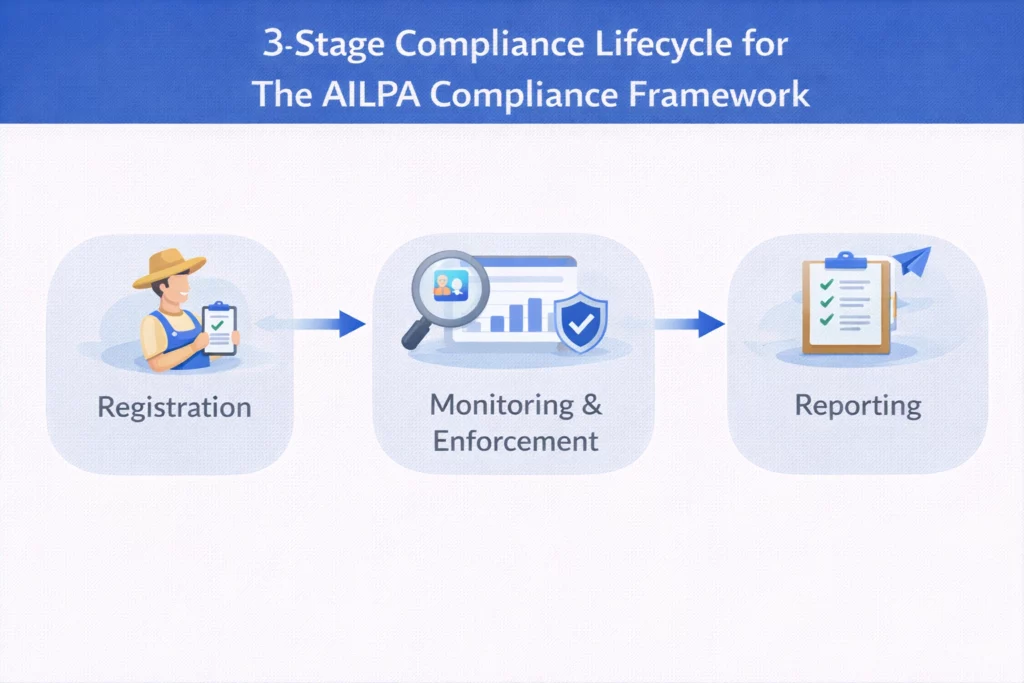
The compliance lifecycle begins with gathering accurate source data, moves into evaluating the risk of illegal harvesting, and concludes with mitigation actions when risks cannot be classified as negligible. This structured progression ensures that compliance is evidence-based, documented, and defensible during audits or regulatory checks.
Illegal Logging Prohibition Act (ILPA) places importer-led accountability at the center of the framework. Businesses, not regulators, are responsible for investigating their supply chains, validating documentation, and maintaining records that prove compliance. This shifts timber legality from a customs issue to an operational responsibility embedded in sourcing and procurement workflows.
The regulation also follows a risk-based approach, meaning not all shipments are treated equally. Where risk is low, standard checks may suffice. Where risk is elevated, enhanced verification and mitigation steps are required.
Importers must gather verifiable data on timber origin, species, supplier identity, and legality documentation.
Businesses evaluate the likelihood that timber was illegally harvested based on country, species, supply chain, and documentation risk factors.
If risk is not negligible, importers must apply additional verification, supplier checks, and corrective actions to reduce exposure.
Importers must gather verifiable data proving timber origin and legality. Under Illegal Logging Prohibition Act (ILPA), compliance starts with collecting accurate, traceable information that allows authorities and businesses themselves to confirm that timber has been legally harvested and responsibly sourced. This foundational step ensures that risk assessments and due diligence actions are based on reliable evidence rather than supplier assurances alone.
Importers are required to securely maintain all compliance records for a prescribed retention period. Documentation must be organized, accessible, and audit-ready to demonstrate that due diligence obligations were properly fulfilled if regulators request verification.
Importers must evaluate the likelihood that timber was illegally harvested using structured risk analysis. Under Illegal Logging Prohibition Act (ILPA), risk assessment is a mandatory step that determines whether timber can be sourced with confidence or requires additional due diligence and mitigation. The goal is to classify risk as negligible or non-negligible based on verifiable evidence.
A practical risk assessment follows a clear workflow:
Identify the timber product, supplier, species, harvest location, and supply chain actors. Risk analysis must be tied to each specific consignment not just the supplier relationship.
Evaluate the illegal logging risk profile of the source country. Consider:
Countries with weak governance or high forest crime rates require deeper scrutiny and enhanced verification.
Certain timber species face higher exposure due to:
Correct scientific species identification is essential to avoid hidden compliance risks.
The more intermediaries involved, the harder it is to verify legality. Risk increases when:
Short, transparent supply chains carry lower compliance risk.
Assess whether permits, licenses, and transport documents are:
Inconsistent or unverifiable paperwork elevates risk.
Broader governance conditions strongly influence timber legality risk.
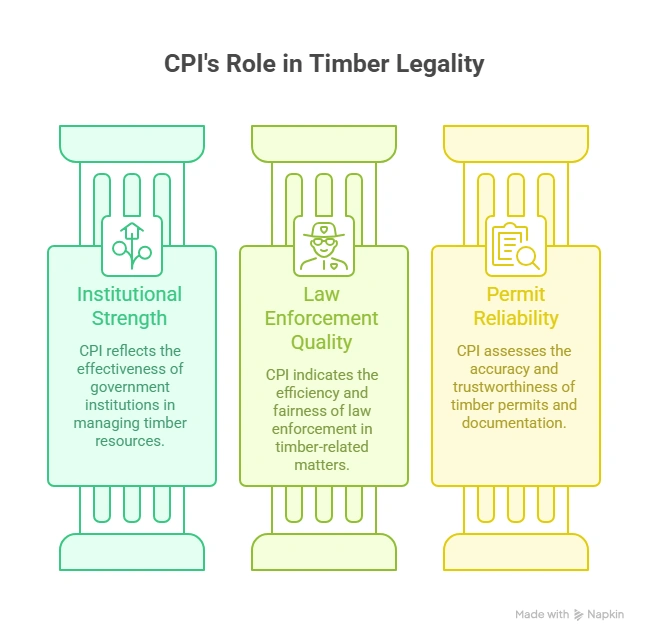
Institutional strength: Stable regulatory institutions and clear forestry laws reduce illegal logging exposure.
Law enforcement quality: Active monitoring, inspections, and prosecution capacity signal stronger compliance environments.
Permit reliability: In higher-risk regions, permits may be improperly issued or fraudulently reused, requiring independent verification.
These governance signals help importers judge whether documentation can be trusted at face value or demands deeper validation.
Within governance and corruption indicators, the Corruption Perceptions Index (CPI) serves as an important proxy for assessing the reliability of a country’s regulatory and enforcement environment. Published annually by Transparency International, the CPI ranks countries based on perceived levels of public sector corruption, scoring them on a scale from 0 (highly corrupt) to 100 (very clean).
In the context of Illegal Logging Prohibition Act (ILPA) risk assessment, CPI is not a standalone compliance requirement but a supporting risk signal that helps importers evaluate how trustworthy official systems may be.
CPI helps importers decide the depth of due diligence required:
If risk cannot be classified as negligible, importers must apply enhanced mitigation steps. Under Illegal Logging Prohibition Act (ILPA), identifying risk is only part of the obligation. When evidence suggests a meaningful possibility that timber was illegally harvested, businesses are required to take additional actions to reduce that risk before the products can enter the Australian market.
One of the most effective mitigation measures is conducting independent third-party audits. These audits verify supplier operations, harvest practices, and documentation integrity through unbiased external assessments. Independent reviews add credibility and help detect gaps that internal checks may miss.
Importers should also undertake certification verification where suppliers claim compliance under recognized forest certification schemes. This includes validating certificate authenticity, checking scope and validity dates, and ensuring certified volumes match shipment quantities. Certification supports due diligence but does not replace legality checks.
Where documentation gaps exist, businesses must request additional supplier documentation. This may include supplementary harvest permits, concession maps, transport records, production logs, or ownership transfer records that strengthen legal evidence.
In higher-risk situations, field verification may be necessary. On-site inspections or local expert assessments can confirm harvest locations, species accuracy, operational legitimacy, and alignment with permit conditions.
Importers are also expected to implement corrective action plans when supplier weaknesses are identified. These plans may involve supplier training, tighter documentation protocols, improved traceability systems, or conditional sourcing arrangements.
To demonstrate negligible risk, importers must show that mitigation measures meaningfully reduce the likelihood of illegal timber entering the supply chain. This requires documented evidence, verifiable records, and a clear rationale linking mitigation actions to risk reduction. Regulators must be able to see that compliance decisions are structured, evidence-based, and defensible.
Importers carry legal responsibility for preventing illegal timber entry. Under Illegal Logging Prohibition Act (ILPA), compliance is not optional; transferable importers are directly accountable for ensuring that timber and timber products entering Australia are legally harvested and properly documented. Legal responsibility applies regardless of whether sourcing is handled through agents, brokers, or intermediaries.
A core obligation is completing pre-import due diligence. Importers must finish information collection, risk assessment, and, where required, risk mitigation before goods enter the Australian market. Due diligence cannot be retroactively completed after shipment arrival.
Importers also have formal declaration responsibilities. They must accurately declare that due diligence has been performed and that the risk of illegal timber is negligible. False or misleading declarations can constitute regulatory violations.
Businesses are required to cooperate with authorities during compliance checks. This includes responding to information requests, providing supporting documentation, and allowing inspections where necessary. Transparent cooperation demonstrates good-faith compliance and reduces enforcement risk.
Strict record retention rules apply. Importers must securely maintain documentation supporting their due diligence process for the prescribed retention period. Records must be complete, organized, and accessible if regulators request verification.
Maintaining audit readiness is equally important. Compliance processes should be structured so evidence can be readily produced to demonstrate how legal risk was assessed and addressed.
Failure to meet Illegal Logging Prohibition Act (ILPA) obligations can result in serious consequences, including financial penalties, shipment seizures, enforceable undertakings, and reputational damage. Repeated or severe breaches may lead to stronger regulatory actions and long-term business risk.
Operational realities make Illegal Logging Prohibition Act (ILPA) compliance complex for global sourcing teams. While the regulation provides a clear framework, implementing it across diverse supply chains often presents practical hurdles that increase compliance risk and operational burden.
Technology transforms Illegal Logging Prohibition Act (ILPA) compliance from paperwork to structured workflows. Instead of relying on scattered emails, paper permits, and manual spreadsheets, digital traceability systems create standardized processes that make legality verification faster, more reliable, and audit-ready.
Modern traceability platforms integrate with ERP and procurement systems through APIs and middleware connectors. This allows legality checks, supplier data, and compliance status to sync automatically with purchasing and inventory workflows, embedding Illegal Logging Prohibition Act (ILPA) compliance directly into day-to-day sourcing operations without disrupting existing enterprise systems.
TraceX provides an end-to-end digital traceability and compliance platform purpose-built for regulated forest-risk supply chains. It enables importers to onboard suppliers through structured data workflows, capture timber origin and species information, and maintain centralized legality documentation aligned with Illegal Logging Prohibition Act (ILPA) requirements.
The platform automates risk scoring using country risk signals, governance indicators, species sensitivity, and supply chain complexity, helping teams quickly identify non-negligible risk shipments. Built-in document validation workflows ensure permits, licenses, and transport records are complete, consistent, and audit-ready.
ILPA compliance in Australia is fundamentally importer-led and risk-based, placing responsibility on businesses to actively verify timber legality before products enter the Australian market. Relying on paperwork alone is no longer sufficient; documentation must be validated, risks must be assessed, and mitigation steps must be applied where exposure remains. Importers that implement structured compliance workflows reduce both legal liability and operational uncertainty, ensuring that due diligence becomes a repeatable business process rather than a last-minute scramble. Digital traceability and compliance systems make this scalable by centralizing supplier data, automating risk checks, preserving chain-of-custody records, and maintaining audit-ready documentation. In a tightening global regulatory environment, technology-enabled compliance is not just efficient; it is essential for maintaining uninterrupted market access and buyer trust.
No. Illegal Logging Prohibition Act (ILPA) requires risk assessment and verification. Documentation must be validated for authenticity, completeness, and consistency.
Yes. Certification supports compliance but does not replace importer responsibility to assess and mitigate legality risk.
Yes. Compliance obligations apply regardless of shipment size if products fall under regulated timber categories.
Manual systems increase audit risk, slow verification, and create documentation gaps. Digital workflows improve accuracy and readiness.
Not if implemented correctly. Integrated digital systems embed compliance into existing sourcing workflows with minimal disruption.