
Quick summary: Australia's ILPA 2024 update demands documented due diligence for every timber import. Learn the 5 key traceability requirements and how to build an audit-ready supply chain system.
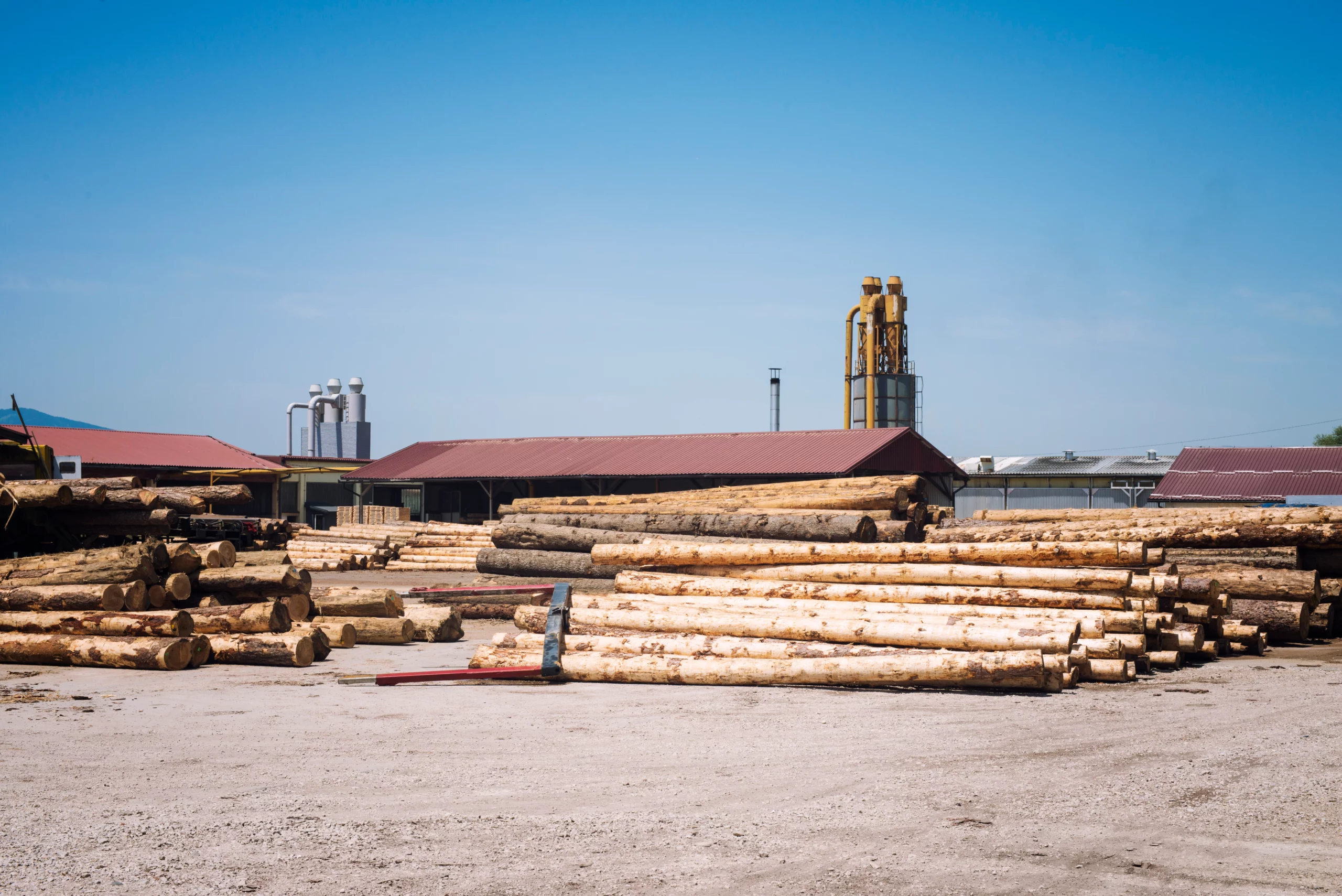
The Illegal Logging Prohibition Act 2012 (ILPA), significantly strengthened by the Illegal Logging Prohibition Amendment Act 2024 and new Rules effective 3 March 2025, requires every timber importer and domestic raw log processor to operate a documented due diligence system covering five obligations: gather supply chain information, assess risk, mitigate risk, keep records, and submit customs declarations. Failure to comply is a criminal offence. Under the Illegal Logging Prohibition Act 2012 (ILPA), supply chain traceability is essential to demonstrate legal sourcing and ensure end-to-end compliance.
The Australian Department of Agriculture, Fisheries and Forestry states that 15% to 30% of all timber traded globally is estimated to be illegally harvested.
For Australian timber importers and domestic log processors, that statistic is no longer just an environmental headline it is a compliance liability.
Since 3 March 2025, the Illegal Logging Prohibition Act 2012 (ILPA) has been operating under substantially strengthened rules. The Illegal Logging Prohibition Amendment Act 2024 and its accompanying Rules have tightened due diligence obligations, consolidated risk assessment pathways, and given Australia’s Department of Agriculture, Fisheries and Forestry (DAFF) expanded powers to test timber species and origin using technology.
The six-month education-focused transition period ended in September 2025. DAFF is now conducting full compliance audits and can issue civil penalties, criminal charges, and seize shipments. The question for every timber supply chain manager is blunt: can you prove your timber is legally sourced, right now, if DAFF sends a notice tomorrow?
This guide explains every ILPA supply chain traceability requirement, unpacks the two new risk assessment pathways, maps the penalty exposure, and shows you what a compliant, audit-ready due diligence system looks like in practice.
| Mar 2025 Date new ILPA Rules came into full effect, ILPA Amendment Act 2024 | $330 Per penalty unit under ILPA (indexed Nov 2024) Crimes Act 1914 / DAFF | Mar 2025 Date new ILPA Rules came into full effect ILPA Amendment Act 2024 |
Illegal Logging Prohibition Act 2012 makes it a criminal offence to intentionally, knowingly or recklessly import wood, pulp or paper products that contain illegally logged timber into Australia, or to process Australian-grown raw logs that have been illegally harvested. The Act also mandates due diligence obligations for importers and processors requiring documented systems that minimise the risk of dealing in illegally sourced timber.
The Illegal Logging Prohibition Amendment Act 2024 and Illegal Logging Prohibition Rules 2024 effective 3 March 2025 introduced several material changes that every importer and processor must understand:
The transition period ended September 2025. Full enforcement is now active. If you have not updated your due diligence system to align with the 2024 Rules, you are currently non-compliant.
Are you fully compliant with ILPA requirements? Learn how to build a robust due diligence system and ensure legal timber sourcing – read our blog.
Can you confidently assess your timber sourcing risk? Explore how ILPA risk assessment helps identify and mitigate compliance gaps.
The ILPA applies to ‘regulated timber products’ a defined list covering wood, pulp, and paper products. Importers must apply due diligence to regulated products with a customs value above AUD $1,000 per consignment. Products made entirely from recycled material are exempt.
| Product Category | Examples | Regulated? |
|---|---|---|
| Solid wood products | Sawn timber, logs, sleepers, poles, beams | Yes |
| Engineered wood | Plywood, MDF, particleboard, LVL, glulam | Yes |
| Wood-based panels | Veneers, fibreboard, oriented strand board (OSB) | Yes |
| Joinery and furniture | Flooring, windows, doors, wooden furniture | Yes |
| Paper and pulp | Paper, paperboard, wood pulp, packaging | Yes |
| Recycled material products | Products made entirely from post-consumer recycled timber | EXEMPT |
| Low-value consignments | Total customs value at or below AUD $1,000 | EXEMPT |
| Imported raw logs processed in Australia | Logs imported then processed domestically | EXEMPT from processor obligations |
The China Processing Gap: Why Origin Data Is Lost Before Australia
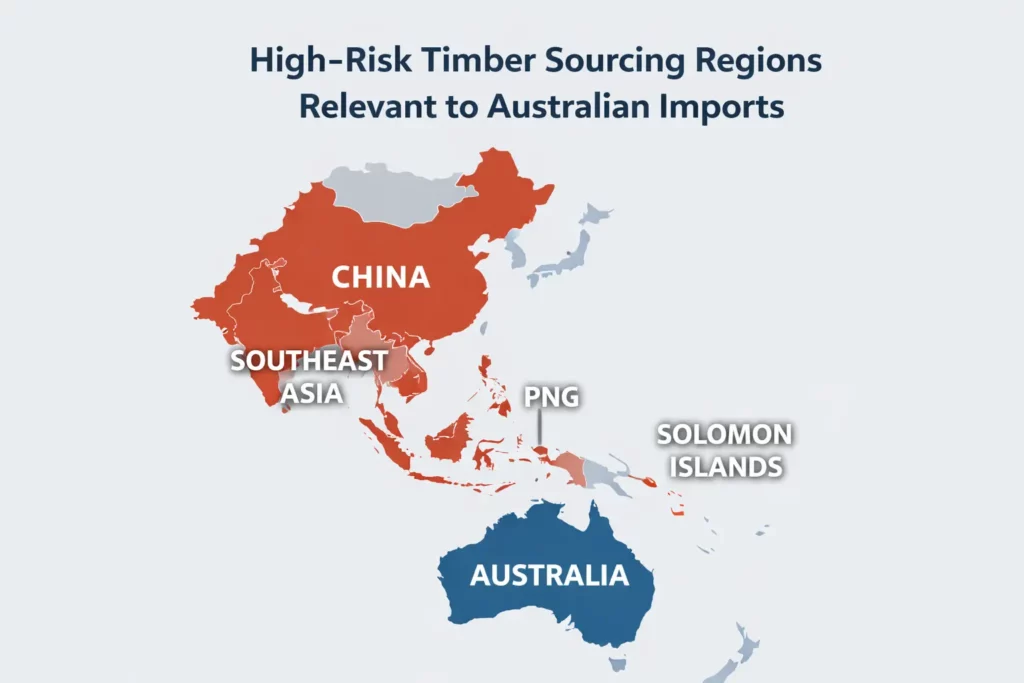
China processes vast quantities of raw timber from high-risk regions Indonesia, Malaysia, Papua New Guinea, Solomon Islands and re-exports finished products to Australia. By the time processed goods arrive, species and harvest origin data has often been stripped from the supply chain. This is ILPA’s single biggest compliance vulnerability: importers sourcing from Chinese processors must trace back to original forest origin, not just the Chinese factory. Paper-based systems cannot reliably do this.
Every timber importer and Australian raw log processor must operate a documented, written due diligence system. The 2024 Rules prescribe five sequential obligations that must be completed before each regulated import or processing activity.
Before importing any regulated timber product, you must have a written due diligence system in place. This document must identify: your name, street address, contact details and ABN/ACN; the person responsible for maintaining the system; and the step-by-step process you will follow for each import. The system must be available to DAFF on request.
For each regulated import, you must collect to the extent reasonably practicable the following information about the timber in the product: common name and scientific name (species) of the tree; the country and specific area within that country where the timber was harvested; the quantity of the shipment; and the name and contact details of your supplier. The information must be gathered before the import occurs.
Under the 2024 Rules, risk assessment follows one of two pathways depending on whether your timber is certified or non-certified. The certified pathway (FSC or PEFC forest management certificates) allows a simplified risk assessment. The non-certified pathway requires a more rigorous documented assessment against a defined set of risk factors including country and region of harvest, species, applicable legal framework, and reported illegal logging risks for that area.
Where risk assessment identifies a non-negligible risk of illegal logging, you must implement risk mitigation measures before proceeding with the import or processing. Mitigation may include obtaining additional documentation, conducting further supplier verification, requesting third-party audits, or requiring certification. Mitigation steps must be documented.
You must maintain records that demonstrate your due diligence system and how it was applied to each specific consignment. Importers must also submit a customs declaration confirming due diligence compliance at the time of import. Records must be produced to DAFF if a Requirement to Give Information and Produce Documents notice is issued. The repeat due diligence exception allows re-use of prior risk assessments for the same timber from the same supplier within 12 months.
The 2024 Rules replaced the previous three-pathway structure with a cleaner two-pathway framework. Understanding which pathway applies and what each requires is the operational core of ILPA compliance.
| Pathway | Applies When | Risk Assessment Process | Key Requirement |
|---|---|---|---|
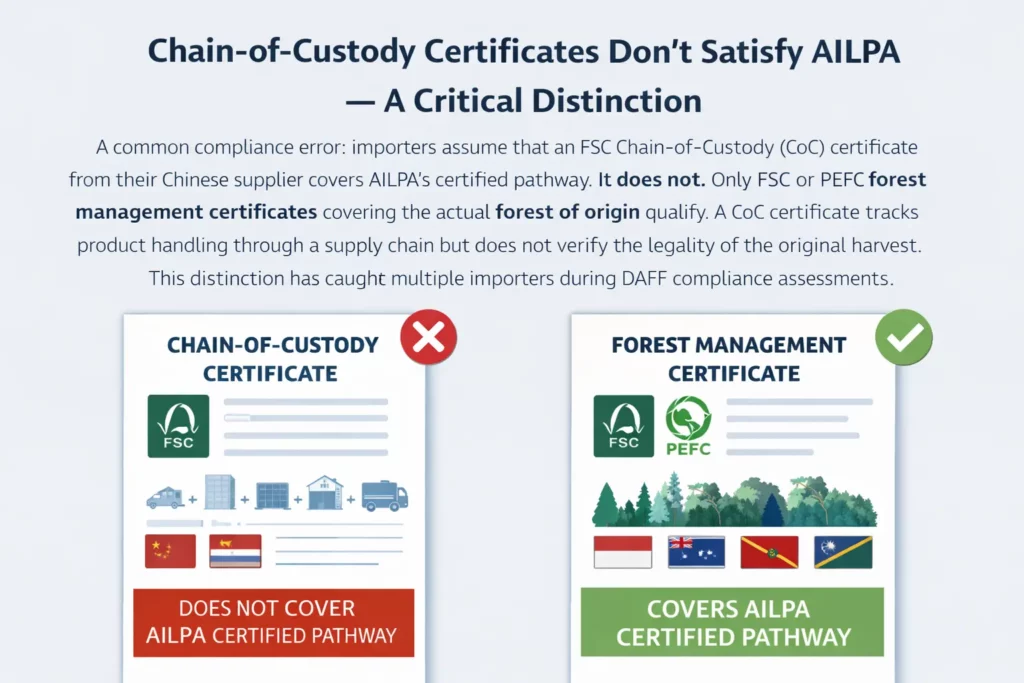
| Certified Timber Pathway | Importer has obtained and verified valid FSC or PEFC forest management certificates for the specific timber | Simplified certification reduces but does not eliminate risk; still requires documented information gathering and a written risk assessment | Must verify the certificate covers forest management (not just chain of custody) for the actual forest of origin |
| Non-Certified Timber Pathway | No valid FSC/PEFC forest management certification exists for the timber | Full documented risk assessment required against all risk factors: country/region of harvest, species, applicable laws, reported illegal logging risks, conflict-affected areas | Must document all information gathered, risk conclusion reached, and reasoning to a ‘reasonable standard’ reviewable by DAFF |
| Repeat Due Diligence Exception | Same timber product, same supplier, within 12 months of previous assessment | Previous assessment and mitigation documentation can be relied upon – update if circumstances change | Exception requires same supplier, same product and same timber origin; new suppliers or new source regions require fresh assessment |
Non-compliance with Australia’s ILPA carries both criminal and civil consequences. The penalty unit value is currently AUD $330 (indexed under the Crimes Act 1914 as of November 2024), and penalties are applied per offence meaning each non-compliant import or processing event is a separate exposure.
| $330 Per penalty unit (current, indexed) Crimes Act 1914, Nov 2024 | Criminal Intentional/reckless illegal timber import — criminal offence ILPA 2012 s.8 | Civil Failure to conduct due diligence — civil penalty per import ILPA 2012 / Rules 2024 |
DAFF publishes details of criminal convictions, civil penalty orders, and enforceable undertakings under the Act creating a public reputational record of non-compliance. For businesses operating in tender environments, retail chains with sustainability commitments, or companies subject to Modern Slavery Act reporting obligations, a published ILPA conviction is a significant commercial risk beyond the financial penalty.
Timber importers and domestic processors operating in Australian markets face a specific set of operational challenges that make ILPA compliance difficult without digital traceability infrastructure.
| Pain Point | ILPA Compliance Risk Created | TraceX Solution |
|---|---|---|
| Paper-based supplier records for species and origin | Cannot produce credible evidence chain to DAFF risk conclusion not defensible to ‘reasonable standard’ | Digital supplier onboarding with geotagged harvest plots, species records, and timestamped data capture |
| No visibility beyond Tier 1 supplier (e.g., Chinese factory) | Cannot trace timber to forest of origin non-certified pathway assessment is impossible without origin data | Multi-tier supply chain mapping with origin-level GPS verification and supplier data chain |
| Manual risk assessment documentation | Fragmented records across spreadsheets and emails fail DAFF audit requests | Centralized, structured due diligence system with per-shipment risk assessment logs and mitigation records |
| Absence of FSC/PEFC forest management certificates | Forced into non-certified pathway heavier documentation burden with no digital support | Automated certificate verification and pathway routing flags certified vs non-certified status per shipment |
| No audit-ready export format | When DAFF issues a Requirement to Give Information notice, assembly of records is slow and incomplete | One-click export of complete due diligence records in PDF, CSV, and XML DAFF-response ready |
| Repeat due diligence not systematically tracked | 12-month exception benefit lost due to no system memory; redundant assessments waste resources | Automated supplier-shipment matching flags eligible repeat due diligence exceptions per Rules s.8 |
The Emerging Market Sourcing Problem Is Australia’s ILPA Frontline
Australia’s highest-risk timber imports come from Southeast Asia Papua New Guinea, Solomon Islands, Indonesia, and Malaysia and via Chinese processors handling raw materials from these regions. These supply chains typically have the weakest digital traceability infrastructure: smallholder and community forest harvesting, fragmented middlemen, and limited connectivity. The companies that close this gap with offline-capable, multilingual digital tools will have the most defensible ILPA compliance posture.
TraceX ILPA Solutions is specifically designed for the regulatory complexity facing agri-commodity and forestry-adjacent exporters. Three platform pillars directly address ILPA’s due diligence requirements.
| TraceX Platform Pillar | Capability | ILPA Requirement Addressed |
|---|---|---|
| Regulatory Compliance Platform | AI-powered due diligence documentation; GPS polygon-based origin mapping validated against satellite datasets; risk scoring; audit-ready one-click export (PDF, CSV, XML) | Gather information (s.8), assess risk, keep records, customs declaration support |
| Sustainable Sourcing Platform | Multi-tier supplier digital onboarding with geotagged harvest plots, species and land records; offline-first mobile GPS capture for remote forest areas; blockchain-backed immutable records | Supply chain information gathering, origin verification, tamper-proof evidence chain |
| Digital MRV Platform | Primary data capture across supply tiers; chain-of-custody verification; third-party audit trail support; ERP and customs system integration | Record keeping, repeat due diligence management, cross-regulation data reuse (EUDR, CSRD) |
TraceX’s emerging-market-first design with offline mobile tools, multilingual field agent interfaces, and GPS capture in low-connectivity regions makes it purpose-built for the Southeast Asian timber sourcing chains that represent Australia’s highest ILPA compliance risk.
For most timber importers and processors, building ILPA compliance is a structured sequencing problem not a technology revolution. The following roadmap moves from immediate obligations to long-term audit resilience.
| Step | Action Required | Output / ILPA Obligation Met |
|---|---|---|
| 1 | Write and formalise your due diligence system document include responsible person, ABN, process description (Rules s.7) | Written DDS in place before next import; DAFF-presentable on request |
| 2 | Map your full supplier chain for each product type; identify Tier 1 (direct supplier) and Tier 2+ (forest of origin) for each SKU | Species, country and sub-country of harvest information gathered (Rules s.8) |
| 3 | Classify each product line as certified (FSC/PEFC forest management certificate) or non-certified; verify certificate type carefully | Correct risk assessment pathway selected; certificate verification documented |
| 4 | Conduct and document risk assessments under the applicable pathway for all current import lines | Risk assessment step completed; written record of conclusion and reasoning |
| 5 | Where risk is non-negligible, implement and document mitigation measures before importation | Mitigation obligations fulfilled; supplier communication and additional docs on file |
| 6 | Set up per-shipment customs declaration workflow; ensure importer submits compliance declaration at time of import | Customs declaration requirement met (Act s.13) |
| 7 | Implement digital record storage with per-shipment audit trail; enable DAFF-ready response to information notices | Records producible to DAFF within response deadline; repeat due diligence exception trackable |
Australian timber importers who also source for European or American markets face converging but non-identical regulatory requirements. Understanding the distinctions and where traceability data can be reused across frameworks is essential for efficient multi-market compliance.
| Regulation | Jurisdiction | Core Obligation | Key Traceability Requirement | Penalties |
|---|---|---|---|---|
| AILPA 2012 / Rules 2024 | Australia | Due diligence system; no illegal timber in imports or domestic processing | Species, country/sub-country of harvest, supplier chain, risk assessment records | Criminal offence + civil penalty per event |
| EUDR 2023 | European Union | Deforestation-free + legally harvested for 7 covered commodities (incl. wood) | GPS polygon-level geolocation; satellite-verified deforestation-free; DDS submission | Up to 4% EU annual turnover; shipment blocking |
| Lacey Act (amended 2008) | United States | Due care in verifying species, country/sub-state of harvest; declaration at import | HS code declaration; species scientific name; country and sub-national harvest location | Criminal fines; civil penalties; seizure |
| UKTR (post-Brexit) | United Kingdom | Prohibition on placing illegally harvested timber on UK market; due diligence | Risk assessment; supplier information; mitigation records | Unlimited fines; prohibition orders |
ILPA + EUDR Data Synergy: One Supply Chain, Two Compliance Wins
Timber companies exporting to both Australia and the EU can architect a single traceability data layer GPS-verified forest of origin, species documentation, supplier chain records that satisfies AILPA’s due diligence requirements AND the EUDR’s geolocation and deforestation-free verification obligations simultaneously. This dual-use traceability architecture reduces compliance cost by up to 40% versus running separate systems.
Australia’s Illegal Logging Prohibition Act no longer has a grace period, a light-touch transition phase, or an ambiguous compliance window. As of March 2025, DAFF is conducting full audits under the strengthened 2024 Rules. The companies that face civil penalties, criminal proceedings, and public naming will be the ones whose due diligence documentation cannot hold up to a standard DAFF information request.
The companies that build audit-ready traceability documented due diligence systems, species-level supply chain data, GPS-verified origin records, blockchain-backed immutability, and per-shipment customs declaration workflows don’t just avoid penalties. They build a competitive advantage: they can source from more markets, respond to buyer sustainability requirements, and future-proof against EUDR, Lacey Act, and UKTR obligations from the same data infrastructure.
The question isn’t whether AILPA compliance is achievable. It’s whether your current systems can prove it.
Illegal logging is a growing global risk. Learn how it impacts timber supply chains and what you can do to stay compliant – read our blog.
From forest to finished product, the timber value chain is complex. Explore how each stage affects compliance and traceability.
Navigating global illegal logging laws can be challenging. Understand key regulations and how they impact your business – read more.
Regulated timber products include solid wood, sawn timber, plywood, MDF, veneers, joinery, furniture, paper, and paperboard. Products made entirely from recycled material and consignments with a total customs value at or below AUD $1,000 are exempt. The full regulated product list is defined in the Illegal Logging Prohibition Rules 2024.
For each regulated import you must collect to the extent reasonably practicable the common and scientific name (species) of the timber, the country and specific area within that country where it was harvested, the quantity of the shipment, and your supplier’s name and contact details. This information must be gathered before importation occurs and retained for DAFF audit purposes.
The certified pathway applies when you have a valid FSC or PEFC forest management certificate for the specific timber it allows a simplified risk assessment but still requires documented information gathering. The non-certified pathway requires a full documented risk assessment against all risk factors. Critically, chain-of-custody (CoC) certificates do not qualify for the certified pathway only forest management certificates covering the original forest of harvest.
Intentionally, knowingly or recklessly importing illegally logged timber is a criminal offence under the AILPA. Failure to meet due diligence requirements is a civil penalty offence calculated in penalty units, currently AUD $330 each (indexed November 2024). DAFF also publishes details of civil penalty orders and criminal convictions, creating a public compliance record.
AILPA focuses on legality of timber harvesting requiring due diligence to ensure timber was not illegally logged. EUDR goes further, requiring proof that commodities including wood are both legally harvested AND deforestation-free (no deforestation after December 31, 2020). EUDR also mandates GPS polygon-level geolocation mapping. However, the two frameworks share a common data foundation: companies with EUDR-compliant traceability origin verification, species documentation, supplier chain records can satisfy most AILPA requirements from the same data layer.