
Quick summary: Learn how JTC 24 defines the Digital Product Passport framework under ESPR, including data standards, architecture, interoperability, and compliance implications.

If you’re preparing for the Digital Product Passport (DPP), you’ve probably asked yourself: “What exactly will the EU expect our system to look like?” Not just what data to provide but how it should be structured, stored, accessed, and verified. That’s where uncertainty becomes expensive. Many manufacturers are investing in traceability tools, QR codes, and ESG platforms without clarity on the technical standards that will ultimately determine compliance. The risk? Building infrastructure that doesn’t align with the framework regulators will use to assess conformity. This is precisely where JTC 24 becomes critical.
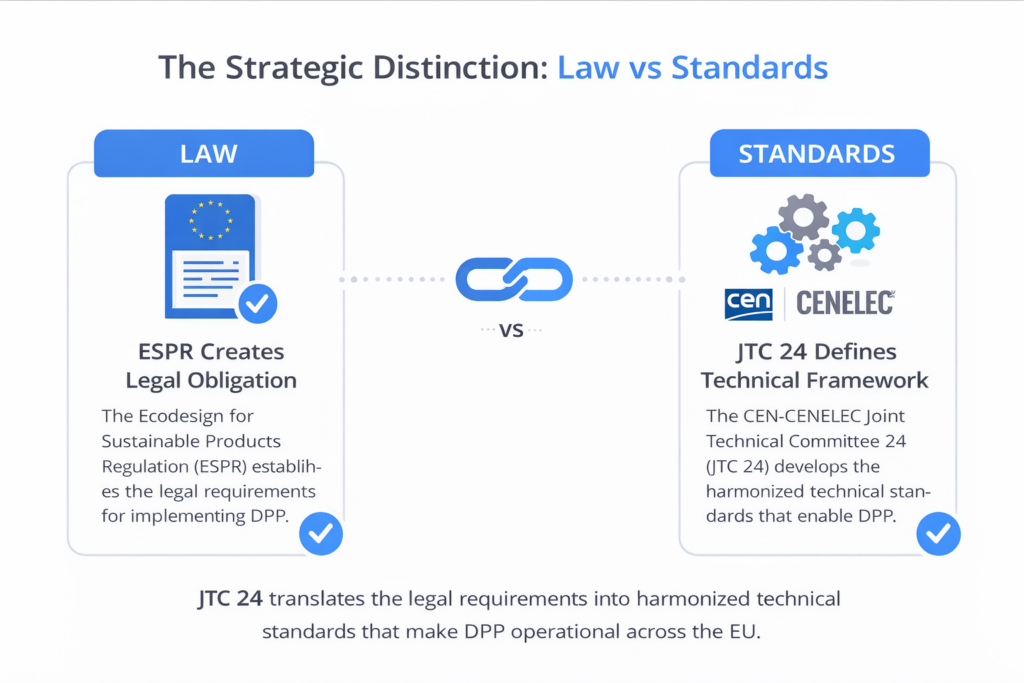
CEN-CENELEC JTC 24 is the technical body shaping the standards that will define how the Digital Product Passport operates across the EU. While the Ecodesign for Sustainable Products Regulation (ESPR) creates the legal obligation, JTC 24 defines the architecture behind it.
In other words:
ESPR tells you that you must implement DPP.
JTC 24 defines how it must function.
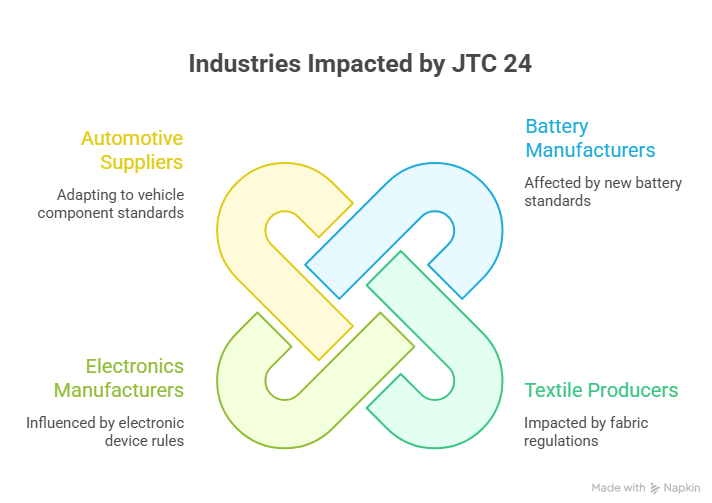
For battery manufacturers, textile producers, electronics suppliers, and automotive players, understanding JTC 24 isn’t an optional technical curiosity; it’s the difference between building scalable compliance infrastructure and retrofitting systems under regulatory pressure.
Let’s break down how JTC 24 defines the Digital Product Passport framework and what it means for your implementation strategy.
Key Takeaways
At the centre of Europe’s Digital Product Passport standardization work sits CEN-CENELEC JTC 24.
JTC 24 is the Joint Technical Committee responsible for developing the harmonized European standards that will underpin the Digital Product Passport (DPP) across industries.
While regulations define what companies must comply with, technical committees define how that compliance should work in practice. JTC 24 is the body translating policy ambition into operational standards.
JTC 24 operates under two major European standardization organizations:
Together, CEN and CENELEC develop voluntary European standards that support EU legislation. When these standards are harmonized and referenced in the Official Journal of the EU, they provide a “presumption of conformity” meaning companies following them are assumed to comply with the legal requirements.
JTC 24 was specifically created to address the technical standardization needs of the Digital Product Passport across product categories.
Ready to operationalize Digital Product Passport (DPP) compliance?
Explore how TraceX DPP Compliance solutions help you structure product data, ensure interoperability, and stay ahead of evolving EU requirements.
The Digital Product Passport is introduced under the Ecodesign for Sustainable Products Regulation (ESPR).
ESPR establishes:
However, ESPR does not define:
This is where JTC 24 comes in.
JTC 24 is tasked with developing standards for:
1️. Data Architecture
How product information should be structured so that it is machine-readable, interoperable, and scalable across the EU.
2️. Interoperability Framework
Ensuring that DPP systems can communicate across different platforms, companies, and Member States without fragmentation.
3️. Digital Product Identifiers
Standards for unique, persistent product IDs that link physical goods to their digital records.
4️. Data Carriers
Specifications around how DPP information is accessed (e.g., QR codes or equivalent technologies).
5️. Data Access & Governance
Principles governing:
In short, JTC 24 defines the technical backbone that makes Digital Product Passports function consistently across Europe.
Want to understand how the Digital Product Passport is technically structured?
Read: “Inside the Digital Product Passport Architecture”
Curious how product-specific DPP requirements will actually be defined?
Read: “How DPP Delegated Acts Will Shape Your Compliance Strategy”
For manufacturers, suppliers, and OEMs, JTC 24 is not just a regulatory footnote.
It determines:
Building DPP infrastructure without understanding JTC 24 risks creating isolated systems that later require costly redesign.
Think of the structure like this:
Without JTC 24, DPP would risk becoming fragmented across Member States, creating digital silos and compliance confusion.
With JTC 24, the EU aims to create a single, interoperable, standardized digital product transparency system.
JTC 24 is the technical architect behind Europe’s Digital Product Passport framework.
For companies investing in traceability, sustainability data systems, or DPP infrastructure, monitoring JTC 24 developments is essential because it defines the operational rules that your systems will ultimately need to follow.
The Digital Product Passport (DPP) is one of the most ambitious digital compliance frameworks ever introduced in the EU. But ambition alone doesn’t create interoperability, scalability, or legal certainty.
That’s why CEN-CENELEC JTC 24 plays such a strategic role.
It does not create the law.
It makes the law operational.
Here’s why that distinction matters.
The Ecodesign for Sustainable Products Regulation (ESPR) mandates that products must carry a Digital Product Passport.
But legislation speaks in legal terms:
What ESPR does not define is:
That translation from legal obligation to technical specification is the job of JTC 24.
Without this translation, companies would interpret requirements differently creating inconsistent and incompatible systems.
Digital Product Passports must work:
If each company builds its own proprietary DPP format, the system collapses into fragmentation.
JTC 24 establishes:
This ensures that:
A battery manufacturer in Germany,
a textile producer in Italy,
and an electronics supplier in France
can operate within the same digital ecosystem.
Interoperability is not optional. It is foundational to the DPP vision and JTC 24 defines how it is achieved.
One of the EU’s core objectives is to prevent regulatory divergence between Member States.
Without harmonized standards:
JTC 24 supports harmonized European standards that, once referenced officially, provide a presumption of conformity.
That means:
If a company follows the harmonized standards developed under JTC 24, it is assumed to comply with ESPR requirements across the EU.
This creates legal certainty.
Europe has seen fragmentation before in digital and environmental regulation.
Without centralized technical standardization:
That would increase costs, complexity, and implementation risk.
JTC 24 acts as the coordination mechanism preventing this fragmentation by:
In short, it protects the integrity of the Digital Product Passport framework.
For manufacturers, suppliers, and OEMs, JTC 24 determines:
Ignoring JTC 24 developments risks building infrastructure that later requires redesign.
Monitoring JTC 24 developments, on the other hand, allows companies to align early reducing rework, integration costs, and regulatory uncertainty.
To understand the strategic role of CEN-CENELEC JTC 24, it’s important to look at its core objectives within the Digital Product Passport (DPP) ecosystem.
JTC 24 is not defining sustainability metrics themselves it is defining the digital infrastructure principles that ensure DPP functions consistently, securely, and at scale across the European Union.
Below are the four foundational objectives shaping the framework.
One of the primary goals of JTC 24 is ensuring that Digital Product Passport data can move seamlessly across systems, companies, and Member States.
Interoperability means:
Without interoperability, DPP would fragment into isolated digital silos.
JTC 24 works to prevent:
The objective is a unified, EU-wide digital transparency infrastructure not a patchwork of disconnected tools.
A Digital Product Passport is only as useful as its structure.
JTC 24 focuses on defining:
This ensures that product information whether it concerns material composition, carbon footprint, repairability, or recyclability follows a standardized architecture.
Why this matters:
If every company defines product attributes differently, data cannot be compared, verified, or aggregated effectively.
Standardized data models allow:
This is a shift from document-based compliance to structured digital information systems.
A central pillar of the DPP framework is linking physical products to their digital records.
JTC 24 addresses this through standards for:
These identifiers must:
For example, a battery module or textile product must have a digital identity that:
Without standardized identification, traceability collapses.
Unique product identification ensures continuity between the physical and digital worlds.
Digital transparency must be balanced with confidentiality.
JTC 24 therefore incorporates principles for:
Not all DPP data will be public.
Some information may be:
The framework must protect:
At the same time, it must ensure sufficient transparency for regulatory and sustainability purposes.
Security and governance are not secondary considerations they are foundational to trust in the DPP ecosystem.
Together, these four objectives define the operational backbone of Digital Product Passports:
Through these pillars, JTC 24 transforms the legal requirements of the Ecodesign for Sustainable Products Regulation into a functional, scalable digital system.
For manufacturers and supply chain operators, aligning with these objectives early reduces the risk of building isolated or non-compliant infrastructure.
Because in a digital regulatory framework, architecture determines compliance success.
The Digital Product Passport (DPP) framework being developed under CEN-CENELEC JTC 24 is not just about adding sustainability data to products. It defines a structured digital architecture that connects physical goods to verified, accessible, and interoperable information systems.
Below are the core architectural components shaping how DPP will function in practice.
At the foundation of the DPP architecture is the Digital Product Identifier (DPI).
This identifier must be:
The identifier connects the physical product to its digital record. This ensures that when a product moves through the supply chain from manufacturer to distributor to recycler its digital passport remains accessible and verifiable.
In practical terms, this identifier is embedded into the product via:
The identifier is not just a label it is the anchor point for the entire DPP ecosystem.
The data carrier is the access mechanism that allows stakeholders to retrieve the Digital Product Passport.
It answers the question:
How does someone access the product’s digital information?
Most commonly, this will involve:
The data carrier does not store all product information directly. Instead, it acts as a secure gateway linking the user to the digital data environment.
This design ensures:
The data carrier bridges the physical and digital worlds.
A critical architectural question in the DPP framework is where and how the data is stored.
JTC 24 addresses two broad architectural models:
The likely approach combines interoperability with distributed hosting. This allows companies to retain control of their data while ensuring it can be accessed consistently across the EU.
Key principles include:
The goal is not to create one massive database but a connected ecosystem.
Not all DPP information is meant to be publicly visible.
JTC 24’s framework distinguishes between different access levels:
This data supports market transparency and informed purchasing decisions.
Access to restricted data may be limited to:
This layered approach ensures a balance between:
Transparency and confidentiality
Regulatory oversight and commercial protection
Role-based access controls and authentication protocols will define who sees what.
Together, these architectural elements ensure that the Digital Product Passport is:
The architecture developed under JTC 24 transforms the legal obligations of the Ecodesign for Sustainable Products Regulation into a functional digital ecosystem.
For manufacturers, this means DPP compliance is not simply about uploading data. It requires:
In short, DPP is digital infrastructure and its architecture determines long-term compliance success.
The Ecodesign for Sustainable Products Regulation (ESPR) introduces the legal requirement for Digital Product Passports (DPP) across prioritized product categories.
But while ESPR defines the obligation, it does not provide the full technical blueprint for implementation.
This is where CEN-CENELEC JTC 24 plays a decisive role.
Under ESPR:
These are legal requirements.
However, ESPR intentionally avoids prescribing specific technical formats, software architectures, or digital identifiers. That level of detail belongs in harmonized standards not in legislation.
JTC 24 develops the technical standards that translate ESPR’s legal language into operational rules.
This includes defining:
Once adopted and referenced, these harmonized standards provide manufacturers with a clear pathway to compliance.
If a company builds its DPP system according to JTC 24 standards, it benefits from presumption of conformity meaning it is assumed to meet the legal requirements of ESPR.
Without harmonized standards:
Standards ensure that:
In short, standards prevent regulatory chaos.
The relationship between ESPR and JTC 24 can be summarized simply:
Regulation = Obligation
ESPR creates the legal duty to implement Digital Product Passports.
JTC 24 Standards = Implementation Pathway
JTC 24 defines how those Digital Product Passports must function technically.
The regulation sets the destination.
The standards define the road to get there.
For companies preparing for DPP:
Ignoring either creates risk.
Aligning early with JTC 24 standards ensures that your Digital Product Passport infrastructure is:
Because in EU regulatory frameworks, compliance is not only about meeting the obligation it is about building according to the recognized standards that operationalize it.
TraceX DPP solutions help manufacturers and supply chain operators build interoperable, standards-aligned Digital Product Passport infrastructure without disrupting existing ERP and PLM systems.
By automating data collection, structuring product-level datasets, and enabling secure access controls, TraceX reduces compliance risk while future-proofing EU market access.
As discussion around the Digital Product Passport accelerates, several misunderstandings about CEN-CENELEC JTC 24 continue to surface.
These misconceptions can delay preparation, distort implementation strategy, and create unnecessary compliance risk.
Let’s clarify the most common ones.
“JTC 24 is just about QR codes.”
This is one of the most persistent myths.
Yes, QR codes (or similar data carriers) will likely be one way users access a Digital Product Passport. But JTC 24’s scope goes far beyond defining a scannable label.
In reality, JTC 24 defines the entire digital architecture behind the DPP ecosystem, including:
The QR code is simply the entry point.
The real work lies in:
Reducing JTC 24’s role to “QR code standards” overlooks the fundamental infrastructure transformation required for compliance.
“Standards are optional.”
Technically, European standards are voluntary.
But in practice, harmonized standards play a critical legal role.
When standards developed under JTC 24 are officially referenced under the Ecodesign for Sustainable Products Regulation (ESPR), they provide what is known as presumption of conformity.
This means:
If your Digital Product Passport system follows the harmonized standards, it is presumed to comply with the legal requirements of ESPR.
You are not legally required to follow the standard word-for-word — but if you choose an alternative approach, you must independently prove that your system meets all regulatory requirements.
In practical terms:
Following harmonized standards significantly reduces legal uncertainty and compliance risk.
Ignoring them increases the burden of proof.
“We can wait until product-specific rules are finalized.”
Many companies assume that full preparation can begin only after delegated acts define the exact product-level requirements.
This is risky.
While product-specific rules will define:
The core digital infrastructure identifiers, data architecture, interoperability models, access layers takes time to build.
Digital transformation projects involving:
rarely happen overnight.
Infrastructure lead times often exceed regulatory timelines.
Waiting for full specificity may compress implementation windows and increase cost.
Forward-looking companies are:
so that when product-specific rules arrive, adaptation is incremental, not structural.
The work of CEN-CENELEC JTC 24 is not a one-time publication of technical rules. It is an evolving standardization process that will unfold in phases closely aligned with the implementation of the Ecodesign for Sustainable Products Regulation (ESPR).
For companies preparing for Digital Product Passports (DPP), understanding this timeline is critical. Compliance readiness will depend not just on the regulation itself, but on how the supporting standards mature over time.
Like all European standardization work, JTC 24 follows a structured development lifecycle.
The typical phases include:
Proposal & Scope Definition
Working Group Drafting
Public Consultation (Enquiry Stage)
Formal Adoption
This structured process ensures transparency, industry participation, and technical robustness, but it also means development takes time.
One of the most important aspects of JTC 24’s work is stakeholder involvement.
Participants in the drafting process typically include:
This collaborative structure ensures that standards are technically feasible and aligned with real-world implementation needs.
For manufacturers, this consultation phase presents both:
Companies that monitor drafts and participate through industry associations gain early visibility into emerging requirements.
ESPR establishes the legal framework for DPP but relies on delegated acts to define product-specific requirements.
These delegated acts will determine:
JTC 24 standards must align with these delegated acts.
This means the standardization process will evolve alongside regulatory clarification.
In practice:
This synchronized evolution ensures that DPP standards remain legally relevant and technically aligned.
The key strategic insight is this:
JTC 24 is not producing a static rulebook.
It is building a living technical framework that will evolve as new product categories and regulatory details emerge.
For companies, this means:
Waiting for complete finalization may appear cautious but infrastructure lead times often exceed regulatory timelines.
Forward-looking organizations treat JTC 24 developments as strategic signals shaping long-term digital architecture.
At its core, CEN-CENELEC JTC 24 is not just another standards body operating in the background of EU regulation. It is shaping the digital architecture that will determine how the Digital Product Passport functions in practice. CEN-CENELEC JTC 24 is the technical backbone of the Digital Product Passport under the Ecodesign for Sustainable Products Regulation. While ESPR creates the legal obligation, JTC 24 defines how DPP systems must function in practice from data structure and interoperability to digital identifiers and access control. Companies that align early with JTC 24 standards reduce compliance risk, avoid costly redesigns, and build future-proof digital infrastructure for EU market access.
Interoperability is the foundation of Digital Product Passports.
Read: “DPP Interoperability: What It Really Requires”
Are you building DPP the right way as a manufacturer?
Read: “Digital Product Passports for Manufacturers: A Practical Guide”
Do you know exactly what data your Digital Product Passport must contain?.
Read: “DPP Data Requirements Explained”
CEN-CENELEC JTC 24 develops the technical standards that support the Digital Product Passport (DPP) under the Ecodesign for Sustainable Products Regulation.
ESPR creates the obligation JTC 24 defines how DPP must technically function.
Standards are technically voluntary.
However, harmonized standards provide presumption of conformity, making compliance significantly easier and lower risk.
It defines:
In short, the digital architecture behind DPP.
DPP must work across industries and EU Member States.
JTC 24 ensures systems can communicate, preventing fragmented national or proprietary solutions.
Digital infrastructure takes time to build.
Aligning early with JTC 24 standards reduces redesign costs, compliance risk, and future implementation pressure.