
Quick summary: Organic Certification in Benin explained for exporters: standards, process, traceability requirements, and how to access EU and US organic markets.
Organic Certification in Benin: Organic Certification in Benin is a formal, third-party verification process ensuring that agricultural products are grown, processed, and handled according to internationally recognized organic standards, without synthetic fertilizers, pesticides, GMOs, or prohibited chemicals. Certification is issued by accredited bodies aligned with EU Organic, USDA Organic, or other recognized standards. For Beninese exporters of high-demand commodities such as cashew, cocoa, shea, and tropical fruits, organic certification is essential to access premium EU, US, and global markets. It guarantees compliance, traceability, and market credibility, enabling higher-value exports and reducing risk of shipment rejection
Organic Certification in Benin is a formal, third-party verification process that confirms agricultural products are produced, processed, and handled according to internationally recognized organic standards without synthetic fertilizers, pesticides, GMOs, or prohibited chemicals. Certification is issued by accredited bodies aligned with EU Organic, USDA Organic, or other recognized standards, not by local claims alone.
Benin shows nascent but promising organic certification efforts, with limited certified operations only one USDA-listed entity as of recent data and focus on crops like cotton, soybeans, and rice under standards such as Cotton made in Africa (CmiA) and Ecocert. Organic cotton production has surged 65% over three years, benefiting nearly 9,000 farmers with 9% higher turnover, stable markets, and improved conditions, particularly for women via GIZ-supported projects. Insights from agroecology programs target 60% adoption of practices among rice and soybean producers by 2025, yielding 25% production increases, rehabilitating 2,120 hectares, and distributing 300 million CFA francs ($504,000) annually to 3,000 producers in 400 organizations (50% women-led).
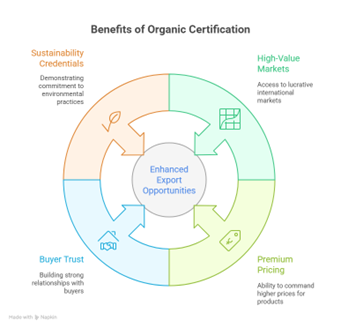
Benin’s organic sector is growing, anchored by cashew, cocoa, shea, and tropical fruits, with certified organic land expanding steadily to meet EU and US market demand. Certified exports command premiums of 15–35%, with traceable, audited production enabling access to deforestation-free and ESG-compliant supply chains. Group certification models support smallholders, while digital traceability systems ensure compliance and boost market credibility for Beninese exporters.
Why Organic Certification Matters
Explore how organic certification impacts export eligibility, price premiums, and buyer trust in global agricultural markets.
Sustainability Is Now a Market Requirement
Learn how sustainability certifications are reshaping sourcing decisions across global agri-value chains.
Any Beninese business exporting products marketed as organic to international markets requires organic certification. This is particularly essential for exporters of high-demand commodities such as cashew, cocoa, shea, mango, pineapple, banana, and spices. Processors, aggregators, and exporters must also be certified if they handle, store, blend, package, or process organic products, as certification must cover the full value chain.
Exporters targeting the EU, US, and other premium global markets must hold valid certification to legally label products as organic. Without certification, shipments risk rejection, lost contracts, or reduced prices. In practice, organic certification in Benin is crucial for market access and premium pricing.
Beninese exporters must comply with the organic standard required by their target market:
Traceability underpins organic certification, enabling regulators and buyers to verify product integrity at every stage. For Beninese exports:
Robust traceability not only supports organic certification but aligns with EU due diligence, EUDR, and ESG expectations, reducing compliance risk, enhancing transparency, and protecting access to premium global markets.
• Smallholder fragmentation is a key challenge. Benin’s organic exports, particularly cashew, cocoa, shea, mango, and pineapple, are sourced from thousands of smallholder farmers across remote regions. Ensuring consistent organic practices, standardized data collection, and full visibility across dispersed farms is difficult without structured systems.
• Manual and semi-digital record-keeping slows compliance. Paper-based farm logs, input records, and aggregation documents are prone to errors, loss, and inconsistencies, weakening traceability and increasing the time and cost of certification and export approvals.
• Audit readiness gaps pose significant risk. Organic audits require verifiable evidence of farming practices, input controls, segregation, and chain-of-custody. Incomplete or poorly organized records can result in non-conformities, corrective actions, or delayed certification renewals.
• Risk of certification suspension remains high. Traceability gaps, repeated audit findings, or inconsistent internal controls can lead to partial or full suspension, impacting buyer confidence, market access, and the price premiums that Beninese exporters depend on.
Sustainable sourcing platform from TraceX replace fragmented, manual workflows with a centralized system designed to manage organic compliance at scale. Through digital farmer onboarding, TraceX platform captures verified farmer profiles, mapped farm plots, certifications, and organic practice data directly at the source, establishing a strong foundation for certification and audits.
Real-time compliance monitoring allows exporters to track input usage, field activities, and Internal Control System (ICS) performance continuously, helping identify risks before they escalate into audit issues. TraceX platform also generates audit-ready documentation, including farm records, batch-level traceability, and chain-of-custody reports, significantly reducing audit preparation time and non-compliance findings.
By standardizing data, automating traceability, and centralizing compliance workflows, TraceX helps Beninese exporters reduce certification risk, improve audit outcomes, and scale organic exports while maintaining access to premium global markets.
Organic certification in Benin has evolved beyond compliance it is a strategic advantage for accessing premium EU, US, and global markets. Success depends on strong farm-level traceability, effective Internal Control Systems (ICS), and audit-ready documentation across diverse smallholder supply chains.
Exporters that invest early in structured data, digital traceability, and continuous compliance reduce certification risk, strengthen buyer confidence, and secure higher price premiums. In today’s competitive export environment, certified organic products from Benin are valued not just for how they are grown, but for the credibility, transparency, and trust consistently demonstrated through verifiable certification.
Ethical Sourcing Matters
Discover how ethical sourcing practices build trust, reduce risks, and create value across agricultural supply chains.
Build a Responsible Supply Chain
Explore strategies for creating transparent and accountable supply chains that meet global sustainability expectations.
Digitally Transform Your Sustainability Efforts
Learn how digital platforms are enabling real-time monitoring, reporting, and compliance in agriculture and agribusiness.
Organic certification in Benin is issued by accredited international certification bodies recognized under standards such as the EU Organic Regulation and USDA Organic (NOP), often working through local inspection partners.
Certification timelines vary, but farms typically require a 2–3 year conversion period if transitioning from conventional farming, followed by inspection and audit before certification is granted.
While not mandatory, group certification using an Internal Control System (ICS) is the most practical and cost-effective approach for Beninese exporters working with smallholder farmers.
No. Even if farmers follow organic practices, exporters cannot label or market products as “organic” in the EU, US, or other premium markets without valid third-party organic certification from an accredited certifier.
High-demand crops include cashew, cocoa, shea, mango, pineapple, and other tropical fruits, driven by EU and US buyer requirements for traceable, certified organic produce.