Quick summary: Organic Certification in Nigeria explained for exporters: standards, process, traceability requirements, and how to access EU and US organic markets.
Organic Certification in Nigeria is mandatory for exporters targeting EU, US, and other regulated markets, as Nigeria does not yet have a nationally recognized organic regulation for exports. Exporters must comply with international standards such as EU Organic Regulation, USDA NOP, or equivalent schemes through accredited third-party certification bodies. Certification requires documented organic production practices, traceability from farm to export, residue testing, and annual audits. Without recognized organic certification, products cannot be marketed as organic in destination markets, making compliance essential for market access and buyer trust.
Organic certification in Nigeria is a formal verification process that confirms agricultural products are grown, processed, and handled according to internationally recognized organic standards without synthetic fertilizers, pesticides, GMOs, or prohibited chemicals. Certification is issued by accredited bodies aligned with global standards such as EU Organic, USDA Organic, or Ecocert, rather than by local claims alone.
Nigeria’s organic certification landscape remains nascent but growing, with certified organic land at ~0.1-0.2% of 70 million agricultural hectares (FiBL 2025), primarily cocoa, cashew, sesame, and hibiscus for EU/US exports amid EUDR/DCF demands organic food ingredient imports surged 69.41% in 2024 despite -10.37% prior CAGR, signalling rising domestic demand
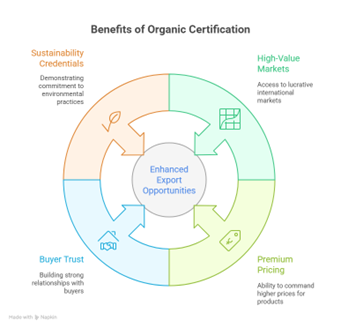
For exporters, organic certification in Nigeria is critical for accessing premium international markets. Buyers in the EU, US, and Middle East require certified organic status as proof of compliance, traceability, and food safety. Without certification, products marketed as “organic” are often rejected or discounted, regardless of farming practices.
It’s important to distinguish between organic practices and certified organic. Many Nigerian farmers use low-input or traditional methods that resemble organic farming, but these practices alone do not qualify products for export as organic. Only third-party certification supported by documented inputs, inspections, and traceability allows products to be legally sold as certified organic exports in global markets.
Organic fertilizers market sees Nigeria at 25.70% African share (USD ~$2.1B total 2025), with biological variants at USD 560M continent-wide (12.1% CAGR to USD 990M by 2030); poultry leads with organic chicken at USD 52.41M (2024, 7.11% CAGR to USD 98.25M by 2033).
Key certifiers include ECOCERT, Soil Association (Nigeria office), and local bodies under NOSDAP/NOGCERT; certified exports (cocoa/cashew) hit USD 50-100M annually (part of Q1 2025 agri-boom), with 2,837 global organic exporters but Nigeria <1% share premiums 20-50% drive smallholder adoption via cooperatives.
Why Organic Certification Matters
Explore how organic certification impacts export eligibility, price premiums, and buyer trust in global agricultural markets.
Sustainability Is Now a Market Requirement
Learn how sustainability certifications are reshaping sourcing decisions across global agri-value chains.
Any Nigerian business exporting products marketed as organic to international markets requires organic certification.
Organic certification in Nigeria is essential for crop exporters handling high-demand commodities such as cocoa, sesame, cashew, cotton, spices, hibiscus, and ginger especially when supplying buyers who mandate verified organic sourcing. Processors and aggregators also need certification if they process, blend, store, or package organic products, as certification must cover the entire value chain, not just the farm.
Most importantly, exporters targeting the EU, US, and other premium global markets must be certified to legally label products as organic and access higher-value buyers. Without certification, shipments risk rejection, loss of contracts, or forced price discounts. In practice, organic certification is no longer optional—it is a direct enabler of market access and price premiums.
Nigerian exporters must comply with the organic standard required by their target export market.
EU Organic Regulation is mandatory for any product sold as organic in the European Union. It requires full traceability from farm to export, approved certification bodies, residue-free production, and documented compliance across farming, processing, storage, and logistics.
USDA Organic (NOP) governs access to the US market. It sets strict rules on input use, buffer zones, recordkeeping, and annual third-party inspections covering farms, processors, and exporters.
Other recognized standards include JAS (Japan) and market-specific schemes operating under equivalency arrangements with the EU or US. Choosing the right standard is critical certification must match the destination market to ensure legal labelling, buyer acceptance, and uninterrupted exports.
The process begins with registering individual farms or farmer groups with a certification body. Exporters must document land history for the past 2–3 years, proving that no prohibited synthetic fertilizers, pesticides, or GMOs were used during the conversion period. This step establishes baseline compliance and determines whether land is eligible for organic certification or must undergo a transition phase.
For group certification, an Internal Control System (ICS) is mandatory. The ICS defines internal inspections, farmer training, input controls, record-keeping procedures, and corrective actions. It enables exporters and cooperatives to manage thousands of smallholders under a single certificate while ensuring consistent adherence to organic standards.
An accredited certification body (recognized under EU, USDA NOP, or equivalent standards) conducts on-site inspections. Auditors verify farm practices, storage facilities, processing units, traceability records, and ICS effectiveness. Sampling, residue testing, and document reviews are commonly part of this stage.
If non-conformities are identified, exporters must implement corrective actions within a defined timeline. This may include updating records, retraining farmers, improving segregation, or tightening input controls. Evidence of corrective measures must be submitted for review before certification approval.
Once compliance is confirmed, the certifier issues an organic certificate, typically valid for one year. Annual renewals require ongoing compliance, updated documentation, and repeat inspections making continuous monitoring and traceability essential for long-term certification and export readiness.
Traceability is the backbone of organic certification because regulators and buyers must be able to verify that products labelled “organic” genuinely comply with organic standards at every stage. For Nigerian exports, this begins with farm-level data and plot identification, ensuring each certified plot is clearly mapped, registered, and linked to approved organic practices.
At the aggregation and processing stages, batch-level segregation and documentation are essential to prevent mixing organic and non-organic produce. Each batch must be traceable back to specific farms and harvests through records, lot numbers, and transaction logs.
A robust chain-of-custody from farm to shipment connects farmers, aggregators, processors, exporters, and logistics partners, creating a continuous audit trail. This level of traceability also aligns with EU due diligence expectations, supporting not just organic compliance but broader requirements around transparency, risk mitigation, and credible sustainability claims.
Digital platforms from TraceX replace fragmented, manual processes with a single, structured system for managing organic compliance at scale. Through digital farmer onboarding, TraceX’s Sustainable Sourcing Platform captures verified farmer profiles, farm plots, and organic practice data at the source, creating a reliable foundation for certification.
Real-time compliance monitoring allows exporters to track input usage, field activities, and internal controls continuously, helping identify risks before they become audit issues. TraceX also generates audit-ready documentation from farm records to batch-level traceability and chain-of-custody reports reducing preparation time and non-compliance findings.
By centralizing data and standardizing workflows, TraceX significantly reduces certification risk, improves audit outcomes, and enables Nigerian exporters to maintain organic certification while scaling access to premium global markets.
Organic certification in Nigeria is no longer just a compliance checkbox it is a strategic enabler for accessing premium EU, US, and global markets. For Nigerian exporters, success depends on strong farm-level traceability, robust Internal Control Systems (ICS), and audit-ready documentation across fragmented smallholder supply chains. Companies that invest early in structured data, digital traceability, and continuous compliance reduce certification risk, improve buyer trust, and unlock higher price premiums. In a competitive export landscape, certified organic is not just about how crops are grown but how credibility is proven.
Ethical Sourcing Matters
Discover how ethical sourcing practices build trust, reduce risks, and create value across agricultural supply chains.
Build a Responsible Supply Chain
Explore strategies for creating transparent and accountable supply chains that meet global sustainability expectations.
Digitally Transform Your Sustainability Efforts
Learn how digital platforms are enabling real-time monitoring, reporting, and compliance in agriculture and agribusiness.
Organic certification is issued by accredited international certification bodies approved under standards such as the EU Organic Regulation and USDA Organic (NOP), often operating through local inspection partners in Nigeria.
Certification timelines vary, but farms typically require a 2–3 year conversion period if transitioning from conventional farming, followed by inspection and audit before certification is granted.
While not mandatory, group certification using an Internal Control System (ICS) is the most practical and cost-effective approach for Nigerian exporters working with smallholder farmers.
No. While farmers may follow organic practices, Nigerian exporters cannot label or market products as “organic” in the EU, US, or other premium markets without valid third-party organic certification from an accredited certifier.
High-demand organic exports from Nigeria include sesame seeds, cocoa, cashew, ginger, hibiscus, cotton, and spices, driven by strong demand from EU, US, and Asian organic and sustainability-focused buyers.