
Quick summary: Building origin traceability for textile Digital Product Passports (DPP): learn how to track fibres from source to finished product, enable multi-tier transparency, and meet EU compliance requirements.
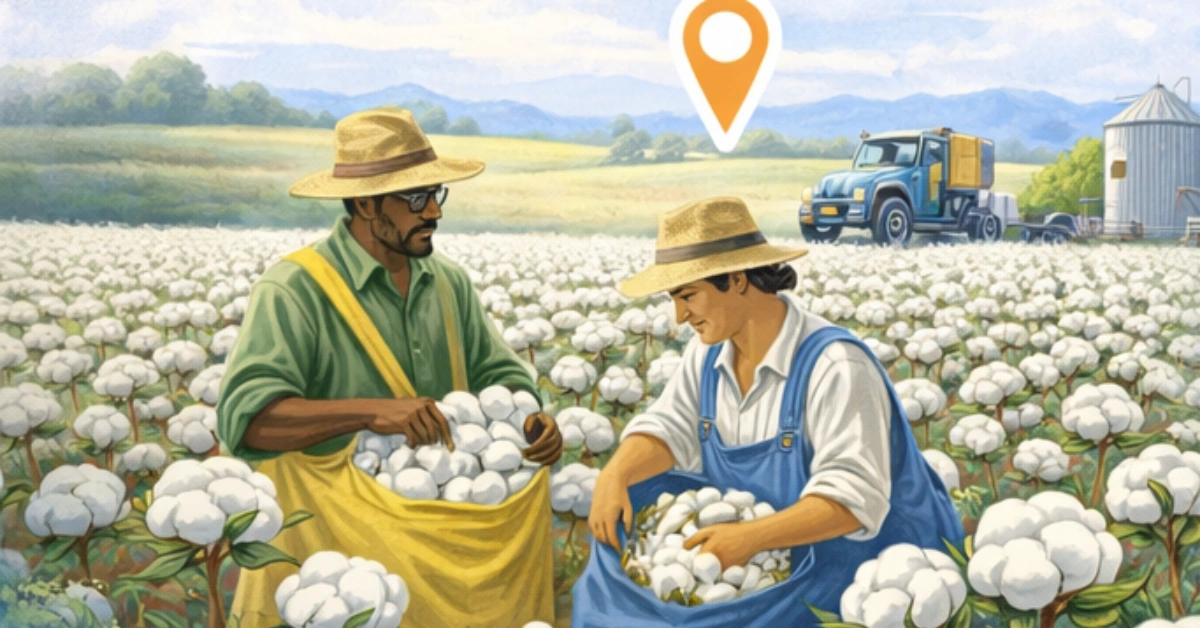
Building origin traceability for a textile Digital Product Passport means capturing verifiable, immutable data at every stage from the seed planted in a farm field to the QR code stitched into a finished garment. Under the EU’s ESPR regulation (effective July 2024), brands selling textiles in the EU must provide a basic DPP by 2027 and a full passport by 2028/2029. That requires tracing fibre provenance, processing steps, and environmental attributes across a supply chain that typically spans five or more countries and dozens of intermediaries.
In April 2025, the European Commission published its ESPR Working Plan and textiles made the first-priority list. With delegated acts expected late 2026 and enforcement targeting 2027-2028, apparel brands face a tight implementation window of roughly six to eight fashion seasons to embed DPP data into every SKU they sell into the EU.
The uncomfortable reality? 67% trace cotton (top fibre), but consumers prioritize origin (69%) over farm (20%); fragmentation hinders full-chain mapping (Sourcing Journal and Cotton Incorporated Industry Traceability Survey, 2024).
According to the latest KPMG Survey, 36% of respondents expect demand uplift for products with better sustainability performance. DPP is increasingly seen as a preference driver for buyers and retailers that require credible data.
The gap between what regulators now demand, fibre-level origin data, supply chain provenance records, environmental impact attributes, and what most brands can actually deliver is enormous. This article provides a practical roadmap for closing it.
Fibre-level traceability means being able to verify, with evidence, the geographic origin of the raw material, the cotton, linen, wool, or synthetic fibre, and connect that evidence through every processing step to the finished product. A Digital Product Passport under ESPR is not satisfied by listing a country of origin; it requires a documented chain of custody from source to shelf.
The study on textile DPPs identifies 16 mandatory and optional data categories. Among the most challenging for brands are:
Most brands today rely on paper-based certificates (e.g., GOTS, BCI) and supplier self-declarations for sustainability claims. These capture a snapshot, not a live, auditable chain of custody. The EU DPP framework explicitly requires data that is accurate, complete, up-to-date, and verifiable. Self-declarations alone will not clear that bar.
The deeper problem is structural. A typical cotton T-shirt passes through 7-10 distinct facilities across 3-5 countries before it reaches a brand’s distribution centre. Each handoff is a potential data break. Without digital integration between tiers, data accuracy degrades at every stage.
‘We cannot manually collect GPS data from 2,000 farmers every season.’ This is the defining challenge for brands sourcing from smallholder-dominated supply chains: the sheer volume of upstream actors combined with connectivity and literacy barriers makes manual data collection economically unviable at scale.
Understand how Digital Product Passports apply to fashion. Explore DPP for textiles in detail.
From fibre to finished product. Learn how to map the textile value chain effectively.
Building a farm-to-garment traceability system requires a technology stack that can capture data at the origin, maintain the chain of custody through processing, and surface that data in DPP-compatible formats. The following framework maps the journey across five key stages.
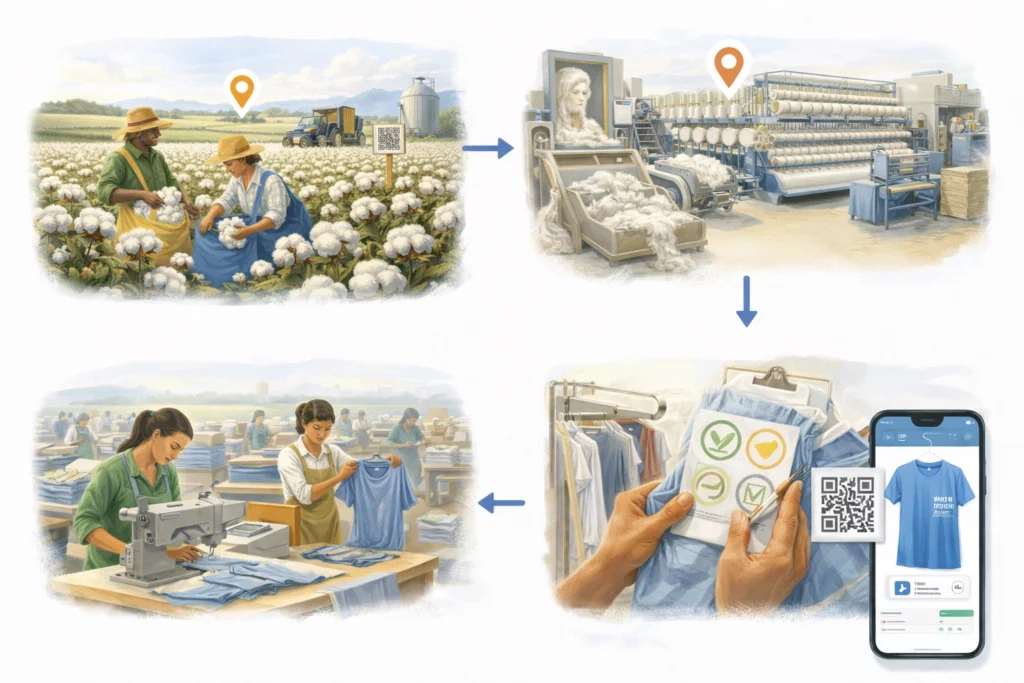
The foundation of fibre traceability is geo-referenced farm data. This means geotagging individual plots using GPS coordinates, recording land tenure and farmer registration details, and capturing crop-specific input data (seeds, fertilisers, pesticides). For cotton, linen, and other natural fibres, this stage must be completed before the fibre leaves the farm gate.
Key data to capture: Farm GPS polygon, land area, farmer identity, certification status (organic, BCI, Fair Trade), crop variety, harvest date, and input records.
Once fibre leaves the farm, it enters a chain of processing facilities. Cotton bales are ginned to remove seeds, spun into yarn, woven or knitted into fabric, and then dyed and finished. Each of these steps must be documented with facility-level data to maintain a continuous chain of custody.
For DPP compliance, brands need: Facility name and GS1 location code, processing date and batch number, fibre input volumes and origins, chemical/dye records (REACH compliance), and energy and water consumption data.
Cotton is currently the most traced fibre (67%), followed by synthetics (57%) and recycled fibres (48%), but even for cotton, systematic documentation beyond the first tier remains the exception, not the rule. (Sourcing Journal and Cotton Incorporated, 2024)
At this stage, fabric becomes a finished garment through cut-and-sew operations. It is also the stage where blending is most common, fabrics combining multiple fibre types from different origins. Each blend must be documented, as DPP composition requirements mandate material percentages, fibre origins, and associated certifications.
Farmgate transaction records, batch-level barcoding, and digital transfer of chain-of-custody data between processing partners are the operational requirements here. QR codes and RFID tags are commonly used to bridge physical garments with their digital records.
Before DPP data is finalised, all sustainability claims must be independently verifiable. This includes cross-referencing farm-level data against satellite deforestation alerts (relevant for linen and natural fibre crops), validating certifications (Fairtrade, UEBT, Rainforest Alliance), and confirming chemical compliance records against REACH substance lists.
The final stage translates supply chain data into a DPP-ready format, a structured digital record accessible via QR code, NFC tag, or barcode attached to the product. Under ESPR Article 12, this data must be accessible to consumers, regulators, and recyclers. It must also be linked to the EU digital registry by July 2026.
| Supply Chain Stage | Key Data Points | Data Capture Method | DPP Requirement | Risk if Missing |
|---|---|---|---|---|
| Farm / Raw Material | GPS plot, crop variety, farm inputs, harvest date | Offline mobile app, GPS tagging | Fibre origin, land tenure verification | Cannot prove deforestation-free sourcing; fails DPP origin requirement |
| Ginning / Spinning | Facility ID, batch no., fibre volumes, energy use | Digital batch records, GS1 codes | Processing chain, energy footprint | Chain of custody gap; regulators cannot verify fibre provenance |
| Weaving / Dyeing | Fabric composition, dye records, REACH compliance | ERP integration, chemical logs | Material composition, hazardous substances | REACH violations; greenwashing exposure |
| Cut, Make and Trim | Blend ratios, facility location, dates, certifications | QR/RFID tagging, certification APIs | Supply chain map, certification data | Incomplete DPP; cannot prove responsible sourcing |
| Finished Product / DPP | Carbon footprint, recyclability, QR code | DPP platform, EU registry API | Full DPP record, QR/NFC on garment | Non-compliance with ESPR; market access blocked |
Origin traceability is the backbone of every meaningful DPP data field. Without knowing exactly where a fibre came from and under what conditions it was grown, brands cannot credibly populate any of the three most scrutinised DPP categories: environmental footprint, hazardous substance compliance, or social impact data.
The regulatory stakes are high. ESPR enforcement expected from 2028 onwards for textiles carries market access implications. Products without a compliant DPP will not be permitted for sale in the EU. For brands for whom the EU represents a significant revenue share, non-compliance is not a fine risk; it is a market exit risk.
The inability to ensure data accuracy can create or exacerbate existing operational challenges and may limit the potential success of future supply chain transformation initiatives. In fact, 41% of retail supply chain leaders are experiencing difficulties with their supply chain. (Impinj Supply Chain Survey, 2025)
Organic cotton is a case study in traceability failure. Verified production volumes of certified organic cotton routinely fall far short of the volumes sold under organic claims globally, a gap attributable to fraudulent certificates and supply chain opacity. The EU Green Claims Directive, running in parallel with ESPR, will require brands to substantiate all environmental claims with verifiable evidence. DPP origin data is the mechanism for that substantiation.
In the United States, the Uyghur Forced Labor Prevention Act (UFLPA) requires brands to prove that cotton in their supply chains did not originate from restricted regions. The EU’s own Forced Labour Regulation, applicable from 2027, will impose analogous requirements on brands selling in the EU. Origin traceability systems built for DPP compliance will simultaneously satisfy forced labour due diligence obligations.
End-to-end textile traceability is not a single technology problem; it is a multi-tier data governance challenge. The brands that successfully build it share four capabilities:
The highest-risk data gap for most brands is at Tier 3 and Tier 4: the farms, ginners, and yarn spinners who have historically operated outside digital systems. Solving this requires mobile-first, offline-capable tools that can register farmer plots with GPS coordinates, capture crop and input records, and upload data via SMS or low-bandwidth connections when connectivity is available. For brands sourcing from India, West Africa, or Southeast Asia, this is non-negotiable.
In the 2024/25 season, 20 brands successfully tracked 126,000 tonnes of US Cotton Trust Protocol fibre via PCCU uptake.
As fibre moves from farm to gin to spinner to fabric mill, each transfer of ownership must be recorded in an immutable ledger. Blockchain technology provides tamper-proof record-keeping that regulators, auditors, and buyers can independently verify. Unlike centrally hosted databases, blockchain records cannot be retrospectively altered, which is precisely what the EU DPP framework requires when it mandates that data be ‘accurate, complete, and up-to-date’.
Mass balance chain of custody models, which reconcile volumes on paper without tracking physical fibre movement, will not satisfy DPP requirements. The EPRS study is explicit: DPP must reflect product-level, not batch-or-volume-level, data.
The bottleneck for most brands is not a lack of will but a lack of data infrastructure to aggregate multi-tier supply chain information into a structured DPP record. Agentic AI systems can parse supplier documents, certifications, test reports, chemical compliance records, and auto-populate DPP data fields, dramatically reducing manual data entry and the associated error rates.
GS1 standards (GS1 Digital Link, GS1 EPCIS) provide the interoperability layer that allows DPP data generated across different supply chain systems to be assembled into a single, EU-registry-compatible product passport.
DPP compliance is not a one-time data collection exercise. Supply chains evolve, suppliers change, certifications expire, new deforestation alerts emerge. Brands need monitoring systems that continuously validate the integrity of DPP data and generate audit-ready reports on demand. The ability to export DPP records in PDF, XML, and CSV formats directly compatible with the EU TRACES system is a practical operational requirement that brands should evaluate in any platform they consider.
TraceX’s Sustainable Sourcing Solutions and DPP Solutions address the fibre-to-DPP data chain across all five stages described above. Built specifically for supply chains in India, Southeast Asia, and Africa, where smallholder farmers dominate upstream sourcing, TraceX closes the data gap that makes textile DPP compliance achievable in practice, not just in theory.
| TraceX Capability | DPP Compliance Outcome |
|---|---|
| GPS polygon-based farmer and plot registration with offline mobile app | Fibre origin verified to farm level; deforestation-free evidence against JRC/Hansen satellite data |
| Blockchain-backed batch transaction records with GS1 standards | Immutable, tamper-proof chain of custody from farm gate to finished product |
| GPS polygon-based farmer and plot registration with an offline mobile app | Automated DPP data population; reduced manual error and processing time |
| Scope 3 emissions calculation from primary supply chain data (not averages) | Carbon footprint data DPP field populated with audit-ready primary data |
| One-click audit-ready export in PDF, XML, CSV – TRACES-ready | Regulatory submission-ready DPP documentation; compliant with EU digital registry requirements |
| Real-time deforestation alerts via Sentinel-2 / GLAD satellite data | Continuous compliance monitoring; early warning on sourcing risk events |
| Multilingual supplier portals for inclusive smallholder onboarding | Full-tier data capture in high-risk, low-connectivity supply chain geographies |
The market for textile traceability technology spans physical tagging solutions, blockchain platforms, and integrated supply chain compliance suites. Understanding the landscape helps brands select the right combination for their supply chain profile.
| Technology | Role in DPP Traceability |
|---|---|
| GPS and Satellite Mapping | Farm-level plot registration; deforestation and land-use verification |
| DNA Tagging (e.g., Haelixa, Applied DNA Sciences) | Physical fibre identity verification through processing survives bleaching, dyeing, and washing. Cost: approximately $0.02 per pound of lint. |
| Blockchain / Distributed Ledger | Physical fibre identity verification through processing survives bleaching, dyeing, washing. Cost: approximately $0.02 per pound of lint. |
| GS1 Digital Link + EPCIS | Tamper-proof chain of custody from farm to garment meets EU data integrity requirements |
| QR Code / NFC Tags | Consumer-facing DPP access point; EU mandates digital carrier on or with the product |
| Agentic AI Document Parsing | Automated extraction of certification, KYC, and compliance data from supplier documents |
| Integrated Compliance Platform (e.g., TraceX) | Interoperability standard for DPP data exchange between supply chain platforms and the EU registry |
| Date / Milestone | Required Action for Textile Brands |
|---|---|
| July 2024 – ESPR in force | Familiarise with the DPP framework; begin a supply chain data audit |
| April 2025 – ESPR Working Plan published | Familiarise yourself with the DPP framework; begin a supply chain data audit |
| July 2026 – EU DPP digital registry live | Textiles confirmed as first priority. Begin platform evaluation and supplier onboarding planning. |
| Late 2026 / Early 2027 – Delegated Act for Textiles published | Final technical requirements confirmed. 12-18 months to full compliance begins. |
| Mid-2027 – DPP rules enter into force | Minimal simplified DPP required: composition, recyclability, supply chain production traceability |
| 2028-2029 – Full DPP implementation | Complete DPP with environmental footprint, social impact data, and full chain of custody |
The 2027 textile DPP deadline is not a distant compliance exercise; it is an operational transformation that requires multi-year preparation. Brands that begin building fibre-to-garment traceability infrastructure now will have a competitive advantage: the ability to open and protect EU market access, substantiate sustainability claims that command premium pricing, and satisfy the converging requirements of ESPR, the EU Green Claims Directive, and forced labour due diligence regulations.
The three non-negotiables for textile DPP readiness are: upstream data capture at farm level (GPS, crop records, farmer identity), an immutable chain of custody through processing tiers (blockchain + GS1), and automated DPP data population that generates EU-registry-compatible outputs without manual aggregation.
TraceX is purpose-built for exactly this challenge, combining offline-capable farmer onboarding, blockchain-backed chain of custody, satellite-validated deforestation monitoring, and agentic AI document parsing into a single platform that covers the entire journey from fibre to finished product passport.
Go beyond Tier 1. Explore how multi-tier supply chain transparency drives compliance and visibility.
Understand what’s coming next. Learn how the EU Textile Strategy is reshaping the industry.
Get your data right. Discover the key data requirements for Digital Product Passports.
Under the ESPR framework, a textile DPP must include at minimum: product composition (fibre types and percentages), recyclability information, supply chain production traceability (key processing steps from fibre to garment), and environmental impact data. The full set of 16 potential data categories, including carbon footprint, hazardous substance records, and social impact information, will be specified in the delegated act expected in late 2026.
Delegated acts defining specific requirements are expected in late 2026, followed by an 18-month compliance period. Brands should plan for a minimal DPP to be required by mid-2027, with full implementation targeted by 2028–2029. The ESPR Working Plan (April 2025) confirmed textiles as a first-priority category.
Fibre-level traceability means documenting the origin and journey of raw material, the cotton, wool, linen, or synthetic fibre, from the farm or production site through every processing step to the finished garment. It matters for DPP because the EU regulation requires verifiable evidence of material origin and provenance, not just a country-of-manufacture declaration. Without fibre-level data, brands cannot populate the origin, composition, or environmental footprint fields in a compliant DPP.
Blockchain provides an immutable, tamper-proof digital ledger that records every transfer of fibre and material through the supply chain. Unlike centralised databases, blockchain records cannot be retrospectively altered, which satisfies the EU DPP requirement for data accuracy and integrity. Combined with GS1 standards, blockchain-backed records create an auditable chain of custody from farm to consumer that regulators, buyers, and certification bodies can independently verify.
Yes, though implementation complexity varies by supply chain structure. The EU ESPR extended the EUDR compliance deadline for SMEs and provided for a phased DPP rollout with a minimal simplified DPP in the first phase. SMEs should begin by conducting a supply chain data audit, identifying tier-2 and tier-3 data gaps, and evaluating platforms that offer scalable, cost-effective onboarding tools for upstream suppliers. Starting now rather than waiting for the delegated act is strongly advisable given the 18-month implementation timeline once rules are published.