
Quick summary: Understand the EU Packaging and Packaging Waste Regulation (PPWR)—why it was introduced, what it requires, and how businesses can transition from packaging waste challenges to full compliance.

The European Union generates almost 80 million tonnes of packaging waste every year. That number 177.8 kg for every man, woman and child living in the EU is not just a statistic. It is the weight of three decades of inadequate policy, a 30-year-old Packaging Directive that was never fit to deal with e-commerce, single-use plastics, or a continent increasingly aware that its waste was ending up in its own rivers and oceans. The Packaging Waste Regulation PPWR is the EU’s answer.
Adopted in December 2024, formally in force since February 2025, and binding on every business selling packaged goods into the EU from August 12, 2026, it is the most comprehensive overhaul of packaging law the bloc has ever attempted. This blog covers everything: why the crisis demanded it, what the regulation actually requires, and what packaging businesses must do now.
According to Eurostat data released in late 2025, the European Union generated 79.7 million tonnes of packaging waste in 2023. This amount includes materials like paper, cardboard, glass, and plastic, with a notable statistic of 35.3 kg of plastic packaging waste generated per EU inhabitant
The EU Packaging and Packaging Waste Regulation (PPWR) addresses Europe’s growing packaging waste crisis.
It sets stricter rules on reduction, recyclability, reuse, and labeling of packaging.
Businesses must redesign packaging, improve data tracking, and ensure compliance across supply chains.
PPWR is part of the broader European Green Deal and Circular Economy Action Plan.
Early adoption helps companies avoid penalties and gain a competitive sustainability advantage.
The PPWR did not emerge suddenly. It was the product of years of policy evaluation, consultation, political negotiation and hard evidence that the existing Packaging Directive was no longer adequate for a 21st-century single market dealing with a 21st-century waste crisis.
| 1994 | Packaging Directive 94/62/EC Adopted First EU-wide packaging rules set recycling targets, allowed national implementation. A foundation, but not fit for e-commerce or the plastic age. |
| 2018 | Directive Revised — Higher Targets Set Recycling targets raised: 65% overall, 55% plastic by 2030. Acknowledged growing waste volumes but retained Directive structure. National disparities persisted. |
| Dec 2020 | EU Council Circular Economy Conclusions Formally committed the EU to all packaging reusable or recyclable by 2030. Signalled the political will behind what became PPWR. |
| Feb 2021 | Circular Economy Action Plan 2.0 New action plan demanded a legislative proposal to replace the Directive with a Regulation. The pivot from directive to regulation was formally planned. |
| Nov 2022 | PPWR Proposal Published European Commission proposed the new Packaging Regulation replacing the Directive with directly applicable rules covering recyclability, reuse, recycled content, and packaging minimisation. |
| Nov 2023 | European Parliament Adopted ENVI Report 426 votes in favour, 125 against. Parliament adopted the Environment Committee’s report, strengthening several requirements. |
| Mar 2024 | Trilogue Agreement Reached Parliament and Council reached provisional agreement on final text after intensive negotiations including controversial fruit and vegetable packaging provisions. |
| Dec 2024 | Formally Adopted by European Council PPWR adopted as Regulation (EU) 2025/40, replacing Directive 94/62/EC. |
| 22 Jan 2025 | Published in EU Official Journal Regulation (EU) 2025/40 formally published legal certainty established for all businesses. |
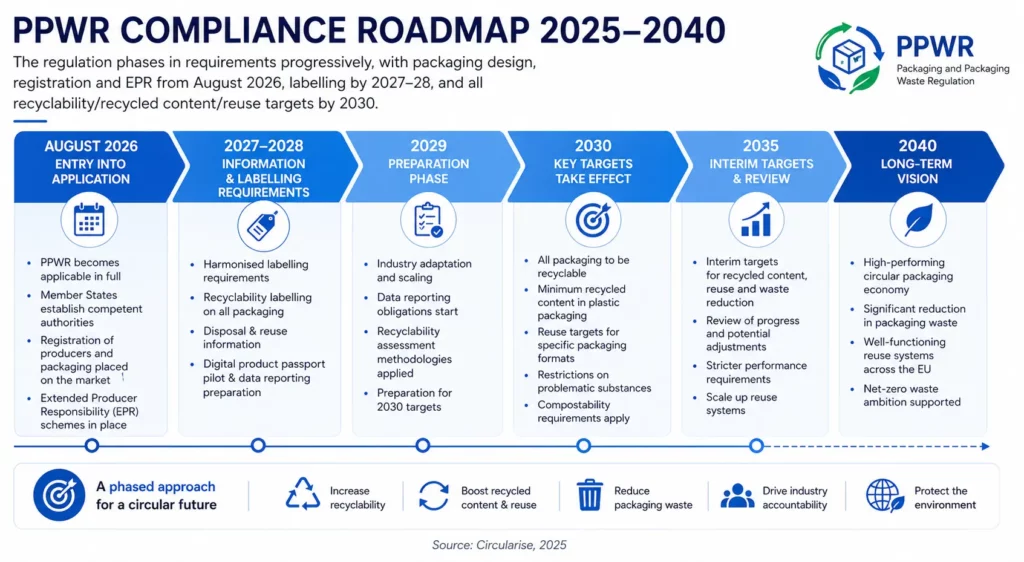
| 11 Feb 2025 | Entered Into Force PPWR legally in force. 18-month transition period begins. |
| 12 Aug 2026 | BINDING APPLICATION DATE Most PPWR provisions apply to all 27 Member States. Packaging design, registration, EPR, and minimisation obligations become enforceable. |
| 2030 | Major Milestone Obligations All packaging recyclable by design (grades A–C only). Mandatory recycled content in plastics. Reuse targets for transport and beverage packaging. Several single-use formats banned. |
| 2040 | Full Circular Economy Targets Recyclability grades A-B only. Recycled content rises to 25–65% by category. Reuse targets increase to 70% for transport packaging. |
| A critical legal distinction: PPWR is a Regulation, not a Directive. It applies automatically in all 27 Member States without national legislation. There is no room for national interpretation, opt-outs, or delayed transposition. This is the most significant change from the 30-year Directive it replaces. Regulation (EU) 2025/40, Recital 3 |
PPWR is reshaping packaging compliance with new requirements around recyclability, traceability, recycled content, and producer responsibility.
Explore our complete PPWR guide to understand the regulation, key obligations, and what businesses must do to prepare.
Europe’s packaging waste problem did not appear overnight. Between 2013 and 2023, packaging waste per EU citizen rose by 21.2 kg a sustained structural increase driven by rising consumption, the explosive growth of e-commerce, and a regulatory framework simply too weak to redirect it. The peak came in 2021, at 84 million tonnes total the largest single-year volume in EU history as pandemic-driven online shopping and food delivery flooded households with plastic packaging.

The rise in packaging waste is not random. Three structural forces explain the bulk of it:

Understand why packaging waste has become a critical issue in the EU.
Read the blog to explore the environmental, economic, and regulatory drivers behind rising packaging waste.
The EU’s headline recycling numbers look like progress 42.1% of plastic packaging waste recycled in 2023, up from 38.2% in 2013. But within those averages lies a 36-point chasm. Belgium leads at 59.5%. Hungary trails at 23.0%. France, one of Europe’s largest economies, manages only 25.7%. Four EU countries Romania, Hungary, Malta, and Greece still recycle less than 50% of total packaging waste.
| Country | Total Packaging Recycling Rate | Plastic Packaging Rate | Status vs 2030 Target |
|---|---|---|---|
| Belgium | 79.7% | 59.5% | Already exceeds 2030 target |
| Netherlands | 75.8% | N/A | Already exceeds 2030 target |
| Italy | 75.6% | N/A | Already exceeds 2030 target |
| Germany | ~70% | 52.2% | On target |
| France | ~60% | 25.7% | Needs significant improvement |
| Austria | ~60% | 26.9% | Needs significant improvement |
| Hungary | 42.8% | 23.0% | Significantly below target |
| Romania | 37.3% | N/A | Lagging highest risk |
| Seven EU countries had already exceeded the 2030 recycling target of 70% by 2023 seven years early. But four countries were still below 50%. PPWR exists precisely to close this gap with binding, uniform rules. |
Packaging waste’s environmental cost is largely invisible to the people who generate it. It does not appear on the shelf price of a product. It does not appear on the national budget. But it accumulates in ocean systems, in soil, in air quality, and increasingly in the human body.
| 11M Tonnes of Plastic Enter Global Oceans Annually (UNEP) | 9% Of All Global Plastic Waste Actually Recycled (OECD) | 3.4% Of Global GHG Emissions From Plastic Production | 450yr Time for a Plastic Bottle to Decompose in the Environment |
Packaging is the dominant category of plastic waste entering marine environments. Between 75 and 199 million tonnes of plastic currently sits in the world’s oceans, with 11 million tonnes being added each year. This is not primarily industrial plastic it is consumer packaging: bottles, wrappers, sachets, films. The Great Pacific Garbage Patch alone contains 1.8 trillion plastic pieces and grows continuously. More than 100,000 marine mammals and 1 million seabirds are killed by this pollution annually.
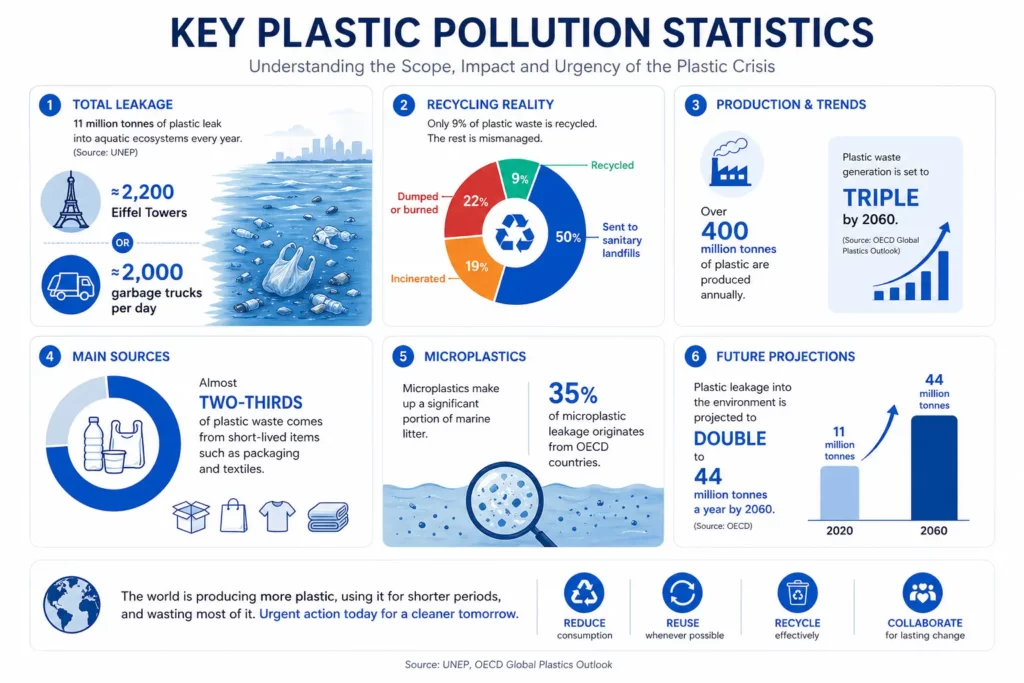
As packaging degrades, it does not disappear it fragments into microplastics and nanoplastics. These particles are now found in Arctic sea ice, in deep ocean trenches, in rainwater, and inside the human body. Microplastics have been detected in human hearts, lungs, livers, and placentas. More than 16,000 chemicals are used in plastic products, and at least 4,219 have been identified with hazardous properties including endocrine disruption and carcinogenicity.
Microplastic pollution is projected to grow from 17 million to 26 million tonnes annually by 2040 under current trajectory a 53% increase. This is not a distant scenario. It is the baseline outcome if packaging waste practices do not fundamentally change.
| Plastic production accounts for 3.4% of global greenhouse gas emissions roughly equivalent to global aviation. Since 99% of plastics are derived from fossil fuel feedstocks, every tonne of virgin plastic packaging placed on the market extends fossil fuel dependency. Incinerating plastic waste used for 19% of global plastic disposal can emit more CO2 per tonne than burning coal. |
The environmental cost of packaging waste is beginning to convert into hard financial liability. Estimated litigation exposure for the plastic industry related to environmental damage is projected at $100 billion globally, with approximately $20 billion in the United States alone. Extended Producer Responsibility fees are making the externality explicit businesses that designed packaging without considering end-of-life costs are now receiving those bills.
Explore the true environmental cost of packaging waste.
Read the blog to understand its impact on ecosystems, emissions, and resource depletion.
The circular economy is built on a deceptively simple idea: nothing is waste everything is a resource for the next cycle. For packaging, that means products must be designed to be recovered, reprocessed, and returned to productive use. The EU’s Circular Economy Action Plan commits the bloc to making all packaging reusable or recyclable by 2030. PPWR translates that commitment into specific, enforceable obligations with real deadlines.
| Circular Principle | What It Means in Practice | PPWR Mechanism |
|---|---|---|
| Reduce | Eliminate unnecessary packaging no false bottoms, oversized boxes, excessive void fill | Art. 43: 5% vol reduction by 2030; empty space limit 40% |
| Reuse | Build systems where packaging circulates multiple times before disposal | Art. 26: 40% transport packaging reusable by 2030; 70% by 2040 |
| Recycle | Design packaging so all components enter real-world recycling streams | Art. 6: All packaging recyclable (grades A–C) by 2030 |
| Recycled Content | Close the loop by buying back recycled materials | Art. 7: 30–65% PCR content in plastics by 2030 |
| Transparency | Enable consumers and recyclers to identify and sort correctly | Art. 12/13: Harmonised labelling + digital QR identifiers by 2027–28 |
The circular economy is not just a packaging design philosophy it is a supply chain, procurement, and logistics overhaul. Packaging businesses that understand this early will build the infrastructure and supplier relationships that make compliance efficient. Those that wait for the deadline will find themselves competing for scarce recycled materials in a supply-constrained market.
| The circular packaging market is projected to grow from $245 billion in 2024 to $455 billion by 2034. Compliance is not a cost it is the entry ticket to the fastest-growing segment of the global packaging industry. |
Discover how circular economy principles are transforming the packaging industry.
Read the blog to learn how businesses are reducing waste, improving recyclability, and driving sustainable growth.
For 30 years, the EU’s packaging framework relied on a Directive Directive 94/62/EC that set targets but allowed Member States to implement them in their own way. The results were predictable: inconsistent enforcement, fragmented recycling infrastructure, massive disparities between leading and lagging countries, and a decade-long upward trend in packaging waste generation that voluntary industry action consistently failed to reverse.
| Why a Directive Was Not Enough A Directive requires each Member State to pass its own national legislation. This created 27 different interpretations of recyclability, 27 different EPR schemes, and 27 different labelling requirements all barriers to the single market and all obstacles to consistent environmental progress. PPWR is a Regulation, which applies directly and uniformly across all Member States without national transposition. A single set of rules for 450 million consumers. |
Understand why the EU is making packaging sustainability mandatory.
Read the blog to explore the regulatory, environmental, and economic drivers behind this shift.
The shift from voluntary to mandatory was driven by the convergence of three forces that the EU could no longer ignore:
PPWR does not stand alone. It is one pillar of the EU’s European Green Deal the bloc’s overarching strategy for achieving climate neutrality by 2050. Alongside PPWR, packaging businesses must understand the following interconnected regulatory frameworks:
| Regulation | Relationship to PPWR | Key Packaging Impact |
|---|---|---|
| EU Green Deal / CEAP | Strategic parent PPWR implements CEAP’s packaging goals | All packaging reusable/recyclable by 2030 |
| Single-Use Plastics Directive | Already banning specific formats — PPWR extends this logic | Bans straws, cutlery — some exemptions under PPWR |
| Green Claims Directive | Governs how PPWR compliance can be communicated to consumers | Restricts ‘eco-friendly’ claims without substantiation |
| Digital Product Passport | PPWR’s digital labelling links to DPP framework | QR codes linking to recyclability, composition data |
| EU REACH | ECHA reviewing substances of concern in packaging by 2026 | PFAS and other additives face restrictions |
| EPR Harmonisation | PPWR EPR builds on national schemes — sets minimum standards | All producers registered, reporting, and paying by 2026 |
Learn how the EU Green Deal is shaping the future of sustainability in Europe.
Read the blog to explore its impact on climate policy, circular economy, and regulatory frameworks.
PPWR is not a single rule. It is a system of six interlocking mechanisms designed to address the packaging waste crisis at every point in the product lifecycle from design studio to doorstep to disposal. Here is what each mechanism requires and what it means for packaging businesses:
From August 12, 2026, all packaging must comply with strict material and space efficiency rules. Empty space in parcels may not exceed 40% (down from no standard). Packaging with features designed only to increase the perceived product size double walls, false bottoms, unnecessary layers is prohibited. By 2030, manufacturers must formally demonstrate that packaging weight and volume are reduced to the minimum necessary.
By January 2030, all packaging placed on the EU market must be recyclable ‘in an economically viable way’. PPWR introduces a graded recyclability classification grades A through E based on design criteria, collection infrastructure, sorting capacity, and actual recycling rates in EU systems. From 2030, only packaging meeting grades A, B, or C may be placed on the market. From 2038, only A and B.
| Recyclability Grade | Definition | Market Status from 2030 |
|---|---|---|
| Grade A | Collected, sorted and recycled at scale in EU infrastructure | Permitted preferred |
| Grade B | Recyclable with minor design improvements needed | Permitted |
| Grade C | Recyclable but dependent on infrastructure development (min. 70%) | Permitted must improve by 2035 |
| Grade D | Technical recyclability only not in practice at scale | Restricted/banned from 2030 |
| Grade E | Not recyclable by current EU standards | Banned from 2030 |
From January 2030, all plastic packaging sold in the EU must contain minimum percentages of post-consumer recycled (PCR) material. Note: post-industrial recycled content does not count only material recovered from consumer waste streams qualifies.
| Packaging Category | Min. PCR Content by 2030 | Min. PCR Content by 2040 |
|---|---|---|
| PET contact-sensitive packaging (e.g., food/cosmetics) | 30% | 50% |
| Other contact-sensitive plastic (non-PET) | 10% | 25% |
| Non-contact plastic packaging (e.g., outer packaging) | 35% | 65% |
| Single-use plastic beverage bottles | 30% (PET) / 10% (other) | 65% |
| Experts are already warning of a ‘demand shock’ when the 2030 targets activate simultaneously across all EU producers. High-quality post-consumer recycled plastic is structurally scarce relative to projected demand. Businesses that secure PCR supply agreements now before the 2026/2030 compliance wave will face lower costs and fewer supply disruptions than those who wait. |
PPWR does not just ask for recyclable packaging it mandates that significant portions of packaging circulate multiple times before disposal. From August 2026, businesses must have reuse systems in place. By 2030, specific numerical targets kick in:
Exception: cardboard boxes are explicitly exempt from transport packaging reuse obligations a significant concession recognising the high EU paper recycling rate (above 80%).
Before PPWR, 27 different national labelling systems created consumer confusion and undermined recycling behaviour. France had mandatory labelling requirements that applied to imports. Germany’s Grüner Punkt system differed from Spain’s Punto Verde. PPWR harmonises everything with a single EU-wide system:
PPWR harmonises EPR obligations across the EU. From August 2026, all businesses placing packaging on the EU market regardless of size or country of origin must register with national producer registers, report packaging volumes by material type, join approved Producer Responsibility Organisations (PROs) in each market, and make financial contributions to packaging collection, sorting, and recycling infrastructure.
| Non-compliance consequence: PPWR requires Member States to introduce ‘effective, proportionate and dissuasive’ penalties. Market access restrictions, product delistings, negative ESG ratings, and legal liability in fulfilment partnerships are all explicitly flagged consequences. There are no size exemptions micro enterprises are equally subject to core obligations. |
See how the EU Packaging and Packaging Waste Regulation (PPWR) addresses the packaging waste crisis.
Read the blog to understand the solutions driving reduction, reuse, and recyclability.
The PPWR application date of August 12, 2026 is not a distant horizon it is an operational deadline requiring decisions today. Core obligations including packaging design rules, producer registration, EPR enrolment, and void space compliance are already active or imminent. Here is a structured starting framework:
| ✓ | Conduct a full packaging audit: list every SKU, its material composition, current recyclability grade (estimate against PPWR criteria), and recycled content percentage this baseline is the foundation for everything else |
| ✓ | Map your EU market footprint: identify every Member State you sell into and check whether national EPR registration is already required (many pre-date PPWR and are already enforceable) |
| ✓ | Identify your highest-volume plastic SKUs and assess PCR content availability from your current suppliers gap-analyse against the 2030 thresholds |
| ✓ | Audit void space in your top 20 SKUs by volume the 40% empty space cap applies from August 2026 and is enforceable from day one |
| ✓ | Review all environmental claims on your packaging against the Green Claims Directive standard remove any that cannot be substantiated with specific, verified data |
| ✓ | Register with national producer databases in every EU market you sell into Germany’s LUCID, France’s CITEO, Spain’s ECOEMBES, and equivalents. Non-registration is already a compliance failure in multiple markets |
| ✓ | Begin supplier conversations on PCR material availability and pricing secure supply agreements before the 2030 demand shock tightens the market |
| ✓ | Evaluate mono-material design options for your top plastic SKUs: multi-layer composite packaging risks landing in Grade D or E from 2030 effectively a market ban |
| ✓ | Begin planning for digital labelling: QR code linking to structured recyclability data is required by 2027 IT system preparation should begin now |
| ✓ | Engage your logistics team on reuse system requirements: cardboard boxes are exempt from transport packaging reuse obligations, but plastic transit packaging is not |
| ✓ | Set specific, time-bound circular packaging targets aligned with PPWR milestones not vague ‘sustainability commitments’ but specific percentages with specific dates |
| ✓ | Launch a pilot SKU redesign: select one high-volume, high-plastic SKU and redesign for mono-material recyclability, tracking cost delta and supplier response |
| ✓ | Build a ‘PPWR Compliance Data Sheet’ for each packaging format: material composition, recyclability grade estimate, PCR content, end-of-life consumer instructions — make this machine-readable |
| ✓ | Establish a quarterly packaging compliance review with cross-functional leadership: procurement, design, legal, logistics, and marketing must all understand their role |
| ✓ | Monitor national PPWR implementation: Member States will implement penalty frameworks differently track developments in your highest-volume markets through 2025–26 |
The packaging waste crisis the EU has been accumulating for a decade 79.7 million tonnes per year, 21.2 kg more per person than in 2013, with oceans accumulating plastic at 11 million tonnes annually was not going to be solved by voluntary action or aspirational directives with 27 different interpretations.
PPWR is the structural response: a directly applicable Regulation that creates one set of rules for 450 million consumers, eliminates national loopholes, and sets a cascading series of deadlines that make the circular economy not just aspirational but compulsory. From August 2026, core obligations are enforceable. From 2030, the major transformation milestones activate and the market for non-compliant packaging closes.
The businesses that will gain competitive advantage from PPWR are already moving. They are auditing their packaging, securing PCR supply, redesigning for mono-material recyclability, registering in EU producer databases, and building the data infrastructure that digital labelling will require. They understand that PPWR is not just a compliance burden it is the access requirement for the fastest-growing segment of the global packaging market.
| The circular packaging market is set to grow from $245 billion (2024) to $455 billion by 2034. Every percentage of market share in that transition belongs to businesses that acted before the mandate arrived. The window for proactive advantage is open. But it will not stay open for long. Market.us Research, 2025 |
The EU Packaging and Packaging Waste Regulation (PPWR) is a legislative framework designed to reduce packaging waste, improve recyclability, and promote a circular economy across the European Union.
PPWR was introduced to address the rapid increase in packaging waste in Europe, reduce environmental impact, and align packaging practices with climate and circular economy goals.
PPWR applies to all businesses placing packaged products on the EU market, including manufacturers, importers, distributors, and retailers.
Key requirements include making packaging recyclable, reducing unnecessary packaging, increasing reuse and recycled content, and improving labeling and reporting.
Companies can prepare by auditing current packaging, adopting sustainable materials, implementing traceability systems, and aligning operations with EU sustainability frameworks.