
Quick summary: PPWR applies August 12, 2026. Get the full requirements list, deadlines, and a step-by-step readiness plan trusted by EU-bound exporters.
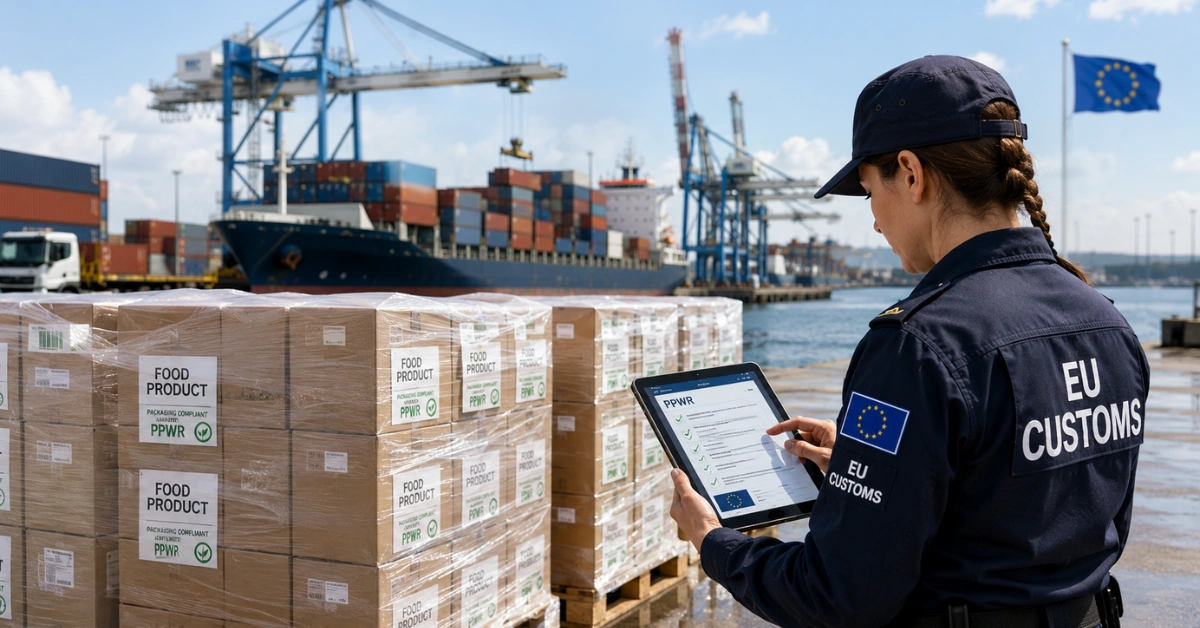
EU packaging waste has crossed 186 kilograms per person per year and the European Commission has decided that the old voluntary approach isn’t working. The Packaging and Packaging Waste Regulation that takes effect on August 12, 2026 is the EU’s most aggressive intervention in packaging policy in three decades. Understanding PPWR requirements is now becoming critical for exporters, manufacturers, FMCG brands, and packaging suppliers as the regulation introduces mandatory obligations around recyclability, packaging reduction, material disclosures, reuse targets, labeling, and digital packaging traceability across EU-bound supply chains.
For exporters in India, Africa, and Southeast Asia who sell into EU markets, the rules don’t just apply to packaging plants in Hamburg or Rotterdam. They apply to your cocoa bag, your spice carton, your basmati pouch the moment it enters the Union.
This guide breaks down exactly what PPWR requires, when each obligation kicks in, and what an EU-bound exporter should be doing right now to avoid shipment rejection, retailer delisting, and customs disruption. Where it helps, we’ll show how TraceX customers are already operationalizing PPWR alongside EUDR, CSRD, and ESPR on a single platform.
The EU’s Packaging and Packaging Waste Regulation (PPWR) is transforming packaging from a sustainability initiative into a mandatory compliance requirement for exporters supplying the European market. For agri-food and FMCG exporters, the regulation introduces strict obligations around recyclability, packaging reduction, labeling, reuse targets, post-consumer recycled (PCR) content, and digital packaging traceability.
The impact extends far beyond packaging manufacturers. Exporters of food, beverages, spices, cocoa, coffee, cosmetics, personal care products, and consumer goods must now understand the packaging materials entering the EU alongside their products.
PPWR is Regulation (EU) 2025/40 a binding, directly enforceable EU law that replaces the old Packaging and Packaging Waste Directive (94/62/EC) with a single set of rules across all 27 member states. It entered into force on February 11, 2025 and starts to apply on August 12, 2026. [Cite: EUR-Lex, Regulation EU 2025/40, 2025]
The distinction between a directive and a regulation isn’t legal jargon it’s the entire reason PPWR is harder than what came before. Under the old PPWD, every EU country interpreted the rules its own way. Spain required one symbol, France required the Triman logo, Italy demanded different labeling. Compliance teams played 27-country whack-a-mole.
With PPWR, that fragmentation is gone. The rules are identical from Lisbon to Helsinki, they apply automatically without national transposition, and they cover every package type primary, secondary, transport, and service packaging regardless of material.
Most exporters underestimate one PPWR detail: importers are legally on the hook. If you sell a packaged good in the EU under your brand, you must issue the Declaration of Conformity yourself. You can’t outsource that risk to a packaging supplier upstream.
The headline date is August 12, 2026 that’s when general application begins. But the obligations phase in across more than a decade, with the heaviest hits landing in 2030, 2035, and 2038. Treating August 2026 as the only deadline is a mistake; the redesign work for 2030 must begin in 2026. [Cite: Ropes & Gray, European Commission Guidance Analysis, April 2026]
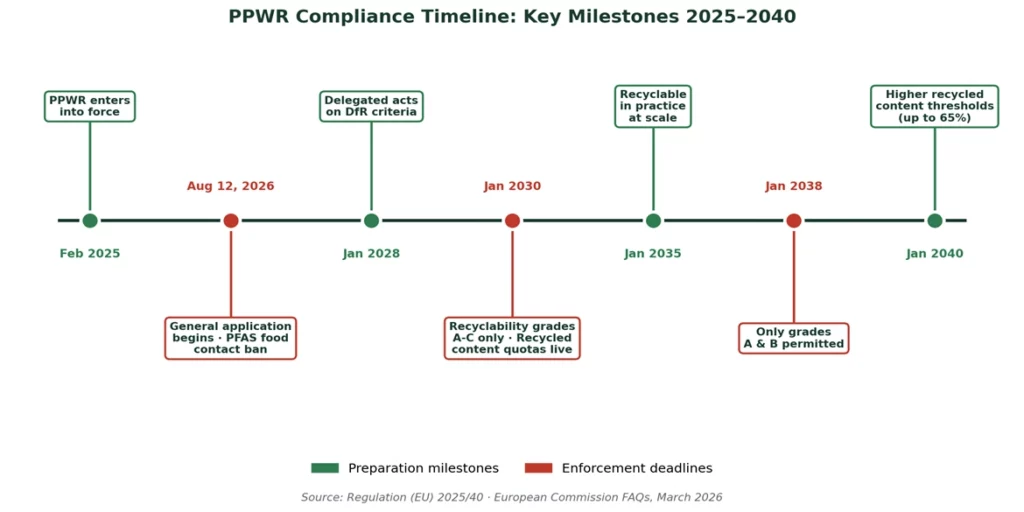
Two dates deserve special attention:
There’s also a quieter consequence in 2028: the European Commission will publish delegated acts defining the formal Design-for-Recycling (DfR) criteria. Many exporters assume they’ll ‘wait for the criteria’ before redesigning. By the time those criteria publish, there will be roughly 24 months to reformulate materials, re-test packaging, re-onboard suppliers, and re-do retailer line reviews. That’s not enough time.
Struggling to understand what PPWR compliance means for your business?
Read our PPWR compliance guide to learn how companies can prepare for recyclability mandates, packaging-data requirements, supplier traceability, labeling obligations, and digital compliance workflows before the 2026 enforcement deadlines.
PPWR compliance can be operationalized in six concrete steps: packaging inventory, composition data, recyclability assessment, supplier traceability, Declaration of Conformity, and digital compliance infrastructure. Each step builds on the previous one skipping any of them creates an audit gap that blocks the next.
Most exporters cannot answer this question in under a week: how many distinct packaging SKUs do you place on the EU market? PPWR requires visibility across primary packaging (the consumer-facing pouch or jar), secondary packaging (the multi-pack carton), transport packaging (pallets, shrink wrap, edge protectors), and service packaging (e-commerce mailers, take-away formats). Most organizations still lack centralized packaging intelligence composition data lives across procurement, R&D, and three converter relationships.
For every SKU, you’ll need material composition, recycled-content percentage, plastic content by weight, hazardous-substance disclosures (PFAS, heavy metals, substances of concern), packaging weight, and recyclability attributes. This data lives upstream with paper suppliers, polymer converters, label printers, and adhesive vendors. PPWR turns this scattered information into regulated compliance data with a paper trail.
Each packaging unit will be graded A through E. From 2030, only grades A–C can be sold; from 2038, only A and B. The grade depends on what percentage of the unit can be recycled at scale in EU infrastructure multilayer films, dark-pigmented PET, mineral-oil inks, and certain adhesive systems are already known to fail.
This is where most projects stall. You need packaging declarations, recycled-content evidence, conformity documentation, and material disclosures from every supplier. If your supplier base is 30 fragmented converters across three continents and they communicate by email and PDF you cannot pass an audit. Compliance becomes a supplier-data project, not a packaging project.
The DoC is the legal artifact. Manufacturers issue it; importers must verify it; distributors must keep it. It declares that the packaging complies with substance restrictions, recyclability requirements, labeling, and recycled-content thresholds. Technical documentation supporting the DoC must be retained for 5 years (10 for reusable packaging).
Spreadsheets do not scale to PPWR. The convergence with ESPR’s Digital Product Passport means packaging compliance is no longer a static PDF it’s structured, machine-readable data that needs to live in a system that integrates with your ERP, your supplier portal, and the EU’s reporting infrastructure. This is the gap TraceX was built to close.
PPWR collapses three separate workstreams packaging design, supplier management, and regulatory documentation into one. Companies that treat them as separate functions discover the seams when an auditor asks for evidence.
From January 1, 2030, all plastic packaging with at least 5% plastic by weight must contain a minimum percentage of post-consumer recycled (PCR) content ranging from 10% to 35% depending on packaging type, rising to 25%–65% by 2040. Critically, only post-consumer recyclate qualifies. Post-industrial recyclate (PIR), which many suppliers currently market as ‘recycled content,’ does not count toward PPWR targets. [Cite: PPWR Article 7 · Sunhat, April 2026 · Measurlabs, March 2026]
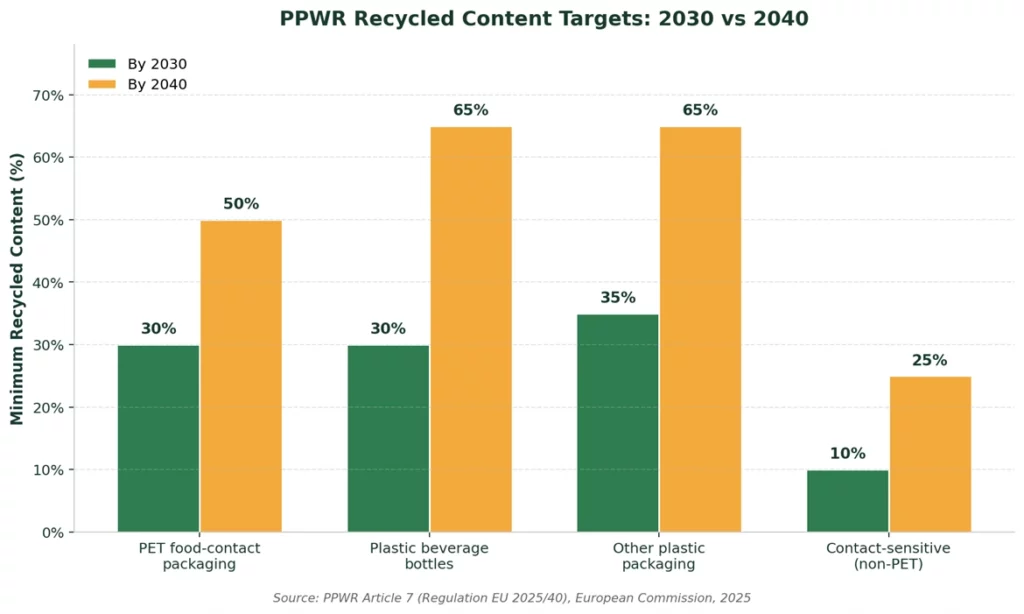
The supply gap is real. Food-grade PCR needed for plastic beverage bottles, dairy pouches, ready-meal trays is constrained today. Mechanical recycling produces food-grade quality reliably only for PET. Chemical recycling capacity exists but isn’t yet at industrial scale across most polymers. That means exporters of food packaging will compete for a thin supply of compliant material in 2028–2030.
There’s also a compliance subtlety worth flagging: recycled-content percentages will be evaluated as the average across a production facility’s annual output, not per individual pack. That gives manufacturers some flexibility but the trade-off is annual auditing and lot-level documentation across every facility supplying the EU.
Indian and Southeast Asian exporters are particularly exposed here. The PCR supply chains feeding into EU-facing packaging are heavily concentrated in Europe today. Building parallel PCR sourcing or qualifying recycled content from local recyclers against EU standards is a 24–36 month project most teams haven’t started.
| Grade | Recyclable by Weight | Permitted From 2030? | Permitted From 2038? |
|---|---|---|---|
| Grade A | ≥ 95% recyclable | ✓ Yes | ✓ Yes |
| Grade B | ≥ 80% recyclable | ✓ Yes | ✓ Yes |
| Grade C | ≥ 70% recyclable | ✓ Yes | ✗ Phased out |
| Grade D | < 70% recyclable | ✗ Prohibited | ✗ Prohibited |
| Grade E | < 70% recyclable | ✗ Prohibited | ✗ Prohibited |
The dirty secret of PPWR is that most compliance failures will trace back not to packaging design but to missing supplier data. A converter who can’t tell you exactly what percentage of post-consumer recyclate is in their PET sheet, or a label printer who can’t disclose adhesive composition, or a co-packer who can’t produce a chain-of-custody for a recycled aluminum can any of those gaps can collapse a Declaration of Conformity.
For exporters working with 100s to 1,000s of upstream suppliers across India, Africa, and Southeast Asia, this is the operational mountain. Smallholder packaging converters, regional film producers, and last-mile co-packers rarely operate digital systems. Their compliance data sits in WhatsApp threads, emailed PDFs, and Excel files with inconsistent column headers.
In our work with agri-food exporters preparing for EUDR, we’ve seen the same pattern that will repeat for PPWR: the first 60 days of any compliance project are spent rebuilding the supplier list, mapping data ownership, and confirming who at each supplier can actually provide composition disclosures. Companies that started PPWR prep alongside EUDR in 2025 are 6–9 months ahead of those starting now.
This is why TraceX’s Regulatory Compliance Platform built originally for EUDR and now extended to handle PPWR’s documentation layer focuses on offline-first mobile capture, multilingual supplier portals, and structured data templates.
Non-compliance with PPWR triggers consequences at multiple points in the supply chain from customs rejection at EU ports, to retailer delisting, to administrative fines set by individual member states under Article 68 of the regulation. The exact financial penalty varies by country, but the operational impact is uniform across the EU.
The most damaging outcomes aren’t always the legal ones. Three commercial risks tend to materialize first:
For exporters whose entire EU business sits on five or six key retailer accounts, the delisting risk is the existential one. PPWR failure isn’t a fine it’s losing the account.
PPWR doesn’t exist in isolation. It’s one node in a connected web of EU sustainability and traceability regulations EUDR (deforestation), CSRD (corporate sustainability reporting), and ESPR (Digital Product Passports) that all depend on the same upstream supplier data. Companies that build separate compliance systems for each end up with four parallel projects and no shared infrastructure. Companies that treat them as one data problem move 3x faster.
Consider where they overlap:
This convergence is the most important strategic insight a sustainability leader can have in 2026: build the data infrastructure once, and it amortizes across four major regulations. Build it four times, and you’ve quadrupled your compliance budget for no reason.
Explore how TraceX EUDR Solutions help businesses manage supplier traceability, geolocation mapping, deforestation-risk monitoring, DDS workflows, and audit-ready compliance through AI-powered digital infrastructure.
TraceX consolidates the six PPWR steps into a single platform that already handles EUDR Due Diligence Statements, ESPR Digital Product Passports, and CSRD Scope 3 reporting for enterprise customers. The product wasn’t built specifically for PPWR it was built for the underlying data problem PPWR depends on.
Three platform capabilities map directly to PPWR’s hardest requirements:
Customers preparing for PPWR alongside EUDR typically see a 60–70% reduction in compliance team hours per supplier, simply because the same data collection covers multiple regulations.
PPWR is not a packaging-team project. It touches procurement, sourcing, IT, ESG, compliance, legal, logistics, and retail operations and most companies haven’t yet aligned those functions around a shared data infrastructure. The exporters who’ll come through 2026–2030 cleanly are the ones treating PPWR readiness as a 12–18 month transformation, not a Q3 2026 sprint.
Three things to do this quarter:
PPWR stands for the Packaging and Packaging Waste Regulation (Regulation EU 2025/40). It’s a binding EU law that replaces the 30-year-old Packaging and Packaging Waste Directive. It applies to all packaging placed on the EU market regardless of material or origin and sets requirements on recyclability, recycled content, labeling, reuse, and substance restrictions.
PPWR entered into force on February 11, 2025, and general application begins on August 12, 2026. Specific obligations phase in across the next 15 years: recyclability grading and mandatory recycled content start January 1, 2030; recyclable-in-practice requirements at January 2035; and only grades A and B permitted from January 2038.
All three, though their obligations differ. Manufacturers issue the Declaration of Conformity and conduct conformity assessment. Importers must verify the DoC and take responsibility if they sell under their own brand. Distributors must confirm packaging is properly labeled and accompanied by required documentation. Technical documentation must be retained for 5 years (10 for reusable packaging).
Penalties are set by individual EU member states under Article 68 of the regulation, so the exact fine varies by country. More commercially damaging consequences include customs rejection at EU borders, retailer delisting, and higher Extended Producer Responsibility (EPR) fees under eco-modulation starting in 2030. For many exporters, the retailer-delisting risk is the most material.
Three key differences. First, PPWR is a regulation not a directive it applies automatically across all 27 EU member states without national transposition. Second, it covers the entire packaging lifecycle with binding targets (recyclability, recycled content, reuse), not just collection rates. Third, it harmonizes labeling so there’s one EU symbol set instead of 27 national variants.