
Quick summary: Discover how Rainforest Alliance Certification in Ghana helps exporters access premium global markets, strengthen smallholder livelihoods, and ensure sustainable, traceable agricultural production. Learn eligibility, requirements, timelines, and compliance strategies.

Rainforest Alliance Certification in Ghana helps exporters demonstrate sustainable production, meet international buyer requirements, and access premium global markets. The certification focuses on environmental protection, fair labor practices, and farm-level traceability especially critical for cocoa and other agricultural exports. By complying with Rainforest Alliance standards, Ghanaian exporters strengthen supply chain transparency, reduce compliance risk, and improve long-term market competitiveness while aligning with evolving sustainability and due-diligence regulations.
Rainforest Alliance Certification is especially critical for Ghanaian exporters, given Ghana’s central role in global cocoa supply chains and rising scrutiny from EU, US, and Asian markets. International buyers increasingly require certified, deforestation-free, and traceable products to meet sustainability commitments and regulations such as the EU Deforestation Regulation (EUDR). For Ghanaian exporters of cocoa and other commodities, Rainforest Alliance Certification provides a trusted, internationally recognized pathway to access and retain these high-value markets.
Ghana’s Rainforest Alliance (RA) certification thrives in cocoa, with 187,000 metric tons certified in 2024 (down from prior peaks due to swollen shoot virus/weather), representing ~27% of national production amid 700K MT MY2024/25 forecast. Companies like Cocoa Abrabopa Association (CAA) paid GHC9.2M premiums to 8,000 farmers (GHC52.50/bag, $70/MT SD), while Federated Commodities (FEDCO) disbursed GHC16M (GHC50-64/bag) under RA 2020 standards, covering thousands across operational areas. Insights highlight RA’s focus on pruning, insecticides, and child labor monitoring, boosting yields/incomes 10-20% and EUDR readiness (95% traceability); Version 1.4 standard (Oct 2025) streamlines audits, aiding recovery from 531K MT low in 2023/24.
In Ghana, Rainforest Alliance Certification is widely adopted across the cocoa sector, with thousands of smallholder farmers participating through licensed buying companies, cooperatives, and sustainability programs supported by global brands. Certification enables farm-level traceability, verification of good agricultural practices, and compliance with environmental and labour standards strengthening Ghana’s position as a reliable source of sustainable cocoa. Certified exporters benefit from preferred buyer status, premium opportunities, and reduced compliance risk, while ensuring alignment with global ESG and due diligence expectations.
Beyond market access, Rainforest Alliance Certification delivers tangible benefits at farm level. Certified farmers receive training in climate-smart agriculture, agroforestry, soil management, and safe labour practices, improving yields, resilience, and long-term livelihoods. This combination of verified sustainability, farmer empowerment, and supply chain transparency helps Ghanaian exporters secure future-proof market access while supporting sustainable growth across the cocoa sector.
Discover how Rainforest Alliance certification helps exporters meet sustainability requirements, strengthen buyer trust, and unlock access to global markets.
Read the blog
Sustainability Is Now a Market Requirement
Learn how sustainability certifications are reshaping sourcing decisions across global agri-value chains.
Cocoa is the cornerstone of Rainforest Alliance Certification in Ghana, reflecting the country’s position as one of the world’s largest cocoa producers. Certification ensures that cocoa is produced using sustainable agricultural practices, including agroforestry, soil conservation, and biodiversity protection, while meeting strict environmental and labour standards. For exporters, certified cocoa strengthens compliance with international buyer requirements and regulations such as the EU Deforestation Regulation (EUDR).
Beyond cocoa, other commodities such as coffee, cashew, oil palm, and rubber are increasingly eligible for Rainforest Alliance certification in Ghana. These crops, often cultivated by smallholders, benefit from improved farming practices, enhanced traceability, and access to premium international markets. Expanding certification across multiple commodities helps diversify export portfolios while promoting sustainable land use.
Rainforest Alliance certification in Ghana is most effective when implemented through cooperatives, producer organizations, or licensed buying companies. Cooperative structures enable smallholders to access training, share resources, and meet certification requirements collectively. For exporters, this creates a more organized, traceable, and compliant supply base with consistent quality and volume.
Certified farms must protect forests and biodiversity, prevent deforestation, and adopt sustainable practices such as soil management, water conservation, and reduced chemical use. Agroforestry systems particularly shade-grown cocoa are strongly encouraged to enhance climate resilience and ecosystem health.
Rainforest Alliance standards enforce fair labour practices, safe working conditions, and equal opportunities. Child labour, forced labour, and discrimination are strictly prohibited. Community engagement and grievance mechanisms are required to support long-term social sustainability in farming communities.
Producers must maintain accurate records covering farm boundaries, production volumes, input use, labour practices, and sales. Farm mapping and batch-level documentation are essential to ensure traceability from farm to export and to pass third-party audits.
The certification journey typically includes:
Rainforest Alliance sets and updates the certification standards, provides guidance, and oversees system integrity. Accredited third-party auditors conduct independent assessments to ensure credibility and transparency.
Certification requires ongoing compliance through annual audits or renewal cycles. Producers are expected to implement continuous improvement plans to address gaps and adapt to evolving sustainability and regulatory requirements.
Ghana’s cocoa sector is dominated by hundreds of thousands of smallholder farmers. Coordinating consistent adoption of sustainable practices, labour standards, and documentation across dispersed farms is operationally complex and resource-intensive for exporters.
Despite progress, many farmers still rely on manual or paper-based record-keeping. Gaps in farm mapping, production records, and labour documentation can delay audits, trigger corrective actions, or limit scalability of certification programs.
Training, audits, monitoring, and ongoing compliance involve recurring costs. For cooperatives and exporters operating across multiple districts or crops, managing these costs while maintaining certification at scale remains a key challenge.
Digital traceability platforms such as the sustainable sourcing solutions offered by TraceX play a critical role in operationalizing Rainforest Alliance certification in Ghana by replacing fragmented, manual processes with structured digital systems.
Platforms enable digital onboarding of farmers, capturing verified data on farm location, size, crops, labour practices, and environmental conditions creating a reliable, auditable farmer registry.
Each harvest or cocoa batch is assigned a unique digital identity, ensuring traceability from certified farms through aggregation, processing, and export reducing risks of mixing or mislabelling.
Continuous data capture allows exporters to monitor sustainability and labour indicators in real time. Non-compliance risks can be identified early and corrected before audits.
Digital platforms automatically organize farm records, production data, social compliance evidence, and environmental practices into audit-ready formats reducing audit preparation time and errors.
Aggregated data helps exporters track yield performance, monitor premium distribution, and identify areas for training or intervention supporting long-term sustainability and scalability.
Transparent, verifiable digital records increase buyer trust and help Ghanaian exporters meet rising expectations from global brands and regulators strengthening access to premium markets.
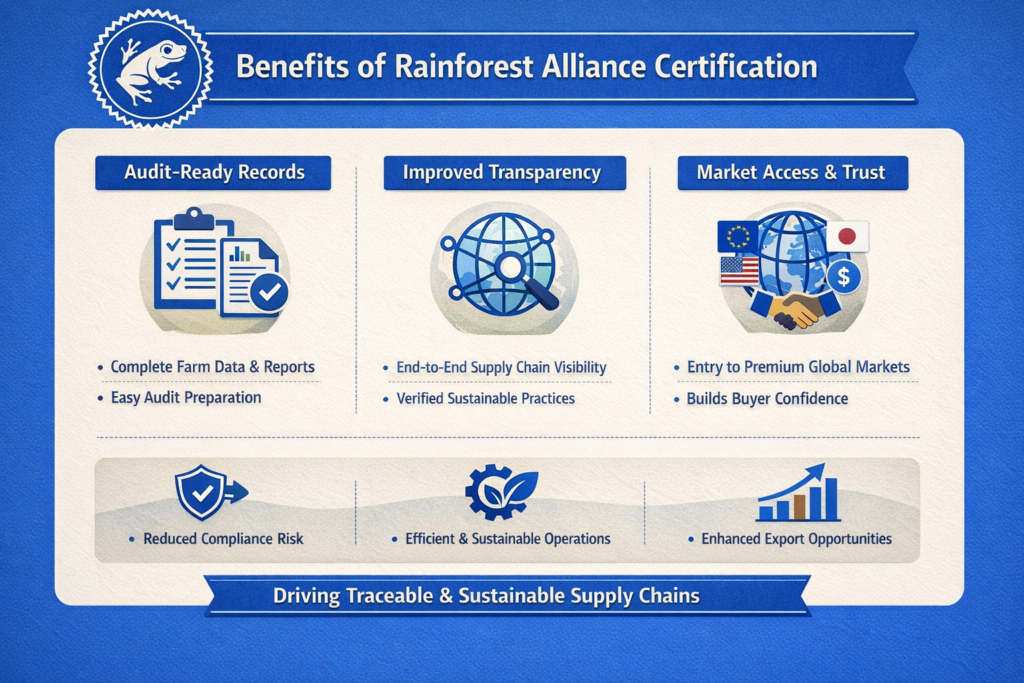
Rainforest Alliance Certification in Ghana is more than a compliance requirement—it is a strategic advantage in a highly competitive global cocoa market. For exporters, certification unlocks access to premium buyers in the EU, US, and Asia, where sustainability, deforestation-free sourcing, and traceability are now baseline expectations. Certified exporters are often preferred suppliers for multinational brands, benefiting from stronger buyer relationships, price premiums, and reduced regulatory risk under frameworks such as the EU Deforestation Regulation.
For smallholder farmers, certification delivers long-term value through training in climate-smart agriculture, agroforestry, and improved farm management. Participation in certified programs strengthens cooperative structures, improves productivity and resilience, and enables access to premiums and more stable incomes. These benefits support both farmer livelihoods and consistent, high-quality supply for exporters.
By enabling verified sustainability, transparent traceability, and credible ESG alignment, Rainforest Alliance Certification positions Ghanaian cocoa and other agricultural exporters as trusted, future-ready partners in global supply chains driving competitiveness while supporting sustainable rural development.
Rainforest Alliance Certification provides Ghanaian exporters with a proven pathway to sustainable growth and long-term market access. By meeting rigorous environmental, social, and traceability standards, exporters strengthen buyer confidence, align with global ESG and due diligence requirements, and reduce compliance risk. At the same time, certification empowers smallholder farmers through better agricultural practices, cooperative engagement, and improved livelihoods. The result is a resilient, transparent, and globally competitive agricultural export sector where sustainability delivers both economic and social returns.
Ethical Sourcing Matters
Discover how ethical sourcing practices build trust, reduce risks, and create value across agricultural supply chains.
Build a Responsible Supply Chain
Explore strategies for creating transparent and accountable supply chains that meet global sustainability expectations.
Digitally Transform Your Sustainability Efforts
Learn how digital platforms are enabling real-time monitoring, reporting, and compliance in agriculture and agribusiness.
Rainforest Alliance Certification in Ghana verifies that agricultural products especially cocoa are produced in line with internationally recognized environmental, social, and labour standards, with strong requirements for traceability, forest protection, and responsible farming practices.
Cocoa is the primary certified crop in Ghana. Other eligible or emerging commodities include coffee, cashew, oil palm, and rubber, particularly when produced by smallholders organized through cooperatives or licensed buying companies.
The certification process typically takes 6–12 months, depending on farm readiness, availability of training, data collection, and third-party audit scheduling.
No. Certification is voluntary, but it is increasingly required or strongly preferred by international buyers, especially in the EU, US, and Asia, and supports compliance with regulations such as the EU Deforestation Regulation.
Exporters gain access to premium markets, stronger buyer trust, and improved ESG and due diligence alignment. Farmers benefit from training in sustainable agriculture, improved productivity, premium payments, and stronger participation in organized supply chains.