
Quick summary: Discover how Rainforest Alliance Certification in Kenya helps exporters access premium global markets, strengthen traceability, and meet sustainability and ESG requirements. Learn eligible products, certification steps, timelines, and compliance benefits for Kenyan exporters.

Rainforest Alliance Certification in Kenya helps exporters of tea, coffee, cocoa, flowers, and horticultural products access premium global markets by demonstrating compliance with internationally recognized sustainability standards. The certification verifies responsible land use, ethical labor practices, and robust traceability across smallholder and estate-based supply chains. While voluntary, Rainforest Alliance Certification in Kenya is increasingly required by buyers in the EU, UK, and US, particularly under growing due-diligence and deforestation regulations. For Kenyan exporters, it strengthens market access, reduces compliance risk, and builds long-term buyer trust through verifiable, audit-ready sourcing practices.
Rainforest Alliance Certification in Kenya is a critical market enabler for exporters targeting premium buyers in the EU, UK, US, and Asia, where sustainably sourced and traceable products are increasingly mandatory. Certified exporters gain preferred-supplier status with multinational brands, particularly across tea, coffee, cocoa, flowers, and horticultural products, helping Kenyan producers meet rising demand for verified environmental and social compliance. Certification also supports alignment with emerging regulations such as the EU Deforestation Regulation (EUDR) and buyer-led due-diligence requirements.
Kenya’s Rainforest Alliance (RA) certification focuses on coffee and tea, supporting thousands of smallholders despite a May 2025 government suspension of tea factory certifications (lifted Nov 2025 after cost reviews), with annual compliance costs of $2,900-$3,200 straining cooperatives. RA aids 34,254 certified coffee/tea farmers in Mount Kenya (2024), tripling Baragwi cooperative’s cherry production from 5M to 15M kg via regenerative practices; Gusii project targets 10,000 coffee smallholders across 16 cooperatives.
In Kenya, Rainforest Alliance certification is especially prominent in the tea and coffee sectors, with thousands of smallholder farmers participating through cooperatives and large estates. Organizations such as the Kenya Tea Development Agency (KTDA) and certified estates have integrated Rainforest Alliance standards to improve traceability, worker welfare, and environmental management, enabling consistent access to global retail and beverage brands. Certified supply chains increasingly rely on digital traceability systems to manage farm data, premiums, and audit readiness.
Beyond market access, Rainforest Alliance Certification provides independent verification of sustainable farming practices, forest protection, and fair labor conditions, reducing reputational and supply chain risks for exporters. For Kenyan producers, certification drives long-term resilience by promoting agroforestry, soil health, climate-smart agriculture, and stable premium payments—strengthening farmer livelihoods while ensuring a reliable supply of high-quality, export-ready commodities.
Discover how Rainforest Alliance certification helps exporters meet sustainability requirements, strengthen buyer trust, and unlock access to global markets.
Read the blog
Sustainability Is Now a Market Requirement
Learn how sustainability certifications are reshaping sourcing decisions across global agri-value chains.
Tea dominates Rainforest Alliance Certification in Kenya, reflecting the country’s position as one of the world’s largest tea exporters. Certified tea ensures that both smallholder farmers and large estates follow sustainable agricultural practices, including soil conservation, water stewardship, biodiversity protection, and ethical labour standards. Rainforest Alliance-certified tea is widely preferred by global buyers in the EU, UK, and US, making certification a critical requirement for long-term market access.
Beyond tea, coffee is a major Rainforest Alliance-certified crop in Kenya, particularly among smallholder cooperatives supplying specialty and premium markets. Horticultural products, including flowers and select fruits, are also increasingly aligned with Rainforest Alliance standards as buyers demand stronger social and environmental assurances. Expanding certification across these commodities enhances export competitiveness, strengthens sustainability credentials, and enables access to higher-value buyers.
Rainforest Alliance certification in Kenya is highly effective when implemented through farmer cooperatives, producer organizations, and estate–outgrower models. Smallholders benefit from access to training, shared services, and premium mechanisms, while exporters gain structured, traceable supply chains that support consistent quality, compliance, and scalability for global markets.
Certified farms in Kenya must protect biodiversity, prevent deforestation, and implement sustainable land management practices. This includes soil health improvement, responsible water use, reduced chemical inputs, and the adoption of agroforestry and integrated pest management practices particularly important in tea- and coffee-growing regions vulnerable to climate stress.
Rainforest Alliance certification enforces strict labour and human rights standards, including fair wages, safe working conditions, gender equity, and zero tolerance for child or forced labour. These requirements are especially critical in Kenya’s tea estates and horticulture sector, where labour practices are closely scrutinized by international buyers.
Producers must maintain accurate, verifiable records covering farm locations, production volumes, input usage, and labour practices. Farm mapping and traceability from farm to export are essential for audits, buyer transparency, and alignment with emerging regulations such as the EU Deforestation Regulation.
Steps for Exporters and Farmer Organizations
The Rainforest Alliance certification process in Kenya typically includes:
Rainforest Alliance sets the standards and provides guidance, while accredited third-party auditors conduct independent assessments to ensure credibility, consistency, and integrity of certified operations.
Certification requires annual audits or renewal cycles, with continuous improvement plans to address evolving sustainability, labour, and traceability expectations from global buyers.
Kenya’s tea and coffee sectors rely heavily on millions of smallholders, making coordination, data collection, and consistent implementation of standards complex. Exporters must manage large farmer networks while ensuring uniform compliance and quality.
Many producers still rely on manual or semi-digital record-keeping, creating gaps in farm-level documentation and traceability. These gaps increase audit risk and make it harder to meet buyer and regulatory requirements for deforestation-free and ethical sourcing.
Training, audits, and ongoing compliance require sustained investment. For cooperatives and exporters managing large farmer bases, these costs can limit scalability without digital tools and streamlined workflows.
TraceX’s Sustainable Sourcing Platform acts as a digital backbone for Kenyan exporters, cooperatives, and estates pursuing Rainforest Alliance certification by replacing fragmented, paper-based processes with structured, auditable systems.
TraceX enables digital registration of smallholders and estates, capturing farm location, size, crop type, labour practices, and environmental indicators ensuring every producer is verified and linked to the certified supply chain.
Each harvest or processing batch is assigned a unique digital ID, enabling traceability from farm or estate to factory and export, reducing risks of mixing, fraud, or misrepresentation.
Continuous data capture allows exporters to monitor compliance with Rainforest Alliance standards and flag deviations early before audits reducing non-compliance risk.
TraceX automatically organizes farm records, production data, labour compliance logs, and sustainability metrics into audit-ready formats, cutting audit preparation time and improving accuracy.
Aggregated insights across farms and estates help exporters track premium distribution, identify risks, improve productivity, and scale certified supply sustainably.
Transparent, verifiable digital records strengthen buyer trust and position Kenyan exporters as reliable suppliers to premium global markets.
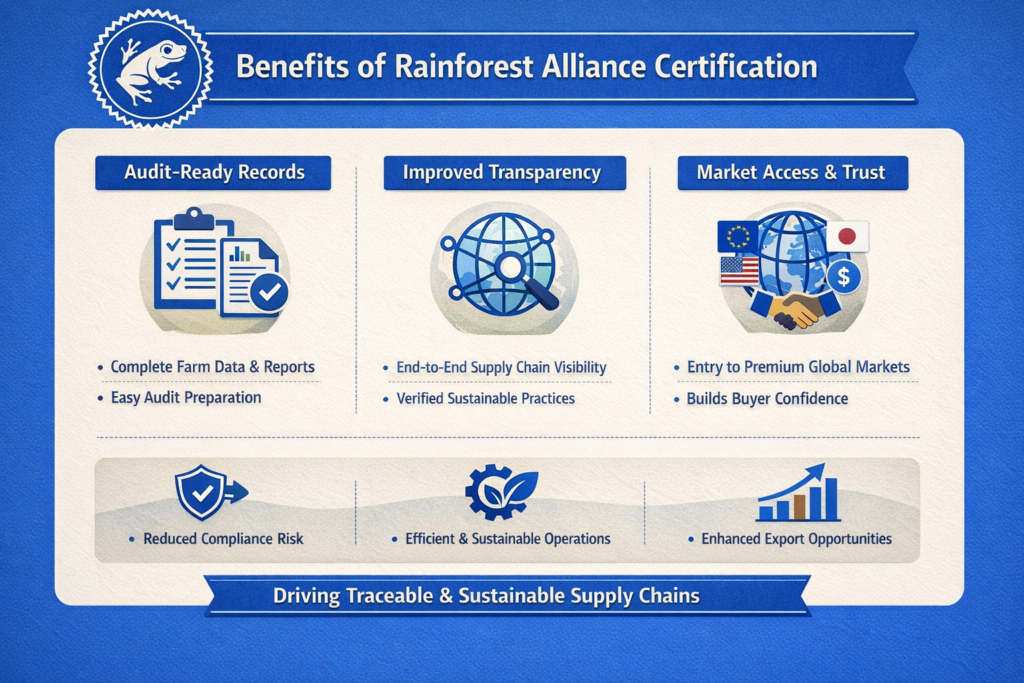
Rainforest Alliance Certification in Kenya is more than a sustainability label it is a strategic advantage for exporters competing in premium global markets. For tea, coffee, and horticulture exporters, certification unlocks access to buyers in the EU, UK, US, and Asia who increasingly require verified environmental and social compliance. It supports price stability, preferred-supplier status with multinational brands, and alignment with due-diligence regulations such as the EU Deforestation Regulation, while strengthening ESG and audit readiness.
For smallholder farmers and estate workers, certification delivers long-term value through training in climate-smart agriculture, improved farm management, safer working conditions, and access to sustainability premiums. By enabling transparency, traceability, and independently verified sourcing, Rainforest Alliance Certification positions Kenyan exporters as trusted, resilient partners in global supply chains creating a win-win for exporters, farmers, and international buyers.
Rainforest Alliance Certification offers Kenyan exporters a clear pathway to scale ethical, traceable, and market-ready supply chains. By meeting rigorous environmental, social, and traceability standards, exporters reduce compliance risk, enhance buyer confidence, and future-proof their businesses against tightening sustainability expectations. For farmers, certification strengthens livelihoods and resilience through better practices and cooperative engagement. Ultimately, Rainforest Alliance Certification is both a market differentiator and a catalyst for sustainable growth across Kenya’s agricultural export sector.
Ethical Sourcing Matters
Discover how ethical sourcing practices build trust, reduce risks, and create value across agricultural supply chains.
Build a Responsible Supply Chain
Explore strategies for creating transparent and accountable supply chains that meet global sustainability expectations.
Digitally Transform Your Sustainability Efforts
Learn how digital platforms are enabling real-time monitoring, reporting, and compliance in agriculture and agribusiness
Rainforest Alliance Certification in Kenya verifies that agricultural products such as tea, coffee, and horticultural crops are produced using sustainable farming practices, ethical labor standards, and robust traceability systems aligned with global buyer expectations.
Tea is the primary certified crop, followed by coffee and select horticultural products. Certification often covers both smallholder farmers organized in cooperatives and large estates supplying international markets.
The certification process typically takes 6–12 months, depending on producer readiness, training requirements, supply chain complexity, and audit scheduling.
No. Certification is voluntary, but it is increasingly required or strongly preferred by buyers in the EU, UK, and US, especially under growing sustainability and due-diligence regulations.
Benefits include access to premium markets, improved buyer trust, sustainability premiums, ESG alignment, reduced compliance risk, and long-term improvements in farmer livelihoods through training and cooperative engagement.