
Quick summary: Discover how Rainforest Alliance Certification in Nigeria helps exporters access premium markets, improve smallholder livelihoods, and ensure sustainable and traceable production. Learn requirements, eligible products, and compliance strategies.

Rainforest Alliance Certification in Nigeria: Rainforest Alliance Certification in Nigeria enables exporters, particularly in cocoa, coffee, and cashew, to access premium global markets while ensuring sustainable, ethical production. Certification verifies compliance with environmental standards, social safeguards, and traceability requirements, strengthening buyer trust and long-term trading relationships. Nigerian exporters benefit from enhanced market credibility, improved smallholder farmer livelihoods, and alignment with ESG and regulatory requirements. While certification involves audits, documentation, and ongoing compliance, it provides price stability, market differentiation, and supports circular, sustainable supply chains, positioning Nigerian commodities competitively in increasingly regulated international trade.
Rainforest Alliance Certification opens doors to high-value markets in the EU, US, and Asia, where retailers and brands actively prioritize sustainably sourced products. Certified exporters are often preferred suppliers for multinational companies, enabling Nigerian producers of cocoa, coffee, cashew, and other commodities to meet increasing global demand for traceable, eco-friendly products. Certification provides a verified pathway to enter these markets, ensuring that exporters can compete internationally while complying with buyer expectations and regulatory requirements such as the EU Deforestation Regulation.
Nigeria’s Rainforest Alliance (RA) certification primarily targets cocoa, with companies like WACOT Ltd leading implementation through sustainability programs covering 3,500 smallholder farmers across 6,000+ hectares in Oyo, Ogun, and Osun states, targeting 3,000 MT annual production. WACOT renewed RA certification in 2024, supplying 2,000 tons to partners like Cocoasource for clients (GCB, Hershey), using traceability via Licensed Buying Agents and direct premium deposits. Sunbeth Global Concepts also holds RA certification for cocoa bean
Certification serves as an independent verification of sustainable farming practices, environmental stewardship, and fair labor conditions. This transparency builds trust with global buyers, mitigating supply chain risks and reducing reputational exposure. For Nigerian exporters, Rainforest Alliance Certification demonstrates adherence to internationally recognized standards, helping brands differentiate their products in crowded markets and align with ESG reporting requirements that are increasingly mandatory for corporate buyers.
Rainforest Alliance promotes environmentally sustainable and socially responsible farming practices, directly benefiting smallholder farmers. Certified programs often provide training in agroforestry, soil health, and integrated pest management, which increases farm productivity and resilience. Farmers also gain access to better prices, stable incomes, and premium payments for certified produce. These benefits help uplift local communities, enhance supply chain sustainability, and ensure long-term availability of high-quality, certified commodities for exporters.
Discover how Rainforest Alliance certification helps exporters meet sustainability requirements, strengthen buyer trust, and unlock access to global markets.
Read the blog
Sustainability Is Now a Market Requirement
Learn how sustainability certifications are reshaping sourcing decisions across global agri-value chains.
Cocoa as the Primary Certified Crop
Cocoa dominates Rainforest Alliance certification in Nigeria, reflecting its importance in both domestic livelihoods and global export markets. Certified cocoa ensures that smallholder farms follow sustainable agricultural practices, from soil conservation to agroforestry, while meeting international labor and environmental standards.
Other Potential Commodities
While cocoa is the primary focus, other crops such as coffee, cashew, and palm oil are increasingly eligible for certification. These commodities are often produced by smallholders and can benefit from sustainable practices, market access, and premiums associated with certification. Expanding certification to these crops enhances environmental protection and improves farmer incomes.
Importance of Smallholder Involvement and Cooperative Structures
Rainforest Alliance certification is particularly effective when implemented through farmer cooperatives or organized groups. Smallholders gain access to training, shared resources, and financial incentives, while exporters benefit from a coordinated supply chain that ensures traceability, compliance, and consistent quality for international markets.
Environmental Standards
Certified farms must protect biodiversity, maintain forest cover, and adopt sustainable farming practices such as soil management, water conservation, and reduced chemical inputs. Agroforestry and integrated pest management techniques are encouraged to enhance ecosystem resilience.
Social Standards
The certification also ensures fair and ethical labour practices. Farmers and workers must receive fair wages, operate under safe working conditions, and have equal opportunities regardless of gender. Child and forced labour are strictly prohibited, and community engagement is encouraged to support broader social development.
Traceability and Farm Management Documentation
Producers must maintain accurate records of production, inputs, and sales, enabling traceability from farm to export. Documentation includes farm maps, input usage logs, and financial records, which are critical for audits and maintaining transparency for global buyers.
Steps for Exporters and Farmer Cooperatives
The certification process typically includes:
Rainforest Alliance oversees standards, training, and guidance, while FLOCERT or other accredited auditors conduct independent audits to ensure integrity and credibility of certified operations.
Renewal and Recertification Cycles
Certification is not permanent; farms and cooperatives undergo annual audits or biennial renewal cycles to ensure ongoing compliance. Continuous improvement plans are often implemented to help producers meet evolving sustainability standards.
Fragmented Supply Chains and Smallholder Coordination
Nigeria’s agricultural sector, especially cocoa and other Rainforest Alliance-eligible crops, is dominated by smallholder farmers scattered across regions. Coordinating these farmers to implement consistent sustainable practices, adhere to labour standards, and maintain production quality is challenging. Exporters must manage multiple touchpoints, communicate standards clearly, and ensure uniform compliance across hundreds or thousands of farms, which can slow certification and affect supply consistency.
Documentation and Traceability Gaps
Many smallholders maintain informal or paper-based records, leading to gaps in documenting farm activities, input use, production volumes, and labour practices. Traceability from farm to export is crucial for Rainforest Alliance certification, but limited farm-level documentation makes it difficult to prove compliance during audits. These gaps can delay certification, trigger corrective actions, or even result in temporary suspension if unresolved.
Costs of Certification and Ongoing Compliance
Certification involves training, audits, and administrative costs, which can be significant for small cooperatives and exporters. Beyond the initial certification, ongoing compliance including annual audits, record maintenance, and standard updates adds recurring costs. For some exporters, these financial and operational burdens may act as a barrier to entry or limit scalability across multiple crops or regions.
Sustainable Sourcing Platform from TraceX, act as a backbone for exporters, cooperatives, and farmer organizations aiming for Rainforest Alliance certification. These platforms transform manual, paper-based processes into structured, automated systems, providing end-to-end visibility across the supply chain.
Structured Farmer Registration and Onboarding
Digital platforms allow exporters to register smallholder farmers digitally, capturing essential details such as farm location, size, crop types, labour practices, and environmental management activities. This ensures that every participating farmer is accounted for, verified, and linked to the cooperative or exporter’s supply chain.
Batch-Level Product Traceability
Each harvest or production batch can be assigned a unique digital ID, enabling tracking from farm to export. This ensures that every product labelled “Rainforest Alliance” can be traced back to compliant farmers, reducing the risk of fraud, mixing, or misrepresentation.
Real-Time Monitoring and Alerts
Digital systems continuously capture data on inputs, yields, labour practices, and sustainability measures. Any deviations from certification standards can be flagged immediately, allowing exporters and cooperatives to correct issues before audits, reducing the risk of non-compliance penalties.
Audit-Ready Documentation
Platforms automatically compile and organize records including farm management logs, production data, social compliance reports, and environmental practices into audit-friendly formats. This reduces preparation time, improves accuracy, and ensures that exporters can provide transparent evidence to certification bodies.
Analytics for Continuous Improvement
By aggregating data across farms and batches, exporters can identify inefficiencies, monitor premium use, and optimize sustainable practices. Insights from digital platforms support both operational decisions and strategic planning for scaling certified products.
Enhanced Buyer Confidence and Market Access
Transparent, verifiable digital records assure international buyers of ethical sourcing and environmental compliance. Exporters using digital traceability gain a competitive edge in premium markets, meeting increasing global expectations for sustainability and traceability.
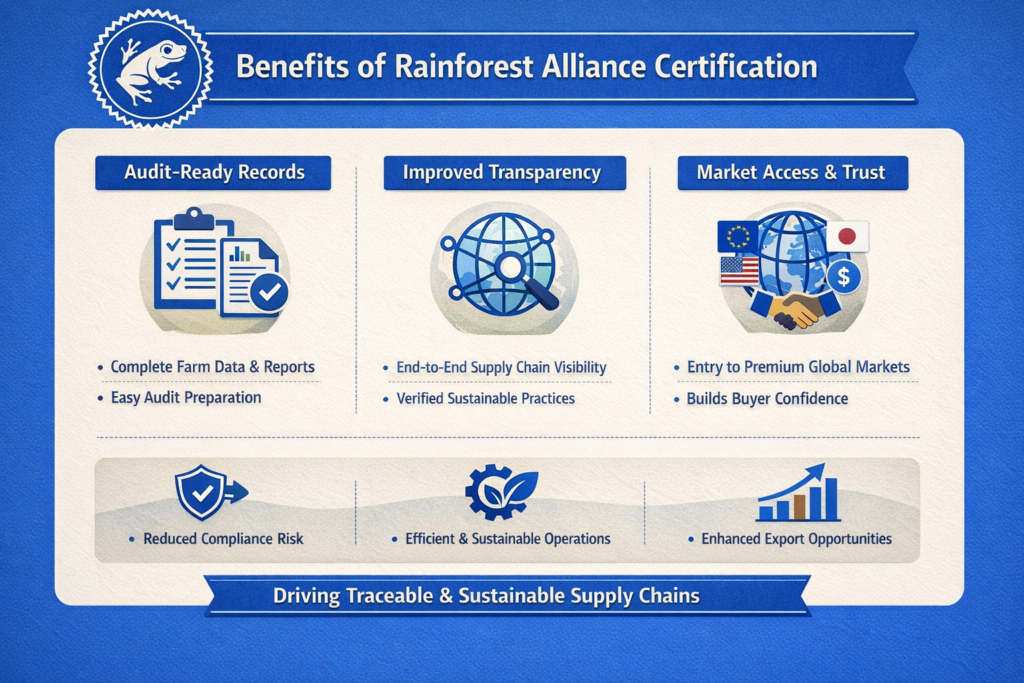
Rainforest Alliance Certification in Nigeria is more than a compliance badge it’s a strategic asset. For exporters, it opens doors to premium markets in the EU, US, and Asia, where buyers prioritize ethically and sustainably sourced products. The certification ensures price stability and access to Fairtrade-aligned buyers, often resulting in premium pricing opportunities. It also strengthens ESG and due-diligence alignment, helping exporters demonstrate responsible sourcing, labour standards, and environmental stewardship critical for multinational contracts and regulatory compliance.
For smallholder farmers, certification translates to tangible long-term benefits: access to training on sustainable practices, improved farm management, and inclusion in cooperative structures that enhance bargaining power. By driving transparency, traceability, and verified sustainability, Rainforest Alliance Certification positions Nigerian cocoa, coffee, cashew, and palm oil exporters as trusted suppliers in global supply chains, strengthening competitiveness and supporting sustainable agricultural development across the country.
The result: a win-win for exporters, farmers, and international buyers, ensuring that sustainability pays both socially and economically.
Rainforest Alliance Certification offers Nigerian exporters a pathway to premium, ethical markets while reinforcing sustainable farming and smallholder empowerment. By meeting rigorous environmental, social, and traceability standards, exporters not only enhance buyer trust but also strengthen ESG alignment and reduce compliance risks. For smallholder farmers, the certification promotes better agricultural practices, cooperative engagement, and long-term livelihood improvements. Ultimately, Rainforest Alliance Certification is both a market differentiator and a strategic tool for sustainable growth in Nigeria’s agricultural export sector.
Ethical Sourcing Matters
Discover how ethical sourcing practices build trust, reduce risks, and create value across agricultural supply chains.
Build a Responsible Supply Chain
Explore strategies for creating transparent and accountable supply chains that meet global sustainability expectations.
Digitally Transform Your Sustainability Efforts
Learn how digital platforms are enabling real-time monitoring, reporting, and compliance in agriculture and agribusiness.
Rainforest Alliance Certification verifies that agricultural products such as cocoa, coffee, cashew, and palm oil are produced sustainably, with respect for the environment, labor standards, and traceability requirements.
Cocoa is the primary certified crop, with coffee, cashew, and palm oil also eligible. Certification typically targets smallholder farmers organized in cooperatives.
The certification process varies, but it typically takes 6–12 months depending on producer readiness, training, and audit scheduling.
No. Rainforest Alliance Certification is voluntary but provides access to premium international markets and is increasingly preferred by global buyers.
Benefits include market access, premium pricing, improved sustainability practices, ESG alignment, and support for smallholder livelihoods through training and cooperative engagement.