Quick summary: Real-time supply chain visibility enables continuous tracking, compliance readiness, and risk mitigation across suppliers and products. Learn how real-time data improves audits, sustainability reporting, and market access.
Most supply chains look efficient on paper until something goes wrong. As regulations tighten and buyers demand proof not promises, real-time supply chain visibility is no longer optional. It’s becoming the baseline for compliance, risk management, and market access.
Delayed updates, siloed systems, and fragmented supplier data mean many companies are still operating with days or weeks of blind spots. The cost of that blindness only shows up when it’s too late: failed audits, rejected shipments at borders, product recalls, and urgent data requests you can’t answer with confidence.
Real-Time Supply Chain Visibility powers transparency and compliance by providing continuous, end-to-end tracking of products, suppliers, and geolocations. Instead of relying on fragmented reports or delayed updates, businesses gain live insights into sourcing, logistics, and certifications. This ensures traceability for regulations like EUDR, accurate risk assessments, and tamper-proof audit records. For exporters and importers, real-time visibility reduces blind spots, prevents compliance gaps, and builds trust with buyers and regulators. By linking every shipment to verified data in real time, companies move from reactive compliance to proactive, transparent supply chain management.
This guide breaks down what real-time supply chain visibility actually means, why it matters now, and how organizations can implement it practically and at scale.
Key Takeaways
Real-time supply chain visibility is the ability to continuously track products, materials, and activities across the entire supply chain from source to delivery using live or near-real-time data. Unlike periodic reporting, it provides up-to-date, verifiable information on location, status, and compliance, not delayed snapshots.
Traditional supply chains rely on periodic reporting weekly updates, monthly dashboards, or post-shipment documents. This approach shows what already happened, often too late to prevent risks.
Real-time visibility, by contrast, captures data as events occur harvests, processing, movements, and handovers allowing teams to detect issues early, respond faster, and maintain control across tiers.
Many systems label themselves “real-time” but simply refresh static dashboards once a month. True real-time visibility is event-driven and continuous, supported by digital data capture, automated updates, and traceable records that reflect the actual state of the supply chain when it matters, not after the fact.
Regulators are raising the bar with frameworks like the EU Deforestation Regulation (EUDR), the US Uyghur Forced Labor Prevention Act (UFLPA), and expanding ESG disclosure rules. Real-time visibility reduces compliance risk by linking geolocation data, supplier certifications, and batch-level tracking directly to shipments. Instead of scrambling for documents during audits, companies can generate proof of deforestation-free and ethically sourced goods instantly, making regulatory inspections smoother and lowering the risk of fines or market bans.
Most companies still rely on static spreadsheets and disconnected systems to manage supplier and shipment data. This leads to blind spots, duplication, and costly manual errors. Real-time visibility replaces this with dynamic dashboards that consolidate supplier onboarding, shipment status, and compliance records in one place. Teams gain live updates on SKUs, DDS filings, and certifications, which cuts down processing time, reduces rework, and ensures audit readiness at scale.
Trust across global supply chains is often fragile, especially when exporters, importers, and farmers operate in silos. Real-time visibility bridges this gap by creating a shared, tamper-proof view of the supply chain. Exporters can demonstrate transparent sourcing practices, importers can validate DDS compliance, and farmers gain recognition for sustainable practices. This not only strengthens buyer confidence but also improves long-term supplier relationships, enabling better contract terms and preferred partnerships.
Compliance starts with visibility.
How supply chain visibility drives compliance
How digital traceability simplifies EUDR
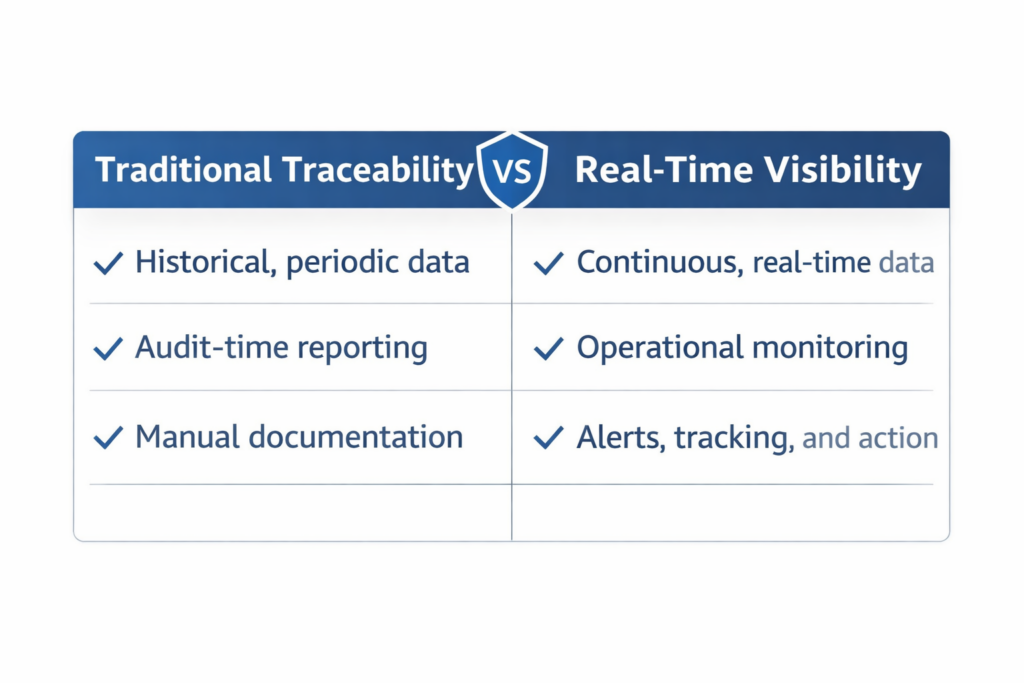
Real-time supply chain visibility has shifted from a “nice-to-have” to a business-critical capability as regulatory scrutiny, buyer expectations, and upstream risks intensify. Companies are no longer judged by intent or policies, but by the quality, timeliness, and verifiability of their data.
Regulations Demand Proof, Not Promises
New regulations such as EUDR, DPP/ESPR, ESG disclosure frameworks, food safety laws, and human rights due-diligence requirements are fundamentally changing compliance. Authorities now expect evidence-based, traceable proof not self-declarations or annual reports.
Audits are becoming continuous and data-driven, meaning companies must be able to demonstrate compliance at any point in time. Without real-time visibility into sourcing, land use, and chain-of-custody events, businesses risk audit failures, shipment delays, or outright market exclusion.
Buyer Expectations Have Shifted
Global buyers have moved beyond accepting supplier declarations. Today’s expectation is verifiable, source-level data that can be independently validated.
This shift includes:
Risk Has Moved Upstream
The greatest risks no longer sit at the factory gate they originate upstream. Supplier non-compliance, hidden sourcing, mixed batches, and undocumented intermediaries can all invalidate sustainability and legality claims.
Without real-time insight into upstream activities, companies face:
Real-time supply chain visibility enables companies to identify, isolate, and address risks before they escalate protecting both market access and brand trust in an increasingly unforgiving regulatory and commercial environment.
What are the Core Features of Real-Time Supply Chain Visibility Platforms

If you’ve ever tried to juggle supplier spreadsheets, WhatsApp updates from the field, and last-minute compliance requests from buyers you know the chaos. Real-time supply chain visibility platforms are built to turn that chaos into clarity. Here’s how:
Centralized supplier data + geolocation
Instead of chasing farmers, exporters, and brokers for siloed data, imagine one shared system where supplier profiles, certifications, and GeoJSON farm coordinates live together. For EUDR compliance, that means you can trace a container of cocoa back to the exact plot in Ivory Coast without opening 20 different files.
IoT + blockchain for tamper-proof records
Think of every transaction, from harvest to shipment, locked into a digital ledger that can’t be altered. IoT sensors feed real-time updates like temperature for cold storage or truck GPS routes while blockchain ensures nobody can fudge the numbers later. The result? A compliance record that auditors (and your buyers) actually trust.
AI-powered risk assessments and alerts
Instead of waiting for an NGO report or regulator letter to flag risks, AI scans supplier data, satellite images, and country benchmarks as it happens. That means you can get an alert if, say, deforestation is detected near a sourcing area in Brazil, giving you time to pivot before it becomes a compliance disaster.
Automated reporting (DDS, ESG disclosures)
Let’s be honest: filing Due Diligence Statements (DDS) or ESG reports manually is a nightmare. Automated platforms turn that data you’re already collecting into ready-to-submit formats for EU TRACES or sustainability disclosures. What used to take days of manual collation now takes minutes without the human error.
The bigger story? These platforms don’t just help you tick regulatory boxes. They free up your team from firefighting, strengthen buyer trust with verifiable data, and position your brand as a leader in transparent, sustainable trade.
Real Time Monitoring Use Cases
Use Case 1: Traceability for Food Safety
A Spice Tech company transformed its online platform from limited visibility to a secure, transparent marketplace using TraceX blockchain traceability solutions. This shift empowered farmers and ensured verified data throughout the supply chain, fostering trust and promoting a more sustainable and ethical spice industry.
Use Case 2: Ensuring Sustainable Practices in Supply Chains
Use Case 3: Compliance with Organic Certification Standards
Organic India streamlined its agricultural operations and digitized farm management with TraceX’s solutions. The platform enabled tracking of regenerative practices, optimized procurement, ensured product traceability, and validated quality certifications, enhancing efficiency and transparency across their supply chain.
Use Case 3: Real-Time Monitoring for Fair Weighing and Enhanced Traceability in Agricultural Procurement
Problem: In the agricultural supply chain, ensuring fair transactions and transparent traceability are essential for building trust between farmers and buyers, improving operational efficiency, and promoting sustainable agricultural practices.
Real-Time Solution: Bluetooth-enabled weighing scales helps streamline the weighing process at procurement points. These scales automatically capture the weight of the produce and send the data in real-time to the central system. After the produce is weighed, dynamic QR codes are generated and affixed to each batch of goods. These QR codes are linked to the product’s real-time data, including weight, origin, date of procurement, and additional product-specific information such as quality parameters.
Benefit: The real-time data ensures that farmers receive accurate compensation based on the actual weight, minimizing errors that might occur with manual methods. As the produce moves from the farm to processing, warehousing, and distribution centers, the QR code updates with real-time data on each stage of the journey. This enables continuous tracking and traceability of the produce, ensuring full transparency.
TraceX combines the intelligence of AI with the security of blockchain. AI continuously scans supplier data, satellite imagery, and risk benchmarks to flag potential compliance issues before they become liabilities. Meanwhile, blockchain locks every transaction—from harvest records to shipment details—into an auditable ledger that can’t be tampered with. That’s peace of mind for exporters and ironclad proof for buyers.
Every farm plot in your supply chain is digitally mapped through GeoJSON coordinates. TraceX links these maps with deforestation databases, country risk profiles, and supplier details to give you an automated risk score. Instead of guesswork, you know exactly which regions and suppliers are low, medium, or high risk—empowering smarter sourcing decisions.
The biggest headache for importers and exporters under EUDR is filing Due Diligence Statements (DDS). TraceX automates the heavy lifting. Once supplier data and geolocation are captured, you can generate and submit DDS directly into the EU TRACES system with a single click. No more manual cut-and-paste across systems.

From the moment a farmer harvests cocoa, coffee, or timber, TraceX captures every step of the journey—storage, processing, export, import. By the time the goods reach the EU, you have a continuous, tamper-proof digital record that connects farm to customs. It’s transparency your buyers can see, and compliance regulators can trust.
Real-time supply chain visibility isn’t just a compliance checkbox — it’s a business advantage. By digitizing supplier data, mapping origins, and integrating compliance into daily workflows, companies gain resilience, buyer trust, and smoother market access. Whether you’re preparing for EUDR, ESG audits, or future regulations, the companies that embrace visibility today will be tomorrow’s leaders in transparency and sustainability.
Get practical insights on how to strengthen your compliance journey.
Because it ensures every shipment, supplier, and location is continuously tracked, helping companies avoid fines, customs delays, and reputational risks.
It links products to geolocation data, verifies supplier compliance, and generates Due Diligence Statements (DDS) for EU TRACES quickly and accurately.
Agriculture, food, timber, rubber, leather, and other EUDR-listed commodity sectors, as well as businesses preparing for ESG audits and sustainability reporting.