
Quick summary: Discover how regenerative agriculture is transforming sustainable coffee farming, improving soil health, climate resilience, and biodiversity for a more sustainable coffee supply chain.
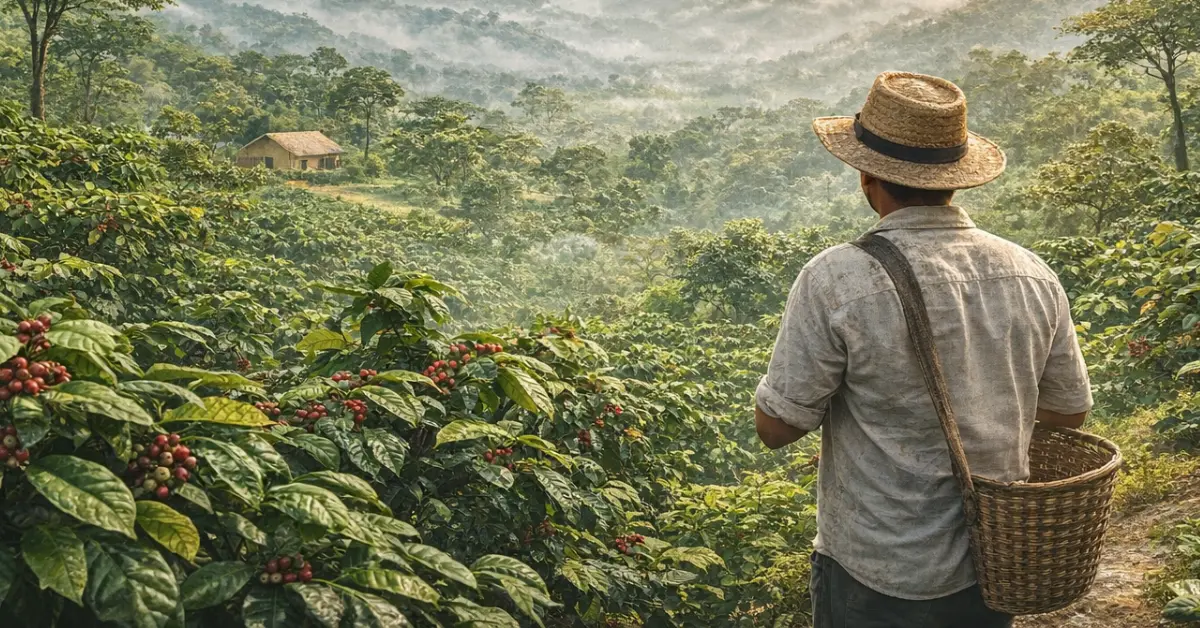
Yes, coffee farms can be revived, and the regenerative practices that rebuild them simultaneously create the digital traceability trail that EU regulators now demand. Regenerative agriculture for coffee is emerging as a critical approach to restore soil health, improve biodiversity, and build climate-resilient coffee supply chains.
The challenge for exporters, processors, and sustainability teams isn’t choosing between compliance and sustainability. It’s building the operational infrastructure to achieve both at once. However, farmers face significant challenges, including limited access to data, difficulty in tracking farm-level practices, and the inability to demonstrate compliance and sustainability outcomes at scale.
TraceX solutions help address these challenges by enabling farm-level data capture, traceability, and compliance workflows, empowering coffee producers to implement regenerative practices while ensuring transparency and market access.
The global coffee industry is under simultaneous pressure from climate volatility, regulatory change, and buyer scrutiny. Yields in traditional arabica-growing regions have declined by up to 25% over the past decade due to rising temperatures, erratic rainfall, and soil degradation conditions that intensified conventional monoculture farming created in the first place.
At the same time, the EU Deforestation Regulation (EUDR), effective December 2026 for large operators, requires that every lot of coffee exported to Europe be backed by GPS-verified, deforestation-free sourcing data. For exporters working with thousands of smallholder farmers across fragmented geographies, that’s an enormous data challenge.
“We can’t manually collect GPS data from 2,000 farmers every season.” – A compliance manager at a mid-sized Indian coffee exporter, summarising what TraceX hears on almost every discovery call.
Regenerative agriculture isn’t just a sustainability talking point. For coffee exporters navigating EUDR and CSRD, it’s a strategic double-win: restore the health of the farm AND generate the granular, auditable data that compliance demands.
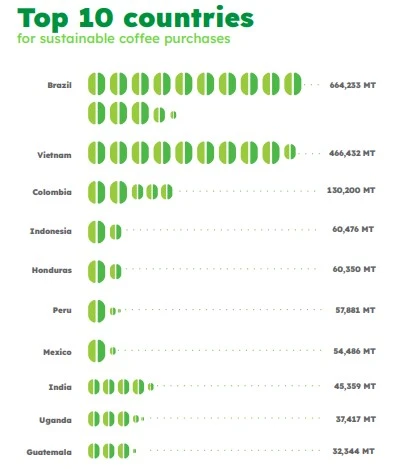
Explore how the coffee supply chain works from farm to cup – discover key insights and challenges.
From origin to consumer, learn how coffee traceability ensures transparency and quality.
Regenerative agriculture goes beyond ‘sustainable’ farming. Where sustainability aims to do less harm, regenerative practices actively rebuild the natural systems that healthy farms depend on: soil organic matter, biodiversity, water retention, and carbon sequestration.
For coffee specifically, the most impactful regenerative practices include:
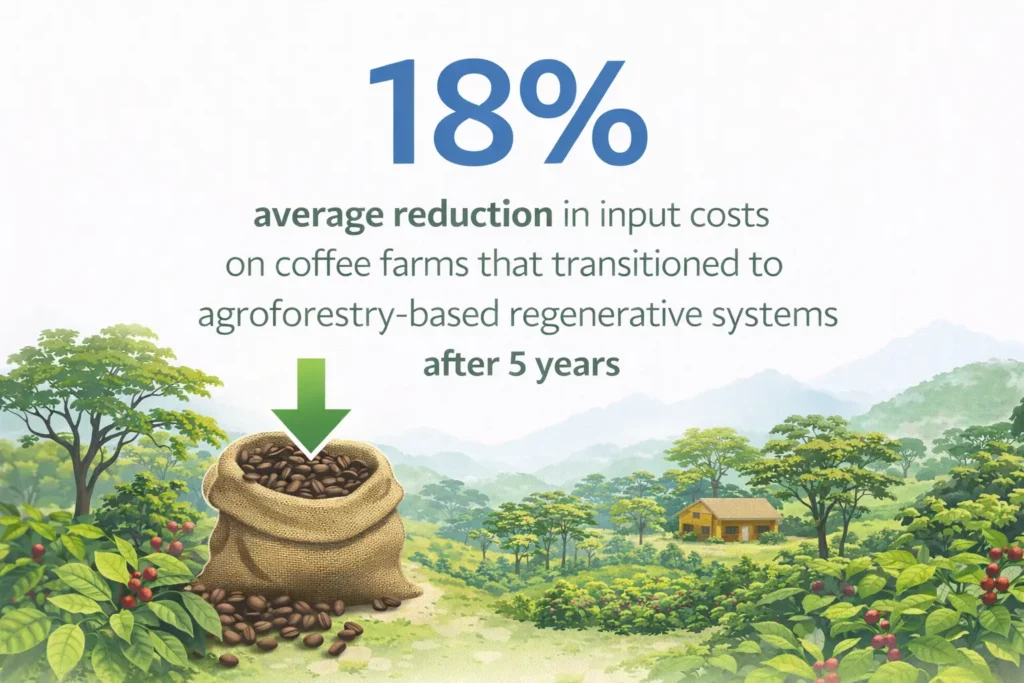
These aren’t experimental techniques. A 2024 meta-analysis published in Nature Sustainability found that farms using agroforestry systems produced comparable or higher arabica yields than open-sun monocultures after a five-year transition period, while reducing input costs by an average of 18% and improving cup quality scores.
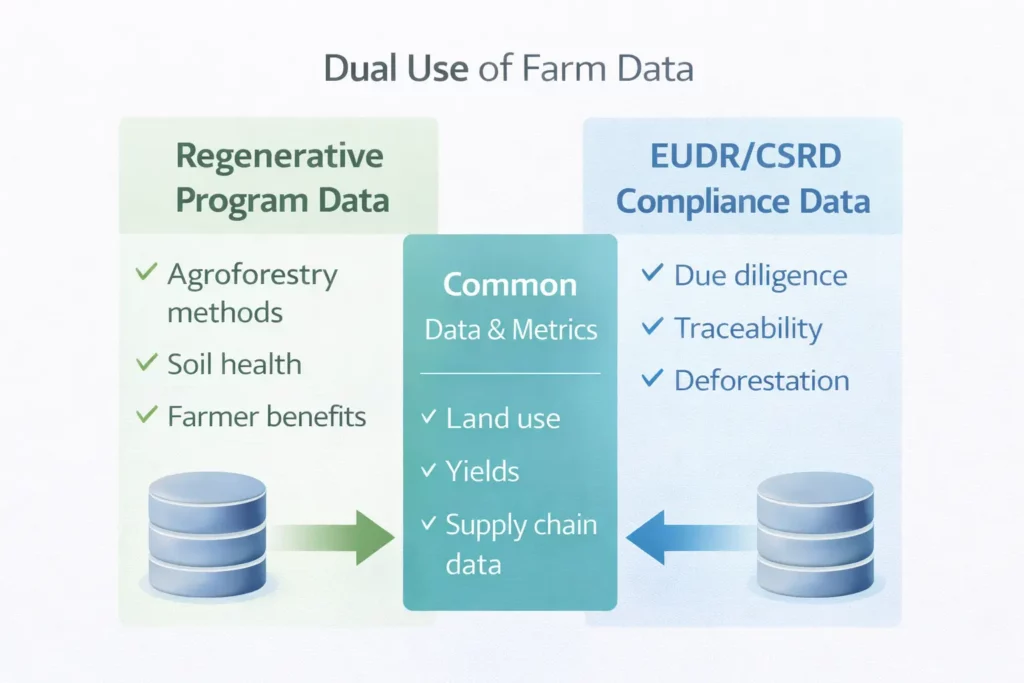
Here’s the insight most coffee supply chain articles miss: every regenerative practice intervention creates exactly the kind of farm-level data that EUDR’s Due Diligence Statement (DDS) requires.
When you GPS-map a farm plot to establish a baseline for soil carbon, you’ve also created the polygon coordinates EUDR needs. When you track fertiliser inputs and crop advisory for regenerative program monitoring, you’ve created the product journey traceability EUDR requires. When you measure and verify carbon sequestration, you’re building the Scope 3 emissions dataset CSRD asks for.
The compliance data and the regenerative monitoring data are structurally identical. The problem is that most exporters are trying to collect them twice, from two separate systems, at enormous cost.
This is the operational gap TraceX was designed to close. Rather than running parallel data collection, one stream for your sustainability team, another for your compliance team, TraceX’s integrated platform captures the farm-level data once and makes it available across every downstream use case: EUDR submission, CSRD reporting, carbon credit issuance, and buyer-facing product passports.
TraceX works with agri-commodity exporters, food processors, and sustainability-focused enterprises across India, Southeast Asia, and Africa. Across these conversations, four recurring challenges define the regenerative agriculture adoption gap:
The average Indian or East African coffee exporter sources from 500-3,000 smallholder farmers, most operating on plots under two hectares. These farmers typically have low digital literacy, limited smartphone access, and operate in areas with poor connectivity. Collecting GPS coordinates, soil health records, and input logs from this network using paper-based systems is virtually impossible at scale.
TraceX’s offline-first mobile app, available in multiple regional languages, enables field agents to capture geotagged plot data, input logs, and farmer KYC documentation without an internet connection. Data syncs automatically when connectivity is restored.
See how integrated KYC validation streamlined farmer onboarding – Explore the full case study.
EUDR requires exporters to prove that no coffee in a given shipment was grown on land deforested after December 31, 2020. This requires GPS polygon-level plot mapping validated against authoritative satellite datasets, specifically the JRC (Joint Research Centre) and Hansen Global Forest Change data.
Manual approaches, visiting farms individually to capture GPS coordinates, take months and still produce data that isn’t satellite-validated. TraceX automates this: GPS polygons captured through the field app are automatically cross-referenced against JRC and Hansen datasets, and the compliance status is updated in real time.

Corporate buyers and investors increasingly require Scope 3 emissions data from primary supply chains not just industry-average estimates. For coffee exporters participating in carbon markets or responding to CSRD requirements, this means measuring actual soil carbon sequestration, emissions from inputs, and on-farm energy use.
TraceX’s Digital MRV platform calculates Scope 3 emissions from primary supply chain data, not averages. When regenerative practices are implemented in agroforestry, cover crops, and compost application, the platform tracks them as inputs and calculates their carbon impact in formats aligned to major carbon registries and SBTi standards.
Exporters know regenerative practices build long-term resilience, but the immediate commercial payoff is often unclear. How do you monetise soil health? How do you prove to a European roaster that your coffee was grown regeneratively and meets their ESG requirements?
TraceX generates dynamic QR-code product passports that give buyers complete farm-to-cup visibility of regenerative input logs, GPS-verified deforestation-free status, farmer profiles, and carbon footprint data directly on the product label. This is the kind of provenance proof that unlocks premium pricing.
Check how TraceX helps food and agri industries
| Challenge | Conventional Approach | Regenerative + TraceX | Business Impact |
|---|---|---|---|
| Supplier GPS and plot mapping | Paper records, missing data | Geo-tagged plots, offline mobile capture | EUDR compliance ready |
| Carbon and soil health tracking | Manual estimates, no primary data | Digital MRV with Scope 3 primary data | Verifiable carbon credits |
| Traceability for buyers | Lot codes, no farm-level visibility | Farm-to-cup QR scan journey | Premium pricing + brand trust |
| Smallholder onboarding | High dropout, language barriers | Multilingual offline-first app | 80%+ farmer retention |
| Regulatory reporting (EUDR) | Manual DDS, high error rate | AI auto-generates and submits to TRACES | Zero shipment blocks |
| Sustainability certification | Expensive audits, long cycles | Continuous digital evidence trail | Faster UEBT / Rainforest Alliance |
The transition to regenerative agriculture doesn’t happen overnight, but the data infrastructure can be established immediately. Here’s a practical sequence:
Regenerative agriculture for coffee is no longer a niche approach it is essential for building resilient, climate-smart supply chains that protect both farmers and ecosystems. As pressures from climate change, soil degradation, and regulatory requirements intensify, the ability to adopt and prove sustainable practices will define long-term success. By combining regenerative farming with digital traceability and data-driven decision-making, stakeholders across the value chain can create a system that is not only environmentally sustainable but also economically viable. The future of coffee depends on scaling these practices, ensuring that farms thrive, supply chains remain transparent, and global demand can be met responsibly.
Build resilient sourcing strategies – explore how sustainable coffee supply chains are shaping the future.
Revive your sourcing approach – learn how regenerative agriculture is transforming coffee farming.
Stay compliant and competitive – discover how to meet EUDR requirements for coffee supply chains.
Yes, and they are mutually reinforcing. Regenerative practices require precisely the farm-level data (GPS plot mapping, input logs, land-use history) that EUDR’s Due Diligence Statement demands. Exporters who implement regenerative programs with digital tracking tools like TraceX build their compliance evidence as a by-product of their sustainability program, not as a separate administrative burden.
With an offline-first mobile platform like TraceX, experienced field agents can onboard 15-25 farmers per day, including GPS plot capture, KYC documentation, and baseline input logging. A network of 1,000 farmers can typically be digitally onboarded in 6-10 weeks with a team of 8-10 field agents, depending on terrain and literacy levels.
Yes. TraceX’s Digital MRV Platform tracks regenerative inputs (agroforestry planting, compost application, reduced-tillage) and calculates sequestration rates against established methodologies aligned to major carbon registries. This generates the verified monitoring data needed to register carbon credit projects under schemes like Verra or Gold Standard.
TraceX generates Due Diligence Statements in the XML format required for direct submission to the EU TRACES system via API. The platform’s agentic AI auto-populates DDS fields from farmer records, GPS data, and supplier documents, reducing manual preparation time from weeks to hours.
TraceX supports all seven EUDR-regulated commodity groups: cattle, cocoa, coffee, palm oil, soy, timber, and rubber. The platform’s underlying infrastructure, GPS polygon mapping, satellite deforestation validation, agentic document processing, and DDS auto-submission work identically across commodity types, making it suitable for diversified agri-exporters.