
Quick summary: FLAG Targets explained: Learn what SBTi FLAG targets are, who must set them, what emissions they cover, and how companies can meet land use and Scope 3 requirements with credible data and traceability.

Land use is now one of the biggest blind spots in corporate climate strategies and one of the fastest-growing sources of emissions risk. While many companies have set net-zero targets, few have clear visibility into the deforestation, agricultural, and land-use impacts buried deep in their supply chains. This gap is exactly why FLAG Targets were introduced. Designed by the Science Based Targets initiative (SBTi), FLAG Targets address the pain point of unmanaged land-based emissions, forcing companies to move beyond high-level commitments and take measurable, science-aligned action on forests, land, and agriculture.
FLAG Targets are Science-Based Targets initiative (SBTi) requirements that address greenhouse gas emissions and removals from Forestry, Land, and Agriculture (FLAG) activities. They apply to companies whose land-use emissions represent a significant share of their total footprint, particularly in food, agriculture, forestry, and consumer goods sectors. FLAG Targets require companies to set science-based reduction and removal pathways for land-based and land-use change emissions, alongside energy and industry targets. By focusing on deforestation-free sourcing, improved agricultural practices, and land restoration, FLAG Targets help companies align with climate science and credible net-zero pathways.
Key Takeaways
FLAG targets are climate targets defined by the Science Based Targets initiative (SBTi) that specifically address greenhouse gas emissions and removals from Forests, Land, and Agriculture (FLAG) activities. They were introduced to tackle one of the largest and most under-addressed sources of global emissions: land use and land-use change driven by agriculture, deforestation, and forestry practices.
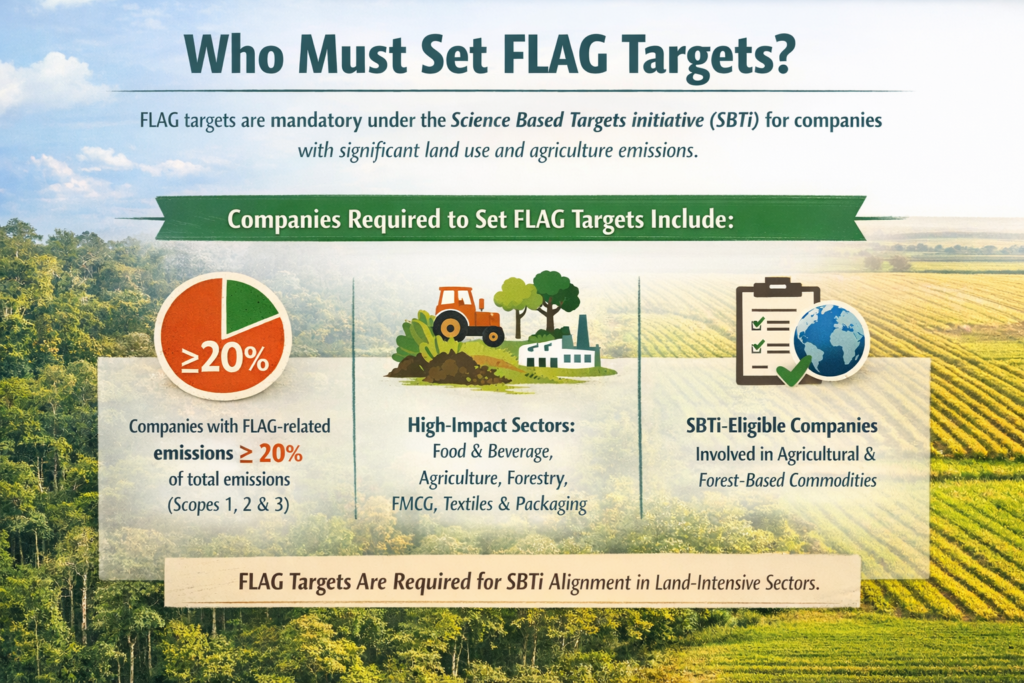
FLAG targets apply to companies whose FLAG-related emissions account for a significant share of their total emissions, typically those operating in food, agriculture, forestry, textiles, FMCG, and bio-based value chains. Unlike traditional SBTi targets that focus on energy and industrial emissions, FLAG targets require companies to set science-based pathways for reducing land-based emissions (such as deforestation and agricultural practices) while also accounting for carbon removals from land systems, including forests and soils.
By introducing FLAG targets, SBTi ensures that companies address both emissions reductions and removals in land-intensive supply chains. This includes commitments to deforestation-free sourcing, improved agricultural practices, and land restoration. FLAG targets are designed to run in parallel with net-zero targets, providing a complete and more credible framework for corporate climate action aligned with global climate science.
Want to understand how FLAG targets actually work in practice?
Explore our detailed guide on SBTi FLAG targets, including eligibility criteria, Scope 3 implications, and step-by-step implementation strategies.
Read the complete guide to SBTi FLAG targets
Setting FLAG targets is one thing—operationalizing them is another.
Learn how Deforestation-Free (DCF) sourcing helps companies reduce land-use change emissions and meet FLAG reduction thresholds with credible, verifiable data.
Discover how DCF sourcing enables FLAG compliance
The Science Based Targets initiative (SBTi) introduced FLAG targets to address a critical gap in corporate climate action: land-use emissions, which account for a significant share of global greenhouse gas emissions but were historically under-represented in corporate targets. As deforestation, agricultural expansion, and land degradation continue to accelerate climate change, SBTi recognized that energy- and industry-focused targets alone were insufficient to align companies with climate science.
Deforestation and land-use change are among the largest drivers of global emissions, particularly in agriculture and commodity-driven supply chains. Deforestation and land-use change (LUC) drive ~11% of global GHG emissions (4.2-5.8 GtCO₂e/yr), with agriculture/forestry/other land use (AFOLU) accounting for 21% total (11.9 GtCO₂e/yr) half from LUC making it the second-largest source after energy. Crop expansion (soy, palm oil, cocoa) causes 45% of AFOLU CO₂ fluxes, with emissions from soil carbon loss (25% average per deforested hectare) and biomass burning; organic soil drainage adds 6-8%.
Yet many companies treated these emissions as indirect, difficult to measure, or outside their control. Land-based emissions are complex, dispersed across smallholders and geographies, and often embedded deep in Scope 3 supply chains. As a result, they were frequently underestimated, excluded, or addressed through high-level commitments rather than measurable action creating a major blind spot in climate strategies.
FLAG targets provide a science-aligned framework to close this gap by explicitly incorporating land-use emissions and removals into corporate target setting. They are aligned with IPCC mitigation pathways, which show that reducing deforestation, improving land management, and enhancing carbon removals from land systems are essential to limiting global warming. FLAG targets require companies to pursue both emissions reductions (such as deforestation-free sourcing and improved agricultural practices) and carbon removals (through restoration, agroforestry, and soil carbon improvements), ensuring that land-intensive sectors contribute credibly to global climate goals rather than relying solely on energy transitions.
FLAG targets cover greenhouse gas emissions and removals arising from Forests, Land, and Agriculture, ensuring that land-intensive supply chains are fully accounted for within corporate climate strategies. Unlike traditional targets focused on energy and industrial emissions, FLAG targets capture both ongoing land emissions and land-use change impacts, which are often the largest climate drivers in food, agriculture, and forest-based sectors.
Land-based emissions refer to the continuous emissions and removals that occur under existing land use. This includes emissions from agricultural activities such as fertilizer application, soil disturbance, livestock grazing, and ongoing forest management, as well as carbon sequestration in soils and standing biomass. These emissions fluctuate year to year and reflect how land is managed over time.
Land use change (LUC) emissions, by contrast, result from the conversion of land from one use to another such as deforestation for cropland, grassland conversion, or wetland drainage. LUC emissions often involve large, one-time releases of stored carbon from vegetation and soils, making them particularly impactful and irreversible if not addressed. FLAG targets require companies to account for both types, rather than focusing on one while ignoring the other.
FLAG targets apply across a broad set of land-related activities. In agriculture, this includes crop and livestock emissions, soil carbon changes, and input-related impacts. In forestry, it covers emissions and removals from forest management, degradation, and restoration. Land-use change emissions capture deforestation, afforestation, and other land conversions, while biogenic emissions and removals account for the natural carbon cycle associated with biomass growth and decay. Together, this comprehensive scope ensures that companies address the full climate impact of their land-based value chains in a science-aligned and transparent way.
FLAG targets and net-zero targets serve different but complementary roles within the Science Based Targets initiative (SBTi) framework. While net-zero targets set an organization’s overall ambition to reduce greenhouse gas emissions in line with climate science, FLAG targets focus specifically on emissions and removals from Forests, Land, and Agriculture areas that require distinct mitigation approaches and cannot be effectively addressed through energy transitions alone.
FLAG targets are separated because land-based emissions follow different mitigation pathways than energy and industrial emissions. Reducing emissions from land use involves avoiding deforestation, improving agricultural practices, restoring ecosystems, and managing carbon stocks in soils and biomass actions that are biologically constrained and often slower to deliver results than switching to renewable energy or improving energy efficiency. Land systems also face unique timelines and constraints, such as growing cycles, permanence risks, and climate variability, which make them unsuitable for inclusion in traditional decarbonization pathways designed for fossil fuel reduction. Treating land use separately ensures these emissions are addressed with appropriate methods and realistic expectations.
Rather than replacing net-zero targets, FLAG targets function as a required sub-target for companies with significant land-use emissions. SBTi requires these companies to set FLAG targets in parallel with their energy and industry targets, ensuring comprehensive coverage of their full emissions profile. Together, this parallel target-setting approach ensures that progress toward net zero is not undermined by unmanaged land-based emissions, while also recognizing the essential role of land systems in delivering both emissions reductions and long-term carbon removals aligned with global climate goals.
FLAG targets are closely tied to Scope 3 emissions because the majority of land-use and agricultural impacts occur outside a company’s direct operations. For most organizations, especially in food, agriculture, FMCG, textiles, and bio-based sectors, the largest climate risks linked to forests, land, and agriculture sit deep within upstream supply chains rather than within owned facilities.
Agricultural production, forestry activities, and land-use change typically happen at the farm or plantation level, often managed by third-party suppliers or smallholders. These activities drive emissions through deforestation, soil disturbance, fertilizer use, and land management practices, all of which fall under Scope 3 (purchased goods and services). Because companies do not directly control these operations, land-based emissions have historically been difficult to measure and manage making them one of the most significant and least transparent components of corporate emissions inventories. FLAG targets explicitly bring these upstream impacts into scope, ensuring they are addressed rather than overlooked.
Meeting FLAG targets fundamentally reshapes how procurement and sourcing teams operate. Companies must move beyond transactional purchasing toward active supplier engagement, requiring collaboration on data collection, land-use practices, and improvement plans. This includes gathering traceable, plot-level information, verifying deforestation-free sourcing, and monitoring land management outcomes over time. As a result, procurement teams need stronger traceability systems, standardized data requests, and long-term supplier partnerships. FLAG targets effectively turn sourcing decisions into climate decisions, making transparent supply chains and reliable data a strategic necessity rather than a reporting exercise.
Setting FLAG targets requires a structured, data-driven approach that reflects the complexity of land-based emissions while aligning with SBTi’s scientific guidance. Unlike energy emissions, FLAG-related impacts are often embedded deep in supply chains, making early groundwork critical.
The first step is establishing a robust FLAG emissions baseline. Companies must identify where and how land-based emissions occur across their value chains. This involves collecting land-use data related to agricultural production, forestry activities, and sourcing regions, as well as mapping suppliers beyond Tier 1 to understand upstream exposure. Supply chain mapping helps pinpoint deforestation risks, land-use change hotspots, and key commodities driving emissions. A credible baseline ensures that future reductions and removals are measurable, defensible, and aligned with SBTi expectations.
Once the baseline is established, companies must define science-aligned pathways to reduce emissions and enhance removals. Reduction strategies typically focus on avoided deforestation, improved land management, and changes in sourcing practices to eliminate land-use change emissions. Removal pathways include regenerative agriculture, agroforestry, and land restoration, which increase carbon sequestration in soils and biomass. These actions must be realistic, scalable, and linked to specific supply chain interventions rather than offsetting mechanisms.
The final step is formally submitting FLAG targets to SBTi for validation. Targets must align with SBTi FLAG guidance, including sector-specific pathways, timelines, and accounting rules for emissions and removals. Companies are expected to demonstrate how FLAG targets run in parallel with energy and industry targets, ensuring full emissions coverage. Once validated, FLAG targets become a core part of the company’s science-based climate commitment, guiding procurement, sourcing, and long-term land-use strategies.
Deforestation-Free (DCF) sourcing is a foundational pillar of FLAG targets because land-use change, particularly deforestation, is one of the largest and most irreversible sources of emissions in land-intensive supply chains. Without eliminating deforestation, companies cannot credibly reduce FLAG-related emissions or align with SBTi pathways.
FLAG targets require companies to reduce land-use change emissions in line with climate science, and avoiding deforestation is the single most effective lever to achieve this. Converting forests to agricultural land releases large amounts of stored carbon and permanently weakens natural carbon sinks. DCF sourcing directly addresses this risk by ensuring that commodities such as cocoa, coffee, palm oil, soy, rubber, and timber are produced without forest conversion. By embedding DCF commitments into sourcing strategies, companies can meet FLAG reduction thresholds, reduce exposure to regulatory risk, and prevent backsliding in emissions performance.
DCF sourcing is only credible when supported by robust traceability systems. Companies must be able to link products to farm-level data, including sourcing locations, production practices, and land-use history. Geolocation and continuous monitoring enable verification that sourcing areas remain deforestation-free over time, rather than relying on static declarations. Traceability transforms DCF sourcing from a policy statement into measurable, auditable action making it a critical enabler for FLAG compliance and long-term supply chain resilience.
While FLAG targets provide a science-based framework for addressing land-use emissions, many companies struggle to implement them in practice due to structural and data-related constraints across global supply chains. These challenges are especially pronounced in land-intensive and smallholder-driven sectors.
One of the biggest barriers to meeting FLAG targets is limited visibility into land use at origin. Many companies lack clear insight into where commodities are produced, how land is managed, or whether deforestation has occurred. Without farm- or plot-level data, it becomes difficult to assess land-use change emissions, identify high-risk sourcing regions, or demonstrate deforestation-free sourcing. This lack of transparency weakens baseline accuracy and undermines progress tracking.
FLAG-related emissions largely sit within Scope 3, where data is often incomplete, inconsistent, or based on generic emission factors. Companies frequently rely on estimates, averages, or supplier self-declarations that are not designed to meet SBTi-level scrutiny. Poor data quality limits the credibility of FLAG baselines and makes it difficult to prove real emissions reductions or removals over time.
Land-based supply chains are typically highly fragmented, involving thousands of smallholders, intermediaries, and informal aggregators. Coordinating data collection, improvement actions, and monitoring across such a diverse supplier base is operationally complex. Fragmentation increases the risk of data gaps, inconsistent practices, and uneven progress toward FLAG targets, particularly in agricultural and forestry sectors.
Even when companies define FLAG-aligned strategies, many lack the tools to continuously monitor and verify outcomes. Traditional, periodic assessments are insufficient to track land-use change, permanence risks, or the effectiveness of interventions such as regenerative practices. Without ongoing monitoring and audit-ready verification, companies face challenges in demonstrating compliance with FLAG targets and maintaining confidence among regulators, investors, and stakeholders.
Digital Measurement, Reporting, and Verification (DMRV) is a critical enabler for turning FLAG targets from high-level commitments into operational, science-aligned action. Because FLAG targets depend on accurate land-use data, continuous monitoring, and credible verification across complex supply chains, digital systems are essential to meet both SBTi expectations and regulatory scrutiny.
Digital MRV enables companies to establish defensible FLAG baselines by combining farm-level geolocation, land-use history, and activity data. Using satellite imagery, GIS mapping, and structured field data, companies can identify deforestation risks, land-use change events, and agricultural practices at origin. TraceX’s DMRV solutions support precise land-use baselining across farms, plots, and sourcing regions creating a reliable starting point for FLAG target setting and progress measurement.
FLAG targets require ongoing assurance that land-use practices remain aligned with reduction pathways. Digital MRV supports continuous monitoring through remote sensing, automated alerts, and periodic field data capture. This allows companies to detect deforestation, land conversion, or reversals early rather than relying on infrequent audits. TraceX enables continuous monitoring across large, fragmented supply chains, helping companies manage permanence risks and demonstrate sustained compliance over time.
SBTi-aligned FLAG targets demand transparent, verifiable evidence, not estimates or static declarations. Digital MRV platforms automatically structure land-use, agricultural, and emissions data into audit-ready reports that can be shared with SBTi, auditors, investors, and regulators. TraceX streamlines MRV workflows by centralizing data, maintaining version control, and generating documentation that reduces verification time and audit friction.
SBTi’s FLAG guidance emphasizes science-based baselines, measurable reductions, and credible monitoring. Digital MRV ensures alignment with these expectations by standardizing data collection, applying consistent methodologies, and enabling traceability across Scopes and suppliers. With TraceX’s end-to-end DMRV infrastructure, companies can confidently demonstrate progress toward FLAG targets while integrating land-use data into broader climate, ESG, and net-zero strategies.
FLAG targets mark a critical shift in how companies address land-based emissions under the Science Based Targets initiative. By explicitly covering emissions and removals from forests, land, and agriculture, FLAG targets close long-standing gaps in Scope 3 accounting and ensure that land-intensive sectors align with climate science. For companies operating in food, agriculture, forestry, FMCG, and textiles, meeting FLAG targets will require stronger traceability, supplier engagement, and digital MRV systems. Those that act early will not only stay compliant with SBTi expectations but also strengthen supply chain resilience and long-term climate credibility.
Land emissions are often the biggest blind spot in corporate climate strategies.
Learn how land-based and land-use change emissions are calculated, monitored, and managed across global supply chains.
Read our guide to land-based emissions
FLAG targets come with detailed rules—and missing them can derail validation.
Explore the official SBTi FLAG guidance explained in practical terms, including thresholds, timelines, and data requirements.
Explore the SBTi FLAG guidance explained
Agriculture drives a significant share of Scope 3 emissions—but few teams know where to start.
Understand the major sources of agricultural GHG emissions, from soil and fertilizer use to livestock and land management.
Learn how agricultural GHG emissions are measured and reduced
FLAG targets are SBTi requirements that address greenhouse gas emissions and removals from Forests, Land, and Agriculture, ensuring land-based emissions are included in corporate climate targets.
Yes. Companies with FLAG-related emissions representing 20% or more of their total emissions are required by SBTi to set FLAG targets alongside energy and industry targets.
FLAG targets focus specifically on land-based emissions and removals, while net-zero targets cover overall emissions. FLAG targets run in parallel and are a required sub-target for land-intensive companies.
Yes. Most FLAG-related emissions occur in upstream agricultural and forestry supply chains, making FLAG targets largely a Scope 3 challenge.
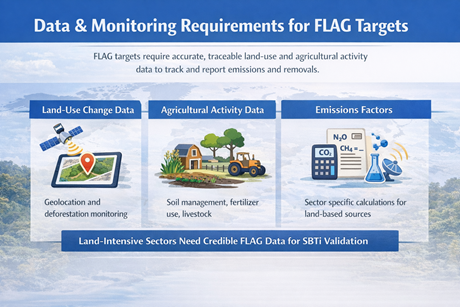
Companies need land-use change data, agricultural activity data, emissions factors, and continuous monitoring supported by traceability and digital MRV systems to demonstrate compliance and progress.