
Quick summary: Explore SBTi FLAG – Science-Based Targets for Forest, Land & Agriculture and learn how companies in agriculture and forest-risk sectors can set measurable, science-based emissions reduction targets, achieve deforestation- and conversion-free sourcing, and meet global climate commitments.
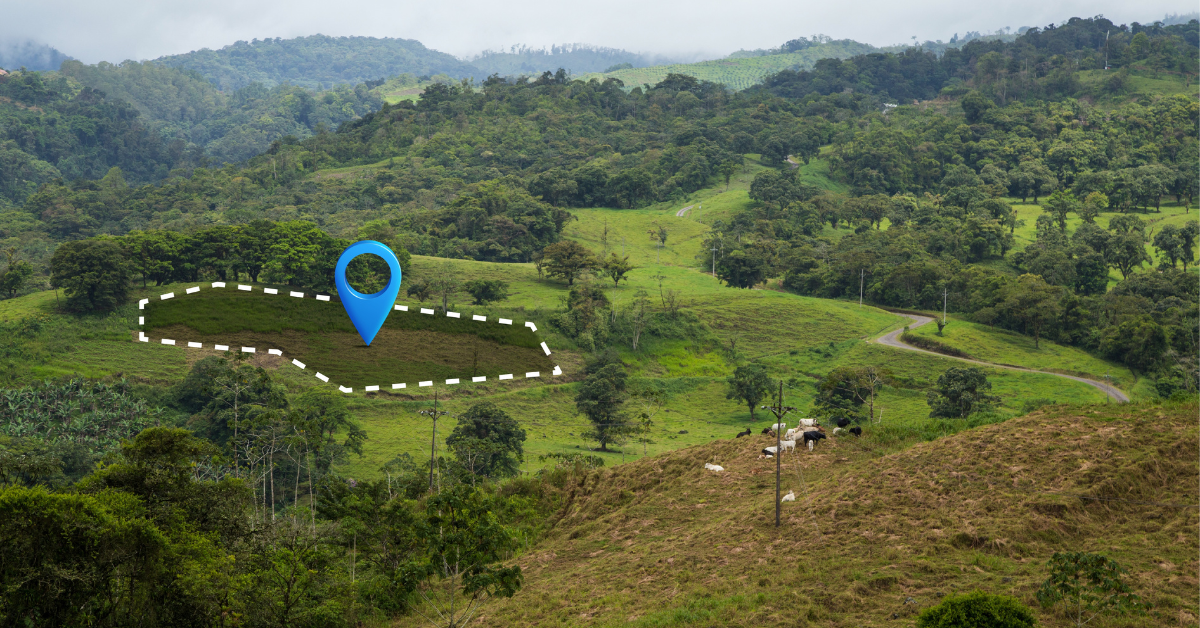
SBTi FLAG – Science-Based Targets for Forest, Land & Agriculture is a framework under the Science Based Targets initiative that guides companies in setting measurable climate targets for emissions from land use, agriculture, and forestry. It covers deforestation, land-use change, and agricultural emissions, alongside removals from soils and biomass. FLAG is mandatory for companies with significant land-sector impacts and complements energy and industry targets by addressing nature-based emissions. It requires credible data, traceability, and deforestation-free sourcing to align corporate climate strategies with a 1.5°C pathway.
SBTi FLAG is a framework introduced by the Science Based Targets initiative to address greenhouse gas emissions and removals associated with land use, agriculture, and forestry sectors responsible for roughly a quarter of global emissions but historically under-accounted for in corporate targets. FLAG was introduced to close this gap and ensure companies with land-based impacts align with a 1.5°C climate pathway. FLAG applies to companies with significant emissions or risks linked to food systems, agriculture, forestry, and forest-risk commodities such as cocoa, coffee, soy, palm oil, cattle, timber, rubber, and paper. This includes food manufacturers, agri-processors, traders, retailers, and brands whose supply chains drive land-use change.
Traditional targets focus on energy and industrial emissions (Scopes 1, 2, and energy-related Scope 3). FLAG adds dedicated requirements for land-use change emissions, agricultural methane and nitrous oxide, and land-based carbon removals. It explicitly addresses deforestation, conversion, and soil emissions areas energy targets do not cover. FLAG strengthens corporate climate strategies by integrating nature, biodiversity, and deforestation into emissions reduction plans. It supports compliance with emerging regulations (such as EUDR), enhances ESG and CDP disclosures, and reinforces credible net-zero pathways by linking climate action with sustainable sourcing, traceability, and ecosystem protection.
Key takeaways
SBTi FLAG (Forest, Land and Agriculture Guidance) is a specialized framework under the Science Based Targets initiative that enables companies to set science-based climate targets for emissions and carbon removals linked to land use, agriculture, and forestry. The FLAG guidance was created to address emissions that are not adequately covered under traditional energy-focused targets, particularly deforestation, land-use change, and agricultural production emissions.
The FLAG framework applies to companies with significant exposure to land-based activities, including food and beverage manufacturers, agricultural processors, traders, retailers, and companies sourcing forest-risk commodities such as cocoa, coffee, soy, palm oil, beef, timber, rubber, and paper products. It also applies to apparel and consumer goods brands with agricultural raw material supply chains.
FLAG became effective in 2023. Companies must set FLAG targets if more than 20% of their Scope 3 emissions come from land use or agriculture, or if they are materially exposed to deforestation and land-use change. FLAG targets are required in addition to, not instead of, energy and industrial targets.
FLAG targets are a core component of corporate net-zero strategies. They ensure land-sector emissions reductions and removals are aligned with a 1.5°C pathway, complementing Scope 1, 2, and energy-related Scope 3 targets. Together, they create a complete, credible climate plan that integrates emissions reduction, nature protection, and long-term sustainability.
Learn How to Build Deforestation-Free Supply Chains
Explore actionable strategies, traceability tools, and compliance tips to align your supply chain with EUDR and sustainability goals.
[Read the Blog →]
Understand the Root Causes of Deforestation
Dive into the drivers of forest loss, from agriculture to land-use change, and learn how businesses can mitigate impact.
[Discover More →]
Land use and agriculture are responsible for around 20–25% of global greenhouse gas emissions, making them one of the largest and most underestimated contributors to climate change. Land-use change, particularly deforestation and ecosystem conversion, releases vast amounts of stored carbon, while agriculture generates significant methane and nitrous oxide emissions from livestock, fertilizer use, and crop production.
Forests and soils are critical carbon sinks. When forests are cleared or degraded, carbon stored over decades is released into the atmosphere. Poor land management also depletes soil organic carbon, reducing the land’s ability to absorb future emissions. Livestock enteric fermentation, manure management, and rice cultivation further intensify agricultural emissions.
Reducing land-sector emissions is essential to meeting 1.5°C climate targets. Without halting deforestation and improving agricultural practices, energy-sector decarbonization alone cannot deliver required emissions reductions or protect critical carbon sinks.
Ignoring FLAG emissions exposes companies to growing risks: tightening regulations (such as deforestation and due-diligence laws), supply-chain disruptions, rising compliance costs, loss of market access, and reputational damage from unsustainable sourcing. Addressing land-use and agricultural emissions is therefore not optional it is central to credible climate strategies, resilient supply chains, and long-term business value.
The SBTi FLAG requirements define how companies must account for and reduce greenhouse gas emissions from forest, land, and agriculture (FLAG) activities as part of SBTi compliance. FLAG targets are mandatory for companies with material land-sector impact and are set in addition to energy and industrial emissions targets.
FLAG targets are required for companies where land-based emissions account for more than 20% of total Scope 3 emissions, or where they operate in or source from forest- and agriculture-intensive value chains. This includes food and beverage companies, agri-processors, traders, retailers, apparel brands, and companies sourcing forest-risk commodities.
The FLAG framework covers:
Companies must set near-term FLAG targets (5–10 years) aligned with a 1.5°C pathway and incorporate them into long-term net-zero strategies. FLAG pathways require immediate action on deforestation and progressive reductions in agricultural emissions, recognizing biological and land-use constraints.
SBTi recognizes multiple mitigation approaches, including:
Together, these FLAG targets ensure companies address their full climate impact by integrating land-sector emissions into credible, science-based climate strategies.
Land-use change (LUC) emissions refer to greenhouse gases released when natural ecosystems such as forests, wetlands, or grasslands are converted to agricultural or other uses. Under SBTi FLAG, LUC emissions primarily include deforestation, ecosystem conversion, and forest degradation linked to commodity production and sourcing.
FLAG requires companies to explicitly identify, quantify, and report emissions from land conversion in their supply chains. This includes historical and ongoing deforestation associated with forest-risk commodities. Companies must apply conservative accounting methods, use geospatial data where available, and treat deforestation as a high-priority reduction area rather than something to offset.
LUC emissions are front-loaded and irreversible—carbon stored over decades is released instantly when land is cleared. Because they represent one of the largest and fastest sources of land-sector emissions, FLAG mandates immediate action to halt deforestation and conversion as a prerequisite for credible climate targets and 1.5°C alignment.
Companies are expected to:
Robust traceability, land-use monitoring, and supplier engagement are essential to meeting FLAG LUC requirements and demonstrating credible climate action.
Deforestation- and Conversion-Free (DCF) sourcing is a central requirement under SBTi FLAG, ensuring that agricultural and forest-risk commodities are produced without deforestation or conversion of natural ecosystems. Under FLAG, DCF means commodities are not linked to the clearing of forests, wetlands, peatlands, or other natural habitats after defined cut-off dates.
SBTi prioritizes high-risk commodities including soy, palm oil, cattle (beef and leather), cocoa, rubber, timber, and coffee. Companies sourcing or trading these commodities must assess deforestation exposure and implement DCF sourcing strategies across their value chains.
DCF sourcing directly reduces land-use change emissions, the most emissions-intensive component of land-sector impact. By eliminating conversion, companies prevent large, upfront carbon releases and ensure FLAG targets deliver real, permanent emissions reductions rather than reliance on offsets.
Global buyers increasingly require verified DCF supply chains supported by plot-level traceability, geolocation data, and third-party verification. FLAG-aligned DCF sourcing also supports compliance with regulations like the EU Deforestation Regulation (EUDR) and aligns with corporate sustainable sourcing and ESG policies, strengthening market access and long-term supply security.
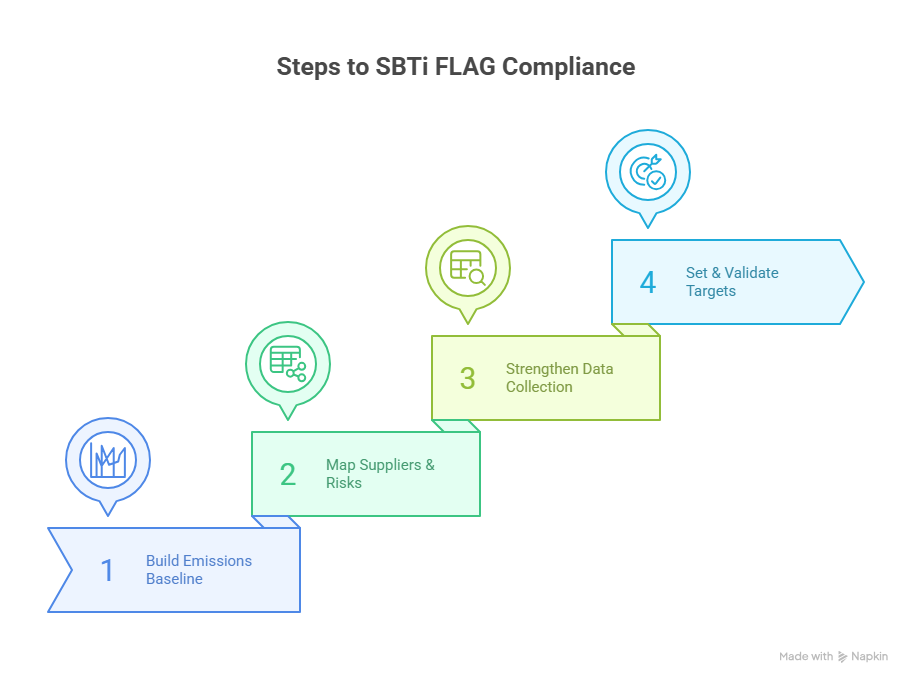
Starting an SBTi FLAG implementation requires early action, strong data foundations, and integration across sustainability, procurement, and supply-chain teams. Companies that approach FLAG strategically can reduce risk, protect market access, and build credible 1.5°C-aligned climate targets.
1. Build an emissions baseline and identify hotspots
Begin by quantifying land-sector emissions across Scopes 1–3, focusing on agriculture, land-use change, and sourcing regions. Identify high-impact commodities, geographies, and suppliers that contribute most to emissions and deforestation risk.
2. Map suppliers and commodity risk
Conduct commodity- and origin-level risk mapping for FLAG-relevant materials such as soy, cocoa, coffee, palm oil, cattle, rubber, and timber. Prioritize suppliers operating in high-deforestation or high-conversion regions.
3. Strengthen land-use and sourcing data collection
Collect farm- or plot-level geolocation, production data, and land-use history. Verified sourcing data is critical for deforestation-free claims, LUC accounting, and credible FLAG targets.
4. Set and validate FLAG targets
Develop near-term FLAG targets aligned with SBTi’s 1.5°C pathways and integrate them with company-wide net-zero commitments. Submit targets for SBTi validation to ensure compliance.
FLAG success depends on accurate, auditable supply-chain data. Weak traceability undermines emissions accounting, exposes companies to regulatory risk, and delays market access.
Digital traceability platforms, satellite monitoring, and Digital Product Passports enable continuous land-use monitoring, supplier transparency, automated reporting, and alignment with regulations like EUDR turning FLAG readiness into a long-term competitive advantage.
Despite growing awareness, many companies face significant obstacles in meeting SBTi FLAG requirements, largely due to structural weaknesses in agricultural supply chains.
Most agri-commodity supply chains rely on fragmented, paper-based records. Inconsistent emissions data, missing production volumes, and unclear sourcing origins make it difficult to build accurate FLAG baselines or quantify land-sector emissions under Scope 3.
Lack of plot-level geolocation and land-use history prevents companies from identifying deforestation or conversion risks. Without farm mapping and satellite verification, land-use change (LUC) emissions remain estimates rather than auditable data points.
Deforestation- and conversion-free (DCF) claims require verifiable evidence. Many companies struggle to demonstrate compliance due to mixed sourcing, aggregation, and absence of traceability systems that link commodities back to specific farms or regions.
FLAG-relevant commodities often pass through several intermediaries across multiple countries. This complexity makes supplier engagement, data standardization, and continuous monitoring challenging especially for global brands sourcing from smallholder-dominated systems.
Addressing these FLAG challenges requires investment in digital traceability, geospatial monitoring, supplier onboarding, and data governance to turn compliance from a risk into a strategic advantage.
Technology is foundational to achieving credible, scalable SBTi FLAG compliance, particularly for companies exposed to complex, land-based supply chains.
End-to-end traceability systems connect commodities to verified farms, suppliers, and geographies. By integrating supplier onboarding, transaction records, and geospatial data, these platforms create a single source of truth for FLAG-relevant commodities and Scope 3 land-sector emissions.
GIS mapping, satellite imagery, and time-series land-use data allow companies to identify deforestation, land conversion, and production risk at plot level. This enables accurate land-use change (LUC) accounting and continuous monitoring aligned with FLAG thresholds.
Digital chain-of-custody tools record sourcing events, volumes, and custody transfers, generating immutable, audit-ready evidence for DCF sourcing claims. This reduces reliance on self-reporting and improves assurance for SBTi validation and third-party audits.
Integrated platforms align FLAG data with broader ESG frameworks and regulations such as CSRD and EUDR. This allows companies to reuse verified land-use and sourcing data across climate disclosures, sustainability reporting, and regulatory compliance reducing duplication and compliance costs.
Together, FLAG traceability and digital compliance tools turn land-sector reporting from a manual burden into an actionable, risk-managed system.
TraceX helps companies meet SBTi FLAG requirements by providing end-to-end digital visibility across land-based supply chains. The platform enables farm-level mapping, geolocation, and land-use monitoring to accurately capture FLAG-relevant emissions, including land-use change and deforestation risk. Through integrated traceability, satellite analytics, and immutable data records, TraceX supports deforestation- and conversion-free (DCF) sourcing, supplier risk assessment, and audit-ready reporting. This allows companies to set credible FLAG targets, verify compliance with EUDR and ESG disclosures, and translate land-sector climate action into measurable, defensible outcomes.
SBTi FLAG is increasingly converging with global regulation, reshaping expectations for agricultural and forest-risk supply chains. FLAG’s requirements on land-use change emissions, deforestation-free sourcing, and traceability align closely with the EU Deforestation Regulation (EUDR), the Corporate Sustainability Due Diligence Directive (CSDDD), and expanding ESG disclosure rules such as CSRD. Together, these frameworks are pushing companies toward the same outcome: verifiable, location-specific insight into how commodities are produced.
FLAG readiness strengthens investor and buyer confidence by turning climate commitments into measurable, auditable action. Companies that can demonstrate credible FLAG targets, supported by reliable land-use data, reduce regulatory risk, avoid market exclusion, and signal long-term operational resilience to capital providers and downstream customers.
Looking ahead, FLAG will fundamentally reshape agricultural and forest-risk commodity markets. Buyers will favor suppliers with mapped farms, deforestation-free evidence, and transparent sourcing. Over time, this shifts value toward compliant producers, accelerates digital traceability adoption, and embeds sustainability as a baseline requirement rather than a voluntary differentiator in global supply chains.
Proactive engagement with SBTi FLAG allows companies to move beyond regulatory compliance and build long-term competitive strength. By addressing land-sector emissions early, organizations reduce exposure to regulatory, supply, and reputational risks while strengthening resilience across agricultural value chains. FLAG-aligned traceability improves access to premium markets, supports buyer and investor confidence, and reinforces brand credibility in an increasingly climate-conscious marketplace. Companies that act now to digitize land-use data, map suppliers, and embed deforestation-free sourcing are better positioned to future-proof operations, protect market access, and turn climate accountability into a strategic advantage.
Understand the EU Deforestation Regulation (EUDR)
Stay ahead of compliance requirements and learn how EUDR impacts forest-risk commodity supply chains.
Read the Blog →
Digital Traceability for EUDR Compliance
Discover how technology can help your business track, verify, and report deforestation-free sourcing effectively.
Explore the Guide →
A Complete Guide to Scope 3 Emissions
Learn how to measure, manage, and reduce upstream and downstream emissions in your value chain.
Get the Guide →
SBTi FLAG (Forest, Land & Agriculture Guidance) provides a framework for companies in agriculture and forest-risk commodities to set science-based targets for reducing emissions from land-use change and agricultural activities.
FLAG applies to companies involved in high-risk commodities like palm oil, soy, cattle, cocoa, timber, rubber, and coffee, focusing on both upstream and downstream emissions linked to land use.
Unlike energy-only targets, FLAG addresses emissions from land-use change, deforestation, and conversion, requiring companies to monitor, report, and mitigate environmental impacts across agricultural and forest-based supply chains.