
Quick summary: How to implement seed supply chain traceability: a 6-step framework covering GPS farm mapping, lot-level tracking, blockchain records, quality integration, real-time alerts, and consumer transparency.

Implementing seed supply chain traceability means digitally tracking every seed lot from breeder or producer through distributor, dealer, and farmer, capturing GPS-verified origin data, quality certifications, lot numbers, and chain-of-custody records at each handoff. Done right, it eliminates counterfeiting risk, enables instant recalls, and unlocks compliance with food safety and sustainability regulations.
A single bad seed lot can wipe out an entire season’s harvest for thousands of smallholder farmers. And yet, in most agri-input supply chains today, a bag of maize or hybrid vegetable seed changes hands 4-6 times before reaching the farmer with nothing more than a paper bill of lading as its trail.
The consequences are well-documented. The FAO estimates that counterfeit or substandard seeds account for more than 30% of seed sales in parts of sub-Saharan Africa and South Asia, a $1.5-2 billion annual problem that falls hardest on farmers who can least afford it. (FAO Seed Systems Report, 2024)
Regulatory pressure is tightening from the other end, too. EU buyers, sustainability auditors, and national seed regulatory bodies now require verified documentation of seed provenance, input usage, and chain-of-custody, the kind of documentation that paper-based systems simply cannot produce.
The good news? Seed traceability is no longer a technology challenge. It’s an implementation challenge. The platforms exist. The standards are defined. What most companies need is a clear, step-by-step roadmap to get from fragmented paper records to a fully auditable digital trail. That’s exactly what this guide delivers.
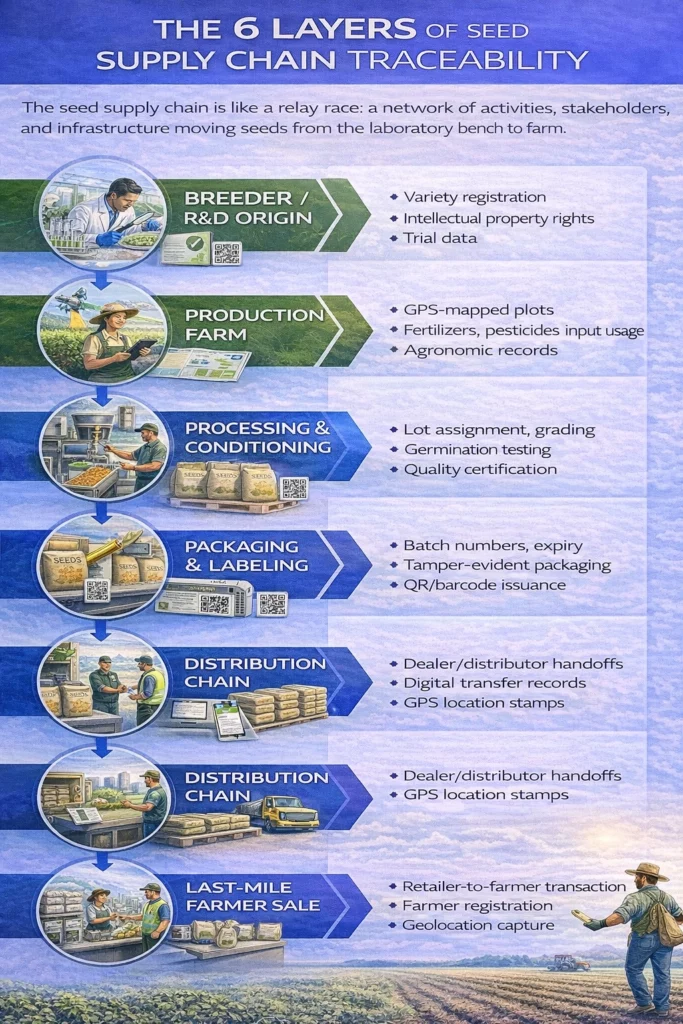
Seed traceability isn’t just about slapping a QR code on a bag. True end-to-end traceability covers every link in the chain and documents what happened at each one. Here’s what a complete traceability layer looks like:
Without coverage of all six layers, you have partial traceability, which means incomplete recall capability, audit gaps, and continued vulnerability to fraud.
Understand the 5-layer framework for end-to-end supply chain traceability. Learn how to build visibility, control, and compliance across every layer.
Use this framework whether you’re a seed company, agri-input distributor, government seed program, or food company sourcing certified seed inputs. Each step builds on the previous one so implementation order matters.
You can’t trace what you haven’t mapped. Before selecting any technology, create a complete visual map of your current seed supply chain: every actor, every handoff point, and every existing data touchpoint.
The biggest traceability gap in seed supply chains is the first mile: farmers and rural suppliers operating without digital records. Getting them onto a digital platform is non-negotiable, but it has to be done in a way that works in low-connectivity, low-digital-literacy environments.
See how offline mapping and data sync transform farm-level compliance. Discover how real-time visibility is achieved even in low-connectivity regions. Read the Case Study.
Every seed lot needs a unique digital identity that follows it from production through to the end buyer. Lot-level tracking is the backbone of any recall capability and the primary fraud prevention mechanism.
Traceability without quality verification is incomplete. This step links your supply chain data to quality testing records, certifications, and regulatory compliance requirements.
Understand OECD certification and its role in seed quality and trade. Learn how certification ensures varietal purity, traceability, and global acceptance.
A traceability system that only works during audits isn’t a traceability system; it’s a filing cabinet. Real operational value comes from real-time monitoring and the ability to act fast when something goes wrong.
Understand how forward traceability works in seed supply chains. Learn how to track seed batches from production to farmer delivery.
The final and often most commercially valuable step is using your traceability data to build consumer trust and command premium pricing. Provenance-verified seed products attract premium buyers, institutional procurement, and sustainability-conscious B2B customers.
A leading Indian seed company supplies hybrid maize and vegetable seeds through a network of 800+ distributors and 12,000 rural retailers across four states. The challenge: counterfeit seeds bearing their brand were being sold in Andhra Pradesh, damaging farmer trust and threatening market share.
Implementation approach using TraceX:
Result: The company can now prove with GPS-verified digital records where every legitimate lot has been sold, making it easy to identify and block unauthorized resellers.
A state government program distributing subsidized seeds to 120,000 smallholder farmers struggled with leakage. Subsidized seeds intended for small farmers were being diverted to commercial markets and sold at inflated prices.
Implementation approach:
Result: Distribution verification time can drop from 45 minutes per batch to under 8 minutes.
A spice exporter supplying certified organic chilli to EU buyers needed to prove that all chilli grown in their network was raised from certified, non-GMO, properly sourced seed varieties, a requirement under the EU’s organic certification standards.
Previously, this was managed through paper certificates that were frequently incomplete or unverifiable. Buyers were beginning to flag audit risk.
Using TraceX’s Sustainable Sourcing Platform, the exporter:
Result: EU buyer can pass the audit the first time. The exporter can also unlock organic premium pricing by providing verified provenance documentation that competing suppliers cannot match.
| Capability | Paper-Based System | TraceX Digital Platform |
|---|---|---|
| Supply chain mapping | Manual, static diagrams | Live digital node map with GPS |
| Farmer/supplier onboarding | Paper forms, manual entry | Offline mobile app, auto-sync |
| Lot-level tracking | Handwritten batch records | QR-coded, blockchain-stamped lots |
| Quality cert integration | Scanned PDFs, email attachments | Linked digital records per lot |
| Recall capability | 3-7 days (manual traceback) | Under 4 hours (automated trace) |
| Counterfeit detection | Reactive, post-damage | Real-time alert on anomalies |
| Compliance reporting | Manual compilation, audit-prone | One-click export, audit-ready |
| Consumer transparency | Not possible | QR code product passport |
| EUDR / organic compliance | Cannot verify digitally | GPS-validated, auto-reported |
| ERP integration | Siloed data | API-first, plugs into SAP/Oracle |
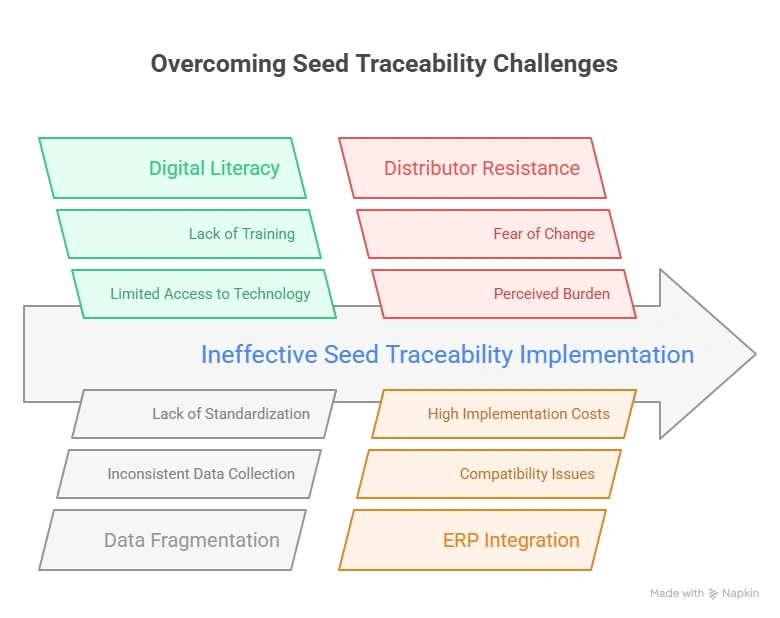
Rural farmers and small seed retailers often lack smartphones or digital literacy. Solution: Use offline-first feature phone apps or USSD-based data capture. Field agents handle onboarding; farmers only need to present ID and allow GPS capture.
Historical seed data lives in spreadsheets, email, and paper. Solution: Begin with current-season data and layer in historical records over time. A phased approach that delivers value quickly drives internal adoption.
Distributors may resist digital tracking if they fear exposure of unauthorized practices. Solution: Frame traceability as a buyer-facing premium feature, not an internal audit tool. Show dealers how digital records protect them from being blamed for counterfeit issues upstream.
Seed companies running SAP, Oracle, or legacy procurement systems can’t afford another siloed platform. Solution: Choose an API-first traceability platform like TraceX that integrates with existing ERP and procurement systems rather than replacing them.
Mid-market seed companies may struggle to justify upfront technology investment. Solution: Calculate the cost of a single counterfeit incident (brand damage, regulatory fine, market recall) versus the annualized cost of a SaaS traceability platform. The ROI case is typically compelling within the first season.
TraceX is built specifically for agri-food supply chains in emerging markets where last-mile connectivity is unreliable, supplier bases are fragmented across thousands of smallholders, and compliance requirements are increasingly tied to international market access.
For seed supply chain traceability specifically, TraceX’s Sustainable Sourcing Platform delivers:
The seed supply chain is one of the most critical and most under-digitized links in global food security. Companies that invest in end-to-end seed traceability today aren’t just protecting themselves from regulatory risk. They’re building the verifiable provenance layer that unlocks premium markets, wins institutional buyer contracts, and protects the farmers at the heart of their supply chains.
The six-step framework in this guide, map, onboard, track, certify, monitor, and activate, gives you a clear implementation path. The technology to execute it exists. The question is whether you act before a counterfeit incident, a failed audit, or a lost contract forces the issue.
TraceX has helped agri-food companies across India, Africa, and Southeast Asia build exactly this kind of supply chain visibility, purpose-built for the complexity of emerging market agriculture.
Seed supply chain traceability is the ability to digitally track and verify the movement of seed lots from origin (breeder or production farm) through every intermediate actor (processor, distributor, dealer) to the final buyer (farmer or institution). It includes GPS-verified origin records, quality certifications, chain-of-custody documentation, and lot-level identification creating an auditable, tamper-proof record of a seed’s journey.
Regulatory bodies in India (CVPB), the EU (organic certification, EUDR), and the US (FSMA) increasingly require documented, verifiable seed provenance as part of food safety and sustainability compliance. Without digital traceability, companies face failed audits, market access restrictions, and reputational risk from unverified sustainability claims.
A phased implementation with a platform from TraceX typically delivers the first working traceability layer including farmer onboarding, lot tracking, and basic chain-of-custody records within 30–60 days for a pilot supply chain. Full-scale rollout across an enterprise seed supply chain (including ERP integration and compliance automation) typically takes 3–6 months, depending on supply chain complexity and existing data infrastructure
Yes if the platform is designed for it. Offline-first mobile apps allow field agents to capture GPS data, farmer profiles, and input records without internet connectivity, syncing when online. SMS and QR verification can be used at the retailer level without requiring farmers themselves to own smartphones. TraceX’s offline-first architecture was specifically built for India and African supply chains with unreliable connectivity.
ROI from seed traceability comes from multiple directions: reduced losses from counterfeit/adulterated seed complaints, faster recall response (from days to hours), avoided regulatory fines, premium pricing enabled by verified provenance and reduced audit preparation costs. For most mid-market to enterprise seed companies, the platform investment pays back within the first season when a single recall or compliance incident is averted.