
Quick summary: Learn how to conduct a supplier assessment for EUDR compliance. Discover key supplier risk indicators, geolocation requirements, due diligence steps, and tools to ensure deforestation-free sourcing.

Imagine this: your shipment is ready for export, contracts are signed, and buyers are waiting, then the compliance review begins. Suddenly, you’re asked for farm-level geolocation data, supplier risk documentation, and proof that your sourcing is deforestation-free. Your suppliers are trusted partners, but trust alone doesn’t meet EUDR due diligence requirements. If your business imports coffee, cocoa, palm oil, rubber, timber, or soy into the EU supplier assessment for EUDR is no longer optional. It is a legal requirement under the EU Deforestation Regulation (EUDR), with enforcement in full effect for large and medium enterprises from December 30, 2026, and for micro and small enterprises from June 30, 2027.
TraceX EUDR Solutions help organizations streamline supplier onboarding, collect geolocation data, conduct deforestation risk screening, and generate compliance-ready due diligence documentation, making supplier assessment faster, more reliable, and fully aligned with EUDR requirements.
The EUDR is not a paperwork exercise. At its core, the regulation demands that every operator placing regulated commodities on the EU market can prove with documented, verifiable evidence that their products are deforestation-free and legally sourced.
That proof starts with your suppliers. A single weak link in your supplier network missing geolocation data, unverified land ownership, or a supplier with a high deforestation-risk profile can invalidate your Due Diligence Statement (DDS) and halt your shipments at customs.
4% Maximum fine for non-compliance: up to 4% of total annual EU turnover (plus product confiscation and potential market bans). Source: EU Deforestation Regulation, Article 25.
Dec 30, 2025 EUDR enforcement date for large and medium enterprises. Micro and small enterprises must comply by June 30, 2026.
Without a strong supplier assessment system, your business is exposed to:
Under EUDR, ‘good faith’ is not enough. You need documented, data-backed due diligence for every supplier in your network. The EU expects traceability not trust.
Want to understand how deforestation risk is evaluated under EUDR?
Read our guide to EUDR Risk Assessment and learn how to classify supplier risk with confidence.
Supplier data is the backbone of EUDR compliance.
Explore our blog on Supplier Data Management for EUDR to learn how to collect, validate, and manage supplier information effectively.
Supplier assessment under the EUDR is governed by Articles 9, 10, and 11 of the regulation. These cover data collection and verification, risk assessment, and risk mitigation, respectively. Here is what each requires from you in practice.
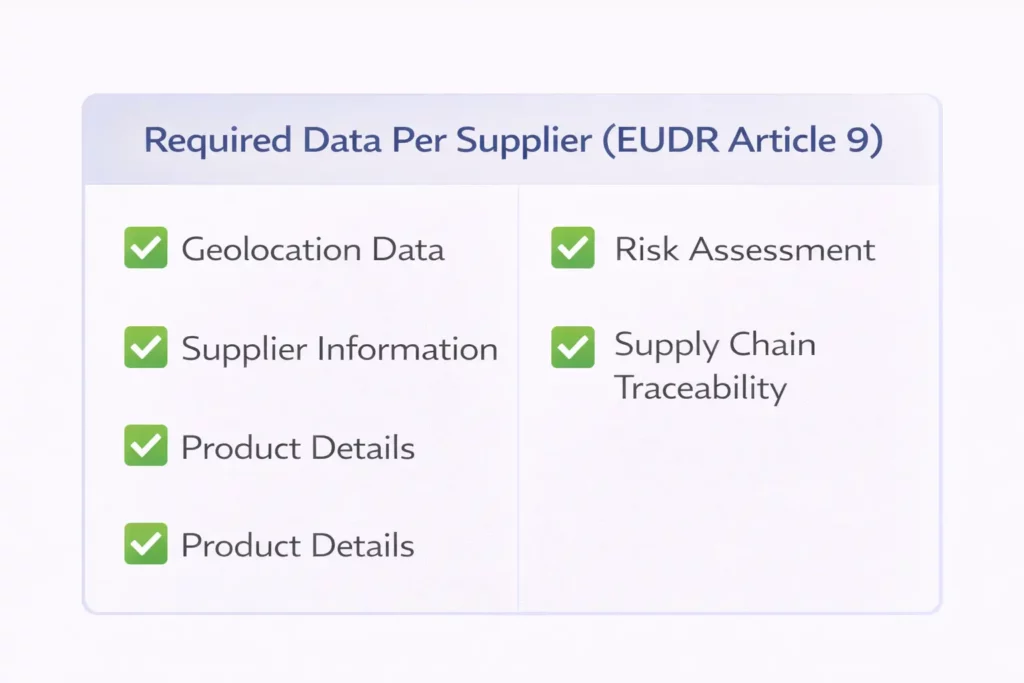
Before a product can be placed on the EU market, you must collect and verify the following from every supplier in your network:
Once data is collected, businesses must evaluate the deforestation risk associated with each supplier and product. The EUDR’s benchmarking system classifies countries into three tiers:
Your risk assessment for each supplier must account for:
34.2% Share of the largest S&P Europe 350 companies that had set targets to reduce deforestation in their supply chains as of 2022 – meaning the majority still have significant gaps to close.
Source: S&P Global Corporate Sustainability Assessment.
If any level of risk is identified, you are legally obligated to take mitigation steps before proceeding. This may include:
The goal is to reduce identified risks to negligible levels before submitting your DDS.
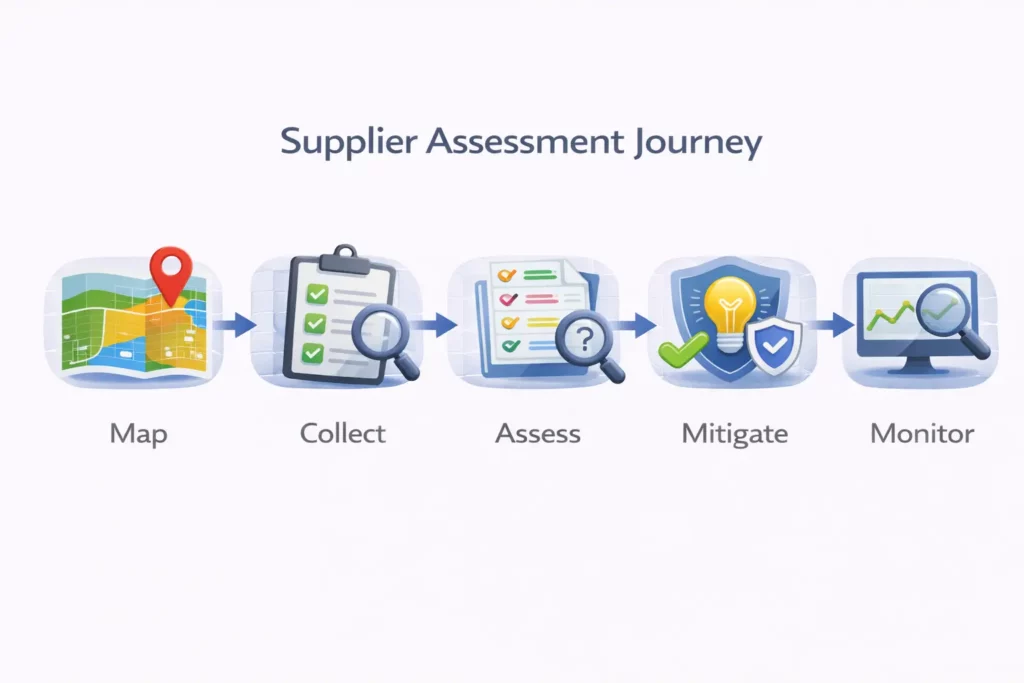
You cannot assess risk you cannot see. Start by identifying every supplier and sub-supplier in your network, tracing back to the specific land plots where regulated commodities are produced.
For each supplier, document:

This is where many businesses stumble and where non-compliance most often begins. EUDR compliance requires precise GPS coordinates for every farm and every plot supplying your products. A single GPS point is rarely sufficient; polygon mapping (the actual boundary of the land) is strongly preferred and often required for standard and high-risk sources.
Best practices for geolocation collection:
Curious how geolocation files are generated for compliance? Get a feel of the GeoJSON Tool and see how easy it is to create farm and plantation boundary files for regulatory submissions.
$170M-$2.5B Annual EUDR compliance-related costs estimated by the European Commission’s own impact assessment. Early investment in digital tools significantly reduces this burden. Source: European Commission Impact Assessment.
Not all suppliers carry equal risk. Once you have geolocation and documentation data, score each supplier based on:
AI-enabled platforms can automate this scoring analyzing supplier location, compliance history, and land-use trends to assign risk scores and flag high-priority suppliers for audit before you sign a contract.
A supplier who does not understand EUDR requirements can unknowingly put your entire compliance program at risk. Supplier engagement is not optional it is a core expectation of the regulation.
Your supplier engagement program should include:
Smallholder Consideration: Smallholder farmers, common in cocoa, coffee, and rubber supply chains, often lack the technical infrastructure for digital compliance. Providing offline mapping tools and local-language training is essential to avoid excluding them from your supply chain.
EUDR compliance is not a one-time checklist. The regulation requires ongoing due diligence, meaning your supplier risk assessments must be updated regularly not just at onboarding.
Continuous monitoring should include:

Once assessment and mitigation are complete, you must submit a Due Diligence Statement (DDS) via the EU TRACES system before any product is placed on the EU market or exported. The DDS must include:
DDS records must be retained for a minimum of five years and made available for inspection on request.

Manual supplier assessment chasing documents, consolidating GPS coordinates in spreadsheets, and manually filing DDS reports is not just inefficient. It is a compliance risk in itself. One missed data point can invalidate an entire shipment.
EUDR traceability solutions from TraceX transform this process by automating the most error-prone and time-consuming steps:
AI analyzes supplier location data, compliance history, and satellite land-use trends to predict deforestation risks before onboarding. Suppliers are automatically ranked, so your team focuses audit resources on the highest-risk relationships first.
All supplier compliance documents, geolocation data, legality proofs, and certifications are stored digitally in a centralized, version-controlled system. No more chasing suppliers for outdated documents or managing compliance via email chains.
Field agents equipped with mobile tools can capture farm-boundary polygons offline and sync them directly to the platform. Data is immediately cross-checked against satellite imagery and deforestation databases.
The platform compiles verified supplier data, geolocation records, and risk assessments to generate EUDR-compliant DDS submissions automatically, eliminating the manual upload burden and reducing rejection risk.
Integrated satellite monitoring tracks land-use changes in sourcing regions continuously. If a supplier’s area shows signs of deforestation, automated alerts enable immediate action before the issue affects your compliance status.
82% Share of companies that have integrated supplier risk evaluations into their data management practices, per Deloitte. Digital platforms make this integration scalable across hundreds of suppliers.
Natural rubber is one of the most complex commodities to trace under EUDR sourced predominantly from smallholder farms across Southeast Asia, with multi-tier supply chains and historically limited digital infrastructure.
A leading global tyre manufacturer faced exactly this challenge: thousands of rubber farmers spread across high-risk regions, inconsistent documentation practices, and a tight timeline to achieve compliance before enforcement.
A single coordinate cannot validate an entire farm plot. EU authorities need to confirm that no deforestation occurred within the production boundary. Polygon mapping is essential for standard and high-risk regions.
EUDR requires continuous monitoring. Supplier risk profiles change, land use changes, ownership transfers, and deforestation events can occur after initial onboarding. Automated monitoring closes this gap.
Under EUDR, the burden of proof rests entirely with the operator placing the product on the EU market. If a supplier provides inaccurate data, your company faces penalties. Verification, not trust, is the standard.
Using last year’s country risk data or applying broad ‘low-risk’ labels without verification exposes you to rejection. The EU’s benchmarking system is dynamic; classifications must be verified against current EU Commission guidance.
Spreadsheets cannot cross-reference geolocation data with satellite imagery, assign dynamic risk scores, or automatically generate TRACES-ready DDS submissions. At scale, manual systems create gaps that become compliance liabilities.
Use this checklist to evaluate where your compliance program stands today:
EUDR compliance is no longer a future challenge it is an immediate operational priority. For large and medium enterprises, enforcement begins December 30, 2026. For smaller businesses, the deadline is June 30, 2027.
The businesses that move now to digitalize their supplier data, automate risk scoring, and build TRACES-ready workflows will not just meet the regulation. They will build a competitive advantage: faster EU market access, stronger buyer confidence, and a supply chain built for long-term resilience.
Unsure how far back your traceability must go?
Read our guide to Supply Chain Mapping in EUDR and learn how to map sourcing from farm to export.
Smallholder sourcing under EUDR can be complex.
Explore our blog on EUDR and Smallholders to understand the challenges and compliance strategies.
Need a clear breakdown of regulatory obligations?
Discover the key EUDR Requirements every operator and importer must meet.
The EUDR covers seven commodity groups: cattle, cocoa, coffee, palm oil, soya, rubber, and wood plus derived products such as leather, chocolate, paper, and rubber goods.
A DDS is a mandatory compliance declaration submitted via the EU TRACES system before any covered product is placed on the EU market or exported. It must include geolocation data, supplier details, product information, and evidence of completed risk assessment and mitigation.
The legal liability rests with the operator placing the product on the EU market not the supplier. If a supplier’s data is inaccurate or incomplete, it is your company that faces potential fines, product confiscation, and market bans. Verification systems are essential.
EUDR requires continuous due diligence. Best practice is to refresh supplier data and risk assessments at least every 90 days, with automated satellite monitoring providing real-time alerts for any land-use changes in sourcing regions.
Yes. You can authorize a third-party platform or customs clearance provider to submit DDS via TRACES as your authorized representative. The platform or agent must be registered in the EUDR Information System.









