
Quick summary: Supplier Data Collection in EUDR for the Cocoa Supply Chain in Spain: understand legal responsibilities, mandatory supplier data, common data gaps, and how Spanish cocoa importers, processors, manufacturers, and traders can achieve EUDR compliance without disrupting imports, production, or EU distribution.

Supplier Data Collection in EUDR for Cocoa in Spain has rapidly become a defining compliance challenge for the Spanish cocoa sector and for good reason. As one of Southern Europe’s key cocoa processing and manufacturing hubs, Spain sits firmly within the regulatory scope of the EU Deforestation Regulation (EUDR).
Spain is not simply a cocoa-consuming country. It plays a critical role as an import, processing, and manufacturing centre for cocoa and cocoa-derived products entering and circulating within the EU. Cocoa beans and semi-finished products arrive through Spanish ports, are processed into cocoa liquor, butter, powder, and finished chocolate products, and are distributed across domestic and EU markets. This position means Spanish-based companies are frequently considered EU operators placing cocoa on the EU market, making EUDR compliance unavoidable.
This guide is designed specifically for:
If your business handles cocoa entering, processed in, or distributed from Spain, mastering Supplier Data Collection in EUDR for Cocoa in Spain is no longer optional it is the foundation for continued EU market access, audit readiness, and regulatory compliance.
The EU Deforestation Regulation (EUDR) requires all cocoa placed on the EU market to be proven deforestation-free and legally produced. In Spain, this obligation falls on importers, processors, manufacturers, traders, and first operators that place cocoa or cocoa-derived products on the EU market.
Spain plays a significant role in Europe’s cocoa value chain as a processing, manufacturing, and consumption hub, particularly for cocoa ingredients and finished chocolate products. Cocoa beans and semi-finished products are imported into Spain through major ports, processed into cocoa liquor, butter, powder, and finished goods, and then sold domestically or distributed across the EU.
This means Spanish-based companies are frequently considered operators under EUDR, with direct legal responsibility for ensuring that cocoa entering their supply chains complies with deforestation-free and legality requirements.
Under EUDR, Spanish companies that place cocoa or cocoa-derived products on the EU market must demonstrate using verifiable supplier- and farm-level data—that the cocoa is not linked to deforestation.
Failure to meet these requirements can result in:
EUDR applies to:
To legally place cocoa on the EU market, Spanish operators must:
For cocoa, EUDR compliance depends entirely on supplier-level and farm-level data, including:
Without this data, a DDS cannot be submitted.
No data = no EU market access.
Spain’s exposure under EUDR stems from its role as a major cocoa processor and manufacturer, not just a consumer market.
Spain is:
Because of this position, Spanish companies often:
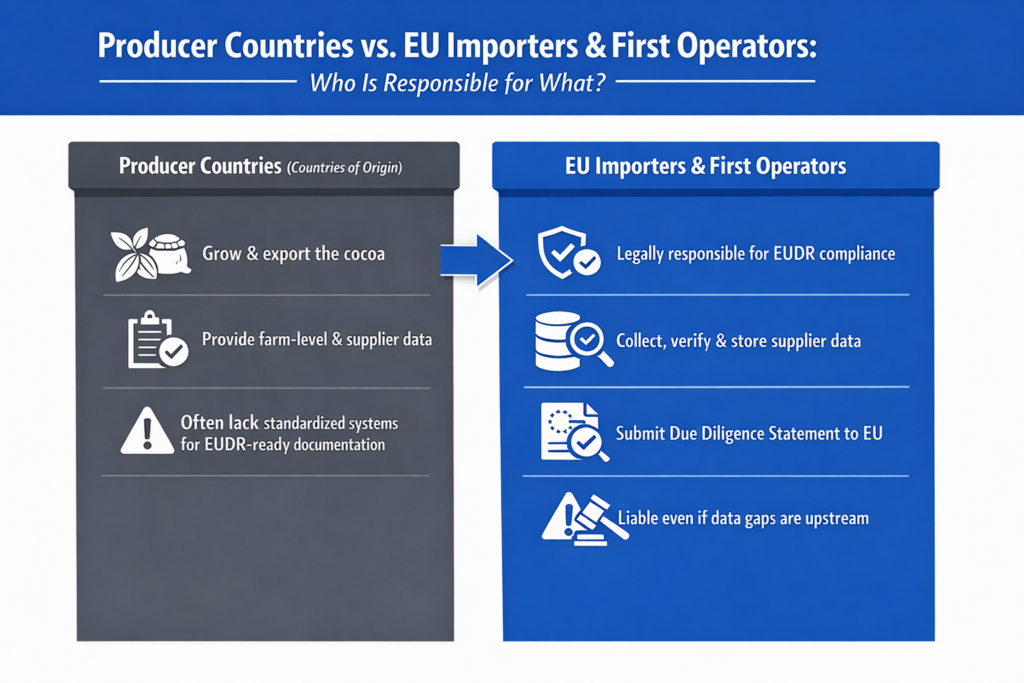
Under EUDR, this makes them legally responsible as operators, even when the cocoa is sourced through traders or intermediaries and even when final consumption happens outside Spain.
For cocoa companies operating in Spain, supplier data collection is not a back-office exercise. It is the primary compliance control point under EUDR.
Companies that succeed will:
Those that don’t risk shipment delays, DDS rejections, and loss of EU market access.
If supplier data for cocoa is incomplete, inconsistent, or cannot be verified, the consequences under EUDR are immediate and material for companies operating in Spain:
In practice, a single missing farm geolocation, unclear plot boundary, or unverifiable supplier record can halt an entire cocoa consignment even if the cocoa is intended for processing in Spain or consumption in another EU country.
For Spanish cocoa operators, supplier data failures often surface after goods arrive, when remediation is costly and timelines are tight.
Read our blog on Supplier Data Management for EUDR to learn how Dutch cocoa companies can standardize supplier data, validate geolocation, and remain audit-ready without disrupting imports or processing operations.
Explore our guide on Supplier Assessment under EUDR to see how to score cocoa suppliers by deforestation risk, data quality, and traceability before shipments arrive at Dutch ports or contracts are finalized.
Under EUDR, any company in Spain that places cocoa or cocoa products on the EU market—or trades cocoa without a valid Due Diligence Statement (DDS)—depends on complete, verifiable supplier data, even if that data is collected upstream.
Below is a role-by-role breakdown for the Spanish cocoa supply chain.
Spanish cocoa importers carry primary EUDR responsibility when they import cocoa from outside the EU and place it on the EU market.
If you import cocoa beans or cocoa products directly into Spain, you are considered a first operator. This means you must:
Even if exporters, cooperatives, or traders provide the data, legal responsibility remains with the Spanish importer.
Spanish cocoa processors, grinders, and manufacturers become first operators under EUDR when they import cocoa themselves.
This applies when companies:
In these cases, processors must ensure:
Processing cocoa does not reduce EUDR responsibility. In many cases, it increases exposure, as the processor becomes the operator placing products on the market.
The EUDR role of traders depends on how they operate:
Trading cocoa without a valid DDS reference creates direct compliance risk, even if the product never leaves your warehouse.
Companies that purchase cocoa after it has already been placed on the EU market are considered downstream operators.
They do not submit a new DDS if:
However, they must still:
If the DDS is missing, invalid, or unverifiable, the downstream operator may become de facto responsible under EUDR.
This distinction is often misunderstood—especially in Spain’s multi-layered cocoa trade.
In practice:
You may not be legally responsible but you are still operationally exposed.
To comply with EUDR for cocoa placed on or moving through Spain, companies must collect non-negotiable supplier data, including:
Missing even one element can invalidate a Due Diligence Statement and block EU market access.
For Spanish cocoa companies, supplier data collection is not an administrative task it is the primary compliance control point under EUDR.
| Compliance Pillar | Key Data Points Required | Critical “Why” for Audits |
| 1. Supplier Identity & KYC | • Full Legal Name & Tax ID (if avail.) • Business Registration Number • Direct vs. Indirect Sourcing Flag • Physical HQ Address • Role: Individual Farmer vs. Coop vs. Buying Station | Smallholder cocoa often passes through multiple local “buying stations.” KYC ensures that the first point of collection is verified, preventing non-compliant beans from entering the formal export stream. |
| 2. Geolocation & Plot Data | • GeoJSON Polygons (Mandatory >4ha) • GPS Center Points (Allowed <4ha) • Total Farm Area vs. Productive Area • Farm Boundary Mapping | Cocoa is often grown under shade trees (Agroforestry). Polygons allow satellite AI to distinguish between a healthy cocoa plantation and actual forest cover to verify the 31 Dec 2020 cut-off. |
| 3. Harvest & Production | • Harvest Cycle (Main vs. Mid crop) • Expected Yield based on Tree Age • Traceability to Sack/Batch Level • Weight & Moisture Content at Intake | Cocoa “laundering” occurs when beans from a newly deforested area are mixed with compliant batches. Auditors use yield-per-hectare logic to ensure a farm isn’t shipping more than its plot size allows. |
| 4. Legality & Compliance | • Land Tenure Documentation • National Cocoa Board Registration • Proof of Forest/Environmental Permits • Self-Declaration on Human Rights | In countries like Côte d’Ivoire and Ghana, 80% of land is under customary law. Auditors look for National ID/Registration as a proxy for legal land-use rights where formal titles don’t exist. |
Even highly sophisticated cocoa processors, manufacturers, and traders in Spain are struggling with EUDR compliance not because of intent, but because cocoa supply chains were never designed for plot-level legal verification.
In practice, most Due Diligence Statement (DDS) failures linked to cocoa imported into or processed in Spain can be traced back to a recurring set of supplier data gaps.
Cocoa entering Spain is typically sourced through:
For Spanish companies managing continuous imports and production runs, this fragmentation makes consistent farm-level data collection extremely difficult, especially when cocoa is already en route or needed for processing schedules.
Despite the scale of Spain’s cocoa processing and manufacturing sector, much supplier data at origin still exists as:
EUDR requires digital, structured, and verifiable data. Paper-based systems fail quickly when cocoa must move efficiently into Spanish processing facilities and onward into EU supply chains.
Geolocation data supplied to Spanish cocoa importers and processors often includes:
Poor-quality geolocation data is one of the fastest paths to DDS failure under EUDR for cocoa processed or placed on the market in Spain.
Cocoa supplier documentation frequently arrives in Spain:
This leads to:
Under EUDR, ambiguity itself is a compliance risk, even when cocoa is responsibly produced.
Aggregation is central to cocoa trading and processing—but highly risky under EUDR.
Typical issues include:
Once the link between
farm → plot → volume → shipment → processed product
is broken, EUDR compliance cannot be demonstrated, regardless of certifications or contracts.
For cocoa companies operating in Spain, EUDR compliance is not about collecting more data. It is about collecting the right data, in the right order, from the right actors.
Start by identifying EUDR-relevant suppliers, not your entire vendor list.
Actions:
Segment suppliers by risk and volume:
Outcome:
Resources are focused where DDS rejection risk is highest before cocoa enters Spanish ports or processing lines.
Unstructured supplier data is the single biggest bottleneck for Spanish cocoa operators.
Best practice includes:
Critical point:
If your data framework does not map exactly to DDS requirements, rework and delays are inevitable.
Data collection without validation does not equal compliance.
Key validation steps:
High-risk suppliers should be:
Outcome:
DDS failures are prevented upstream not discovered during customs clearance, audits, or buyer reviews.
TraceX EUDR Compliance Solutions help Spanish cocoa companies move from fragmented, high-risk supplier data to DDS-ready compliance in a single, connected workflow.
For cocoa companies operating in Spain, TraceX turns supplier data collection from a compliance bottleneck into a scalable, audit-ready operating model.
Supplier Data Collection in EUDR for the Cocoa Supply Chain in Spain is no longer a back-office task. It is the deciding factor for whether cocoa can legally enter, be processed, and circulate within the EU market.
As a major cocoa processing and manufacturing hub, Spain places importers, processors, and manufacturers at the centre of EUDR enforcement. Companies that succeed will treat supplier data as a structured, verifiable asset mapping and prioritizing suppliers, standardizing collection, validating geolocation and legality, and addressing risk before cocoa enters production.
Those that don’t will face DDS rejections, operational delays, buyer refusals, and commercial disruption.
Read our blog on EUDR Compliance for Coffee Supply Chains to see how importer, roaster, and trader responsibilities connect and where most compliance failures happen.
Explore our guide on EUDR for Operators and Traders to understand legal responsibility, DDS handover, and what checks you must perform before buying or selling coffee in the EU.
Dive into our practical breakdown of EUDR Due Diligence , including required data, risk assessment steps, and how to avoid delays at customs.
Spanish companies must collect supplier identification (KYC), farm- and plot-level geolocation (preferably polygons), harvest years, volumes supplied, traceability to specific batches or lots, and proof of legal production in the country of origin. Without this data, a Due Diligence Statement (DDS) cannot be submitted, and cocoa cannot be legally placed on or traded within the EU market.
Yes if the processor or manufacturer is the first operator placing cocoa or cocoa-derived products on the EU market. Spanish companies importing cocoa beans or semi-finished products directly must hold verified farm- or plot-level geolocation data. Companies sourcing cocoa already placed on the EU market must retain a valid DDS reference and maintain traceability records.
Yes, and digital submission is strongly recommended. Non-EU suppliers including farmers, cooperatives, exporters, and licensed buying companies can provide EUDR data through digital questionnaires, farm-mapping tools, or platforms that capture GPS polygon data and supporting documentation. Digital data is faster to validate and significantly reduces DDS rejection risk.
Under EUDR, operators in Spain must retain all due diligence and supplier data for at least five years and make it available to competent authorities upon request.
If supplier data changes such as new farm plots, updated geolocation, ownership changes, or volume adjustments the risk assessment must be updated. Material changes may require a new or revised DDS before cocoa linked to the updated data can be placed on or traded within the EU market.