
Quick summary: Supplier Data Collection in EUDR for the Coffee Supply Chain in Italy: understand legal responsibilities, mandatory supplier data, common gaps, and how Italian roasters and importers can achieve EUDR compliance without disrupting production or market access.
Supplier Data Collection in EUDR for Coffee in Italy has rapidly emerged as a critical compliance challenge for the Italian coffee sector. As one of Europe’s most influential roasting and consumption markets, Italy sits at a unique intersection of import dependency, brand concentration, and regulatory exposure under the EU Deforestation Regulation (EUDR).
Italy is not a major producer of green coffee, but it is one of the world’s most important coffee roasting and branding hubs. Large volumes of green coffee are imported from origin countries and other EU entry points, transformed by Italian roasters, and sold domestically and across global markets. This means Italian companies frequently act as first operators placing coffee on the EU market, making EUDR compliance unavoidable.
This guide is designed specifically for:
If your business places coffee on the EU market from Italy whether roasted, branded, or traded mastering Supplier Data Collection in EUDR for Coffee in Italy is now a prerequisite for continued market access.
EUDR is an EU regulation requiring all coffee sold in the EU to be proven deforestation-free and legally produced. In Italy, responsibility falls heavily on roasters, importers, and brand owners that place coffee on the EU market.
Under EUDR, Italian first operators must prove using supplier and farm-level data that coffee is not linked to deforestation. Failure to do so can result in blocked products, rejected DDS submissions, and financial penalties.
Italy ranks as Europe’s second-largest green coffee importer after Germany, importing around 672,000 metric tons valued at $2.48 billion in 2023, with Brazil, Vietnam, and India supplying over 65%
Italy is one of Europe’s largest coffee roasting markets, home to globally recognised brands and a dense network of medium and large roasters. While green coffee often enters the EU via ports in Germany, the Netherlands, or Belgium, Italian companies remain legally responsible if they are the first to place the coffee on the EU market under their name.
EUDR applies to coffee at both green and roasted stages. To legally place coffee on the EU market, companies must:
For coffee, this depends entirely on supplier-level data, including:
Italy’s exposure under EUDR stems from its role as a roasting, branding, and market-placing powerhouse rather than as a port-of-entry hub.
Italy is:
Because Italian companies often place finished coffee products on the EU market, they frequently qualify as first operators under EUDR even when green coffee was imported via another EU country.
In practice, this means Italian roasters and brand owners carry full legal responsibility for upstream supplier data, farm geolocation, and deforestation risk even when sourcing through traders or intermediaries.
Compared to countries focused mainly on consumption, Italy’s concentration of first operators makes it highly exposed to EUDR enforcement. For Italian coffee companies, supplier data collection is not a technical detail it is the foundation of legal market access under EUDR.
If supplier data linked to coffee placed on the EU market from Italy is incomplete, inconsistent, or cannot be verified, the consequences under EUDR are immediate:
In practice, a single missing farm geolocation or unclear supplier record can invalidate an entire Due Diligence Statement (DDS) even for roasted or branded coffee.
Read our blog on Supplier Data Management for EUDR to learn how Italian coffee companies can standardize supplier data, validate geolocation, and remain audit-ready without disrupting production or sales.
Explore our guide on Supplier Assessment under EUDR to understand how to score suppliers by deforestation risk, data quality, and traceability before products are placed on the EU market or exported.
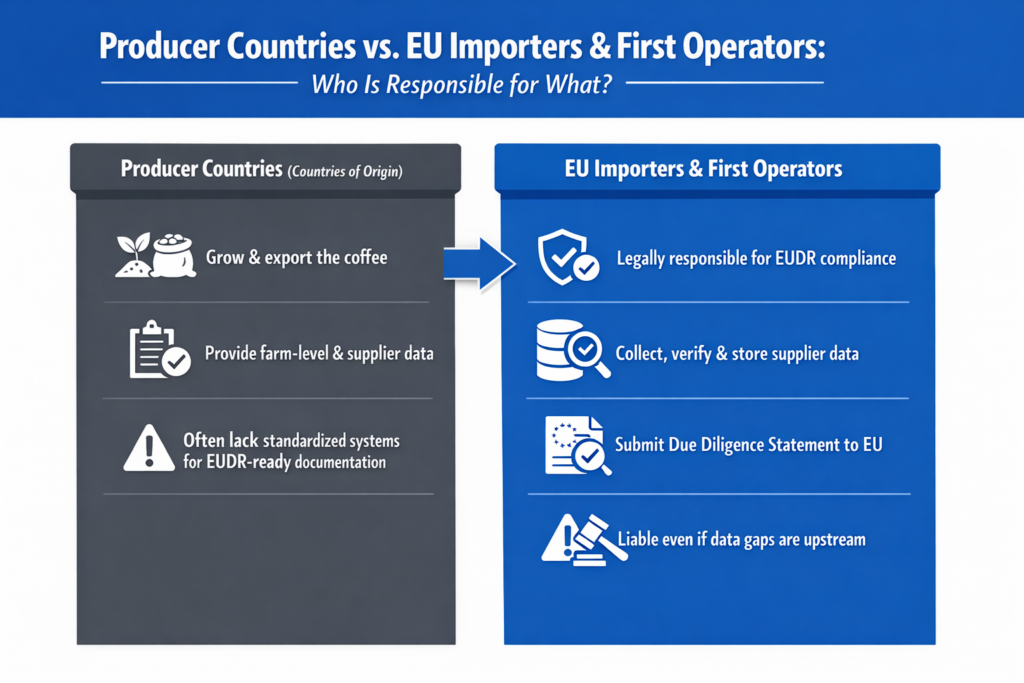
Under EUDR, any company in Italy that places coffee on the EU market or sells coffee without a valid DDS reference depends on complete and verifiable supplier data, even if that data was collected by upstream partners.
Below is a role-by-role explanation for the Italian coffee sector.
Italian importers who bring green coffee into the EU under their name carry full EUDR responsibility.
If you import green coffee from outside the EU and place it on the EU market, you are a first operator and must:
Even when exporters, agents, or cooperatives provide data, legal liability remains with the Italian importer.
Italian roasters are among the most exposed actors under EUDR.
You are considered a first operator if you:
In these cases, roasters must ensure:
Roasting does not reduce EUDR responsibility in many cases, it creates first-operator status.
The role of traders and brand owners in Italy depends on how coffee is sourced and sold:
Trading or branding coffee without a valid DDS creates direct compliance exposure.
Companies that purchase coffee after it has already been placed on the EU market are considered downstream operators.
They do not submit a new DDS if:
However, they must:
If the DDS is missing, invalid, or unverifiable, the downstream operator may become de facto responsible under EUDR.
This distinction is frequently misunderstood in Italy’s brand-led coffee sector.
Legal Responsibility
Data Dependency
In practice:
You may not be legally responsible but you are still commercially and operationally exposed.
This section outlines the non-negotiable supplier data required to comply with EUDR for coffee placed on the EU market from Italy.
Missing even one element can invalidate a Due Diligence Statement and block market access, regardless of where the green coffee originally entered the EU.
| Compliance Pillar | Key Data Points Required | Critical “Why” for Audits |
| 1. Supplier Identity & KYC | • Full Legal Name & Reg. Number • Physical Address • Country of Production (Origin) • Role: Farmer vs. Coop vs. Exporter | Links coffee to a responsible economic actor. Shipments without a verified actor are non-compliant by default. |
| 2. Geolocation & Plot Data | • GeoJSON Polygons (Mandatory >4ha) • GPS Center Points (Allowed <4ha) • Defined plot boundaries | Polygons are the only way to cross-reference satellite imagery to prove no deforestation occurred after 31 Dec 2020. |
| 3. Harvest & Production | • Harvest Year/Production Period • Exact Volume per Plot/Coop • Traceability to Batch/Lot Number | Prevents “laundering” by ensuring volumes are realistic relative to farm size and regional crop calendars. |
| 4. Legality & Compliance | • Land-use legality proof • Local permits/registrations • Producer Declarations (Self-Attest) | Proves coffee wasn’t just deforestation-free but also produced in line with local environmental and labour laws. |
Even highly established Italian roasters and brand owners are struggling with EUDR because coffee supply chains were never designed for plot-level legal verification. In Italy, most Due Diligence Statement (DDS) risks emerge from the same recurring supplier data gaps often hidden deep upstream.
Coffee placed on the EU market by Italian companies is typically sourced through:
The challenge:
For Italian roasters working with blends, private labels, and high throughput, this fragmentation makes consistent farm-level data collection extremely difficult, especially when product timelines are tight.
Despite Italy’s advanced roasting and branding capabilities, upstream supplier data often still exists as:
Why this fails under EUDR:
EUDR requires digital, structured, and verifiable data. Paper-based systems collapse quickly once roasted coffee must be legally defended.
Geolocation data provided to Italian buyers frequently includes:
The risk:
For Italian first operators, inconsistent geolocation is one of the fastest ways to invalidate compliance, even if the coffee itself is responsibly sourced.
Supplier documentation often arrives:
This creates:
Under EUDR, ambiguity itself becomes risk, regardless of intent or sustainability claims.
Aggregation is common in Italy’s coffee model but dangerous under EUDR.
Typical issues:
Once the link between
farm → plot → volume → batch → product
is broken, EUDR compliance cannot be demonstrated even for finished roasted coffee.
For Italian coffee companies, EUDR compliance is not about collecting more data it’s about collecting the right data, in the right order, from the right suppliers. Below is a practical, job-to-be-done framework used by roasters, brand owners, and importers in Italy.
Start by identifying EUDR-relevant suppliers, not your entire vendor ecosystem.
Actions:
Segment suppliers by risk and volume:
Outcome:
Compliance effort is focused where DDS failure would have the highest commercial impact.
Unstructured supplier data is the biggest source of rework for Italian roasters.
Best practice includes:
Critical point:
If your data framework does not align exactly with DDS requirements, compliance breaks at submission time.
Data collection alone does not equal compliance.
Key validation steps:
High-risk suppliers should be:
Outcome:
DDS failures are prevented before products are roasted, branded, or sold.
TraceX EUDR Compliance Solutions enable Italian coffee companies to move from fragmented, high-risk supplier data to DDS-ready compliance through a single, connected workflow.
TraceX supports digital supplier onboarding, capturing KYC details and required documents directly from farmers, cooperatives, and exporters. Farms and plots are recorded using GPS-verified polygon capture, while AI-driven geolocation validation checks accuracy and flags deforestation-risk overlaps early. Automated EUDR-aligned risk scoring helps Italian teams prioritize remediation before coffee is roasted or placed on the EU market. All data is structured to be TRACES-ready and integrates seamlessly with ERP and production systems used by Italian roasters and brand owners.
For Italy’s coffee sector, TraceX transforms EUDR supplier data collection from a regulatory burden into a scalable, brand-safe operating model.
Supplier Data Collection in EUDR for the Coffee Supply Chain in Italy is no longer a back-office exercise it is the deciding factor for whether roasted and branded coffee can legally be sold in the EU. As one of Europe’s most influential roasting and branding hubs, Italy places roasters, importers, and brand owners at the centre of EUDR enforcement. Companies that succeed will treat supplier data as a structured, verifiable asset: prioritising suppliers, standardising data collection, validating geolocation and legality, and addressing risk before products reach the market. Those that don’t will face rejected DDS submissions, blocked sales, and brand-level exposure. In short, mastering supplier data collection is how Italian coffee companies protect market access, business continuity, and credibility under EUDR.
Read our blog on EUDR Compliance for Coffee Supply Chains to see how importer, roaster, and trader responsibilities connect and where most compliance failures happen.
Explore our guide on EUDR for Operators and Traders to understand legal responsibility, DDS handover, and what checks you must perform before buying or selling coffee in the EU.
Dive into our practical breakdown of EUDR Due Diligence , including required data, risk assessment steps, and how to avoid delays at customs
Italian companies must collect supplier identification (KYC), farm- and plot-level geolocation (preferably polygons), harvest year, volumes supplied, traceability to batch or lot, and proof of legal production. Without this data, a Due Diligence Statement (DDS) cannot be submitted and coffee cannot be legally placed on the EU market.
Yes if the roaster is the first operator placing coffee on the EU market. Italian roasters importing green coffee directly must hold verified farm- or plot-level geolocation data. Roasters sourcing coffee already placed on the EU market must retain a valid DDS reference and maintain traceability records.
Yes, and digital submission is strongly recommended. Non-EU suppliers including farmers, cooperatives, and exporters can provide EUDR data through digital questionnaires, farm-mapping tools, or platforms that capture GPS polygons and supporting documents. Digital data accelerates validation and significantly reduces DDS rejection risk for Italian roasters and brand owners.
Under EUDR, Italian operators must retain all due diligence and supplier data for at least five years and make it available to competent authorities upon request.
If supplier data changes such as new plots, updated geolocation, ownership changes, or volume adjustments the risk assessment must be updated. Material changes may require a new or revised DDS before coffee linked to that data can be placed on or sold within the EU market.