
Quick summary: Supplier Data Collection in EUDR for the Coffee Supply Chain in Spain: understand responsibilities, mandatory data, common gaps, and how Spanish coffee companies can achieve EUDR compliance without disrupting trade.
Supplier Data Collection in EUDR for Coffee in Spain has rapidly emerged as a critical compliance challenge for the coffee sector and with good reason. As one of Southern Europe’s key entry points for agricultural commodities, the impact of the EU Deforestation Regulation (EUDR) is particularly significant in Spain.
Spain is not only a major coffee-consuming market but also an important hub for coffee importation, roasting, processing, and intra-EU distribution. Large volumes of green coffee enter through Spanish ports, are processed by roasters and traders, and then supplied to domestic markets or redistributed across the EU. This positioning means that Spanish-based companies are frequently the first EU operators legally responsible for placing coffee on the market making EUDR compliance unavoidable.
This guide is designed specifically for:
If your business handles coffee entering or moving through Spain, mastering Supplier Data Collection in EUDR for Coffee in Spain is no longer optional it is the foundation for maintaining market access, reducing regulatory risk, and operating confidently under the new EU compliance landscape
The EU Deforestation Regulation (EUDR) is an EU law requiring coffee sold on the EU market to be proven deforestation-free. In Spain, this obligation falls primarily on importers and first operators placing coffee on the EU market. Spanish coffee companies must demonstrate using supplier and farm-level data that coffee entering the EU was not produced on land deforested after 31 December 2020, or risk shipment blocks, fines, and loss of market access.
Spain’s coffee supply chain revolves around green bean imports via ports like Valencia/Algeciras, roasting (Europe’s 5th largest market), and re-export of roasted products. Imports total ~200k tonnes green coffee (Oct 2025: €201M), with Vietnam (123.7k tonnes 2023, 61% decaf), Brazil (55k tonnes), Colombia (11.7k tonnes) as top suppliers; 60% Robusta share.
Spain plays a strategic role in Europe’s coffee trade. It is a major point of entry for green coffee through Mediterranean ports, a significant roasting and processing location, and an important distribution hub supplying both domestic consumption and other EU markets. As a result, Spanish-based importers and traders are frequently the first EU operators under EUDR making compliance unavoidable.
The EUDR applies to coffee in both green and roasted forms. To legally place coffee on the EU market, companies must:
For coffee, compliance hinges on robust supplier data collection, including:
No data = no compliance.
Spain’s exposure under EUDR is driven by its role as a gateway and processor within the EU coffee supply chain:
Because Spanish companies often act as the first EU operators, they carry the highest legal responsibility under EUDR even when coffee is later sold or consumed elsewhere in Europe.
In practice, this places Spain among the EU countries with the greatest compliance exposure, making strong supplier data collection and farm-level traceability essential for any business operating in the Spanish coffee market.
If supplier data is incomplete, inconsistent, or cannot be verified under EUDR, the consequences are immediate and severe for companies operating in Spain:
Even a single missing geolocation coordinate or unclear supplier record can stop an entire shipment.
Read our blog on Supplier Data Management for EUDR to learn how coffee companies standardize data collection, validate geolocation, and stay audit-ready without slowing imports.
Explore our guide on Supplier Assessment under EUDR to understand how to score suppliers by deforestation risk, data quality, and traceability—before shipments are blocked or contracts are signed.
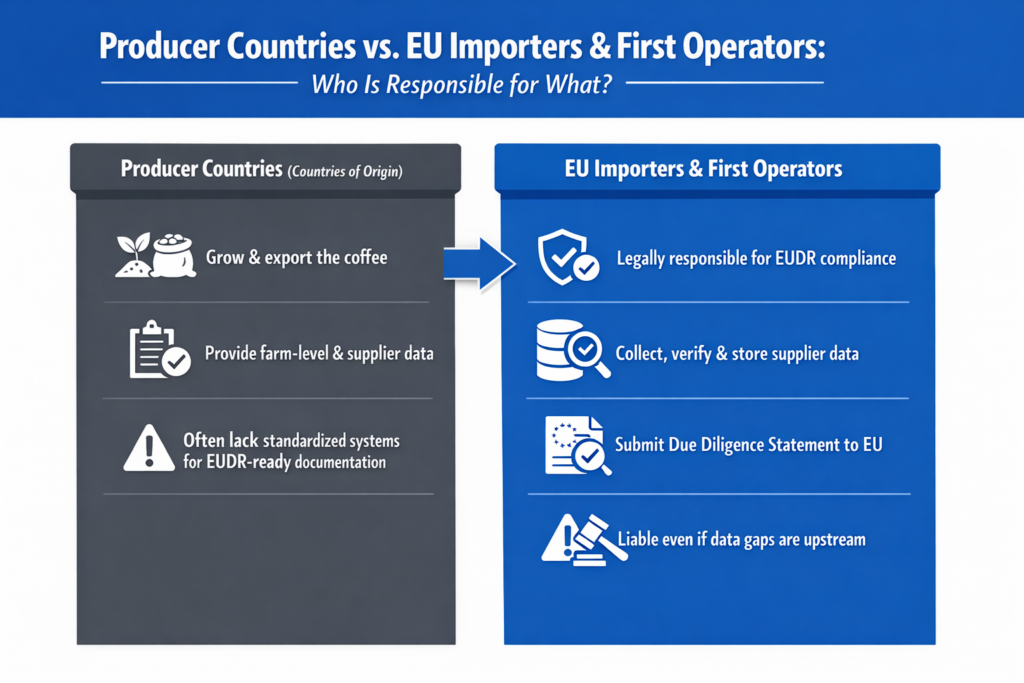
Under EUDR, any company in Spain that places coffee on the EU market or passes it along without a valid Due Diligence Statement (DDS) depends on complete and verifiable supplier data, even if it did not collect the data itself.
Below is a clear, role-by-role breakdown.
Spanish coffee importers carry the highest level of EUDR responsibility.
If you import green coffee from outside the EU and place it on the EU market, you are a first operator. This means you must:
Even if exporters, agents, or cooperatives provide the data, legal responsibility remains with the importer.
Spanish roasters are also considered first operators when they import green coffee themselves.
This applies if roasters:
In these cases, roasters must ensure:
Roasting does not reduce EUDR responsibility it often increases it.
Trader responsibility depends on how they operate:
Trading without a valid DDS creates direct compliance exposure.
Companies purchasing coffee after it has been placed on the EU market are downstream operators.
They do not submit a new DDS if:
However, they must:
If the DDS is missing, invalid, or unverifiable, the downstream operator may become de facto responsible.
This is one of the most misunderstood aspects of EUDR.
Legal responsibility
Data dependency
In practice:
You may not be legally responsible but you are still operationally exposed.
To comply with EUDR, the following supplier data is non-negotiable. Missing even one element can invalidate a Due Diligence Statement and block market access:
For Spanish coffee companies, robust supplier data collection is not a documentation exercise it is the foundation of lawful market access under EUDR.
| Compliance Pillar | Key Data Points Required | Critical “Why” for Audits |
| 1. Supplier Identity & KYC | • Full Legal Name & Reg. Number • Physical Address • Country of Production (Origin) • Role: Farmer vs. Coop vs. Exporter | Links coffee to a responsible economic actor. Shipments without a verified actor are non-compliant by default. |
| 2. Geolocation & Plot Data | • GeoJSON Polygons (Mandatory >4ha) • GPS Center Points (Allowed <4ha) • Defined plot boundaries | Polygons are the only way to cross-reference satellite imagery to prove no deforestation occurred after 31 Dec 2020. |
| 3. Harvest & Production | • Harvest Year/Production Period • Exact Volume per Plot/Coop • Traceability to Batch/Lot Number | Prevents “laundering” by ensuring volumes are realistic relative to farm size and regional crop calendars. |
| 4. Legality & Compliance | • Land-use legality proof • Local permits/registrations • Producer Declarations (Self-Attest) | Proves coffee wasn’t just deforestation-free but also produced in line with local environmental and labour laws. |
Even experienced operators in Spain are struggling with EUDR compliance because traditional coffee supply chains were never designed for plot-level legal verification. In Spain, many Due Diligence Statement (DDS) failures stem from the same recurring supplier data gaps.
Coffee imported into Spain is often sourced from:
This fragmentation makes consistent farm-level data collection extremely difficult, especially when shipments are time-sensitive.
Across many origin countries supplying Spain, supplier data still exists as:
EUDR requires digital, structured, and verifiable data. Paper-based systems simply do not scale.
Geolocation data is frequently provided as:
Inconsistent geolocation is one of the fastest paths to EUDR non-compliance.
Supplier documentation often arrives:
This creates:
Under EUDR, ambiguity equals risk even if the coffee itself is compliant.
Aggregation is common in coffee trading but risky under EUDR.
Typical issues include:
Once the link between farm → plot → volume → shipment is broken, EUDR compliance cannot be proven.
For Spanish coffee companies, EUDR compliance is not about collecting more data it’s about collecting the right data, in the right sequence, from the right suppliers.
Start with EUDR-relevant suppliers, not your entire supplier list.
Actions:
Then segment suppliers by risk and volume:
Outcome:
Resources are focused where DDS failure risk is highest.
Unstructured data is the biggest cause of EUDR delays. Standardization is mandatory.
Best practices:
Critical point:
Your framework must map exactly to DDS data requirements—anything else creates rework.
Data collection alone is insufficient. Validation turns data into compliance.
Key validation steps:
High-risk suppliers should be:
Outcome:
DDS failures are prevented upstream not discovered at customs.
TraceX EUDR Compliance Solutions enable Spanish coffee companies to move from fragmented, high-risk supplier data to DDS-ready compliance in a single, connected workflow.
TraceX supports:
For importers, roasters, and traders in Spain, TraceX turns supplier data collection from a compliance bottleneck into a scalable, audit-ready process that keeps coffee moving.
Supplier Data Collection in EUDR for the Coffee Supply Chain in Spain is no longer a back-office task it is the deciding factor for whether coffee can legally enter and circulate within the EU market.
As a major entry point, processing centre, and distribution hub, Spain places importers, roasters, and traders directly in the path of EUDR enforcement. Companies that succeed will be those that treat supplier data as a verifiable, structured asset mapping and prioritizing suppliers, standardizing data capture, validating geolocation and legality, and mitigating risk before shipments move.
Those that don’t will face blocked DDS submissions, customs delays, and commercial disruption.
In short, mastering supplier data collection is how Spanish coffee companies protect market access, continuity, and credibility under EUDR.
Read our blog on EUDR Compliance for Coffee Supply Chains to see how importer, roaster, and trader responsibilities connect and where most compliance failures happen.
Explore our guide on EUDR for Operators and Traders to understand legal responsibility, DDS handover, and what checks you must perform before buying or selling coffee in the EU.
Dive into our practical breakdown of EUDR Due Diligence , including required data, risk assessment steps, and how to avoid delays at customs.
Spanish companies must collect supplier identification (KYC), farm- and plot-level geolocation (preferably polygons), harvest year, volumes supplied, traceability to batch or lot, and evidence of legal production in the country of origin. Without this data, a Due Diligence Statement (DDS) cannot be submitted and coffee cannot be placed on the EU market.
Yes if the roaster is the first operator placing coffee on the EU market. Spanish roasters importing green coffee directly must hold verified farm- or plot-level geolocation data. Roasters purchasing coffee already placed on the EU market must retain a valid DDS reference and maintain traceability records.
Yes, and digital submission is strongly recommended. Non-EU suppliers (farmers, cooperatives, exporters) can provide EUDR data through digital questionnaires, mapping tools, or platforms that capture GPS polygons and documentation. Digital data is faster to validate and significantly reduces DDS rejection risk for Spanish importers.
Under EUDR, Spanish operators must retain all due diligence and supplier data for at least five years and make it available to competent authorities upon request.