
Quick summary: Supplier Data Collection in EUDR for the Coffee Supply Chain in Switzerland: understand data responsibilities, mandatory supplier information, common data gaps, and how Swiss coffee traders, roasters, and exporters can support EUDR compliance for EU market access without disrupting trade.
Supplier Data Collection in EUDR for Coffee in Switzerland has rapidly become a defining compliance challenge for the Swiss coffee sector and for good reason. As a major European hub for coffee trading, processing, and brand ownership, Switzerland sits firmly within the scope of the EU Deforestation Regulation (EUDR), even though it is not an EU member state.
Switzerland is far more than a coffee-consuming market. It is a global centre for coffee trading, roasting, and brand headquarters, with large volumes of green coffee imported, stored, traded, and transformed before being sold into the European Union. Many Swiss-based companies place coffee on the EU market directly or indirectly, which means they are often treated as operators or upstream suppliers under EUDR. As a result, robust supplier data collection is no longer a back-office task it is a regulatory requirement.
Because Swiss companies play a pivotal role early in the value chain, gaps in farm-level data, geolocation, or supplier documentation can quickly translate into compliance risk for EU market access.
This guide is designed specifically for:
If your business sources, trades, or sells coffee from Switzerland into the EU, mastering Supplier Data Collection in EUDR for Coffee in Switzerland is no longer optional it is the foundation for continued access to European markets.
EUDR is an EU regulation that requires coffee placed on the EU market to be proven deforestation-free and legally produced. While Switzerland is not an EU member state, EUDR still applies directly to Swiss coffee companies that place coffee on the EU market or supply EU operators making compliance unavoidable for much of the Swiss coffee sector.
Switzerland is not only a coffee-consuming country; it is a global hub for coffee trading, roasting, and brand ownership. Large volumes of green coffee are imported into Switzerland, traded, stored, processed, or roasted, and then sold into EU markets. Many Swiss-based traders, roasters, and brand owners are therefore considered operators or upstream economic actors under EUDR, responsible for providing compliant data to EU buyers or submitting Due Diligence Statements (DDS) themselves.
Switzerland’s coffee supply chain imports green beans (186,323 tonnes in 2023, Europe’s 6th largest at ~192k tonnes 2021, +7.1% CAGR 2017-21) mainly via Basel port on the Rhine from Brazil, Colombia, Vietnam, and Uganda (+$11.1M 2023-24).
Under EUDR, Swiss companies supplying coffee into the EU must demonstrate using verifiable supplier and farm-level data that the coffee is not linked to deforestation. Failure to do so can result in blocked shipments, rejected DDS submissions by EU partners, contractual termination, and loss of market access.
EUDR applies to coffee in both green and roasted forms. To legally place coffee on the EU market, companies must:
For coffee, compliance depends almost entirely on supplier-level and farm-level data, including:
No data = no EU market access.
Switzerland plays a unique and highly exposed role in Europe’s coffee supply chain:
Because many Swiss companies sell directly into the EU, they are often responsible for ensuring EUDR-ready data is available either as the operator placing coffee on the EU market or as the critical upstream supplier without whom EU operators cannot comply.
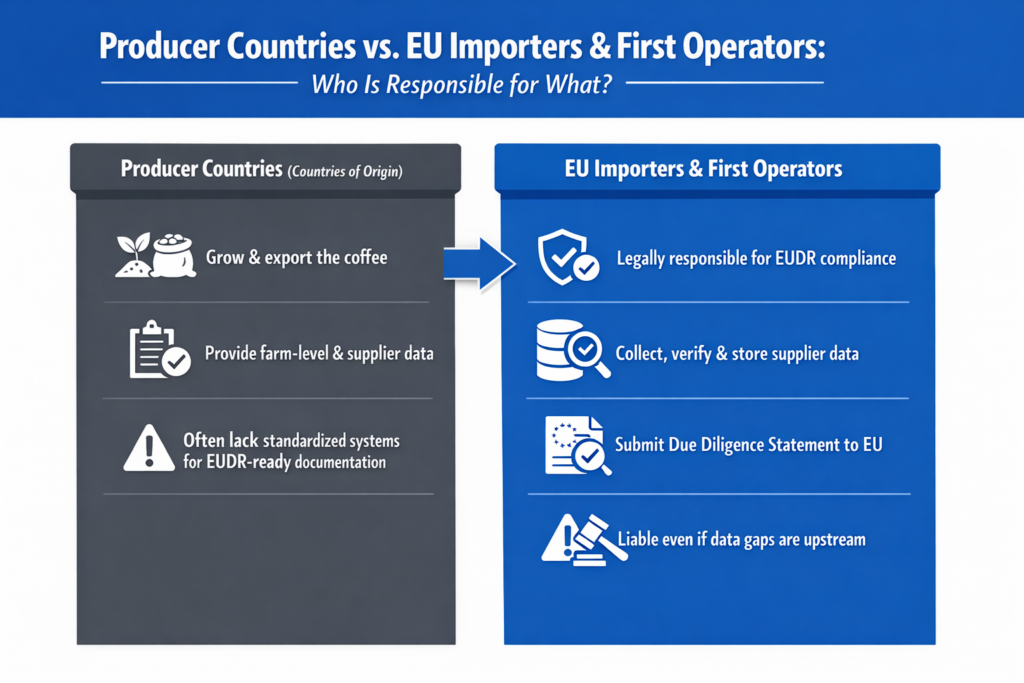
Even when coffee is physically imported into the EU by a downstream partner, data responsibility flows upstream. If Swiss traders or roasters cannot provide compliant geolocation, origin, and traceability data, EU buyers may be unable or unwilling to accept shipments.
In practice, this gives Switzerland high indirect EUDR exposure, comparable to major EU entry points. For Swiss coffee companies, supplier data collection is not a support function it is the single most important compliance dependency under EUDR.
Without structured, verifiable supplier data, Swiss coffee businesses risk being excluded from EU supply chains, regardless of product quality or sustainability commitments.
If supplier data is incomplete, inconsistent, or cannot be verified, the consequences under EUDR are immediate and commercially serious even when companies are based outside the EU.
For Swiss coffee companies supplying the EU, the impacts include:
In practice, a single missing farm geolocation or unclear supplier record can block an entire shipment even if the coffee is high quality and already contracted. Because Swiss companies often sit upstream of EU operators, data gaps in Switzerland frequently become compliance failures in the EU.
Read our blog on Supplier Data Management for EUDR to learn how Swiss coffee companies can standardize supplier data, validate geolocation, and stay audit-ready without disrupting trade.
Explore our guide on Supplier Assessment under EUDR to see how Swiss traders and roasters can score suppliers by deforestation risk, data quality, and traceability before coffee is sold into EU markets.
Under EUDR, any Swiss company that sells coffee into the EU or supplies EU operators depends on complete, verifiable supplier data, even if the legal obligation to submit the DDS lies with an EU-based buyer.
Below is a clear, role-by-role breakdown for the Swiss coffee supply chain.
Switzerland is home to some of the world’s largest coffee trading houses. These companies face high EUDR exposure.
If you:
You are data-critical under EUDR, even if the DDS is filed by an EU importer.
Swiss traders must:
If Swiss traders cannot provide compliant data, EU buyers cannot legally place the coffee on the market.
Swiss roasters become EUDR-relevant when they:
In these cases, roasters must ensure:
Roasting or value addition in Switzerland does not reduce EUDR exposure. In many cases, it increases scrutiny because Swiss brands are visible to regulators and buyers.
Swiss exporters supplying coffee to EU-based importers are upstream data providers under EUDR.
Even though the EU importer submits the DDS, Swiss exporters must:
If data cannot be verified, EU importers may refuse shipment acceptance—regardless of contractual terms.
In some cases, Swiss companies trade coffee that has already been placed on the EU market.
They do not submit a new DDS if:
However, they must still:
If the DDS is missing or unverifiable, risk shifts downstream quickly, even to Swiss intermediaries.
This is one of the most misunderstood aspects of EUDR—especially for Swiss companies operating outside the EU.
In practice:
You may not file the DDS but you control whether it can be filed at all.
For coffee supplied from Switzerland into the EU, the following supplier data is non-negotiable:
Missing even one of these elements can:
| Compliance Pillar | Key Data Points Required | Critical “Why” for Audits |
| 1. Supplier Identity & KYC | • Full Legal Name & Reg. Number • Physical Address • Country of Production (Origin) • Role: Farmer vs. Coop vs. Exporter | Links coffee to a responsible economic actor. Shipments without a verified actor are non-compliant by default. |
| 2. Geolocation & Plot Data | • GeoJSON Polygons (Mandatory >4ha) • GPS Center Points (Allowed <4ha) • Defined plot boundaries | Polygons are the only way to cross-reference satellite imagery to prove no deforestation occurred after 31 Dec 2020. |
| 3. Harvest & Production | • Harvest Year/Production Period • Exact Volume per Plot/Coop • Traceability to Batch/Lot Number | Prevents “laundering” by ensuring volumes are realistic relative to farm size and regional crop calendars. |
| 4. Legality & Compliance | • Land-use legality proof • Local permits/registrations • Producer Declarations (Self-Attest) | Proves coffee wasn’t just deforestation-free but also produced in line with local environmental and labour laws. |
Even highly sophisticated coffee traders, roasters, and brand owners in Switzerland are struggling with EUDR not because of intent, but because coffee supply chains were never designed for plot-level legal verification. In practice, most EUDR-related disruptions affecting Swiss coffee companies supplying the EU trace back to the same recurring supplier data gaps.
Coffee sourced by Swiss companies typically originates from:
For Swiss traders and roasters supplying multiple EU buyers, this fragmentation makes consistent farm-level data collection extremely difficult, especially when commercial timelines move faster than data readiness.
Despite Switzerland’s role as a global coffee hub, much upstream supplier data still exists as:
EUDR requires digital, structured, and verifiable data. Paper-based origin systems break quickly when Swiss companies must support EU buyers filing Due Diligence Statements (DDS).
Geolocation data provided to Swiss traders and roasters frequently includes:
Poor geolocation quality is one of the fastest ways Swiss-supplied coffee becomes commercially unviable for EU buyers.
Supplier documentation often arrives:
This leads to:
Under EUDR, ambiguity itself is treated as risk, even when production practices are responsible.
Aggregation is standard in Swiss coffee trading models but risky under EUDR.
Common issues include:
Once the link between
farm → plot → volume → shipment
is broken, EUDR compliance cannot be demonstrated, regardless of reputation or sustainability claims.
For Swiss coffee companies, EUDR compliance is not about collecting more data it’s about collecting the right data, in the right sequence, from the right actors. Below is a practical framework used by Swiss traders, roasters, and brand owners supplying the EU.
Start by identifying EUDR-relevant suppliers, not your entire vendor base.
Actions:
Segment suppliers by risk and volume:
Outcome:
Compliance effort is focused where EU market-access risk is highest, not spread thin across all suppliers.
Unstructured supplier data is the biggest bottleneck for Swiss companies supporting EU DDS filings.
Critical point:
If your data framework does not align exactly with DDS requirements, delays and rework are inevitable.
Data collection without validation does not equal compliance.
High-risk suppliers should be:
Outcome:
DDS failures are prevented upstream, not discovered by EU buyers or regulators.
TraceX EUDR Compliance Solutions help Swiss coffee companies move from fragmented, high-risk supplier data to EU-ready compliance in a single, connected workflow.
Through digital supplier onboarding, TraceX captures required documents and KYC data directly from farmers, cooperatives, and exporters reducing back-and-forth and data loss. Farms and plots are recorded using GPS-verified polygon capture, while AI-driven geolocation validation flags inaccuracies and deforestation-risk overlaps early. Automated EUDR-aligned risk scoring allows Swiss teams to prioritize remediation before coffee is sold into EU markets. All data is structured to be DDS- and TRACES-ready, eliminating last-minute rework and aligning with the ERP systems commonly used by Swiss traders and roasters.
For Swiss coffee companies supplying the EU, TraceX turns supplier data collection from a compliance bottleneck into a scalable, audit-ready operating model.
Supplier Data Collection in EUDR for the Coffee Supply Chain in Switzerland is no longer a support function it is the gatekeeper to EU market access. As a global trading, roasting, and brand hub, Switzerland sits upstream of EUDR enforcement, with Swiss companies often controlling the data EU operators depend on.
Those that succeed will treat supplier data as a strategic, verifiable asset: mapping and prioritizing suppliers, standardizing data collection, validating geolocation and legality, and resolving risk before coffee enters EU commerce. Those that don’t will face rejected DDS filings, buyer refusals, and lost contracts.
In short, mastering supplier data collection is how Swiss coffee companies protect continuity, credibility, and long-term access to EU markets under EUDR.
Read our blog on EUDR Compliance for Coffee Supply Chains to see how importer, roaster, and trader responsibilities connect and where most compliance failures happen.
Explore our guide on EUDR for Operators and Traders to understand legal responsibility, DDS handover, and what checks you must perform before buying or selling coffee in the EU.
Dive into our practical breakdown of EUDR Due Diligence , including required data, risk assessment steps, and how to avoid delays at customs.
Swiss companies supplying coffee into the EU must collect and provide supplier identification (KYC), farm- or plot-level geolocation (preferably polygons), harvest year, supplied volumes, traceability to batches or lots, and evidence of legal production. Without this data, EU operators cannot submit a valid Due Diligence Statement (DDS), and the coffee cannot be placed on the EU market.
Yes, if the roaster sells coffee into the EU and acts as an upstream operator or data provider. Swiss roasters sourcing green coffee directly must hold verified farm- or plot-level geolocation data. If the coffee has already been placed on the EU market, roasters must retain a valid DDS reference and maintain traceability records.
Yes, and digital submission is strongly recommended. Farmers, cooperatives, and exporters can submit EUDR data through digital questionnaires, GPS-based farm mapping, or traceability platforms. Digital data is easier to validate, reduces errors, and lowers the risk of DDS rejection by EU buyers.
While legal retention obligations apply to EU operators, Swiss companies supplying the EU are typically required by contract and audit expectations to retain EUDR-related supplier and traceability data for at least five years, so it can be provided to EU buyers or authorities upon request.
If supplier data changes such as new plots, updated geolocation, ownership changes, or volume adjustments the risk assessment must be updated. Material changes may require EU buyers to submit a new or revised DDS before coffee linked to the updated data can be sold on the EU market.