
Quick summary: Supplier Data Collection in EUDR for the Coffee Supply Chain in France: understand responsibilities, mandatory data, common gaps, and how French coffee companies can achieve EUDR compliance without disrupting trade.
Supplier Data Collection in EUDR for Coffee in the United Kingdom has quickly become a defining compliance challenge for the coffee sector and for good reason. Despite being outside the EU, the UK remains deeply integrated with EU coffee supply chains, and the impact of the EU Deforestation Regulation (EUDR) is especially pronounced for UK-based companies trading with EU markets.
The UK is not only a major coffee consumer market; it is also a significant hub for coffee importation, roasting, trading, and re-export into the EU. Green coffee is sourced from multiple origin countries, processed by UK roasters and traders, and then supplied either to the domestic market or onward into EU member states. This positioning means UK-based companies are frequently required to support EU customers with EUDR-compliant supplier data, making EUDR readiness unavoidable for continued access to EU markets.
This guide is designed specifically for:
If your business handles coffee entering, exiting, or transiting through the UK with onward sales into the EU, understanding and mastering Supplier Data Collection in EUDR for Coffee in the United Kingdom is no longer optional it is the foundation for protecting EU market access and maintaining commercial relationships.
The EU Deforestation Regulation (EUDR) is an EU law requiring coffee sold on the EU market to be proven deforestation-free. While the United Kingdom is no longer part of the EU, EUDR has direct and material impact on UK coffee companies that export to, trade with, or support customers in the EU.
UK coffee businesses must be able to provide EUDR-compliant supplier and farm-level data to EU buyers. Without it, coffee cannot be placed on the EU market creating blocked shipments, lost contracts, and commercial risk for UK exporters and traders.
The UK coffee supply chain imports primarily green beans (Brazil, Vietnam top origins), roasts domestically, and distributes via wholesalers to roasters, cafes, and retail. Roasted imports hit $771M (Nov 2024-Oct 2025), with volume contraction but value surge from prices; key players include DRWakefield (green importer), Ue Coffee Roasters, Flexi Trade Ltd.
The UK is not only a large coffee consumer market; it is also a significant hub for coffee importation, roasting, trading, and re-export into the EU. Green coffee enters the UK from multiple origin countries, is transformed by roasters and traders, and then supplied either to the domestic market or onward into the EU. This positioning makes EUDR readiness unavoidable for UK companies that want to retain EU market access.
The EUDR applies to coffee at both green and roasted stages when the coffee is placed on the EU market.
To sell coffee into the EU, UK-linked supply chains must ensure that the EU first operator can:
For coffee, this hinges on supplier-level data, including:
No data = no EU market access.
The UK’s exposure stems from its role as a key upstream and intermediary actor in EU coffee supply chains:
Even though the UK is outside the EU, UK companies are often data gatekeepers for EU first operators. If UK suppliers cannot provide compliant data, EU buyers cannot file a DDS placing UK businesses at high commercial risk.
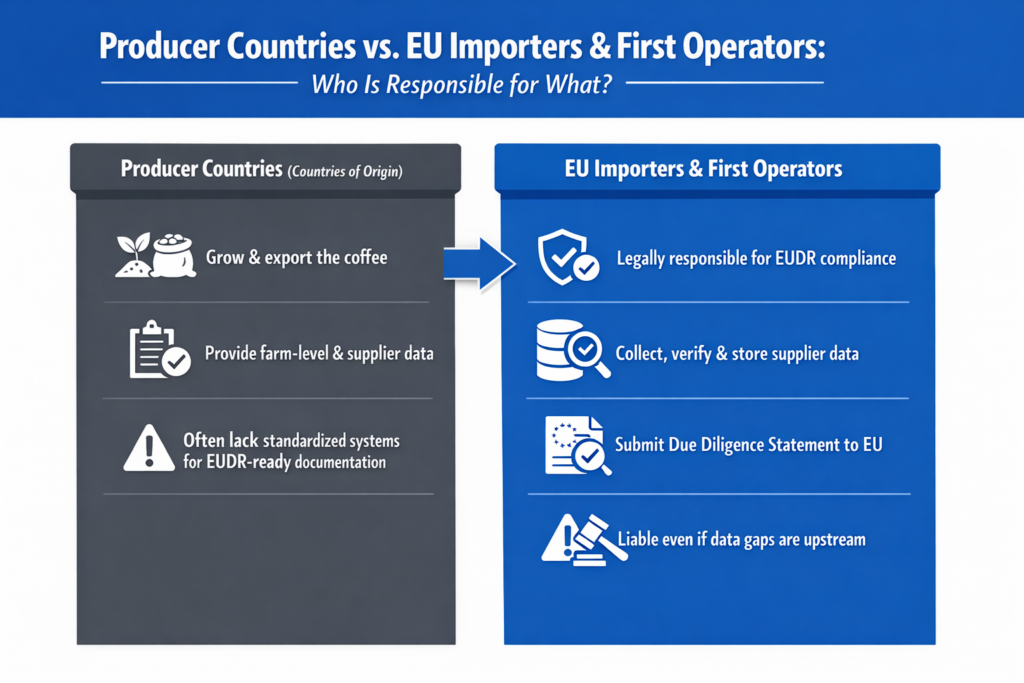
If supplier data is incomplete, inconsistent, or cannot be verified:
Even a single missing geolocation or unclear supplier record can stop an entire EU-bound shipment.
Read our blog on Supplier Data Management for EUDR, where we break down how coffee companies can standardize data collection, validate geolocation, and stay audit-ready without slowing down imports
Explore our guide on Supplier Assessment under EUDR to learn how to score suppliers by deforestation risk, data quality, and traceability—before shipments are blocked or contracts are signed.
While UK companies do not submit DDS filings themselves, they are operationally critical to EUDR compliance.
Any UK company that supplies coffee into the EU or supports EU buyers must provide complete, verifiable supplier data.
If a UK importer:
Then the UK importer must:
Failure to do so blocks EU market access.
UK roasters supplying roasted coffee to EU markets must ensure:
Roasting in the UK does not shield products from EUDR EU placement triggers compliance.
Roles depend on how trading is conducted:
Trading without DDS-ready data creates commercial exposure.
In practice:
UK companies may not be legally liable but they are commercially exposed.
To support EUDR compliance, UK suppliers must provide non-negotiable data, including:
Without this data, EU buyers cannot submit a valid DDS.
| Compliance Pillar | Key Data Points Required | Critical “Why” for Audits |
| 1. Supplier Identity & KYC | • Full Legal Name & Reg. Number • Physical Address • Country of Production (Origin) • Role: Farmer vs. Coop vs. Exporter | Links coffee to a responsible economic actor. Shipments without a verified actor are non-compliant by default. |
| 2. Geolocation & Plot Data | • GeoJSON Polygons (Mandatory >4ha) • GPS Center Points (Allowed <4ha) • Defined plot boundaries | Polygons are the only way to cross-reference satellite imagery to prove no deforestation occurred after 31 Dec 2020. |
| 3. Harvest & Production | • Harvest Year/Production Period • Exact Volume per Plot/Coop • Traceability to Batch/Lot Number | Prevents “laundering” by ensuring volumes are realistic relative to farm size and regional crop calendars. |
| 4. Legality & Compliance | • Land-use legality proof • Local permits/registrations • Producer Declarations (Self-Attest) | Proves coffee wasn’t just deforestation-free but also produced in line with local environmental and labour laws. |
Even well-established coffee companies in the United Kingdom are encountering EUDR-related challenges not because of intent, but because traditional coffee supply chains were never designed for plot-level legal verification. For UK companies supplying the EU, most EUDR failures trace back to a consistent set of supplier data gaps.
Coffee supplied by UK companies to EU markets is often sourced from:
This fragmentation makes reliable farm-level data collection extremely difficult especially under shipping and contract timelines.
Across many origin countries supplying UK buyers, supplier data still exists as:
EUDR requires digital, structured, and verifiable data. Paper-based systems fail at scale.
Geolocation data is frequently provided as:
Inconsistent geolocation is one of the fastest ways UK-linked supply chains fail EUDR checks.
Supplier documentation often arrives:
This leads to:
Under EUDR, ambiguity equals risk even when the coffee itself is compliant.
Aggregation is common in coffee trading but high-risk under EUDR.
Typical issues include:
Once the link between
farm → plot → volume → shipment
is broken, EUDR compliance cannot be demonstrated.
For UK coffee companies supplying the EU, these data gaps are no longer operational inconveniences they are direct threats to market access. Closing them requires digital, standardised, and validated supplier data that can support EU due diligence without slowing trade.
For coffee companies in the United Kingdom, EUDR readiness is not about collecting more data it is about collecting the right data, in the right sequence, from the right suppliers. Even though the UK is outside the EU, UK importers, roasters, and traders supplying the EU must support EUDR compliance with structured, verifiable supplier data.
Below is a practical, job-to-be-done framework used by UK coffee companies supplying EU markets.
Begin by identifying EU-relevant suppliers, not the entire supplier base.
Actions:
Then segment suppliers by risk and volume:
Outcome:
Resources are focused where EU DDS failure risk is highest, not spread evenly across all suppliers.
Step 2 – Standardised Data Collection Framework
Unstructured supplier data is the main cause of EUDR delays. Standardisation is non-negotiable.
Critical point:
Your framework must map exactly to DDS data fields anything extra creates rework and delays.
Step 3 – Validation & Risk Scoring
Collecting data is not enough. Validation converts data into EU-ready compliance.
Key validation steps:
High-risk suppliers should be:
Outcome:
EU DDS failures are prevented upstream rather than discovered at customs or during audits.
For UK coffee companies supplying the EU, structured supplier data collection is now a commercial requirement, not a compliance add-on. Companies that prioritise, standardise, and validate supplier data early will protect EU market access and maintain continuity of trade under EUDR.
TraceX EUDR Compliance Solutions enables UK coffee companies to provide DDS-ready supplier data to EU buyers through a single, connected workflow:
TraceX turns EUDR from a trade barrier into a competitive advantage for UK suppliers.
Supplier Data Collection in EUDR for Coffee in the UK is no longer a support function it is a commercial requirement for EU market access.
UK coffee companies that treat supplier data as a structured, verifiable asset mapping suppliers, standardising collection, validating geolocation, and addressing risk early will retain EU customers and continuity of trade.
Those that do not will face rejected shipments, broken contracts, and lost market access.
In short: EUDR readiness is how UK coffee companies stay relevant in EU coffee trade.
Read the complete EUDR guide to understand your obligations, required data, and due diligence steps clearly and practically.
Read our blog on EUDR Compliance for Coffee Supply Chains to see how importer, roaster, and trader responsibilities connect and where most compliance failures happen.
Explore our guide on EUDR for Operators and Traders to understand legal responsibility, DDS handover, and what checks you must perform before buying or selling coffee in the EU.
Dive into our practical breakdown of EUDR Due Diligence , including required data, risk assessment steps, and how to avoid delays at customs.
French companies must collect supplier identification (KYC), farm- and plot-level geolocation (preferably polygons), harvest year, volumes supplied, traceability to batch or lot, and proof of legal production in the country of origin. Without this data, a Due Diligence Statement (DDS) cannot be submitted and coffee cannot be placed on the EU market.
Yes if the roaster is the first operator placing coffee on the EU market. French roasters that import green coffee directly must hold verified farm- or plot-level geolocation data. Roasters purchasing coffee already placed on the EU market must retain a valid DDS reference and maintain traceability records.
Yes, and digital submission is strongly preferred. Non-EU suppliers (farmers, cooperatives, exporters) can provide EUDR data via digital questionnaires, mapping tools, or platforms that capture GPS polygons and documentation. Digital data is faster to validate and significantly reduces DDS rejection risk for French importers.
Under EUDR, French operators must retain all due diligence and supplier data for at least five years and make it available to competent authorities upon request.
If supplier data changes such as new plots, updated geolocation, ownership changes, or volume adjustments the risk assessment must be updated. Material changes may require a new or revised DDS before coffee linked to that data can be placed on the EU market.