
Quick summary: Supplier Data Collection in EUDR for the Palm Oil Supply Chain in Italy: understand legal responsibilities, mandatory plantation-level data requirements, common supplier data gaps, and how Italian palm oil importers, refiners, food manufacturers, oleochemical producers, biofuel operators, and traders can achieve EUDR compliance without disrupting operations or EU market access.

Supplier Data Collection in EUDR for Palm Oil in Italy has rapidly become a defining compliance challenge for the Italian palm oil sector and for good reason. As one of Europe’s major food manufacturing, confectionery, biofuel, and oleochemical markets, Italy sits firmly within the regulatory scope of the EU Deforestation Regulation (EUDR).
Italy is not a palm oil producer. It is a significant refining, processing, food manufacturing, and industrial hub for palm oil and palm-derived products within Europe. Large volumes of crude palm oil (CPO), refined palm oil, palm kernel oil (PKO), and derivatives enter Italy directly from producing countries such as Indonesia and Malaysia, or via EU entry points like the Netherlands, Belgium, and Spain. These imports are then processed into confectionery, baked goods, spreads, cosmetics, detergents, oleochemicals, and biofuels before being distributed across Italy, the EU, and global markets.
This central industrial role means Italian-based companies are frequently first EU operators or critical downstream operators making EUDR compliance unavoidable.
This guide is designed specifically for:
If your business handles palm oil placed on or moving through the Italian market, mastering Supplier Data Collection in EUDR for Palm Oil in Italy is no longer optional it is the foundation for EU market access, regulatory compliance, and commercial continuity.
Read the complete EUDR guide to clearly understand your legal responsibilities, mandatory supplier data requirements, and due diligence steps for palm oil in Italy.
The EU Deforestation Regulation (EUDR) requires palm oil placed on the EU market to be deforestation-free and legally produced.
In Italy, responsibility falls heavily on:
Italy is one of Europe’s largest industrial consumers of palm oil, particularly in:
Significant volumes of palm oil enter Italy directly or through other EU ports before being refined, fractionated, blended, or converted into derivative products.
Under EUDR, Italian companies placing palm oil or palm-derived products on the EU market must prove using supplier- and farm-level data that the palm oil is not linked to deforestation.
Failure to comply can result in:
EUDR applies not only to crude palm oil but also to a wide range of processed and derivative products, including:
To legally place palm oil on the EU market, Italian companies must:
For palm oil, compliance depends entirely on structured, verifiable supplier data, including:
Palm oil supply chains typically include:
Because palm oil is highly aggregated at mill level, traceability complexity increases significantly.
No data = no market access.
Italy plays a high-exposure role in Europe’s palm oil ecosystem because it is:
Even when palm oil physically enters through another EU Member State (such as Rotterdam or Antwerp), Italian operators may carry EUDR responsibility if they:
This creates heightened exposure for:
Italy’s industrial food and FMCG scale amplifies EUDR liability across multiple supply chain tiers.
Palm oil supply chains are structurally complex and globally distributed.
They typically involve:
Aggregation at mill level makes plantation-level traceability particularly challenging. Without precise geolocation and structured chain-of-custody documentation, demonstrating compliance becomes highly complex.
For Italian palm oil companies particularly confectionery manufacturers, food brands, FMCG producers, and biofuel operators sourcing from high-deforestation-risk countries supplier data collection is not an administrative task. It is the central compliance control point under EUDR.
If you cannot:
You cannot legally place palm oil on the EU market.
For Italy’s palm oil sector, operationalizing structured, verifiable supplier data is the difference between regulatory continuity and commercial disruption under EUDR.
If supplier data for palm oil is incomplete, inconsistent, or cannot be verified, the consequences under the EU Deforestation Regulation are immediate and material for companies operating in Italy:
In practice, a single missing plantation polygon, unclear plot boundary, unverifiable land-use permit, missing mill traceability record, or incomplete supplier documentation file can halt the sale or movement of palm oil — even if the product entered the EU through another Member State and is already stored, refined, or processed in Italy.
Supplier data integrity determines market access.
Read our blog on Supplier Data Management for EUDR to learn how German cocoa companies can standardize supplier data, validate geolocation, and stay audit-ready without disrupting production or sales.
Explore our guide on Supplier Assessment under EUDR to see how to score cocoa suppliers by deforestation risk, data quality, and traceability before contracts are signed or production begins.
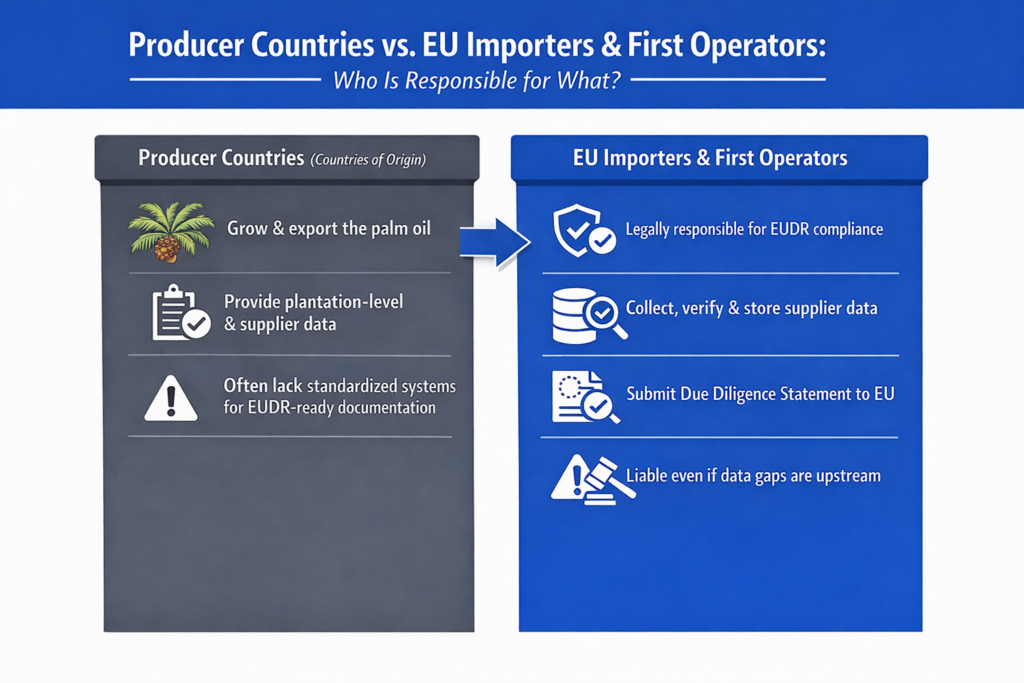
Under EUDR, any company in Italy that places palm oil or palm-derived products on the EU market or trades palm oil without a valid Due Diligence Statement (DDS) reference depends on complete, verifiable supplier data, even if that data originated upstream or in another EU country.
Below is a role-by-role breakdown for the Italian palm oil supply chain.
Palm oil importers based in Italy carry full EUDR responsibility when acting as first operators.
If you import crude palm oil (CPO), refined palm oil, palm kernel oil, or derivatives directly from non-EU countries and place them on the EU market under your name, you are considered a first operator. This means you must:
Even if exporters or international traders provide documentation, legal responsibility remains with the Italian operator.
Italian-based refiners and processors become first operators under EUDR when they:
This includes:
In these cases, companies must ensure:
Processing, fractionation, or transformation does not reduce EUDR exposure. Aggregation at mill and refinery level increases compliance complexity.
Palm oil traders operating in Italy have different obligations depending on their role:
If you import palm oil into the EU or place it on the EU market:
You are a first operator and must collect and verify supplier data and submit a DDS.
If you trade palm oil already placed on the EU market:
You are a downstream operator, but you must still:
Trading palm oil without a valid DDS reference creates direct compliance exposure even if the product remains in storage or in transit within Italy.
Companies purchasing palm oil or palm-derived products after they have already been placed on the EU market are considered downstream operators.
They do not submit a new DDS if:
However, they must still:
If the DDS is missing, invalid, or unverifiable, the downstream operator may become commercially and operationally exposed particularly during inspections or enforcement audits.
This distinction is often misunderstood within Italy’s food, FMCG, chemical, and biofuel industries.
Legal Responsibility
Data Dependency
In practice:
You may not be legally responsible but you are still operationally and commercially exposed if supplier data is weak.
To comply with EUDR, Italian operators must collect non-negotiable supplier data for all palm oil placed on or traded within the EU market.
Missing even one element can invalidate a Due Diligence Statement and block EU market access.
Without verified geolocation and structured chain-of-custody documentation, a DDS cannot be validly submitted.
For Italian palm oil companies particularly those sourcing from high-deforestation-risk regions in Southeast Asia or Latin America supplier data collection is not a compliance formality.
It is the central determinant of whether palm oil can legally enter, circulate, and remain in the EU market under EUDR.
| Compliance Pillar | Key Data Points Required | Critical “Why” for Audits |
|---|---|---|
| 1. Entity & Mill Mapping | MPOB/BPN License Numbers: Official regulatory IDs in Malaysia/Indonesia.Mill Parent ID: Global ID of the processing facility.Smallholder Cluster ID: For aggregated “Independent Smallholder” batches.Refinery Batch ID: Linking refined oil back to specific CPO (Crude Palm Oil) inlets. | The “Leaking” Silo Risk: Palm oil is highly liquid and mixed at the mill. Auditors verify the “First Point of Collection” to ensure that fresh fruit bunches (FFB) from “ghost” plantations (unlicensed or in protected zones) aren’t entering the mill under a compliant neighbor’s ID. |
| 2. Geolocation & Perimeters | GeoJSON Polygons: Mandatory for estates >4ha; GPS points for smallholders <4ha.“HCV” Overlap Check: High Conservation Value area maps.Planting Year Data: Evidence that the palms were planted before the 2020 cut-off.Satellite Chronology: Monthly time-series imagery (Jan 2021–Present). | The “Shadow Plantation” Detection: Large palm estates often have “buffer zones.” Polygons are used to ensure no illegal “encroachment” has occurred into neighboring primary forests or peatlands since Dec 31, 2020, which is a common trigger for EU port rejections. |
| 3. Yield & Harvest Velocity | FFB (Fresh Fruit Bunch) Weight Tickets: From the plantation gate to the mill.Oil Extraction Rate (OER): Mill efficiency metrics.Harvest Cycle Logs: Frequency of harvesting (typically every 10–14 days).Mass Balance Ledger: Reconciling total inflow vs. total outflow of CPO. | The “FFB Laundering” Check: Auditors apply “Yield Logic” (Avg. 18–24 t/ha per year). If a farm “shaves” more FFB than its biology allows, it is flagged as a high-risk entry point for “laundering” fruit from deforested or peat-drained areas. |
| 4. Legality & Human Rights | ISPO/MSPO Certificates: Mandatory national standards (as of Jan 2026).FPIC Documentation: Free, Prior, and Informed Consent from local/Indigenous communities.Labor Audit Logs: Proof of no forced labor or child labor (consistent with ILO standards).Peatland Licenses: Permits for cultivation on designated peat (if applicable). | The “Customary Rights” Anchor: In 2026, “Legality” extends beyond trees to people. Auditors check if the land was acquired legally from local communities. Without digital proof of FPIC, a shipment can be blocked even if the land has zero |
Even highly structured Italian palm oil importers, refiners, confectionery manufacturers, food processors, oleochemical producers, and biofuel operators face serious EUDR exposure because palm oil supply chains were never originally designed for plantation-level deforestation verification.
In practice, most Due Diligence Statement (DDS) risks affecting palm oil placed on the Italian market originate upstream but materialize at the moment of EU market placement.
Palm oil used in Italy is typically sourced through:
The challenge:
For Italian refiners, confectionery producers, and food manufacturers handling bulk palm oil shipments, fragmentation and mill-level aggregation make plantation-level attribution highly complex especially when palm oil enters the EU via ports such as Rotterdam or Antwerp before reaching Italy.
Palm oil is a high-volume, bulk commodity with early-stage aggregation.
Common traceability gaps include:
Once the link between:
plantation → plot polygon → mill → refinery → derivative product
is broken, EUDR compliance cannot be demonstrated — regardless of sustainability certifications or contractual commitments.
Mill-level aggregation is the single largest traceability vulnerability in Italian palm oil supply chains.
Geolocation data supplied to Italian operators often includes:
The risk:
For palm oil, polygon-level mapping at plantation or smallholder plot level is non-negotiable. Point data is insufficient under EUDR.
Italian palm oil importers and processors frequently encounter:
Under EUDR:
Even small inconsistencies can escalate into compliance exposure.
Upstream palm oil documentation often exists as:
Why this creates risk under EUDR:
EUDR requires structured, machine-readable, and verifiable data not fragmented email attachments.
For palm oil companies in Italy, EUDR compliance is not about collecting more data it is about structuring and validating critical data before palm oil is placed on the EU market.
Identify EUDR-relevant suppliers not your entire procurement ecosystem.
Actions:
Segment suppliers by:
Outcome:
Compliance resources are directed where exposure is highest.
Unstructured supplier data is the primary compliance bottleneck.
Best practice includes:
Critical insight:
If supplier data does not map directly to DDS submission fields, operational delays and DDS rejection risk increase significantly.
Data collection alone does not equal compliance.
Geolocation Validation
Volume & Allocation Validation
Supplier Risk Scoring
High-risk suppliers should be:
Outcome:
DDS failures are prevented upstream not discovered during Italian enforcement audits.
TraceX EUDR Compliance Solutions help Italian palm oil importers, refiners, and manufacturers transform fragmented supplier documentation into a structured, audit-ready workflow.
TraceX enables:
For Italian palm oil operators, TraceX converts supplier data collection from a compliance bottleneck into a scalable operational control system protecting food production, confectionery manufacturing, oleochemical operations, biofuel supply, and EU market access.
Build an EUDR-ready palm oil supply chain without manual reconciliation.
Talk to TraceX compliance experts about automating supplier data collection for palm oil under EUDR.
Supplier Data Collection in EUDR for the Palm Oil Supply Chain in Italy is no longer an administrative task it is the defining control point for market access.
Italy’s heavy reliance on imported palm oil for confectionery, bakery, FMCG, oleochemical, and biofuel production places refiners, traders, and manufacturers at the center of EUDR enforcement exposure.
Companies that succeed will treat supplier data as a structured, validated compliance asset mapping plantations, verifying polygons, reconciling mill-level volumes, and managing aggregation risk before palm oil is placed on the EU market.
Those that do not risk DDS rejection, enforcement action, shipment blockage, and commercial disruption.
In Italy’s palm oil sector, mastering supplier data collection is how companies protect operational continuity, regulatory compliance, and long-term EU market access under EUDR.
Read our blog on EUDR Compliance for Palm Oil Supply Chains to see how importer, roaster, and trader responsibilities connect and where most compliance failures happen.
Explore our guide on EUDR for Operators and Traders to understand legal responsibility, DDS handover, and what checks you must perform before buying or selling coffee in the EU.
Dive into our practical breakdown of EUDR Due Diligence, including required data, risk assessment steps, and how to avoid delays at customs.
Frequently Asked Questions (FAQ’s)
Italian companies must collect supplier identification (KYC), plantation- or plot-level geolocation (polygon coordinates), harvest year, production volumes, mill identification, traceability linking shipments to specific plantations or mills, and proof of legal land use. Without this data, a Due Diligence Statement (DDS) cannot be submitted, and palm oil or palm-derived products cannot be legally placed on or traded within the EU market.
Yes if the company is the first operator placing palm oil on the EU market. Italian companies importing crude or refined palm oil directly must hold verified plantation- or plot-level geolocation data and complete a documented risk assessment. Companies sourcing palm oil already placed on the EU market must retain a valid DDS reference and maintain traceability records linking to the original compliant batch.
Yes, and digital submission is strongly recommended. Non-EU suppliers including plantations, smallholders, mills, aggregators, exporters, and traders can provide EUDR data through structured digital questionnaires, plantation-mapping tools, or platforms capturing GPS polygon data and land-use documentation. Digital data improves validation accuracy and significantly reduces DDS rejection risk for Italian operators.
Under the EU Deforestation Regulation, operators in Italy must retain all due diligence documentation and supplier data for at least five years and provide it to competent authorities upon request.
If supplier data changes such as new plantation plots, updated polygon boundaries, revised mill sourcing, ownership adjustments, or production volume updates — the risk assessment must be reviewed and updated. Material changes may require a new or revised DDS before palm oil or palm-derived products linked to the updated data can be placed on or traded within the EU market.









