
Quick summary: Supplier Data Collection in EUDR for the Rubber Supply Chain in Germany: understand legal responsibilities, mandatory supplier data, common compliance risks, and how German tire manufacturers, processors, and importers can meet EUDR requirements without disrupting production or EU market access.

Supplier Data Collection in EUDR for Rubber in Germany has become a critical compliance priority for the country’s tire manufacturers, automotive suppliers, and industrial processors. While Germany is not primarily an import gateway like the Netherlands, it is Europe’s largest manufacturing economy and one of the largest consumers of natural rubber in the EU.
Germany plays a central role in transforming imported rubber into:
Because of this downstream manufacturing strength, German companies are often operators placing rubber-derived products on the EU market making EUDR compliance legally binding at the point of manufacture and commercialization.
For German manufacturers, EUDR compliance is not about port-level logistics it is about supply chain transparency from plantation to finished product.
The EU Deforestation Regulation (EUDR) requires that rubber and rubber-derived products placed on the EU market must be:
In Germany, EUDR obligations apply primarily to:
Germany’s rubber supply chain is import-heavy, with natural rubber imports at $391M (2023, ~200k tonnes equiv.) and total rubbers $17.88B exports/$13B+ imports (2024), processing into tires (Continental, Michelin) and components via Hamburg port hubs.
Even when raw rubber enters the EU through other countries (e.g., the Netherlands or Belgium), German companies placing finished rubber products on the market can still be classified as operators under EUDR.
That means compliance responsibility cannot be outsourced even if sourcing is managed by traders or intermediaries.
German companies placing rubber or rubber-derived goods on the EU market must:
Failure to comply can result in:
For Germany’s automotive sector where ESG scrutiny is already intense enforcement risk carries both legal and brand implications
Germany’s rubber challenge is upstream visibility.
Manufacturers must collect and validate supplier-level data that often originates thousands of kilometers away in:
Required data includes:
For large tire manufacturers using multi-origin supply chains, aggregation and mixing increase traceability complexity.
No verified geolocation data = no compliant finished product.
Germany’s risk profile differs from logistics hubs like the Netherlands.
Its exposure stems from:
Unlike transit countries, Germany’s EUDR enforcement risk is embedded in manufacturing and commercialization not just import clearance.
This means:
Compliance is enforced at the product level, not just the raw material level.
For German tire manufacturers and industrial processors, supplier data collection under EUDR is not just a compliance checkbox.
It is now a core supply chain governance function.
Key priorities include:
Because German companies operate in highly visible global markets, enforcement or non-compliance would have cascading commercial impacts across automotive supply chains.
For German companies, EUDR compliance requires:
Supplier data collection is no longer administrative.
It is strategic risk management.
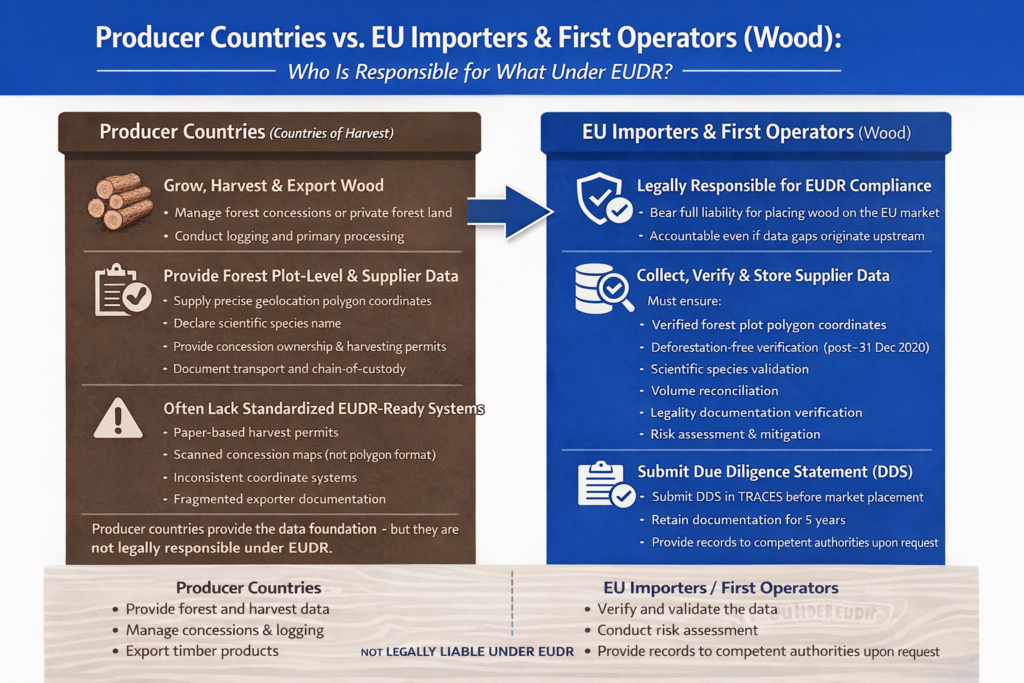
If supplier data for rubber is incomplete, inconsistent, or unverifiable, the consequences under the EU Deforestation Regulation (EUDR) are immediate and commercially significant for German operators.
• Finished rubber goods may be blocked from being placed on the EU market
• Tire shipments may be halted before distribution
• Authorities can impose financial penalties and corrective measures
• Companies face intensified regulatory audits
• Automotive OEMs may reject deliveries due to missing or invalid Due Diligence Statement (DDS) references
• Production schedules may be disrupted due to non-compliant raw material inputs
In Germany, where rubber feeds directly into high-value automotive and industrial manufacturing, a single missing plantation polygon, unverifiable geolocation coordinate, or incomplete supplier record can halt commercialization of finished goods.
Unlike port-based disruption, Germany’s exposure is embedded in manufacturing output. If rubber inputs are non-compliant, the finished tire, component, or industrial product cannot legally enter the EU market.
For Germany’s automotive ecosystem, compliance failures do not stay within a single factory they can cascade across Tier 1 suppliers, OEM production lines, and export commitments.
Read our blog on Supplier Data Management for EUDR to learn how Dutch cocoa companies can standardize supplier data, validate geolocation, and remain audit-ready without disrupting imports or processing operations.
Explore our guide on Supplier Assessment under EUDR to see how to score cocoa suppliers by deforestation risk, data quality, and traceability before shipments arrive at Dutch ports or contracts are finalized.
Under EUDR, any company in Germany that places rubber or rubber-derived products on the EU market must ensure supplier data is complete, verifiable, and linked to a valid DDS reference even if that data originates upstream.
Below is a role-by-role breakdown for the German rubber supply chain.
Germany hosts major global tire manufacturers. When these companies place tires on the EU market using natural rubber, they may qualify as operators under EUDR particularly when importing directly or when first commercializing the product.
Responsibilities include:
• Ensuring plantation-level polygon geolocation exists
• Verifying deforestation-free status post-31 December 2020
• Conducting documented risk assessments
• Submitting a Due Diligence Statement (DDS) where applicable
• Preserving traceability from rubber input to finished tire
Because rubber is transformed during tire production, traceability systems must preserve upstream compliance evidence throughout the manufacturing process.
Processing does not remove responsibility it increases documentation complexity.
German industrial manufacturers using natural rubber in:
• Automotive seals and belts
• Engineering components
• Machinery parts
• Conveyor systems
may become operators if they import directly or place rubber-derived goods on the EU market for the first time.
In these cases, companies must ensure:
• Rubber volumes are traceable to mapped plantation polygons
• Risk assessments are completed and documented
• DDS submissions are properly filed before commercialization
Failure to validate upstream supplier data can prevent finished goods from being legally marketed.
If a German company imports natural rubber directly from origin countries under its own name, it becomes a first operator under EUDR.
This includes responsibility to:
• Collect supplier and plantation data
• Validate geolocation and deforestation status
• Conduct structured risk assessment
• Submit DDS prior to placing rubber on the EU market
Even if origin suppliers provide documentation, legal liability remains with the German importer.
German traders play different roles depending on transaction structure.
If you import rubber directly:
You are a first operator and must collect, verify, and file DDS documentation.
If you trade rubber already placed on the EU market:
You are a downstream operator but must still:
• Verify a valid DDS reference exists
• Maintain traceability to the original compliant batch
• Retain supplier and transaction records
• Pass DDS references to buyers
Trading rubber without a valid DDS reference exposes the trader to audit risk and commercial disruption.
Companies purchasing rubber-derived goods within Germany may qualify as downstream operators.
They are not required to file a new DDS if:
• A valid DDS already exists
• The product remains unchanged
• Traceability is preserved
However, they must still:
• Verify DDS references
• Maintain documentation for audits
• Ensure compliance evidence is retained
If the DDS is missing or unverifiable, downstream companies may face shipment rejection, contractual disputes, or regulatory exposure.
This distinction is critical in Germany’s manufacturing-heavy rubber sector.
• Lies with the first operator placing rubber or rubber-derived products on the EU market
• Includes liability for incorrect or misleading supplier data
• Affects manufacturers, OEM suppliers, and downstream distributors
• Even when not legally filing DDS, they depend on upstream supplier data integrity
• Missing or weak data can halt product sales or exports
In Germany:
You may not be the original importer but if you place the finished rubber product on the market, compliance exposure sits with you.
For rubber placed on the EU market by German companies, the following supplier data is non-negotiable:
If even one of these elements is missing or unverifiable, the Due Diligence Statement may be invalid preventing lawful commercialization of rubber-derived products.
| Compliance Pillar | Key Data Points Required | Critical “Why” for Audits |
| 1. Supplier Identity & Onboarding | • Smallholder ID / Dealer License • Business Registration (Processors) • Tier-1 to Tier-N Mapping • Ownership/Landlord details | Rubber often passes through “Village Dealers” before reaching a processing plant. KYC is essential to ensure that “middlemen” aren’t laundering rubber from unmapped or illegal forest incursions into the factory supply. |
| 2. Geolocation & Plot-Level Proof | • GeoJSON Polygons (Mandatory >4ha) • GPS Center Points (Allowed <4ha) • Coordinates to 6 decimal places • Satellite Baseline (Post-Dec 2020) | Rubber trees (Hevea brasiliensis) look identical to natural forest in low-res satellite data. Accurate polygons allow high-res AI to detect “monoculture rows” vs. natural forest canopy to confirm no clearing occurred after the 2020 cutoff. |
| 3. Harvest & Mass Balance | • Monthly Dry Rubber Content (DRC) • Tapping Cycle Logs • Batch IDs for Smoked Sheets/Latex • Processing Yield Ratios | Unlike timber, rubber is harvested daily. Auditors use Mass Balance Verification to check if a factory’s output exceeds the biological yield capacity of its mapped polygons. If you produce more than your mapped trees can “bleed,” it’s a red flag for illegal sourcing. |
| 4. Legality & Land Tenure | • Land Use Permits / Concession IDs • Proof of Customary Rights (if applicable) • Labor & Human Rights Declaration • GPSNR Alignment (Sustainability Policy) | In Southeast Asia and Africa, many smallholders operate on customary land without formal titles. Auditors look for National Rubber Board registrations or tax receipts as “proxy evidence” of legal land-use rights to satisfy the legality requirement. |
Even the most sophisticated tire manufacturers, automotive suppliers, rubber processors, and industrial component producers in Germany are encountering EUDR compliance challenges because global rubber supply chains were never designed for plantation-level regulatory verification.
In practice, most Due Diligence Statement (DDS) failures affecting rubber used in German manufacturing can be traced back to recurring supplier data weaknesses.
Natural rubber imported into Germany directly or via other EU entry points often originates from:
Common issues include:
• Inconsistent plantation identifiers
• Seasonal variation in supplier lists
• Limited visibility into sub-suppliers
• Mixing of rubber volumes before export
For German manufacturers relying on stable input flows, fragmentation at origin creates upstream data instability that can jeopardize finished product commercialization.
A single batch of rubber used in tire production may trace back to hundreds of smallholders each requiring verified geolocation and legality documentation.
Despite Germany’s highly digitized industrial ecosystem, much supplier data at origin remains:
• Handwritten plantation records
• Informal collection notes
• Paper-based land documentation
• Local spreadsheets maintained by cooperatives
EUDR requires structured, digitally verifiable, geospatially validated data.
Paper-based systems do not integrate cleanly into German ERP, procurement, or compliance workflows creating friction between upstream realities and downstream legal requirements.
Common geolocation issues affecting German rubber buyers include:
• Point coordinates submitted instead of polygon boundaries
• Incomplete plantation mapping
• Overlapping or duplicated plot data
• Coordinates outside known rubber-growing zones
• Missing timestamps linked to production cycles
Consequences:
• Satellite verification generates inconclusive or high-risk flags
• Risk assessments become unreliable
• DDS submissions are delayed or rejected
For German manufacturers placing finished rubber products on the EU market, poor-quality geolocation data can block commercialization at the final product stage.
Polygon-level plantation mapping is no longer optional it is foundational.
Supplier documentation frequently arrives:
• In local languages without certified translation
• With inconsistent naming conventions
• Without standardized legal declarations
• Using land classification terms unfamiliar to EU authorities
Under EUDR, unclear legality equals compliance risk even if the rubber is responsibly sourced.
German companies operating in a highly regulated industrial environment face elevated audit scrutiny. Ambiguity in upstream documentation increases exposure during regulatory review.
Aggregation is intrinsic to global rubber trade — but it introduces structural compliance risk.
If the chain linking:
plantation → polygon → volume → batch → finished product
is disrupted, EUDR compliance cannot be demonstrated.
For German tire and automotive suppliers, aggregation risk is particularly critical because rubber undergoes transformation. Once inputs are mixed and processed, reconstructing upstream traceability becomes far more complex.
Traceability must survive transformation.
For rubber companies operating in Germany, EUDR compliance is not about collecting more data it is about collecting validated, manufacturing-linked, DDS-ready data.
Start by identifying EUDR-relevant rubber suppliers linked to products placed on the EU market.
Actions:
• Map all rubber inputs used in EU-bound products
• Identify direct import suppliers versus EU-based traders
• Trace rubber batches to origin where possible
• Flag high-volume or high-frequency suppliers
Segment suppliers by:
• Volume contribution
• Country-level deforestation risk
• Data maturity
• Aggregation complexity
Prioritization model:
• High volume + high deforestation risk → immediate verification
• High volume + moderate risk → structured validation
• Low volume + high risk → remediation plan or alternative sourcing
Outcome:
Compliance controls are implemented before rubber enters production not after products are manufactured.
Unstructured supplier submissions are the primary bottleneck in German compliance programs.
Best practice includes:
• Structured digital questionnaires aligned to DDS fields
• Mandatory plantation-level polygon geolocation
• Production and tapping timeline capture
• Legal compliance declarations standardized for EU review
• Digital document storage linked to batch-level traceability
Critical principle:
If supplier data does not directly map to DDS requirements, last-minute reformulation will delay commercialization.
German manufacturing operates on precision compliance systems must match that standard.
Data collection alone does not ensure compliance.
Validation must include:
• Polygon boundary completeness
• Accuracy checks within recognized rubber-growing zones
• Satellite overlay confirmation
• Compliance with 31 December 2020 cut-off
• Land-use history screening
• Proximity to protected or high-risk zones
• Data completeness score
• Geographic risk exposure
• Aggregation complexity
• Traceability resilience
High-risk suppliers should be:
• Flagged before production scheduling
• Assigned remediation timelines
• Replaced where risk mitigation fails
Outcome:
DDS rejections are prevented before finished goods are placed on the EU market.
TraceX EUDR Compliance Solutions help German tire manufacturers, rubber processors, and industrial suppliers transition from fragmented upstream data to structured, production-ready compliance.
• Digital supplier onboarding captures plantation-level KYC and documentation
• GPS-verified polygon mapping ensures geolocation integrity
• AI-driven geospatial validation identifies deforestation exposure
• Automated risk scoring integrates with procurement workflows
• DDS-ready data structures support seamless submission and audit defense
• ERP integration maintains traceability from rubber input to finished product
For Germany’s manufacturing-driven rubber sector, TraceX transforms supplier data collection into an integrated compliance operating model protecting commercialization timelines and safeguarding EU market access.
Build an EUDR-ready rubber supply chain that aligns with Germany’s precision manufacturing standards.
Supplier Data Collection under EUDR for Germany’s rubber supply chain is no longer an upstream administrative task it determines whether finished rubber products can legally be commercialized within the EU.
Germany’s exposure lies not at the port but at the factory and product level.
Companies that digitize supplier onboarding, implement polygon-level geolocation validation, and embed structured risk assessment into procurement will maintain uninterrupted market access.
Those that rely on fragmented upstream data will face DDS rejections, product delays, contractual disputes, and enforcement scrutiny.
In Germany’s rubber sector, mastering supplier data collection is how companies protect manufacturing continuity, regulatory credibility, and long-term competitiveness under EUDR.
Understand what EUDR means for your rubber supply chain. Read our complete guide to EUDR cocoa compliance and learn how to protect EU market access.
Explore our guide on EUDR for Operators and Traders to understand legal responsibility, DDS handover, and what checks you must perform before buying or selling coffee in the EU.
Dive into our practical breakdown of EUDR Due Diligence , including required data, risk assessment steps, and how to avoid delays at customs.
German companies placing rubber or rubber-derived products on the EU market must collect: supplier identification (KYC), plantation- or plot-level polygon geolocation, production or tapping period, supplied volumes, traceability linking rubber to batches or finished products, and proof of legal production in the country of origin. Without this structured data, a Due Diligence Statement (DDS) cannot be validated, and finished rubber goods cannot be legally commercialized in the EU.
Yes, if they qualify as first operators or import rubber directly. German companies placing rubber or rubber-derived products on the EU market must ensure verified plantation- or plot-level geolocation data exists and supports deforestation-free sourcing. Even when sourcing through EU traders, manufacturers must retain a valid DDS reference and preserve traceability to compliant rubber inputs.
Yes. Suppliers in Southeast Asia, Africa, and Latin America can submit EUDR-compliant data digitally through structured onboarding tools, plantation-mapping platforms, or systems capturing GPS polygon data and supporting legal documentation. Digital submission significantly improves validation speed, reduces geolocation errors, and lowers DDS rejection risk before products reach commercialization in Germany.
Operators in Germany must retain due diligence documentation and supplier data for at least five years. Records must be readily accessible to competent authorities in case of audit, investigation, or regulatory review.
If supplier data changes such as new plantation plots, updated geolocation boundaries, ownership modifications, or revised rubber volumes the risk assessment must be updated. Material changes may require submission of a new or revised DDS before affected rubber-derived products can be placed on the EU market.