
Quick summary: Supplier Data Collection in EUDR for the Wood Supply Chain in Italy: understand legal responsibilities, mandatory forest-level data requirements, common supplier gaps, and how Italian timber importers and manufacturers can achieve EUDR compliance without disrupting production or EU and export distribution.

Supplier Data Collection in EUDR for Wood Supply Chains in Italy has rapidly become a strategic compliance priority for Italian timber importers, furniture manufacturers, traders, and distributors. As one of Europe’s largest wood-processing and furniture-producing economies, Italy plays a central role in transforming imported timber into high-value finished goods placing it firmly within the enforcement scope of the EU Deforestation Regulation (EUDR).
Italy is not only a major processor of wood but also a significant importer of sawn timber, veneer, plywood, panels, pulp, and semi-finished wood components. Large volumes enter directly from non-EU producer countries or through EU trade hubs such as Germany, the Netherlands, and Belgium. Once in Italy, these materials are transformed into furniture, interior design products, flooring, packaging, and paper or redistributed across EU and global markets.
For Italian companies, mastering Supplier Data Collection under EUDR is now fundamental to maintaining EU market access and protecting export continuity.
This guide is designed specifically for:
If your business handles wood or wood-derived products entering or moving within Italy, structured supplier data collection under EUDR is no longer optional it is essential for uninterrupted EU trade
The EU Deforestation Regulation (EUDR) requires companies placing certain commodities including wood on the EU market to prove that products are:
In Italy, responsibility typically falls on:
Even if timber enters through another EU Member State before reaching Italy, Italian companies may bear responsibility if they are the first to place the product on the EU market.
Companies must:
EUDR applies to a broad range of wood and wood-based products commonly used in Italy’s manufacturing sector, including:
For Italian operators, compliance depends entirely on structured supplier data, including:
Without verified geolocation and full traceability documentation, a valid DDS cannot be submitted.
No data = no lawful placement on the EU market.
Incomplete or inaccurate documentation can lead to shipment delays, increased audit scrutiny, administrative penalties, or reputational damage particularly for Italian brands exporting globally
Italy’s exposure is driven by several structural factors:
Unlike transit-heavy trading hubs, Italy combines high import volumes with intensive downstream transformation. Wood often moves quickly from import to processing to finished goods production, increasing documentation complexity.
Italian companies are therefore exposed both as first operators and as downstream manufacturers reliant on upstream compliance integrity.
For Italian wood companies, supplier data collection is not simply an administrative requirement — it is the central operational risk under EUDR.
Italian wood supply chains are frequently multi-tiered and international, involving:
Ensuring accurate forest plot geolocation polygons, verified species identification, volume reconciliation, legality documentation, and full chain-of-custody traceability requires structured digital systems not fragmented spreadsheets or email-based document exchanges.
Under EUDR, if a company cannot trace wood back to the specific forest plot and demonstrate both legality and deforestation-free status, the product cannot legally be placed on the EU market.
For Italian operators especially those in furniture and high-value manufacturing — supplier data collection has shifted from sustainability reporting to regulatory survival. Companies that fail to operationalize structured, verifiable supplier data risk:
In Italy’s manufacturing-driven wood economy, robust supplier data systems are now a prerequisite for regulatory compliance, operational continuity, and long-term EU market access under EUDR.
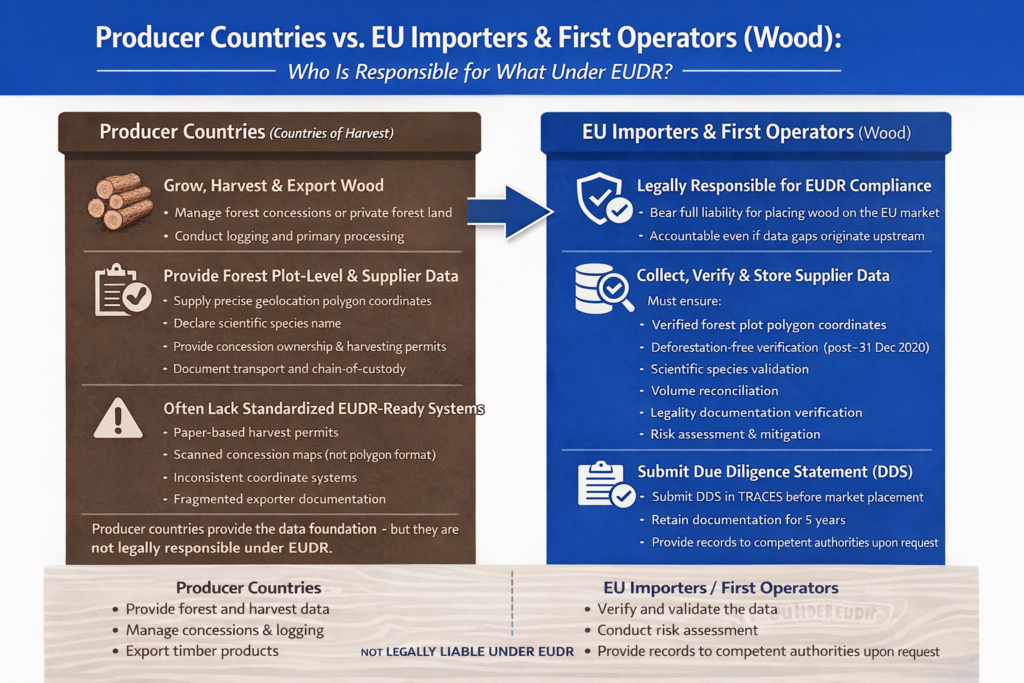
If supplier data for wood products is incomplete, inconsistent, or unverifiable, the consequences under the EU Deforestation Regulation (EUDR) are immediate and commercially significant for Italian companies.
Italy’s wood sector — particularly furniture, flooring, interior design, and packaging — is heavily export-oriented. This means compliance failures can disrupt not only domestic sales but also EU-wide and international distribution.
If supplier data gaps are identified:
In practice, a single missing forest plot polygon, incorrect scientific species name, or unverifiable harvesting permit can delay or invalidate an entire shipment even if the timber has already been processed into furniture, flooring, or packaging products.
For Italian wood manufacturers, supplier data gaps are not minor documentation errors they are direct market access, production continuity, and export risks.
Read our blog on Supplier Data Management for EUDR to learn how Dutch coffee companies can standardize supplier data, validate geolocation, and stay audit-ready without slowing imports.
Explore our guide on Supplier Assessment under EUDR to see how to score suppliers by deforestation risk, data quality, and traceability before shipments move through Dutch ports or contracts are signed.
Under EUDR, any company in Italy that places wood or wood-derived products on the EU market or trades wood without a valid Due Diligence Statement (DDS) reference depends on complete, verifiable supplier data, even if that data originates upstream.
Below is a role-by-role breakdown within the Italian wood supply chain.
Italian timber importers carry the highest level of EUDR responsibility.
If you import logs, sawn timber, veneer, plywood, pulp, panels, or other wood products directly from non-EU countries and place them on the EU market, you are considered a first operator.
You must:
Even if exporters, certification schemes, or agents provide documentation, legal responsibility remains with the Italian importer.
Italian manufacturers including furniture producers, flooring manufacturers, interior design companies, packaging producers, and paper mills may become first operators when importing timber directly from outside the EU.
This applies when companies:
In these cases, they must ensure:
Processing timber into finished goods does not remove EUDR responsibility. In fact, it increases documentation complexity due to:
For Italy’s manufacturing-driven wood sector, integration between procurement, compliance, and production systems becomes critical.
Italian wood traders operate under different obligations depending on their activity.
If you import wood into the EU:
You are a first operator and must collect, verify, and assess supplier data and submit a DDS.
If you trade wood already placed on the EU market:
You are a downstream operator, but you must still:
Trading timber or finished wood products without a valid DDS reference creates direct compliance exposure even if the trader never physically alters the product.
Companies purchasing wood after it has already been placed on the EU market are considered downstream operators.
They do not submit a new DDS if:
However, they must still:
If the DDS is missing, invalid, or unverifiable, downstream operators in Italy may face operational disruption, halted sales, and regulatory scrutiny.
This distinction is often misunderstood in Italy’s highly interconnected wood manufacturing ecosystem.
In practice:
You may not hold formal legal responsibility but you remain commercially and operationally exposed if supplier data is incomplete or weak.
To comply with EUDR, Italian operators must collect and retain non-negotiable supplier data for all wood products placed on the EU market.
Missing even one of these elements can invalidate a Due Diligence Statement and block EU market placement.
Without verified plot-level geolocation and legally compliant harvesting documentation, a DDS cannot be validly submitted.
For Italian wood companies operating in one of Europe’s most manufacturing-intensive economies, supplier data collection is no longer a compliance checkbox it is the decisive factor determining whether timber can legally enter, circulate, and remain in the EU market under EUDR.
| Compliance Pillar | Key Data Points Required | Critical “Why” for Audits |
| 1. Supplier Identity & KYC | • Full Legal Name & Reg. Number • Physical Address • Country of Production (Origin) • Role: Forest Owner vs. Concession Holder vs. Sawmill | Establishes the chain of custody. Audits require proof that every entity handling the wood is a verified, legal operator. |
| 2. Geolocation & Plot Data | • GeoJSON Polygons (Mandatory for the plot of land) • GPS Coordinates • Precise forest concession boundaries | Unlike some commodities, timber requires exact polygons to ensure the specific trees harvested were not part of a protected or recently deforested area. |
| 3. Species & Harvest Data | • Scientific Name (Genus/Species) & Common Name • Harvest Date/Period • Quantity (Volume in m³ or Net Mass) • Log/Batch Identification | Prevents species substitution and “wood laundering.” The volume must match the biological capacity of the specific plot of land. |
| 4. Legality & Environmental Compliance | • Harvesting Permits/Concession Licenses • Proof of compliance with local land tenure rights • Evidence of adherence to national forest legislation | Ensures the wood is legally harvested. It confirms the operator had the right to harvest and followed local environmental and labor codes. |
Even highly structured Italian timber importers and manufacturers face EUDR challenges because traditional wood supply chains were not designed for plot-level geolocation validation and deforestation cut-off verification. In practice, most Due Diligence Statement (DDS) risks in Italy stem from recurring supplier data weaknesses particularly where imported timber feeds into furniture, flooring, and interior manufacturing clusters.
Italy’s wood sector is transformation-intensive: raw or semi-processed timber is rapidly converted into high-value finished goods. This increases traceability pressure and magnifies the impact of upstream data gaps.
Wood entering Italy is often sourced through:
For Italian manufacturers operating fast-turn production for domestic and export markets, fragmented sourcing makes reliable forest-level traceability operationally complex especially when materials move quickly into machining, veneering, lamination, or finishing lines.
Despite Italy’s strong industrial base, upstream documentation frequently includes:
Given Italy’s strong enforcement of EU environmental legislation, documentation inconsistencies are likely to be scrutinized during inspections particularly for export-oriented manufacturers.
Common geolocation gaps in Italian supply chains include:
The risk:
For Italian operators exporting high-value wood products, geolocation validation is one of the most technically sensitive elements of EUDR compliance.
Italian furniture and interior manufacturers frequently process mixed hardwood inputs. Common supplier data gaps include:
Under EUDR:
Even minor discrepancies can escalate into compliance exposure during inspections or customer due diligence reviews.
Italy’s globally recognized furniture and design industries introduce additional compliance complexity:
Once the traceability link between:
forest plot → harvest documentation → shipment → Italian manufacturing batch → finished product
is broken, EUDR compliance cannot be demonstrated.
For Italian exporters, traceability breakdowns directly threaten EU and international market access.
For Italian operators, EUDR compliance requires a structured, digitally integrated supplier data strategy particularly where imports feed into manufacturing clusters and export channels.
Not all suppliers carry equal risk.
Actions:
Outcome:
Compliance resources focus where production exposure and export revenue risk are greatest.
Unstructured supplier submissions are the primary bottleneck in Italian wood supply chains.
Best practices include:
Critical insight:
If supplier data does not directly map to DDS submission requirements, Italian manufacturing timelines may be disrupted by last-minute compliance corrections.
Data collection alone does not ensure compliance validation is essential.
Supplier Risk Scoring
High-risk suppliers should be:
Outcome:
DDS issues are resolved before timber enters Italian production facilities.
TraceX EUDR Compliance Solutions help Italian timber importers and manufacturers transition from fragmented supplier documentation to a structured, audit-ready compliance workflow.
Through digital onboarding, TraceX collects supplier KYC data, concession documentation, and harvesting permits directly from forest operators and exporters. GPS-verified polygon capture ensures accurate forest-level geolocation, while AI-powered validation detects deforestation overlaps and coordinate inconsistencies at an early stage. Automated EUDR-aligned risk scoring enables Italian compliance teams to prioritize high-risk suppliers before procurement or manufacturing integration.
Structured outputs are TRACES-ready and integrate with ERP, procurement, and production systems commonly used in Italy’s wood manufacturing clusters.
For Italian wood companies, TraceX transforms EUDR compliance from a documentation burden into a scalable operational control framework that supports both domestic sales and export continuity.
Supplier Data Collection under EUDR in Italy is no longer a sustainability reporting task it is a strategic operational safeguard.
As one of Europe’s most manufacturing-intensive wood economies, Italy faces both import dependency and export sensitivity. Companies that succeed will treat supplier data as a structured, validated compliance asset mapping forest plots, digitizing documentation, verifying legality, and embedding traceability into procurement and production systems.
Those that fail to do so risk DDS rejection, export disruption, audit exposure, and reputational damage.
In Italy’s design-driven and export-oriented wood sector, mastering supplier data collection is how companies secure regulatory compliance, production continuity, and long-term EU market access under EUDR.
Read our blog on EUDR Compliance for Timber Supply Chains to see how importer, roaster, and trader responsibilities connect and where most compliance failures happen.
Explore our guide on EUDR for Operators and Traders to understand legal responsibility, DDS handover, and what checks you must perform before buying or selling coffee in the EU.
Dive into our practical breakdown of EUDR Due Diligence , including required data, risk assessment steps, and how to avoid delays at customs.
Italian companies placing wood or wood-derived products on the EU market must collect supplier identification (KYC), forest plot-level geolocation (polygon coordinates), country and region of harvest, harvest timeframe, scientific species name, harvested volume, proof of legal harvesting rights, and full traceability linking shipments to specific forest plots. Without this data, a Due Diligence Statement (DDS) cannot be submitted and products cannot be legally placed on or traded within the EU market.
Yes if the manufacturer is the first operator placing imported wood on the EU market. Italian manufacturers importing timber directly from non-EU countries must hold verified forest plot polygon data and conduct a documented risk assessment before submitting a DDS. Manufacturers purchasing wood already placed on the EU market must retain a valid DDS reference and maintain traceability documentation.
Yes, and digital submission is strongly recommended. Non-EU suppliers including forest concession holders, logging operators, veneer producers, and exporters can provide EUDR-compliant data through structured digital templates, forest-mapping tools, or platforms that capture GPS polygon coordinates and supporting harvest documentation. Digital data improves validation accuracy and reduces DDS rejection risk for Italian importers and manufacturers.
Under EUDR, operators in Italy must retain all due diligence documentation and supplier data for at least five years and make it available to competent authorities upon request. This includes geolocation files, harvesting permits, legality documentation, risk assessments, mitigation measures, and DDS references.
If supplier data changes such as new forest plots, updated geolocation boundaries, revised concession ownership, new species declarations, or volume adjustments the risk assessment must be updated. Material changes may require a new or revised Due Diligence Statement before wood linked to the updated data can be placed on or traded within the EU market. Failure to update documentation can result in audit findings, shipment delays, administrative penalties, or export disruption.