
Quick summary: Supplier Data Collection in EUDR for the Wood Supply Chain in Switzerland: understand export responsibilities, mandatory forest-level data requirements, common supplier gaps, and how Swiss timber exporters and manufacturers can meet EUDR expectations without disrupting EU trade.

Supplier Data Collection in EUDR for Wood Supply Chains in Switzerland has rapidly become a strategic compliance priority for Swiss timber traders, furniture manufacturers, wood processors, and exporters. Although Switzerland is not part of the European Union, its deep economic integration with the EU means that Swiss wood companies exporting to EU Member States must fully comply with the EU Deforestation Regulation (EUDR).
Switzerland is a significant wood-processing nation with strong domestic forestry, but it also imports timber, plywood, veneer, pulp, paper, and finished wooden products from both EU and non-EU countries. Swiss manufacturers export substantial volumes of furniture, construction materials, engineered wood, and packaging into the EU market. As a result, EUDR obligations apply whenever Swiss companies place wood or wood-derived products on the EU market through export.
For Swiss operators, Supplier Data Collection under EUDR is not optional it is fundamental to maintaining uninterrupted access to EU customers.
This guide is designed specifically for:
• Swiss timber exporters shipping wood products into the EU
• Wood traders sourcing from non-EU origins and selling into EU markets
• Furniture and construction material manufacturers exporting to Germany, France, Italy, and other EU countries
• Pulp and paper companies supplying EU buyers
• Packaging producers serving EU-based clients
• Compliance, procurement, and sustainability teams operationalizing EUDR requirements for EU-bound goods
If your business exports wood or wood-derived products from Switzerland into the EU, mastering Supplier Data Collection under EUDR is essential to preserving EU market access.
The EU Deforestation Regulation (EUDR) requires companies placing certain commodities including wood on the EU market to prove that products are:
• Deforestation-free (not harvested from land deforested after 31 December 2020)
• Produced in compliance with the laws of the country of origin
• Covered by a submitted Due Diligence Statement (DDS)
Although Switzerland is not subject to EU legislation domestically, Swiss companies become indirectly subject to EUDR when:
• They export wood products into the EU
• They act as suppliers to EU importers who must submit a DDS
• They are contractually required by EU buyers to provide EUDR-compliant documentation
In many cases, the EU importer submitting the DDS will require complete and verified supplier data from Swiss exporters.
Even though legal submission responsibility may lie with the EU-based importer, Swiss exporters remain commercially dependent on providing compliant, verifiable data.
For wood products exported from Switzerland to the EU, companies must be prepared to provide:
• Supplier-level and forest plot-level data
• Geolocation polygon coordinates for harvest plots
• Harvest timeframe and origin information
• Scientific species names
• Volume reconciliation data
• Proof of legal harvesting rights
• Full traceability linking shipments to forest plots
If Swiss companies cannot provide complete, structured supplier data, EU buyers may refuse shipments or suspend contracts due to their own DDS obligations.
EUDR applies to a wide range of wood and wood-based products exported from Switzerland, including:
• Logs and sawn timber
• Veneer and plywood
• Particleboard and fibreboard
• Wooden furniture
• Engineered wood products
• Pulp and paper
• Wood packaging materials
Swiss exporters must be prepared to provide structured data equivalent to what EU operators must submit in a DDS.
This includes:
• Precise forest plot-level geolocation polygons
• Country and sub-national region of harvest
• Harvest date or production timeframe
• Scientific species identification
• Volume harvested and supplied
• Verified legality documentation
• Traceability linking shipments to specific forest plots
Without verified geolocation and complete traceability documentation, EU importers cannot validly submit a DDS.
No DDS = no lawful placement on the EU market.
For Swiss exporters, incomplete documentation can result in rejected shipments, delayed customs clearance within the EU, contract cancellations, and loss of EU customers.
Switzerland’s exposure stems from structural trade and manufacturing realities:
• Strong export orientation toward EU markets
• High-value furniture and engineered wood exports
• Cross-border trade integration with Germany, France, and Italy
• Use of imported tropical hardwood in premium products
• Complex processing and transformation before export
Unlike EU Member States, Switzerland does not have domestic EUDR enforcement but Swiss companies face strict commercial enforcement through EU buyers.
If supplier data is weak, EU customers may refuse goods regardless of Swiss domestic compliance standards.
Swiss companies are therefore commercially exposed even if they are not legally the first EU operator.
For Swiss wood companies, supplier data collection is not just a sustainability requirement it is a commercial survival factor for EU trade.
Wood supply chains serving Swiss exporters often involve:
• Domestic forest concession owners
• Imported timber from non-EU countries
• Logging contractors
• Sawmills and processors
• International suppliers
• EU import partners
Ensuring accurate geolocation polygons, species verification, volume reconciliation, legality documentation, and traceability alignment requires structured digital systems not fragmented documentation chains.
Under EUDR, if timber cannot be traced back to specific forest plots with validated legality and deforestation-free status, EU importers cannot place the product on the EU market.
For Swiss exporters, supplier data collection has shifted from sustainability differentiation to EU market access protection.
Companies that fail to operationalize structured, verifiable supplier data risk shipment rejection, contractual disputes, and long-term commercial disadvantage in EU markets.
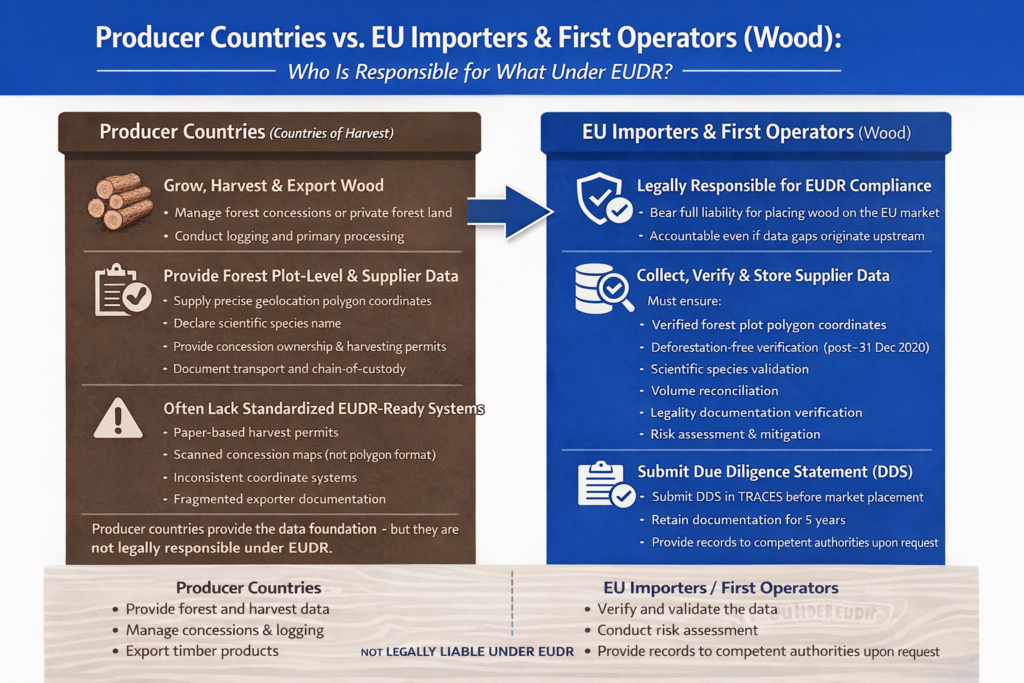
If supplier data for wood products exported from Switzerland to the EU is incomplete, inconsistent, or unverifiable, the consequences under EUDR are commercially immediate and significant for Swiss companies:
• EU importers may refuse shipments before customs clearance
• Products may be blocked at EU borders due to missing or invalid DDS references
• Contracts with EU buyers may be suspended or terminated
• Shipments may face delays pending additional documentation
• Swiss exporters may lose preferred supplier status with EU customers
In practice, a single missing forest plot polygon, incorrect scientific species declaration, or unverifiable harvesting authorization can delay or invalidate an entire shipment even if the wood has already been processed into finished goods in Switzerland.
For Swiss wood exporters, supplier data gaps are not minor paperwork errors — they directly threaten EU market access, revenue continuity, and long-term buyer relationships.
Read our blog on Supplier Data Management for EUDR to learn how Dutch coffee companies can standardize supplier data, validate geolocation, and stay audit-ready without slowing imports.
Explore our guide on Supplier Assessment under EUDR to see how to score suppliers by deforestation risk, data quality, and traceability before shipments move through Dutch ports or contracts are signed.
Although Switzerland is not an EU Member State, any Swiss company exporting wood or wood-derived products into the EU depends on complete, verifiable supplier data to support the Due Diligence Statement (DDS) submitted by its EU customer.
Below is a role-by-role breakdown for the Swiss wood supply chain.
Swiss timber exporters supplying wood products into the EU are commercially critical to EUDR compliance.
If you export logs, sawn timber, veneer, plywood, pulp, furniture, or other wood products to EU buyers, your customer as the first EU operator must submit a DDS.
This means you must provide:
• Supplier- and forest plot-level data
• Verified polygon geolocation coordinates
• Scientific species identification
• Harvest timeframe and origin details
• Legality documentation
• Traceability linking shipments to forest plots
Even though the EU importer submits the DDS, incomplete or unreliable supplier data from Switzerland can result in shipment rejection.
Swiss furniture manufacturers, engineered wood producers, packaging companies, and paper mills exporting to the EU must ensure upstream supplier data is EUDR-compliant.
This applies when companies:
• Use imported timber in finished goods exported to the EU
• Source tropical or temperate hardwood from non-EU origins
• Supply EU customers requiring DDS documentation
In these cases, Swiss manufacturers must ensure:
• Forest plot-level traceability is preserved
• Scientific species data is accurate
• Volume reconciliation aligns with harvest documentation
• Legality documentation is complete
Processing timber into finished products does not remove traceability expectations it increases complexity due to aggregation and transformation.
Swiss traders sourcing wood globally and reselling into the EU face high commercial exposure.
If you:
• Source from non-EU countries and sell into the EU
• Consolidate shipments before export
• Act as an intermediary between forest operators and EU buyers
You must ensure that supplier data is complete and structured to support DDS submission by EU customers.
Trading wood without supporting EUDR-compliant data can lead to:
• Contractual disputes
• Shipment refusal
• Long-term reputational risk in EU markets
This distinction is critical for Swiss exporters.
• Lies with the EU-based first operator placing wood on the EU market
• Includes liability for submitting inaccurate DDS data
• Is enforceable under EU law
Commercial Exposure
• Applies to Swiss exporters supplying the EU
• EU buyers depend on Swiss supplier data
• Weak data can halt exports even if Swiss domestic law is satisfied
In practice:
Swiss companies may not be legally liable under EU law — but they remain commercially exposed if supplier data is incomplete or unverifiable.
To support EU customers’ compliance obligations, Swiss wood exporters must collect and retain non-negotiable supplier data.
Missing even one of these elements can prevent an EU importer from submitting a valid DDS.
Without verified geolocation and compliant harvesting documentation, EU customers cannot lawfully place the product on the EU market.
For Swiss wood exporters operating in a trade-dependent economy, supplier data collection is no longer a sustainability formality it is the decisive factor determining whether products can enter and circulate within the EU under EUDR.
| Compliance Pillar | Key Data Points Required | Critical “Why” for Audits |
| 1. Supplier Identity & KYC | • Full Legal Name & Reg. Number • Physical Address • Country of Production (Origin) • Role: Forest Owner vs. Concession Holder vs. Sawmill | Establishes the chain of custody. Audits require proof that every entity handling the wood is a verified, legal operator. |
| 2. Geolocation & Plot Data | • GeoJSON Polygons (Mandatory for the plot of land) • GPS Coordinates • Precise forest concession boundaries | Unlike some commodities, timber requires exact polygons to ensure the specific trees harvested were not part of a protected or recently deforested area. |
| 3. Species & Harvest Data | • Scientific Name (Genus/Species) & Common Name • Harvest Date/Period • Quantity (Volume in m³ or Net Mass) • Log/Batch Identification | Prevents species substitution and “wood laundering.” The volume must match the biological capacity of the specific plot of land. |
| 4. Legality & Environmental Compliance | • Harvesting Permits/Concession Licenses • Proof of compliance with local land tenure rights • Evidence of adherence to national forest legislation | Ensures the wood is legally harvested. It confirms the operator had the right to harvest and followed local environmental and labor codes. |
Even highly structured Swiss timber traders and manufacturers face EUDR-related challenges because traditional wood supply chains were not designed for plot-level geolocation validation or deforestation cut-off verification. While Switzerland is not an EU Member State, Swiss exporters supplying the EU must meet the same data expectations as EU operators.
In practice, most DDS-related risks affecting Swiss exporters stem from recurring supplier data weaknesses particularly where imported timber feeds into export-oriented manufacturing.
Wood used in Swiss manufacturing is often sourced through:
• Multiple forest concessions across Africa, Asia, Eastern Europe, and Latin America
• Exporters consolidating timber from different harvest zones
• International trading houses
• Mixed-species or mixed-origin shipments
• EU intermediaries supplying semi-processed materials
The challenge:
• Harvest plots change by season or concession
• Documentation standards vary by country of origin
• Suppliers operate through layered trading structures
• A single Swiss production batch may contain timber from multiple forest plots
For Swiss manufacturers supplying EU customers under tight delivery timelines, fragmented sourcing makes forest-level traceability complex especially when materials are quickly transformed into finished goods.
Although Switzerland has a strong industrial base, upstream timber documentation often includes:
• Paper-based harvest permits
• Scanned concession maps
• Manual transport authorizations
• Non-standardized supplier spreadsheets
• Trade documents without geospatial validation
• Paper documents cannot be digitally validated
• Scanned maps rarely meet polygon geolocation standards
• Manual transcription increases error probability
• EU importers may reject incomplete datasets
Swiss exporters are commercially exposed because EU buyers must submit a compliant DDS. Weak upstream documentation can lead to shipment refusal.
Geolocation is one of the most technically sensitive EUDR requirements.
Common issues include:
• Single GPS points instead of full polygon boundaries
• Concession-wide coordinates instead of harvest block polygons
• Incorrect coordinate systems or formatting errors
• Lack of satellite imagery validation
The risk:
• Inability to verify the 31 December 2020 deforestation cut-off
• Classification as “non-negligible risk”
• EU importer refusal to submit DDS
• Delayed or blocked exports
For Swiss exporters, geolocation validation is critical to maintaining EU customer confidence.
Swiss furniture and engineered wood manufacturers often process mixed hardwood species.
Common data gaps include:
• Use of trade names instead of scientific species names
• Multiple species grouped under a single HS code
• Volume discrepancies between harvest data and export invoices
• Yield losses not reconciled in batch traceability
Under EUDR expectations:
• Scientific species identification is mandatory
• Declared volumes must align with harvest documentation
• Chain-of-custody must be auditable
Even small inconsistencies can cause EU buyers to delay or reject shipments.
Switzerland’s export-oriented manufacturing adds further traceability challenges:
• Timber from multiple forest plots combined during processing
• Semi-finished inputs sourced from global suppliers
• Finished goods containing multi-origin wood
• Internal batch systems not aligned with forest-level mapping
Once the link between:
forest plot → harvest documentation → export shipment → Swiss manufacturing batch → EU-bound finished product
is broken, EU importers cannot confidently submit a DDS.
For Swiss operators, EUDR compliance requires a structured supplier data strategy particularly where exports feed directly into EU markets.
Identify suppliers that impact EU-bound exports.
Actions:
• Map non-EU and high-risk suppliers
• Identify forest concession holders and harvest operators
• Confirm availability of polygon-level geolocation
• Flag mixed-origin materials entering export production
Segment suppliers by exposure:
• High volume + high-risk origin → immediate validation
• High volume + moderate risk → early verification
• Low volume + high risk → reassess sourcing strategy
Outcome:
Compliance efforts focus where EU export exposure is highest.
Unstructured supplier inputs are the primary risk bottleneck.
Best practices include:
• Structured EUDR-aligned templates capturing:
Critical insight:
If supplier data does not directly map to DDS submission requirements, Swiss export timelines may be disrupted by last-minute corrections requested by EU buyers.
Data collection alone is insufficient validation is essential.
• Polygon accuracy checks
• Satellite overlay screening
• Deforestation cut-off verification
• Protected area overlap analysis
• Harvest permit authentication
• Concession ownership validation
• Land-use authorization checks
• Country risk profile
• Data completeness
• Traceability complexity
• Historical compliance performance
• Flagged before export production
• Required to implement corrective measures
• Replaced if risk remains non-negligible
DDS-related risks are mitigated before goods leave Switzerland for the EU.
TraceX EUDR Compliance Solutions help Swiss timber exporters and manufacturers move from fragmented supplier documentation to structured, EU-ready compliance workflows.
Through digital onboarding, TraceX collects supplier KYC data, concession documentation, and harvest permits directly from forest operators and exporters. GPS-verified polygon capture ensures accurate forest-level geolocation, while AI-powered validation detects deforestation overlaps and coordinate inconsistencies before EU submission. Automated EUDR-aligned risk scoring allows Swiss export teams to prioritize high-risk suppliers before shipments are dispatched. Structured data outputs support EU importer DDS requirements and integrate seamlessly with ERP and export management systems commonly used in Switzerland.
For Swiss wood exporters, TraceX transforms EUDR compliance from a commercial risk into a scalable export control system.
Build an EUDR-ready wood supply chain that protects EU export continuity and long-term customer relationships.
Supplier Data Collection under EUDR is not merely a compliance exercise for Swiss wood companies it is a strategic export safeguard. As a highly trade-dependent economy with strong EU market integration, Switzerland faces indirect but significant EUDR exposure. Companies that succeed will treat supplier data as a structured, validated export asset: mapping forest plots, digitizing documentation, verifying legality, and embedding traceability into procurement and export systems. Those that fail to do so risk shipment rejection, contract loss, and long-term EU market disadvantage. In Switzerland’s wood sector, mastering supplier data collection is how exporters secure regulatory alignment, commercial resilience, and sustained EU market access under EUDR.
Read our blog on EUDR Compliance for Timber Supply Chains to see how importer, roaster, and trader responsibilities connect and where most compliance failures happen.
Explore our guide on EUDR for Operators and Traders to understand legal responsibility, DDS handover, and what checks you must perform before buying or selling coffee in the EU.
Dive into our practical breakdown of EUDR Due Diligence , including required data, risk assessment steps, and how to avoid delays at customs.
Swiss companies exporting wood or wood-derived products to the EU must provide supplier identification (KYC), forest plot-level geolocation (polygon coordinates), country and region of harvest, harvest timeframe, scientific species name, volume supplied, proof of legal harvesting rights, and full traceability linking shipments to specific forest plots. Without this data, EU importers cannot submit a valid Due Diligence Statement (DDS), and products cannot be legally placed on the EU market.
Yes if their products are exported to the EU and contain non-EU or high-risk timber. Swiss manufacturers must ensure verified forest plot-level geolocation data is available to support the EU importer’s DDS submission. If sourcing from EU suppliers with an existing DDS reference, they must retain traceability documentation and pass valid references to EU customers where applicable.
Yes, and digital submission is strongly recommended. Non-EU forest operators, logging companies, and exporters can provide EUDR-compliant data through structured digital questionnaires, geospatial mapping tools, or platforms capturing GPS polygon data and harvest documentation. Digital data improves validation accuracy and reduces the risk of EU shipment rejection for Swiss exporters.
Although Switzerland is not directly governed by EU law, Swiss exporters supplying the EU must retain supplier data and supporting documentation for at least five years to align with EUDR expectations. EU customers may request access to geolocation files, legality documentation, risk assessments, mitigation records, and shipment traceability data during audits.
If supplier data changes such as updated forest plots, revised geolocation boundaries, ownership transfers, species adjustments, or volume corrections the associated risk assessment must be updated. Material changes may require the EU importer to revise or resubmit a Due Diligence Statement before products linked to the updated data can be placed on the EU market. Failure to update documentation can lead to shipment delays, contract disputes, or loss of EU market access.