
Quick summary: Learn what supplier data is required for Digital Product Passports (DPPs), including multi-tier traceability, standardized identifiers, lifecycle-linked data, and audit-ready compliance reporting.

As Digital Product Passports (DPPs) move from policy to enforcement under regulations like ESPR, the EU Battery Regulation, and EUDR, one question is stopping companies in their tracks: do we actually have the right supplier data to comply? Supplier data for Digital Product Passports (DPPs) includes verified supplier identity, site locations, material composition, certifications, lifecycle events, and compliance records across all supply chain tiers. This data enables regulatory compliance under ESPR, supports traceability, and ensures audit-ready product transparency throughout the product lifecycle.
For most organizations, supplier information is fragmented across spreadsheets, emails, and disconnected systems making it impossible to prove who supplied what, where it came from, and how it was produced. Without structured, verified supplier data across tiers, DPPs become a compliance risk rather than a readiness asset.
Understanding exactly which supplier data is required and how to collect it at scale is now critical for regulatory approval, market access, and future-proof traceability.
Key Takeaways
Digital Product Passports (DPPs) are built on verifiable, lifecycle-linked supplier data, not one-time declarations or self-attestations. Under regulations such as ESPR, the EU Battery Regulation, and EUDR, companies must demonstrate how a product is made, where materials originate, and how they move and transform across the supply chain. This requires supplier data that is structured, timestamped, and continuously updated at each lifecycle event from raw material extraction to manufacturing, distribution, repair, and end-of-life.
Regulators increasingly demand proof of who supplied what, where, when, and under which conditions. This includes supplier identity, production sites, material composition, certifications, geolocation (for deforestation-free claims), and ESG attributes such as carbon footprint and due diligence records. Without this depth of supplier data, companies cannot substantiate DPP claims or respond confidently to inspections, data requests, or buyer audits.
Non-compliance with DPPs under ESPR (effective 2026-2030) could block EU access, mirroring GDPR fines up to 4% of revenue; 70% of firms cite supplier data silos as the top barrier. CS3D demands supply chain due diligence, where DPPs document 100% raw material traceability to mitigate human rights and environmental risks
Incomplete or inconsistent supplier data creates immediate risk. DPPs with missing upstream information can trigger non-compliance findings, delayed product approvals, shipment holds, or restricted market access, particularly in the EU. Over time, repeated gaps erode buyer trust and increase audit failures, turning DPPs into a liability rather than a compliance enabler. In practice, robust supplier data is not just supportive of DPPs it is the foundation that determines whether DPP compliance is achievable at scale.
Robust supplier data cuts onboarding by 40% via automation and boosts efficiency 15-32% for SMEs through AI anomaly detection. It unlocks radical transparency, faster supplier vetting, and predictive compliance, with DPP market growth to $1.78B by 2030 (45.7% CAGR) tied to data-sharing maturity. In commodities, this ensures EUDR-like standards for exporters.
Struggling to bring suppliers along on your DPP journey?
Read our blog on Supplier Engagement for Digital Product Passports to learn how to drive participation, reduce resistance, and build multi-tier transparency at scale.
DPP compliance starts with the right data at onboarding.
Explore our guide to Supplier Onboarding for Digital Product Passports and discover how to collect standardized, audit-ready supplier data from day one.
Supplier identity data establishes who is legally responsible for each activity in the product lifecycle. This includes the company’s legal name, registration number, and its defined role in the value chain (e.g., raw material supplier, manufacturer, processor, recycler, or logistics provider).
Using GS1 Global Location Numbers (GLNs) for organizations and sites is critical, as regulators and buyers increasingly require standardized identifiers to link suppliers consistently across systems and tiers. Without verified identity data, it is impossible to assign accountability, manage recalls, or prove compliance across multi-tier supply chains making DPPs legally weak and audit-prone.
DPPs must link products to physical locations, not just companies. Site-level data includes production, processing, storage, and recycling locations, along with their operating scope and certifications.
For regulations like EUDR, precise geolocation data (latitude/longitude) is mandatory to prove deforestation-free origin. Even beyond EUDR, site data allows regulators to verify where regulated activities occurred, assess regional risk exposure, and validate environmental and labour claims. Without accurate site mapping, DPP claims cannot be independently verified.
Material and component data defines what the product is made of. This includes raw materials, components, and sub-components, along with material composition and regulated substance declarations. Batch-, lot-, or serial-level identifiers (such as GTINs and EPCs) are essential to link materials to specific products and lifecycle events. This data underpins compliance with ESPR, the EU Battery Regulation, and circularity requirements, enabling reporting on recyclability, durability, repairability, and material recovery. Incomplete material data breaks traceability and invalidates DPP lifecycle insights.
DPPs must reference verifiable proof of compliance, including organic, sustainability, safety, and quality certifications. Key elements include issuing bodies, certification scope, and validity periods.
Best practice is to store certifications as digitally verifiable records, not static PDFs, allowing automated validation and expiry monitoring. This reduces audit friction, prevents reliance on outdated documents, and ensures that DPPs always reflect current compliance status rather than historical claims.
Unlike traditional compliance systems, DPPs are event-driven. Lifecycle event data captures what happened to a product, where, when, and by whom—covering manufacturing, transformation, aggregation, shipment, receipt, repair, and recycling events.
Using GS1 EPCIS-aligned event data ensures standardized, timestamped, and interoperable traceability. This is essential because DPPs are designed to reflect a product’s live history, not a snapshot in time. Static records cannot support continuous compliance, recalls, or circular economy use cases.
DPPs increasingly serve as a bridge between product compliance and ESG reporting. Supplier-level data on emissions, energy use, environmental risks, and social due diligence feeds requirements under CSRD, ESG frameworks, and Scope 3 carbon reporting.
This data enables regulators and buyers to assess not just product conformity, but also the sustainability and risk profile of the supply chain behind it. Without reliable ESG and due-diligence inputs from suppliers, DPPs fail to support transparency, risk management, or sustainability-driven market access.
Digital Product Passports (DPPs) aim to make products fully traceable, sustainable, and compliant across their entire lifecycle. Achieving this goal requires visibility far beyond Tier-1 suppliers. In most value chains, the highest environmental, social, and regulatory risks sit upstream at Tier-2 and Tier-3 levels where raw materials are extracted, processed, and transformed.
Relying only on Tier-1 data creates blind spots. It limits the ability to verify material origins, substantiate sustainability claims, and demonstrate compliance with regulations covering forced labor, deforestation, hazardous chemicals, and carbon emissions. For many regulated materials such as batteries, electronics, textiles, and metals Tier-2 and Tier-3 data is no longer optional but essential for credible DPP implementation.
Full supply chain transparency cannot be achieved overnight. Progressive data disclosure allows companies to phase in deeper supplier data over time while protecting sensitive business information.
In practice, this means:
This layered approach balances compliance, confidentiality, and supplier readiness, while allowing DPP data to mature alongside regulatory timelines.
Not all materials require the same level of traceability. DPP frameworks increasingly apply a risk-based model, focusing the deepest data collection where risks are highest. Low-risk materials may only require Tier-1 disclosure, while high-risk or regulated materials demand traceability down to raw material sources, including audits and certifications.
By aligning data depth with material criticality, geographic risk, and regulatory exposure, companies can scale DPP implementation efficiently without overwhelming their supply chains.
Multi-tier supplier data transforms DPPs from static compliance tools into dynamic systems for risk management, due diligence, and long-term value creation. Organizations that invest early in upstream transparency are better positioned to meet regulatory demands, reduce disruption, and build trust with customers and authorities alike.
Digital Product Passports rely on accurate, connected, and verifiable supplier data across the product lifecycle. However, many organizations struggle to meet DPP requirements due to persistent data gaps in their supply chains. These gaps not only delay compliance but also expose companies to regulatory, operational, and reputational risk.
One of the most critical failures in DPP implementation is the absence of Tier-2 and Tier-3 supplier information. While Tier-1 suppliers are usually known and managed, upstream actors such as processors, refiners, mines, or farms often remain invisible.
This lack of upstream data prevents companies from:
Since most ESG and regulatory risks occur upstream, missing Tier-2 and Tier-3 data directly undermines the credibility of a DPP and can render it non-compliant.
Supplier and material data is often scattered across ERP systems, PLM tools, compliance platforms, and spreadsheets each using different identifiers. A single supplier may appear under multiple names, codes, or locations across systems.
This inconsistency leads to:
Without consistent identifiers for suppliers, sites, materials, and products, DPPs cannot maintain the digital continuity required for lifecycle traceability.
Many organizations still rely on emails, surveys, and spreadsheets to collect supplier information. While this may work at small scale, it becomes unmanageable when DPPs require frequent updates, multi-tier coverage, and verification.
Manual data capture results in:
DPPs require structured, machine-readable, and regularly updated data—something spreadsheets were never designed to support.
Supplier declarations are often collected as one-time documents (e.g., compliance statements or certificates) and stored separately from product lifecycle systems. These static declarations lack context and cannot adapt as products evolve.
This creates several problems:
DPPs require dynamic, lifecycle-linked data that updates when products, suppliers, or conditions change. Static declarations fail to meet this requirement and are increasingly rejected by regulators.
Each of these gaps breaks the core promise of DPPs: end-to-end transparency and verifiable compliance. Together, they prevent organizations from:
Closing these gaps requires moving from fragmented, manual data practices to integrated, digital, and multi-tier supplier data systems designed specifically for DPP requirements.
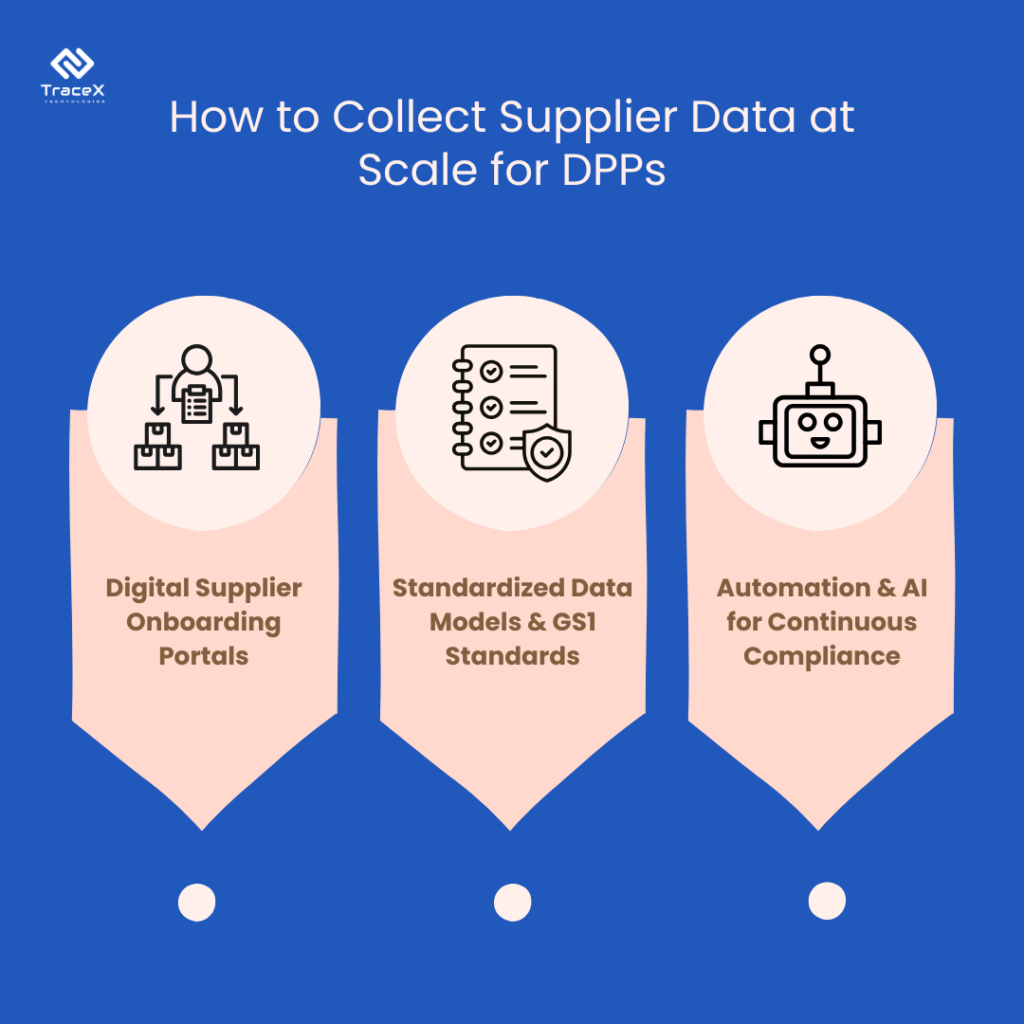
Managing supplier data for Digital Product Passports (DPPs) is one of the most complex challenges companies face under emerging EU regulations. The difficulty is not just collecting data, but keeping it consistent, traceable, and audit-ready across multiple tiers and regulatory regimes. This is where digital platforms from TraceX play a critical role.
Digital platforms replace fragmented spreadsheets and disconnected systems with a single, centralized supplier data repository. In the TraceX context, supplier information across Tier-1, Tier-2, and Tier-3 is collected, standardized, and continuously maintained in one trusted environment.
AI-powered supplier onboarding simplifies participation for upstream suppliers by:
By aligning suppliers to GS1-compliant identifiers (for companies, locations, products, and materials), TraceX ensures that each supplier and site is uniquely and consistently represented across all systems. This eliminates duplicate records and preserves digital continuity an essential requirement for DPP compliance.
DPPs require more than static declarations; they depend on event-based traceability that reflects what actually happens across the product lifecycle. TraceX captures supply chain events using GS1 EPCIS standards, recording when materials are produced, transformed, shipped, or incorporated into products.
This event-based approach enables:
Instead of manually updating product passports, EPCIS events continuously “feed” DPPs with verified, time-stamped data, creating a living digital record that evolves with the product.
One of the biggest advantages of digital DPP platforms is their ability to produce audit-ready outputs across multiple regulatory frameworks without duplicating effort.
In the TraceX platform, the same underlying supplier and event data supports:
Because data is structured, version-controlled, and lifecycle-linked, reports can be generated on demand, with full traceability back to the original supplier, site, and event. This significantly reduces audit preparation time and regulatory risk.
TraceX solutions convert complex, multi-tier supplier data into DPP-ready outputs that meet regulatory and interoperability requirements. These outputs are:
Rather than treating DPPs as a separate compliance exercise, TraceX platform embeds them directly into everyday supply chain operations turning traceability into a strategic capability rather than a regulatory burden.
By combining AI-powered onboarding, GS1-aligned identifiers, EPCIS event capture, and DPP-ready reporting, digital platforms from TraceX make DPP supplier data management scalable, reliable, and future-proof. The result is faster compliance, stronger due diligence, and greater transparency across the entire value chain.
Digital Product Passports are only as reliable as the supplier data behind them. To meet DPP requirements, companies must move beyond basic Tier-1 disclosures and establish consistent, traceable, and lifecycle-linked supplier data across multiple tiers. This includes standardized supplier identifiers, verified material and origin data, event-based traceability, and continuously updated compliance evidence. When managed through digital platforms, this supplier data becomes a strategic asset enabling regulatory compliance, audit readiness, and long-term supply chain resilience. In short, robust supplier data is not just a DPP requirement; it is the foundation of credible, scalable product transparency.
Confused about how GS1 identifiers fit into Digital Product Passports?
Read our blog on GS1 Identifiers for DPPs and learn how standardized IDs enable end-to-end traceability and interoperability.
Unsure whether Digital Product Passports apply to your products?
Read our blog on the scope of Digital Product Passports to understand which products are covered, what data is required, and when compliance applies.
You can’t trace what you can’t map.
Discover how supplier mapping strengthens traceability and see how multi-tier supplier visibility supports DPP compliance and risk management.
Supplier identity, site locations, material composition, certifications, and lifecycle events are mandatory.
Yes. DPP regulations increasingly require upstream supplier visibility beyond Tier 1.
No. Manual systems cannot scale, validate, or maintain continuous compliance.









