
Quick summary: Supplier engagement for DPPs explained: required data, onboarding strategies, standardized identifiers, and how to ensure ESPR-compliant, audit-ready Digital Product Passports.

Suppliers are the backbone of DPP compliance. Without upstream participation, DPPs fail. Supplier engagement for DPP involves onboarding and coordinating suppliers to provide verified product, batch, and transformation data across the supply chain. Effective engagement ensures ESPR compliance, traceability, and auditable lifecycle records from raw materials to finished products.
Most companies face a common challenge when implementing Digital Product Passports (DPPs): their supply chain data is scattered. Suppliers may submit information in different formats, some manually on spreadsheets, others digitally, leading to inconsistencies, missing fields, and delays. This fragmentation creates critical gaps in product lifecycle traceability. Without end-to-end visibility from raw materials to finished goods companies risk non-compliance with ESPR, EPR, or Battery Regulation, delayed audits, recalls, and even reputational damage.
Structured and proactive supplier engagement is key to making Digital Product Passports (DPPs) effective. By standardizing data collection, using persistent identifiers, and leveraging digital collaboration platforms like TraceX, companies can ensure complete and verifiable supplier information, maintain regulatory compliance with ESPR, Battery Regulation, and circular-economy requirements, and streamline operations by reducing manual follow-ups and accelerating multi-tier onboarding. In essence, strategic supplier engagement transforms fragmented, delayed, and inconsistent supplier data into a single, reliable digital record that underpins traceability and lifecycle visibility across the entire DPP ecosystem.
Key Takeaways
Supplier Engagement for Digital Product Passports (DPPs) refers to the structured process of involving, onboarding, and collaborating with all suppliers in a product’s supply chain to ensure they provide accurate, complete, and timely data required for a DPP.
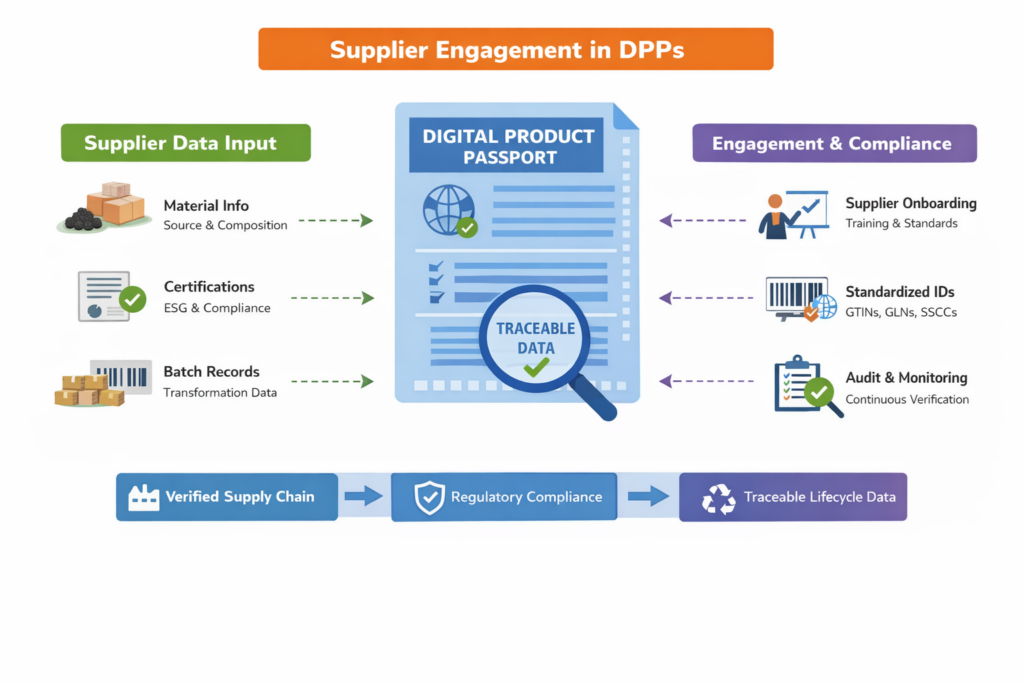
A DPP is only as strong as the data it contains. Suppliers are responsible for providing critical information such as:
Without supplier engagement, data gaps appear in the DPP, leading to traceability issues, compliance risks under regulations like ESPR or Battery Regulation, and potential greenwashing claims.
In short, supplier engagement ensures that all upstream data flows seamlessly into the DPP, creating a verified, traceable, and auditable record for the full product lifecycle.
One case study showed an onboarding program increased known suppliers by 6 times twice the industry average while enabling Life Cycle Assessments for material optimization. Pilot programs with multiple suppliers achieved 95% data accuracy and 40% faster onboarding via standardized requests. SME studies highlight benefits like improved traceability but note neutral-to-positive sentiment, with 15-32% efficiency gains from collaborative data sharing.
Unsure what data suppliers must provide for Digital Product Passports?
Explore the exact supplier data points regulators and buyers expect from materials to ESG claims Read the blog on supplier data requirements for DPPs
Learn how to engage Tier-2 and Tier-3 suppliers, close traceability gaps, and meet ESPR requirements
Read the blog on multi-tier supplier engagement for DPPs
Here’s a detailed explanation of the supplier data required for Digital Product Passports (DPPs), with context on how it supports traceability, compliance, and sustainability goals
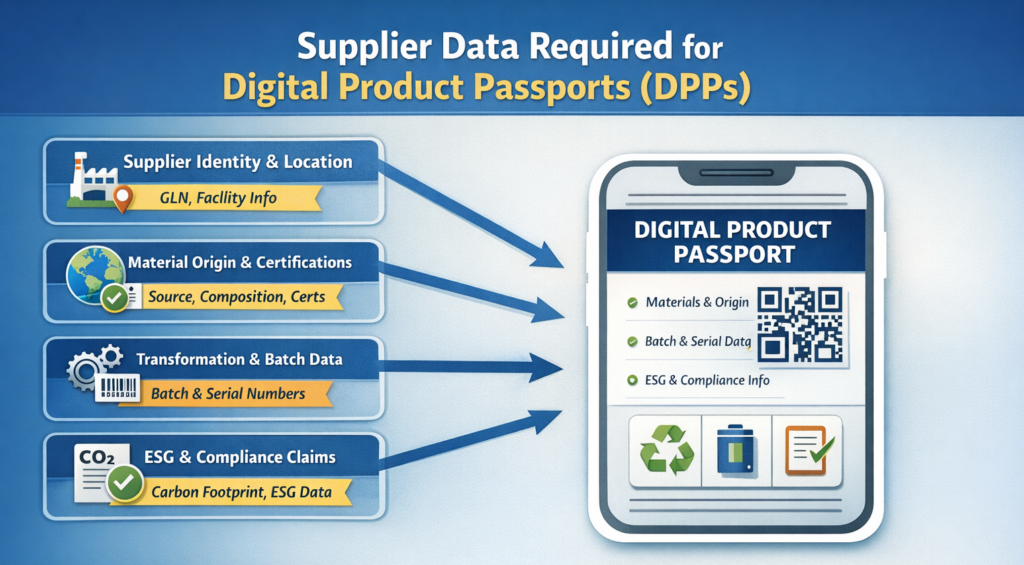
Persistent identifiers like GTINs, GLNs, and SSCCs link each supplier to the materials or products they provide. This ensures that all supplier data is audit-ready, standardized, and interoperable across digital platforms. By connecting supplier inputs to product lifecycles in DPPs, companies can:
Effective supplier engagement for DPPs requires capturing comprehensive data across identity, materials, transformations, and ESG metrics. Standardizing this data and linking it with persistent identifiers ensures traceable, verifiable, and audit-ready digital product passports that satisfy regulatory, sustainability, and operational needs.
Onboarding suppliers for Digital Product Passports (DPPs) at scale requires a structured, technology-enabled approach that balances speed, data quality, and regulatory compliance across multi-tier supply chains.
Not all suppliers contribute the same level of data. A tiered approach prioritizes Tier-1 suppliers (direct manufacturers, processors) for full DPP data capture material composition, transformation events, and compliance claims while progressively onboarding Tier-2 and Tier-3 suppliers for upstream material origin, certifications, and ESG data. This phased model reduces friction while ensuring critical lifecycle data is captured early.
Manual spreadsheets and email-based data collection do not scale. Digital self-service portals allow suppliers to securely enter, update, and validate required DPP data directly. Built-in guidance, mandatory fields, and validation rules ensure consistency and reduce back-and-forth, significantly shortening onboarding timelines.
Many suppliers are unfamiliar with DPP, ESPR, or Battery Regulation requirements. Clear onboarding playbooks, role-based training, and standardized compliance guidelines help suppliers understand what data is required, why it matters, and how it will be used. This improves data accuracy and supplier cooperation while reducing audit risks.
At scale, automation is essential. Digital platforms can automatically validate supplier inputs against schemas, certifications, and identifiers (e.g., GLNs, batch IDs), flag missing or inconsistent data, and trigger corrective workflows. This ensures DPP data is complete, verifiable, and audit-ready without continuous manual intervention.
In practice: scalable supplier onboarding transforms DPPs from a compliance bottleneck into a continuous, reliable data flow enabling lifecycle traceability, regulatory readiness, and faster time-to-market across global supply chains.
Digital Product Passports (DPPs) and ESPR compliance cannot be achieved with Tier-1 data alone. True lifecycle transparency requires visibility into Tier-2, Tier-3, and upstream suppliers where most material, environmental, and compliance risks originate.
ESPR requires verifiable information on material origin, composition, recyclability, and environmental performance across the full product lifecycle. Many of these data points raw material sourcing, processing methods, and upstream certifications sit beyond Tier-1 suppliers. Without multi-tier engagement, DPPs contain gaps that undermine compliance, increase audit risk, and weaken sustainability claims.
Engaging all tiers at once is unrealistic. A progressive approach works best: start with high-level disclosures (supplier identity, location, basic material origin), then expand to detailed data such as transformation events, ESG metrics, and certifications over time. This staged model reduces supplier fatigue while steadily improving DPP completeness.
Not all upstream suppliers carry equal risk. Companies should prioritize engagement based on material criticality, regulatory exposure, deforestation risk, carbon intensity, or market sensitivity (e.g., batteries, textiles, electronics). High-risk suppliers are onboarded first with stricter data requirements, while lower-risk suppliers follow simplified workflows.
Multi-tier engagement only works if traceability remains intact. Using standardized identifiers (GTINs, GLNs, batch and lot IDs) ensures materials and components can be linked across tiers without data breaks. Event-based traceability connects upstream sourcing to downstream manufacturing, creating a single, continuous audit trail that supports DPPs, ESPR market surveillance, and circular economy reporting.
Engaging suppliers beyond Tier-1 turns fragmented upstream data into a connected, lifecycle-wide DPP reducing compliance risk, strengthening sustainability credibility, and future-proofing supply chains under ESPR.
Standardized identifiers are the backbone of effective supplier engagement for Digital Product Passports (DPPs). Without a shared identification system, supplier data remains fragmented, inconsistent, and difficult to verify across multi-tier value chains.
GS1 standards provide globally recognized identifiers that create a common language between suppliers, manufacturers, and regulators.
In a DPP context, identifiers act as persistent digital anchors. A GLN connects a supplier to a specific production site, while GTINs link materials or components to finished products. Batch, lot, or serial numbers then tie transformation events such as processing, assembly, or blending back to upstream suppliers. This structured linkage allows companies to trace materials across tiers and lifecycle stages without manual reconciliation.
Data breaks occur when different suppliers use inconsistent naming conventions, internal codes, or spreadsheets. Standardized identifiers eliminate this risk by ensuring every data point references the same, globally unique IDs. This consistency is critical for interoperable DPPs, enabling data exchange between suppliers, platforms, regulators, and downstream partners without rework or data loss.
Consider an electronics manufacturer sourcing components from multiple suppliers with factories across Asia and Europe. By assigning GLNs to each supplier site and GTINs to every component, transformation events from chip fabrication to final assembly are digitally linked. When ESPR audits or battery passport checks occur, the company can instantly retrieve verified, site-specific data across all suppliers avoiding compliance gaps, reducing audit time, and ensuring DPP integrity.
Many Digital Product Passport (DPP) initiatives struggle not because of regulation complexity, but due to how suppliers are engaged. These recurring mistakes undermine data quality, delay compliance, and increase operational risk.
A common error is approaching DPPs as a one-time data collection exercise tied to a regulatory deadline. In reality, DPPs require continuous, lifecycle-wide data updates. When supplier engagement stops after initial onboarding, data quickly becomes outdated, incomplete, and unusable for audits, recalls, or market surveillance.
Requesting all possible DPP data upfront often overwhelms suppliers especially SMEs and upstream tiers. Long questionnaires and unclear requirements lead to delays, low response rates, and inconsistent submissions. This approach also increases resistance, as suppliers view DPPs as administrative burden rather than operational necessity.
Relying on internal supplier codes, email-based spreadsheets, or free-text fields creates data fragmentation. Without standardized identifiers (such as GTINs and GLNs), supplier data cannot be reliably linked to products, batches, or lifecycle events, resulting in traceability breaks and audit risks.
Many companies focus only on Tier-1 suppliers, leaving Tier-2 and Tier-3 data collection until late in the program. This leads to missing origin, material, or transformation data—precisely the information regulators scrutinize under ESPR and related DPP regulations.
Quick Fixes: How to Correct These Issues
Successful DPP programs treat supplier engagement as an ongoing collaboration supported by digital tools, standardized identifiers, and phased data collection rather than a last-minute compliance task.
Digital platforms are the backbone of scalable supplier collaboration for Digital Product Passports (DPPs). They replace fragmented, manual coordination with automated, lifecycle-driven workflows that ensure data quality, traceability, and continuous compliance.
Modern DPP platforms provide secure, role-based supplier portals where suppliers submit required data once and update it as lifecycle events occur. Standardized templates, guided forms, and multilingual support reduce errors and onboarding friction across Tier-1 to Tier-3 suppliers.
AI-powered workflows validate supplier inputs in real time by:
This reduces manual review, accelerates onboarding, and improves audit readiness.
Instead of static documents, platforms capture event-level data (sourcing, transformation, shipment, repair). Real-time dashboards give compliance, sustainability, and operations teams a live view of DPP readiness, risk hotspots, and missing upstream data.
APIs connect supplier systems (ERP, MES, LCA tools, certification databases) directly into the DPP platform. This enables multi-tier visibility without repeated follow-ups, preserving data continuity across suppliers, sites, batches, and products.
TraceX solutions operationalize this model by combining:
The result is a single, verified digital record that keeps suppliers aligned, data consistent, and DPP compliance continuous not reactive.
Effective supplier engagement is what transforms Digital Product Passports from a regulatory obligation into a resilient compliance and data infrastructure. By aligning suppliers around standardized data, persistent identifiers, and event-based traceability, companies can achieve continuous DPP compliance across complex, multi-tier supply chains. Organizations that invest early in structured supplier onboarding, digital collaboration platforms, and automated validation reduce regulatory risk, improve audit readiness, and unlock long-term operational efficiency. In a DPP-driven regulatory landscape, supplier engagement is no longer optional it is the core enabler of trusted, lifecycle-wide product data.
Confused about how Digital Product Passports actually work?
Break down the systems, data layers, and standards behind compliant DPPs
Read the blog on DPP architecture explained
DPP success starts with suppliers.
Learn how to onboard suppliers at scale, standardize data, and reduce compliance friction
Read the blog on supplier onboarding for DPPs
Traceability is the backbone of every DPP.
Discover how event-based supply chain traceability enables audit-ready, lifecycle-complete DPPs
Read the blog on supply chain traceability for DPPs
Supplier engagement ensures accurate, complete, and verifiable lifecycle data from upstream suppliers, which is essential for ESPR compliance, traceability, and audit readiness.
DPPs require supplier identity, material origin and composition, transformation events, batch and serial data, and verified ESG or compliance claims linked through standardized identifiers.
Companies can scale supplier engagement by using digital platforms with self-service portals, AI-driven data validation, standardized identifiers, and API integrations for multi-tier visibility and continuous compliance.