
Quick summary: Discover the five essential elements of supply chain provenance and learn how they can help businesses enhance transparency, accountability, and sustainability in their operations.
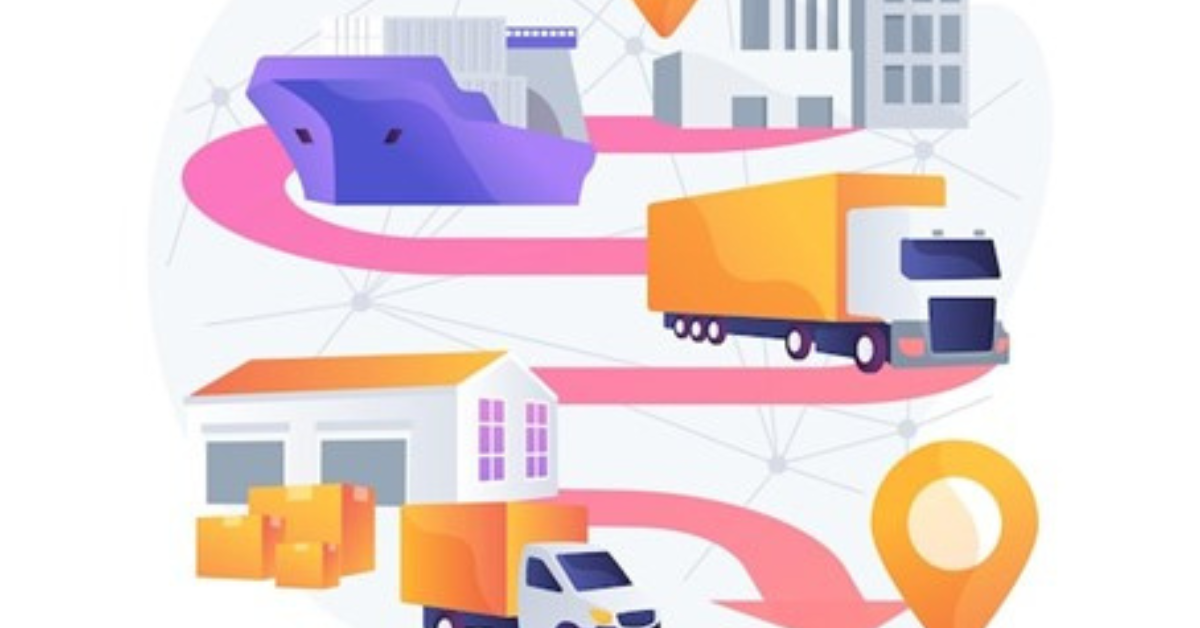
Supply chains are more global, complex, and regulated than ever before. Regulators, buyers, investors, and consumers demand verifiable proof of product origins, ethical sourcing, and sustainability performance, not just marketing claims or certificates. Supply Chain Provenance is the foundation of global compliance and trust, enabling organizations to verify the origin of products, their manufacturing process, and the parties involved in handling them throughout the supply chain. By linking suppliers, materials, processes, and lifecycle events with traceable, auditable data, supply chain provenance supports compliance with regulations such as EUDR, ESPR, CSRD, and Digital Product Passports. Beyond compliance, it strengthens transparency, reduces risk, and builds credibility with regulators, buyers, and consumers in increasingly regulated global markets.
Major regulations like the EU Deforestation Regulation (EUDR), Ecodesign for Sustainable Products Regulation (ESPR), Corporate Sustainability Reporting Directive (CSRD), and emerging Digital Product Passport (DPP) mandates require documented traceability tied to every supplier and material in a product’s lifecycle.
Without a structured supply chain provenance, the ability to trace where every component comes from and how it moved through the value chain, companies face regulatory risk, market exclusion, reputational damage, and operational blind spots. Provenance is no longer a competitive nicety; it is the foundation of compliance and trust in global commerce.
Key Takeaways
Supply chain provenance refers to the comprehensive tracing of a product’s origin, components, transformations, and chain-of-custody throughout its entire journey from raw materials to end users. It answers critical questions such as:
In essence, provenance is not just traceability it is verified history, linking every stage of the supply chain to a reliable record that can be audited, reported, and trusted.
Read our guide on Traceability for Supply Chain Compliance to learn how end-to-end visibility reduces regulatory risk and audit failures.
Discover how product traceability works in practice—from raw material sourcing to batch-level recalls
In the 2026 regulatory environment, Provenance, the documented history of where a product began and every hand it passed through has shifted from a “marketing nice-to-have” to a “Legal License to Operate.”
When regulators demand proof of compliance, a high-level corporate policy is no longer enough. You need Primary Data. Here is how provenance serves as the foundational evidence for modern compliance frameworks:
The EU Deforestation Regulation (EUDR) is the most aggressive example of provenance-as-law. It requires a “Product-to-Plot” link.
The Ecodesign for Sustainable Products Regulation (ESPR) uses the Digital Product Passport (DPP) to ensure products are built for a circular economy.
The Corporate Sustainability Reporting Directive (CSRD) has turned ESG reporting into a financial-grade audit.
Sector-specific laws, such as the UFLPA (Uyghur Forced Labor Prevention Act) or global Food Safety Standards, rely on an unbroken chain of custody.
| Requirement | Old Way (Check-Box) | Modern Way (Provenance) |
| Deforestation | “Our suppliers signed a code of conduct.” | “Here are the polygon maps for this batch.” |
| Material Origin | “This is 50% recycled plastic.” | “Here is the audit trail from the collection center.” |
| Labor Ethics | “We audit 10% of our Tier 1 factories.” | “Every worker interaction is digitally verified.” |
| Market Access | Based on trust and relationships. | Based on verified, machine-readable data. |
Provenance is built on five foundational pillars that unify compliance and transparency:
This is the starting point: every raw material and component must be linked to a verified source ideally with geolocation and legal identity. Accurate origin data enables responsible sourcing, sustainable procurement, and regulatory compliance from day one
In the coffee bean-to-cup supply chain, origin identification begins at the farm level, where each coffee plot is mapped with precise geolocation coordinates and linked to a verified farmer or cooperative. Farm mapping captures plot boundaries, ownership or usage rights, and production practices, creating a legally and geographically verifiable source of origin.
This data is critical for demonstrating responsible sourcing and sustainability claims, particularly for export markets. By anchoring every coffee batch to mapped farms, exporters can prove where beans were grown, prevent mixing with unverified origins, and meet regulatory and buyer requirements for transparency, deforestation-free sourcing, and ethical procurement from the very first step of the supply chain.
Provenance requires recording how materials are processed, assembled, and transformed not just where they came from. This includes:
Detailed process data ensures consistency across batches and supports compliance with safety, environmental, and ethical standards.
For an agri exporter, supply chain provenance goes beyond identifying farm origin—it involves capturing how crops are processed, handled, and transformed into export-ready products. This includes documenting manufacturing standards such as sorting, cleaning, grading, drying, and packaging procedures, ensuring every step meets safety and quality protocols.
Quality assurance checkpoints are recorded at each stage to verify that batches meet regulatory and buyer specifications. Certifications and audit records, including organic, fair-trade, or sustainability credentials, are linked to each batch digitally.
By maintaining detailed, batch-level process data, the exporter ensures consistency, compliance, and traceability across all shipments, reduces the risk of non-compliance, and provides verifiable proof to global buyers that products meet safety, environmental, and ethical standards.
Transparency means sharing key data up and down the supply chain, breaking silos so stakeholders can:
It’s not enough to know what was sourced companies must show how and under whose oversight it was sourced.
Traceability mechanisms are the tools that make provenance real:
Modern traceability creates a verifiable, persistent digital history of every product movement, transformation, and transaction. This is essential for regulations that demand lifecycle documentation such as ESPR and DPPs.
Provenance must culminate in proof not just visibility but verified evidence that regulators and auditors can accept.
This includes:
Compliance verification protects companies from legal exposure and reinforces consumer trust
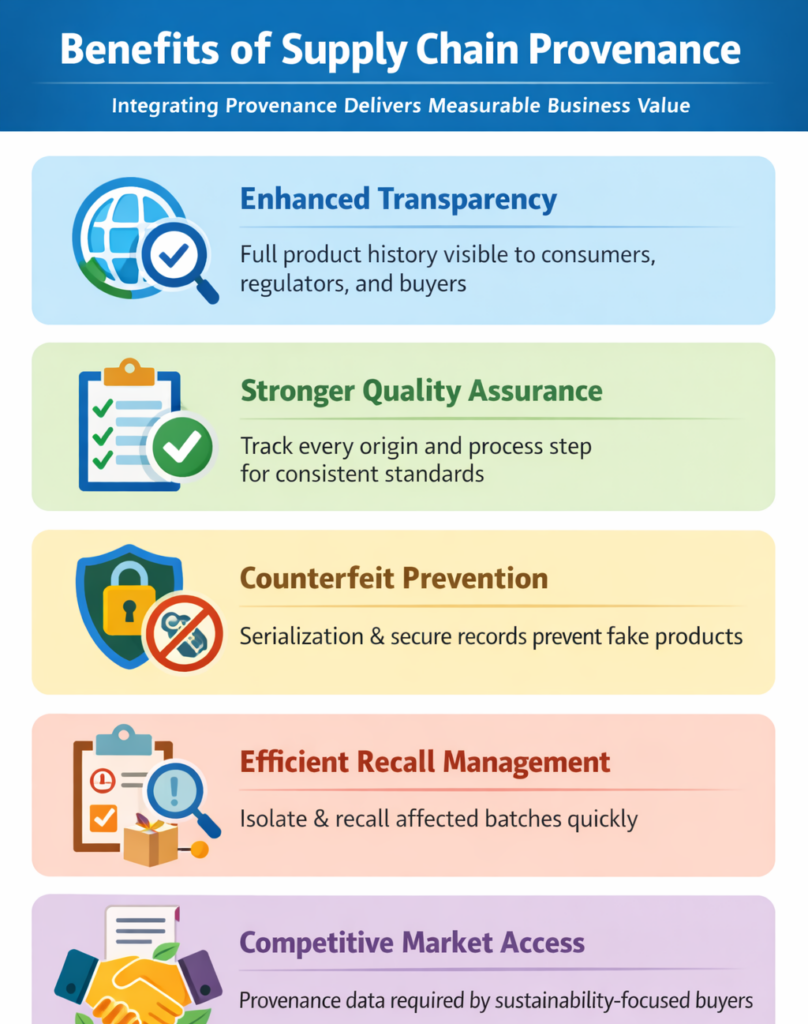
Implementing robust supply chain provenance is critical, but several challenges frequently hinder companies from realizing its full benefits:
Many organizations rely on siloed systems for supplier information, ERP data, and quality control records. This fragmentation prevents a unified view of materials, batches, and supplier activities, making it difficult to trace products across the supply chain and comply with regulations such as ESPR, EUDR, CSRD, or battery regulations.
Legacy processes using paper forms or Excel spreadsheets introduce errors, slow data updates, and limit scalability. Manual tracking cannot handle dynamic, multi-tier supply chains, leading to gaps in traceability, delayed compliance reporting, and risk of non-conformance during audits.
Without persistent identifiers such as GTINs, GLNs, and SSCCs, linking suppliers, sites, batches, and products becomes error-prone. Inconsistent identifiers disrupt traceability, prevent interoperability between systems, and make it difficult to deliver audit-ready provenance data required by regulators and buyers.
Engaging Tier-2 and Tier-3 suppliers is often the hardest part. Many upstream suppliers may lack digital systems, are hesitant to share sensitive data, or are unaware of regulatory requirements. Without their participation, critical gaps in traceability remain, jeopardizing compliance with ESG reporting, DPPs, and deforestation-free sourcing requirements.
By addressing these pain points with structured digital systems, companies can turn provenance from a compliance burden into a strategic advantage, ensuring regulatory adherence, ESG alignment, and operational efficiency.
TraceX offers a comprehensive, digital-first approach to supply chain provenance and regulatory compliance, leveraging blockchain and AI to ensure transparency, traceability, and audit readiness. Here’s how it works:
TraceX platform captures every stage of a product’s journey from raw material sourcing to processing, assembly, and distribution. Each event is recorded digitally, ensuring end-to-end traceability. This allows companies to demonstrate exactly where materials came from and how they were handled, supporting compliance with regulations such as ESPR, EUDR, CSRD, and DPP requirements.
By leveraging blockchain technology, TraceX ensures that recorded data is tamper-proof and verifiable. This immutable record of supplier inputs, material transformations, and batch-level events builds trust with buyers, regulators, and auditors, eliminating doubts about data integrity.
TraceX platform enables companies to generate instant reports on provenance, sustainability metrics, and compliance KPIs. Instead of waiting for manual audits, organizations can provide real-time visibility to regulatory authorities and stakeholders, reducing the risk of fines, shipment delays, or non-compliance.
TraceX platform connects seamlessly with Digital Product Passport (DPP) systems and other traceability platforms. Supplier, batch, and product data flows automatically into DPPs, ensuring continuous compliance and interoperability across systems. This supports circular economy goals, ESG reporting, and cross-regulatory requirements efficiently.
In 2026, the transition from “vague promises” to “immutable proof” is being driven by three specific regulatory scenarios.
Here is how provenance operates within these three critical frameworks:
The EU Deforestation Regulation (EUDR) has turned geolocation from a mapping tool into a legal requirement. It is no longer enough to know the region your cocoa or beef came from; you must know the specific forest plot.
The Ecodesign for Sustainable Products Regulation (ESPR) is about more than just how a product is made; it’s about how it survives. The Digital Product Passport (DPP) is the vehicle for this information.
The Corporate Sustainability Reporting Directive (CSRD) has effectively ended the era of “greenwashing by omission.” Companies are now legally liable for the accuracy of their sustainability claims across their entire value chain (Scope 3).
| Regulation | The Critical Data Point | How Provenance Proves It | Market Consequence |
| EUDR | Geolocation Polygons | Links GPS coordinates to specific batches. | Market Access vs. Seizure |
| ESPR/DPP | Material Composition | Tracks recycled content from source to shelf. | Circularity vs. Waste |
| CSRD/ESG | Primary Scope 3 Data | Records real-time energy/social events at the source. | Investor Trust vs. Litigation |
Supply chain provenance is no longer just a compliance requirement it’s a business differentiator. By systematically tracking origin, processing, and transformation events across multi-tier suppliers, companies can meet global regulatory mandates such as ESPR, EUDR, CSRD, and battery regulations. Integrating digital traceability, standardized identifiers, and platforms like TraceX ensures audit-ready reporting, strengthens buyer and consumer trust, mitigates risk, and unlocks access to sustainability-focused markets. Provenance empowers organizations to transform transparency into operational excellence and competitive advantage.
Explore Our Traceability Guide to understand how products, materials, and suppliers are tracked end to end.
Learn Why Real-Time Visibility Matters for managing upstream risk, ESG performance, and regulatory compliance.
Understand Due Diligence Requirements with practical insights on supplier risk assessment and traceability.
Supply chain provenance is the documented history of a product’s origin, processing, and transformation. It ensures regulatory compliance, builds trust with buyers, and supports sustainability and ESG goals.
By mapping suppliers at all tiers, standardizing identifiers (GTIN, GLN, SSCC), using digital traceability platforms, and recording event-based data across materials and batches.
Key regulations include the EU Deforestation Regulation (EUDR), ESPR Digital Product Passports, CSRD ESG reporting, and industry-specific standards like battery and food compliance regulations.