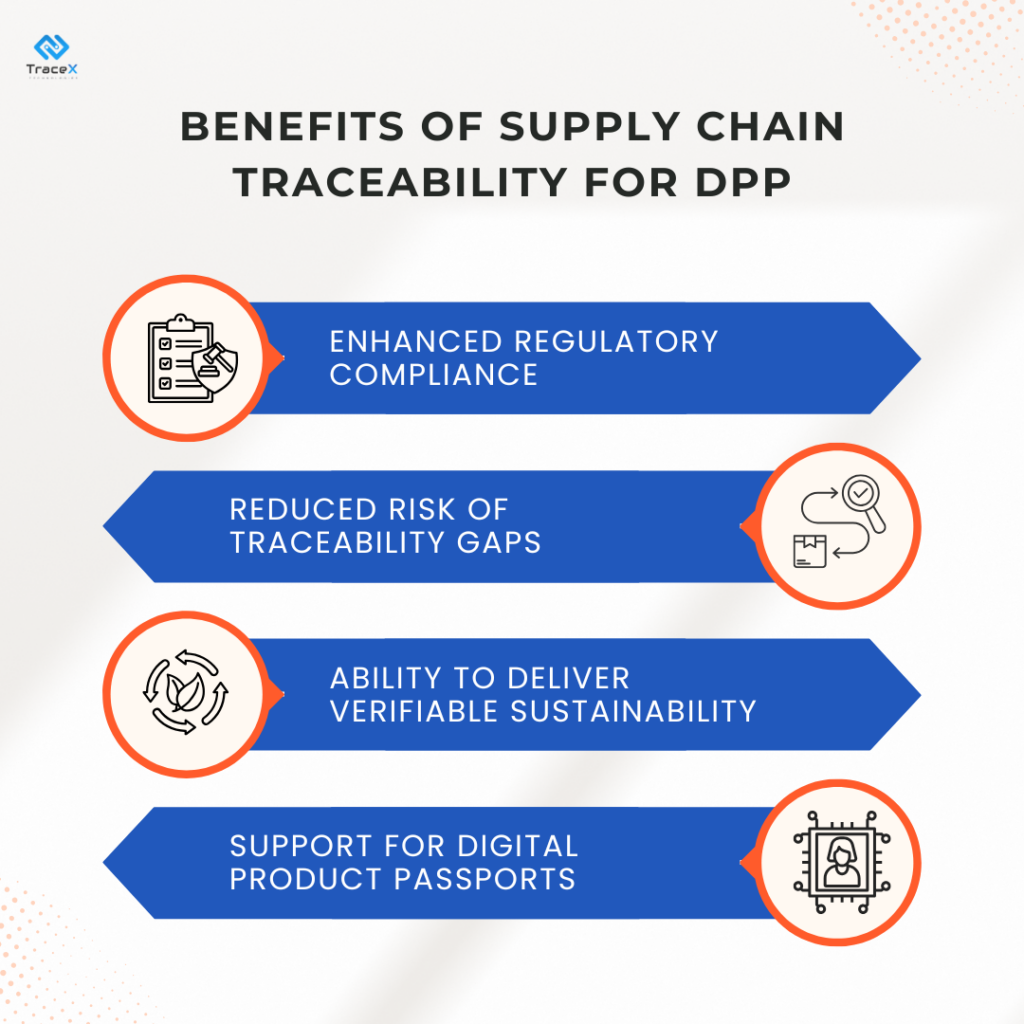
Supply Chain Traceability for Digital Product Passports (DPPs)
Published
, 14 minute read
Share this article
Quick summary: Learn how Supply Chain Traceability for Digital Product Passports (DPPs) ensures end-to-end visibility, ESPR compliance, and verified sustainability claims across products, suppliers, and transformations.
In today’s regulated and sustainability-driven markets, knowing what a product is made of isn’t enough companies must prove where it came from, how it was made, and how it moves through the supply chain. Supply Chain Traceability for Digital Product Passports (DPPs) ensures that every product can be tracked from origin through production, transformation, and distribution using standardized identifiers like GTINs, GLNs, and batch/serial numbers.
Many organizations treat Digital Product Passports (DPPs) as static documents, capturing only surface-level product data. This approach creates traceability gaps, audit failures, and compliance risks, leaving companies unable to respond to ESPR requirements, verify sustainability claims, or provide consumers and regulators with trustworthy, real-time product information.
By capturing supplier data, material provenance, and transformation events, DPPs provide end-to-end visibility, enable compliance with regulations like ESPR, and support consumer transparency. Effective traceability prevents data gaps, facilitates audits, and allows real-time verification of sustainability, origin, and regulatory claims, making Supply Chain Traceability for Digital Product Passports (DPPs) a critical foundation for compliant, interoperable, and trustworthy supply chains.
Key Takeaways
Digital Product Passports (DPPs) enhance supply chain traceability by creating a live, end-to-end digital record of products from origin through transformation to market.
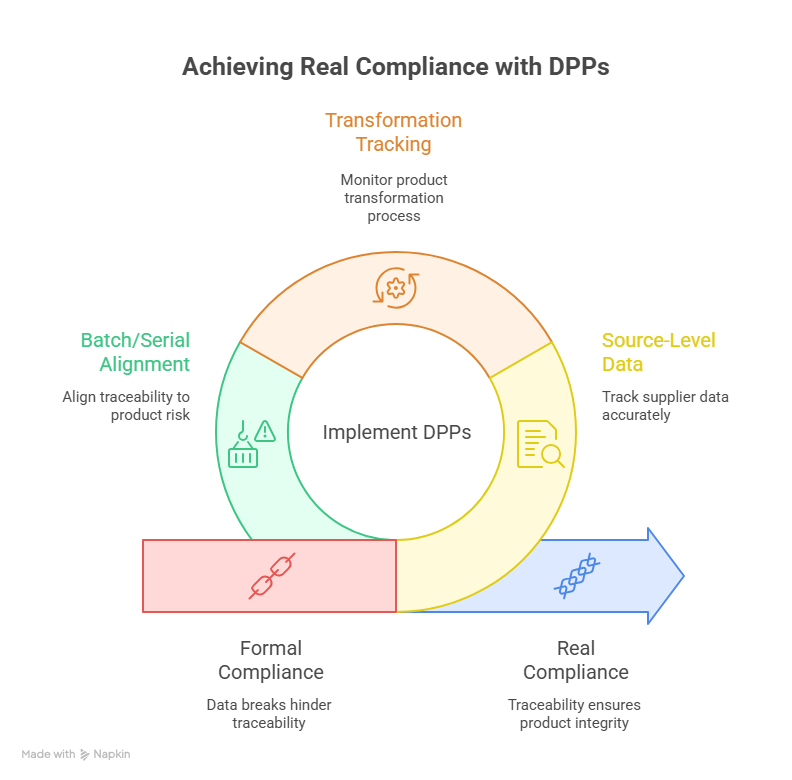
Source-level traceability links products to suppliers, material provenance, and production sites, while transformation tracking records how raw materials become finished goods at batch or serial level.
Common data breaks caused by inconsistent identifiers, manual handoffs, system incompatibility, and silos can be prevented through persistent identifiers, event-based tracking, and seamless upstream-downstream integration.
ESPR-ready DPPs require modular, standards-aligned architectures, and without traceability, companies face compliance risk, unverifiable sustainability claims, and loss of regulator and consumer trust.
The Ecodesign for Sustainable Products Regulation (ESPR) is transforming how organizations must demonstrate sustainability and regulatory compliance. At its core, Digital Product Passports (DPPs) enable end-to-end traceability, providing a live, verifiable digital record of a product’s lifecycle. Unlike traditional compliance, which often relies on static documents or spreadsheets, ESPR DPPs embed traceability into the supply chain itself.
Linking Products to Verifiable Upstream Data
ESPR DPPs require products to be directly connected to upstream sources. This includes:
Supplier identities and locations using standardized identifiers (GLNs)
Material provenance, including raw materials, recycled content, and certifications
Production events, such as processing, transformation, and packaging
By linking products to verifiable upstream data, organizations can prove the origin and sustainability of each component, enabling regulators, auditors, and customers to trust the information.
From Document-Based Compliance to Continuous Digital Traceability
Traditional compliance approaches often rely on periodic reporting or static documents, which are prone to errors, gaps, and outdated information. ESPR DPPs shift this paradigm by:
Capturing traceability data in real time at every supply chain stage
Using persistent, standardized identifiers (GTINs, batch numbers, serial numbers) to link events across systems
Supporting automated reporting and validation, reducing manual reconciliation
This transition allows companies to maintain a live digital trail, ensuring that traceability is accurate, auditable, and up-to-date.
Traceability Across Suppliers, Materials, Transformations, and Batches
ESPR DPPs recognize that traceability is not just about the final product it must span the entire value chain:
Suppliers: Multi-tier supplier data ensures origin transparency and regulatory compliance.
Materials: Each material or component must be tracked, including recycled or renewable content.
Transformations: Processing, assembly, and manufacturing events are logged to maintain continuity.
Batches/Serials: Both batch-level and unit-level tracking support recalls, quality control, and ESG reporting.
By encompassing all these elements, ESPR DPPs prevent data breaks and allow traceability to scale across global, multi-tiered supply chains.
Learn how Digital Product Passports transform supply chain transparency →
Learn what source-level traceability is and why it matters for DPPs →
What Is Source-Level Traceability in DPPs?
Source-level traceability refers to the ability to trace a product back to its origin, suppliers, and production sites. In the context of ESPR Digital Product Passports (DPPs), this means documenting the entire upstream journey of materials and components, rather than just recording the final product or brand information.
ESPR emphasizes value-chain transparency, requiring companies to demonstrate that every material and component in a product meets sustainability, safety, and regulatory standards. Unlike traditional reporting, which often stops at brand-level disclosures, source-level traceability ensures that every step from farm or mine to factory is verifiable.
This level of traceability is critical for:
Regulatory compliance under ESPR and associated EU initiatives
Digital Product Passports, which rely on verified upstream data
Sustainability claims and consumer transparency, enabling trust in environmental and social impact reporting
Capturing Supplier Data for ESPR Compliance
To achieve source-level traceability, organizations must capture detailed supplier data. Key data elements include:
Supplier Identity and Location
Legal entity names, addresses, and unique identifiers (e.g., GLNs)
Ownership structure and operational sites
Material Origin and Attributes
Type and classification of materials (e.g., plastics, metals, textiles)
Source location, extraction method, or cultivation method
Organic, fair trade, or sustainability certifications
ISO, REACH, or sector-specific compliance claims
Evidence of audits or third-party verification
Why standardized identifiers matter
Using GS1 identifiers or similar standards ensures consistency across suppliers and systems
Reduces errors in mapping suppliers to products and materials
Facilitates interoperability for DPPs, audits, and regulatory reporting
Managing Incomplete Upstream Data in DPPs
A common challenge is that upstream supplier data is often missing, partial, or delayed. This is particularly true for multi-tier supply chains or global operations. Without strategies to handle incomplete data, traceability and compliance efforts can stall.
Effective strategies include:
Progressive Data Enrichment
Collect partial data initially and enrich it over time
Use verified updates from suppliers to gradually improve data completeness
Maintain versioned records in DPPs for auditability
Risk-Based Supplier Prioritization
Focus on suppliers or materials with the highest regulatory or ESG risk
Prioritize critical origin points or high-impact materials for immediate compliance
Gradually extend traceability to lower-risk suppliers
Data Confidence and Completeness Indicators
Assign confidence scores to supplier data based on verification and source reliability
Highlight gaps and track improvements over time
Ensure auditors and regulators can understand the quality and reliability of upstream data
By implementing these approaches, organizations can maintain compliant and actionable source-level traceability, even when complete upstream data is not immediately available.
How DPPs Track Product Transformations Across the Value Chain
Digital Product Passports (DPPs) go beyond static product information by capturing transformation events the processes that change raw materials into intermediate or finished products. Each transformation is a critical traceability point and must be linked to verifiable identifiers.
Key transformation events include:
Raw material → intermediate product: e.g., cotton bales processed into fabric rolls
Intermediate product → finished good: e.g., fabric cut and sewn into garments
Packaging and assembly: e.g., multiple components combined into a final electronics product
Why this matters for ESPR
ESPR requires traceability not just of where materials originate, but also how they change throughout production. Recording transformations ensures that:
Regulatory and sustainability claims reflect the true product lifecycle
Material composition, recycled content, or environmental impact is accurately tracked
Audits and recalls can pinpoint affected products at any stage
Linking transformations to identifiers:
GTINs for product types at each stage
Batch or lot numbers for production events
GLNs for locations or facilities performing transformations
This ensures that each transformation is auditable, verifiable, and connected across the value chain.
Batch vs Serial-Level Traceability for DPPs
Batch-Level Traceability
Definition: Tracks a group of products produced under the same conditions as a single unit
Best for: Commodities, process manufacturing, and high-volume goods (e.g., textiles, food ingredients)
Advantages:
Lower data volume, easier to manage
Scales efficiently across high-volume production
Supports recalls and quality tracking at the batch level
Serial-Level Traceability
Definition: Tracks individual units with unique serial numbers
Required for: High-risk, regulated, or durable goods (e.g., pharmaceuticals, electronics, medical devices)
Advantages:
Enables precise unit-level recalls
Supports product-specific compliance and warranty tracking
Provides granular visibility for ESG and sustainability reporting
Determining the Right Granularity for ESPR Compliance
Material risk and regulatory requirements: High-risk or regulated products often require serial-level traceability
Volume and complexity: Large-scale commodities may be efficiently tracked at batch level
Sustainability and circularity goals: Products intended for recycling or reuse may benefit from serial-level tracking to measure environmental impact per unit
Rule of thumb: Start with batch-level for efficiency, and implement serial-level where precision is required, linking all identifiers to transformation events within the DPP.
What Causes Data Breaks in DPP Traceability
Effective Digital Product Passports (DPPs) rely on seamless data flow across suppliers, production sites, and distribution networks. Data breaks gaps or inconsistencies undermine traceability, compliance, and sustainability claims. Common causes include:
Inconsistent identifiers
Using different product, batch, or location codes across systems or suppliers leads to mismatched records.
Example: A GTIN used internally does not match the GTIN recognized by a downstream partner.
Manual data handoffs
When information is transferred via spreadsheets, emails, or PDF reports, errors, omissions, and delays are common.
Manual entry also increases the risk of duplicate records or misaligned batches.
Supplier system incompatibility
Suppliers may operate legacy systems, regional ERPs, or disconnected platforms that cannot integrate automatically with DPP systems.
Lack of standardization prevents real-time verification of materials, transformations, and compliance claims.
Region-specific data silos
Data stored separately for local reporting, certifications, or regulatory requirements can fragment visibility across the value chain.
This makes it difficult to generate a continuous, auditable traceability record.
Designing DPPs to Prevent Traceability Gaps
To avoid these breaks, DPPs should be architected for consistency, automation, and interoperability:
Using persistent product, batch, and location identifiers
GS1 identifiers (GTINs, GLNs, SSCCs) provide globally unique, standardized references.
Persistent identifiers ensure every event in the supply chain can be linked reliably across systems and suppliers.
Event-based traceability instead of static records
Instead of capturing only periodic or summary data, DPPs should record individual events: material receipt, transformation, shipment, and delivery.
Event-based data allows real-time visibility, facilitates audits, and supports precise recalls.
Linking upstream and downstream data without duplication
Establish a single source of truth for each identifier, avoiding duplicate records.
Use standardized data exchange protocols so upstream suppliers and downstream partners can share information automatically.
Integrate multi-tier supplier data to maintain a continuous, end-to-end traceability chain.
Architecture Considerations for ESPR-Ready Traceability
To comply with the Ecodesign for Sustainable Products Regulation (ESPR), Digital Product Passports (DPPs) must go beyond static records and provide live, verifiable, and interoperable traceability across the entire value chain. Achieving this requires careful architectural design that supports scalability, interoperability, and regulatory resilience.
ESPR mandates that DPPs contain reliable, verifiable information on product composition, origin, and transformations. For DPPs to be truly functional:
Data must be interpretable across multiple systems and supply chain tiers
Traceability must span suppliers, manufacturers, logistics providers, and regulators
Standards such as GS1 identifiers (GTIN, GLN, SSCC) must be consistently applied to enable global interoperability
Without a standards-aligned architecture, organizations risk data fragmentation, non-compliance, and costly rework as regulations evolve.
Separation of Key Architectural Layers
A robust ESPR-ready DPP architecture separates the system into three key layers, each serving a specific role:
Identity Layer
Responsible for standardized, persistent identifiers (GTINs for products, GLNs for locations, batch/serial numbers for production events)
Provides a single source of truth to link all traceability and compliance data
Ensures consistency across suppliers, regions, and downstream applications
Data Layer
Stores all supply chain, material, transformation, and compliance data
Supports event-based traceability rather than static snapshots
Enables verification of sustainability claims, certifications, and regulatory reporting
Access and Presentation Layer
Provides role-based access to different stakeholders: consumers, auditors, regulators, or internal teams
Integrates QR codes or GS1 Digital Link for dynamic data access
Ensures information is readable, actionable, and compliant with privacy/regulatory requirements
By clearly separating these layers, organizations can upgrade, extend, or replace individual layers without disrupting the entire DPP system, ensuring long-term scalability.
Avoiding Vendor Lock-In and Future Regulatory Rework
Selecting standards-based architectures prevents reliance on proprietary identifiers or closed platforms
Modular design allows organizations to adapt to future ESPR updates, ESPR-aligned EU regulations, or global traceability requirements
Reduces the need for costly system redesigns when regulations or supply chain partners change
What Happens If Traceability Is Missing in ESPR DPPs
Digital Product Passports (DPPs) under ESPR rely on end-to-end traceability to verify product composition, origin, and sustainability claims. Without proper traceability, organizations face several critical risks:
Compliance Risk and Enforcement Exposure
Regulators require verifiable proof of material origin, production processes, and environmental claims.
Missing traceability can trigger audits, fines, or mandatory product recalls.
Companies may struggle to meet ESPR reporting requirements, exposing them to legal and financial penalties.
Inability to Substantiate Sustainability Claims
Sustainability and circularity claims such as recycled content or low environmental impact must be verifiable at product and batch level.
Without traceable upstream data, organizations cannot provide evidence, undermining ESG reporting and certifications.
Loss of Trust with Regulators and Customers
Inaccurate or incomplete traceability erodes confidence with regulators, auditors, supply chain partners, and consumers.
Brand reputation and market access can be negatively impacted, especially in sustainability-conscious markets.
How Digital Platforms Like TraceX Help
Digital traceability platforms from TraceX are designed to eliminate these risks by operationalizing ESPR DPP requirements:
Standardized, persistent identifiers
GTINs, GLNs, batch, and serial numbers provide a consistent reference for all products, locations, and transformations.
Ensures that every event in the supply chain is verifiable and auditable.
End-to-end supplier data capture
Multi-tier supplier onboarding and integration allow upstream data including materials, certifications, and production events to flow seamlessly into the DPP.
Platforms can flag missing or incomplete data, enabling progressive enrichment without halting compliance.
Event-based, real-time traceability
Transformation events, shipments, and batch updates are recorded automatically.
Reduces manual errors, ensures continuous compliance, and provides regulators with live, auditable evidence.
Regulatory and sustainability dashboards
TraceX consolidates ESPR-relevant data for audits and reporting.
Enables verification of sustainability claims and supports Digital Product Passports without manual reconciliation.
Consumer-facing transparency via GS1 Digital Link
QR codes link physical products to live, verified DPP data.
Builds trust by allowing consumers to access authentic product origin and sustainability information.
Speak with a TraceX specialist to see how our digital traceability platform operationalizes ESPR DPP requirements, ensures end-to-end supply chain visibility, and transforms compliance into a live, audit-ready system.
Building Compliant and Transparent Supply Chains with DPPs
Supply Chain Traceability for Digital Product Passports (DPPs) is no longer optional it is the foundation for regulatory compliance, sustainability verification, and consumer trust. By linking products, materials, transformations, and suppliers through standardized identifiers, DPPs provide an end-to-end, auditable digital trail. Platforms like TraceX enable real-time traceability, event-based tracking, and seamless supplier data integration, ensuring ESPR compliance while supporting Digital Product Passports that are scalable, interoperable, and trustworthy. Effective traceability mitigates risk, substantiates sustainability claims, and transforms compliance from a reactive task into a proactive capability.
Read more about Product Traceability for regulated supply chains →
Explore Batch Level traceability for DPPs →
Learn how to design scalable DPP architecture for ESPR →
Frequently Asked Questions (FAQ’s)
What is Supply Chain Traceability for Digital Product Passports (DPPs)?
It is the ability to track and verify a product’s journey from origin through production, transformation, and distribution, using standardized identifiers to provide a live, auditable digital record.
Why is traceability critical for ESPR compliance?
ESPR requires proof of material origin, sustainability claims, and product transformations. Traceability ensures that all upstream and downstream data is accurate, verifiable, and audit-ready.
How do digital platforms like TraceX support DPP traceability?
Platforms like TraceX integrate supplier data, track batch and serial-level transformations, and provide real-time, event-based traceability. They enable automated compliance, consumer transparency, and live Digital Product Passports.
Start using TraceX
Transparency, Trust, & Success for your Climate Journey.
We use cookies on our website to give you the most relevant experience by remembering your preferences and repeat visits. By clicking “Accept All”, you consent to the use of ALL the cookies. However, you may visit "Cookie Settings" to provide a controlled consent.
This website uses cookies to improve your experience while you navigate through the website. Out of these, the cookies that are categorized as necessary are stored on your browser as they are essential for the working of basic functionalities of the website. We also use third-party cookies that help us analyze and understand how you use this website. These cookies will be stored in your browser only with your consent. You also have the option to opt-out of these cookies. But opting out of some of these cookies may affect your browsing experience.
Necessary cookies are absolutely essential for the website to function properly. These cookies ensure basic functionalities and security features of the website, anonymously.
Cookie
Duration
Description
cookielawinfo-checkbox-analytics
11 months
This cookie is set by GDPR Cookie Consent plugin. The cookie is used to store the user consent for the cookies in the category "Analytics".
cookielawinfo-checkbox-functional
11 months
The cookie is set by GDPR cookie consent to record the user consent for the cookies in the category "Functional".
cookielawinfo-checkbox-necessary
11 months
This cookie is set by GDPR Cookie Consent plugin. The cookies is used to store the user consent for the cookies in the category "Necessary".
cookielawinfo-checkbox-others
11 months
This cookie is set by GDPR Cookie Consent plugin. The cookie is used to store the user consent for the cookies in the category "Other.
cookielawinfo-checkbox-performance
11 months
This cookie is set by GDPR Cookie Consent plugin. The cookie is used to store the user consent for the cookies in the category "Performance".
viewed_cookie_policy
11 months
The cookie is set by the GDPR Cookie Consent plugin and is used to store whether or not user has consented to the use of cookies. It does not store any personal data.
Functional cookies help to perform certain functionalities like sharing the content of the website on social media platforms, collect feedbacks, and other third-party features.
Performance cookies are used to understand and analyze the key performance indexes of the website which helps in delivering a better user experience for the visitors.
Analytical cookies are used to understand how visitors interact with the website. These cookies help provide information on metrics the number of visitors, bounce rate, traffic source, etc.
Advertisement cookies are used to provide visitors with relevant ads and marketing campaigns. These cookies track visitors across websites and collect information to provide customized ads.