
Quick summary: Discover the key challenges and solutions in building a sustainable coffee supply chain. Learn how environmental, economic, and social factors impact sustainability and the role of innovative practices and technologies in achieving a greener future for coffee.
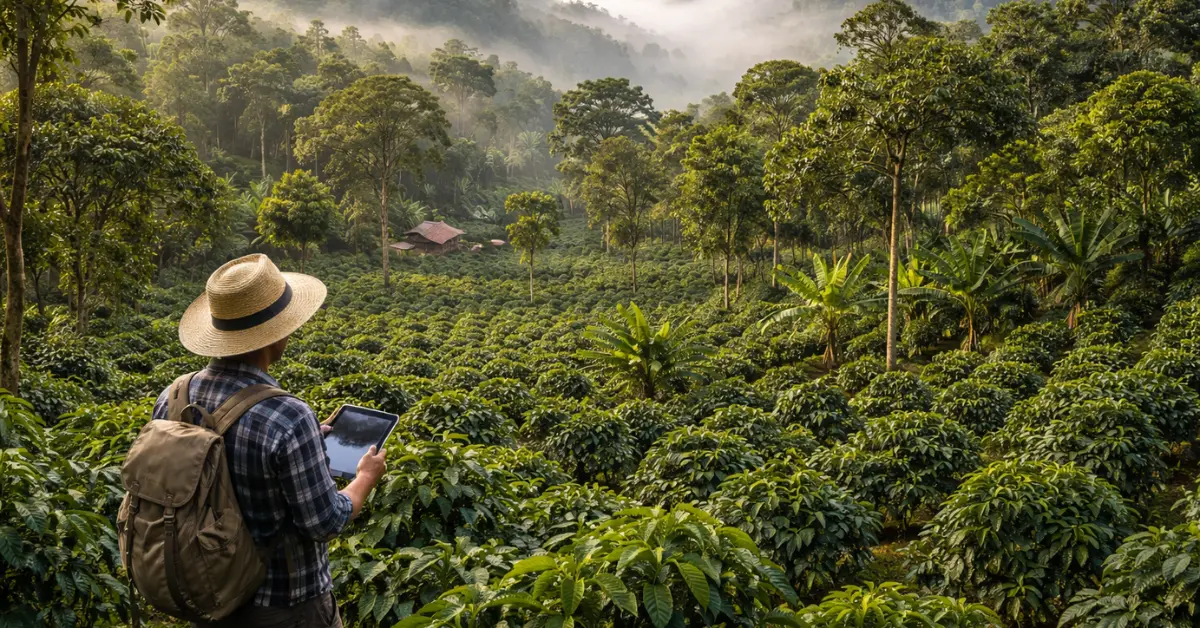
Over 2.25 billion cups of coffee are consumed every day. But behind that ritual lies a system under severe stress. Smallholder farmers who produce 95% of the world’s coffee are fighting rising temperatures, collapsing soil health, and volatile prices simultaneously. Building sustainable coffee supply chains is now critical to protect farmer livelihoods, restore ecosystems, and ensure long-term global coffee availability.
Climate change is shrinking the so-called ‘coffee belt.’ Shade trees are disappearing. And synthetic fertilizer use is releasing the very emissions that make the climate crisis worse. This is not a future problem. It is happening now, and the coffee industry’s survival depends on acting with precision.
The coffee industry faces a dual imperative: protect farmer livelihoods today while reducing the emissions and land-use practices that threaten coffee’s viability tomorrow. TraceX Integrated Solutions is built to make both possible.
| 2.25B Cups consumed daily worldwide | 12.5M Coffee farms globally — 95% are smallholders | 68% Of coffee’s climate impact from farm & processing |
Smallholder farmers are the backbone of global coffee production. With 95% of farms under 5 hectares, these growers operate with thin margins, limited access to markets, and disproportionate exposure to climate risk.
80% Of global coffee production comes from smallholder farms
The most immediate action available to protect smallholder income is transitioning to climate-resilient coffee varieties that maintain yield quality under temperature stress, irregular rainfall, and new pest pressures.
Key interventions include:
| Feature | Conventional Monoculture | Diversified Resilient Farm | Annotated Yield and Economic Benefit |
|---|---|---|---|
| System Design | Single crop (e.g., all corn or rice) across the entire landscape. | Mixed cropping, agroforestry, and integration of livestock. | Risk Pooling: Diversification prevents ‘zero-yield’ years if one specific crop fails. |
| Soil Health | Intensive tillage; heavy reliance on synthetic NPK. | Minimum tillage; cover crops; organic amendments. | Nutrient Efficiency: 25-40% reduction in synthetic N inputs due to natural N-fixation. |
| Pest Control | Prophylactic chemical pesticides. | Biological control via habitat for natural predators. | Lower Loss: Approximately 63% decrease in pest-disease incidence compared to monoculture. |
| Water Strategy | Extraction-heavy (borewells/intensive irrigation). | Water-smart (rainwater harvesting, high soil organic matter). | Drought Buffer: 40-60% water savings; higher soil moisture retention during dry spells. |
| Yield Stability | High in optimal years; crashes during heat/drought. | ‘Near-neutral’ or higher total system biomass. | Stability: 20-38% higher average yields over a 5-year cycle including stress years. |
| Production Costs | High and volatile (fuel, seeds, chemicals). | Lower input dependence (internalized fertility). | Profitability: Benefit-cost ratio of approximately 1.88 vs. 1.22 for monocultures (2025 data). |
TraceX supports farmer transition by enabling digital farm profiles, crop data tracking, and agronomic advisory delivery so knowledge reaches the farmer, not just the boardroom.
Empower smallholder farmers with smarter tools – explore farm management solutions designed for real-world impact.
The coffee supply chain spans from cultivation to consumption, involving farmers, processors, exporters, roasters, and retailers. Each stage growing, harvesting, milling, exporting, roasting, and brewing requires traceability to ensure quality, ethical sourcing, and compliance with standards. According to the International Coffee Organization (ICO), improving transparency at each stage is vital for sustainability and market access.
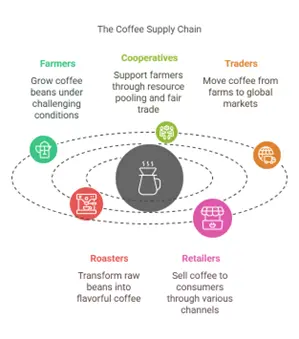
The coffee supply chain can be broken down into four main stages:
This is the beginning of the coffee journey, where coffee beans are grown and harvested. Farmers or cooperatives sell their beans to traders, exporters, or directly to roasters. Sourcing decisions are critical for sustainability ensuring that the beans come from farms that practice environmentally friendly farming, like agroforestry or climate-smart techniques.
After harvest, coffee beans go through a processing stage where they are cleaned, dried, and prepared for export. This is where a lot of the environmental impact happens some methods, like wet processing, use large amounts of water, and improper waste management can lead to pollution. Sustainable processing practices focus on reducing water usage and waste production.
Once the beans are roasted, they’re distributed to retailers or directly to consumers. This stage has significant environmental impacts, especially in terms of transportation. As a result, many businesses are working to minimize their carbon footprint by optimizing logistics and reducing packaging waste.
Finally, coffee reaches consumers, either through retail outlets or online stores. Here’s where consumer choices play a big role. Sustainable coffee brands are increasingly in demand, as consumers become more aware of the ethical and environmental impacts of their coffee choices. Ethical and sustainable coffee brands prioritize environmental protection, fair trade, and social responsibility throughout their supply chain. By choosing ethical and sustainable coffee, consumers contribute to a more transparent and responsible coffee industry that values both people and the planet.
Each step of the coffee supply chain has the potential to create positive change or further exacerbate issues like deforestation, poor working conditions, and climate change. By understanding these steps and supporting sustainable practices, we can all play a part in making the coffee supply chain more ethical, transparent, and environmentally friendly.
Learn how to ensure transparency, sustainability, and compliance in every bean you trade.
Soil degradation from conventional coffee farming is one of the most underreported sustainability risks in the industry. Monocropping, chemical overuse, and deforestation strip soil of its organic matter, making farms progressively less productive and more erosion-prone.
Growing coffee under a canopy of native trees does more than protect the crop from direct sun. It creates a micro-ecosystem that reduces soil temperature and moisture loss, provides habitat for pollinators and pest predators reducing pesticide need, contributes organic matter through leaf litter improving soil carbon over time, and supports biodiversity that makes farms more resilient to disease outbreaks.
Intercropping growing additional crops alongside coffee delivers measurable benefits for soil chemistry and farmer income. Legumes fix atmospheric nitrogen back into soil, reducing synthetic fertilizer dependency. Banana, plantain, and fruit trees provide shade and supplementary income streams. Rotating crops disrupts pest cycles and improves soil microbial diversity.
When farmers can document intercropping practices through digital tools, they gain access to sustainability certifications that unlock premium pricing.
Agroforestry integrates trees, crops, and sometimes livestock in a managed, mutually beneficial system. For coffee specifically, it has emerged as a gold-standard approach because it sequesters carbon in both soil and biomass supporting carbon credit claims, provides windbreaks that reduce plant stress during extreme weather events, restores degraded land and can prevent further deforestation pressure, and qualifies farms for premium certifications like Rainforest Alliance, Fair Trade, and Organic.
Regenerative agriculture focuses on rebuilding soil health, increasing biodiversity, and improving ecosystem services through holistic farming practices. In the context of coffee, regenerative agriculture can be a game-changer.
A circular economy in coffee focuses on minimizing waste and maximizing the use of resources by creating closed-loop systems. Circular economy principles encourage the repurposing of coffee waste, such as using coffee pulp to create compost or biogas, thus reducing landfill waste and promoting sustainable resource use.
| 40% More carbon sequestered in agroforestry vs. monoculture | 30% Reduction in synthetic fertilizer use with intercropping systems | 2x Higher income for shade-grown certified smallholders vs. conventional |

Coffee’s carbon footprint is more concentrated than most supply chain managers realize.
According to CDP, the majority of coffee’s carbon footprint – 75% to 91% – is generated before the coffee beans even leave the farm.
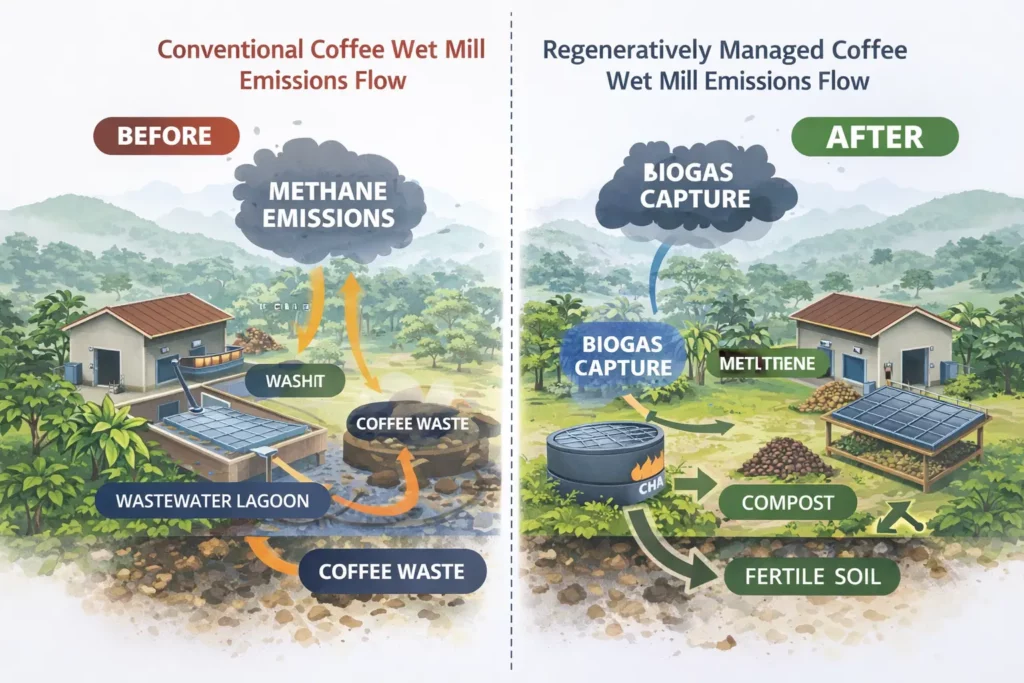
This means the most impactful emission reductions happen upstream, on the farm and at the wet mill.
The most effective emissions reduction approaches for coffee are:
Emissions reduction at scale requires measurement, monitoring, and reporting (MRV) systems. Without them, sustainability claims are unverifiable and increasingly, regulators and buyers are demanding proof.
TraceX provides end-to-end carbon MRV capabilities that allow farm-level data collection on inputs, land use, and practices; automated calculation of emissions baselines and reductions; audit-ready documentation for EUDR, carbon credits, and buyer sustainability reports; and real-time dashboards for exporters and cooperatives to track portfolio-wide progress.
The EU Deforestation Regulation (EUDR) requires that operators placing coffee on the EU market prove their supply chain does not contribute to deforestation or forest degradation after December 31, 2020. Compliance requires geo-coordinates (polygon-level, not just plot centroids) for all farm plots in your supply chain, a documented Due Diligence System (DDS) with risk assessment methodology, batch-level traceability linking each bag of coffee to a specific farm, and ongoing monitoring and annual reporting obligations. TraceX provides a EUDR-ready platform with GeoJSON farm mapping, risk assessment tools, and DDS documentation support.
The highest-impact practices for GHG reduction in coffee are: agroforestry implementation, transition from synthetic to organic fertilizers, shade-grown cultivation, biogas capture from wet mill waste, and precision irrigation. Each requires farm-level data capture to verify and report.
Smallholder farmers access premium markets through certification programs (Rainforest Alliance, Fairtrade, Organic), cooperative structures that aggregate supply and share traceability costs, direct trade relationships with buyers who require farm-level transparency, and digital traceability platforms that provide the documentation required by premium buyers.
Regenerative agriculture goes beyond organic certification. While organic prohibits synthetic inputs, regenerative agriculture actively rebuilds soil health, biodiversity, and carbon sequestration capacity. For coffee, this means agroforestry, cover cropping, composting, no-till practices, and integrated water management all designed to improve the ecosystem over time rather than simply avoid harm.
In India’s Araku Valley home to one of the world’s first specialty coffee brands grown by tribal smallholder farmers TechnoServe partnered with TraceX to deploy an end-to-end digital traceability solution across 3,500 farmers in 355 villages.
The results:
‘TraceX was exactly the solution we were looking for. Through their blockchain-enabled traceability platform, TraceX empowers farmers by giving them more visibility, improving efficiency and profitability, building trust and transparency.’ – Sandesh Deranna, Crop Lead, Coffee Value Chain, TechnoServe
| Capability | What It Does for Coffee Sustainability |
|---|---|
| Farm Geo-Mapping | Polygon-level mapping of smallholder plots for EUDR compliance and deforestation risk assessment |
| Carbon MRV | Measures, monitors, and reports carbon sequestration from agroforestry and regenerative practices |
| Traceability Chain | Tracks each batch of coffee from farm to export with tamper-evident digital records |
| Agronomy Advisory | Delivers climate-smart farming guidance directly to farmers via multilingual mobile app |
| EUDR Due Diligence | Automates DDS documentation, risk classification, and compliance reporting for EU market access |
| Farmer Onboarding | Offline-capable app for rapid onboarding of smallholders across remote geographies |
Coffee sustainability is not a checkbox. It is a continuous system of practices, measurements, and investments many of which start at the soil level and ripple through every tier of the supply chain.
The farms that will survive climate change are those planting the right varieties, managing soil as a living asset, embedding trees into production systems, and measuring their impact with tools buyers and regulators can trust.
The supply chains that will thrive are those building digital transparency from the ground up giving farmers visibility, giving buyers verifiable proof, and giving regulators the documentation they require.
Climate resilience is no longer optional. It is the foundation for farmer livelihoods and buyer confidence alike. The path forward lies in combining digital tools, traceability systems, and sustainable practices to secure incomes today while future-proofing the coffee industry for tomorrow.
Ready to Future-Proof Your Coffee Supply Chain? Explore how digital transformation accelerates sustainability, how Rainforest Alliance certifications support EUDR compliance, and what it takes to deliver truly deforestation-free coffee to global markets.
Read the Blogs:
Digital Transformation for Sustainability in Agriculture
How Rainforest Certifications Support EUDR Coffee Compliance
Building a Deforestation-Free Coffee Supply Chain
While complex, digital tools and structured traceability systems make it scalable and manageable across global supply chains.
Yes. With proper support, training, and digital onboarding, smallholders can provide the data and practices needed for compliance and sustainability.
Initially, yes, but it reduces long-term risks, improves yield quality, and opens access to premium and regulated markets.
Traceability links coffee back to its origin, ensuring transparency, verifying practices, and enabling compliance with global regulations.
Because climate risks, regulatory pressures, and consumer expectations are rising, early adoption ensures resilience and competitive advantage.