
Quick summary: Learn how sustainable sourcing in agribusiness drives traceability, ESG goals, and regulatory compliance. Explore strategies, challenges, and solutions for building transparent supply chains.

Sustainable sourcing in agribusiness means procuring agricultural commodities in ways that protect ecosystems, respect farmers’ livelihoods, and satisfy increasingly strict regulations, and it’s no longer optional. With the EU Deforestation Regulation (EUDR) and CSRD both in force, companies without digital traceability infrastructure face shipment rejections, investor scrutiny, and market access loss.
Here’s what most articles won’t tell you: the biggest obstacle isn’t intent, it’s data. Agribusinesses know they need to source sustainably. What they can’t do is prove it. Fragmented supplier records, paper-based farm documentation, and disconnected ERP systems make it impossible to generate the audit-ready evidence that regulators, buyers, and investors now demand.
Supply-chain opacity remains a major ESG barrier in agri-food, EUDR non-compliance poses material trade risk for exporters, and consumer purchase decisions are increasingly influenced by transparency.
This guide covers the full landscape: what sustainable sourcing actually requires in 2026, how ESG frameworks and new regulations have reshaped procurement, which certifications matter and why, and how traceability technology is the connective tissue that makes it all work. Whether you’re an ESG director, supply chain manager, or procurement lead, this is the operational playbook you need.
A sustainable agribusiness supply chain isn’t a marketing statement; it’s a set of verifiable operational commitments that extend from seed to shelf. In 2026, sustainable sourcing means four things working together: environmental accountability (no deforestation, reduced emissions), social equity (fair farmer incomes, safe labor practices), regulatory compliance (EUDR, CSRD, ESPR), and digital traceability to prove all three.
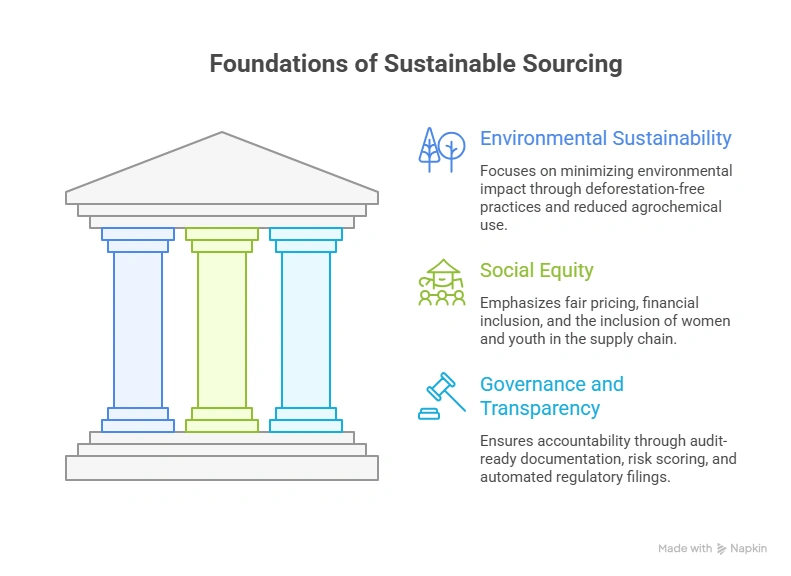
The challenge isn’t knowing what sustainability requires; it’s building the data infrastructure to demonstrate it. A coffee exporter in India supplying German roasters now needs to show, at the SKU level, that every kilogram of coffee came from a geo-verified plot that hasn’t been deforested since 2020, paid a traceable price to a named farmer, and carries an unbroken digital chain of custody.
Over 70% of smallholder farmers in South Asia and Sub-Saharan Africa still use paper records for transactions and land documentation. That gap between analog farm reality and digital compliance requirements is where most agribusinesses are losing market access and premium positioning.
TraceX’s Sustainable Sourcing Platform was built specifically for this last-mile challenge: offline-first mobile apps, multilingual farmer portals, GPS polygon capture, and automated farmgate transaction trails, making digital onboarding viable even without reliable connectivity.
Challenge: A mid-sized Karnataka-based coffee exporter supplying 3 European buyers needs EUDR compliance, but had 1,400+ smallholder suppliers with no digital records.
Solution: TraceX solutions can deploy offline GPS capture mobile apps with field agents across districts. Farmer profiles with geo-tagged plots can be built in weeks. Automated DDS generation can cut per-shipment compliance time from 4 days to 4 hours.
Outcome: Zero shipment rejections. EU buyers can renew contracts with a premium for verified sustainability claims.
ESG isn’t a sustainability team problem anymore; it’s a P&L issue. Agribusinesses that can’t produce credible ESG data are getting cut from EU supplier lists, facing investor pressure, and watching competitors capture premium market segments. Companies that get ESG right, by contrast, are unlocking new revenue streams through carbon credits, attracting impact investment, and commanding verified-sustainable premiums.
| ESG Dimension | Framework | Supply Chain Requirement | Risk if Missed |
|---|---|---|---|
| Environmental | EUDR / CSRD | Deforestation-free sourcing, GPS-verified plots, satellite monitoring | Shipment rejection, EU market ban |
| Environmental | CSRD / SBTi | Scope 3 emissions from primary supply chain data (not averages) | Audit failure, investor downgrade |
| Social | Fairtrade / UEBT | Fair pricing evidence, farmer financial inclusion, labor audits | Certification loss, brand damage |
| Governance | ESPR / GS1 | Digital Product Passports, blockchain-backed chain of custody | Product recall liability, EU import block |
| Carbon / Nature | TNFD / SBTN | Nature-based solutions tracking, biodiversity impact reporting | SBTi non-alignment, capital cost increase |
Explore how ESG is transforming agribusiness. Discover how sustainability, traceability, and compliance are shaping the future of agriculture.
Companies that invest in verifiable ESG supply chain data are seeing measurable returns. Third-party verified sustainability claims can support price premiums in agri-food markets, but the exact premium depends on category, buyer segment, and verification strength.
Separately, CSRD-compliant companies may attract more institutional interest than non-disclosers, reflecting the market value of stronger ESG transparency.
TraceX’s Digital MRV platform calculates Scope 3 emissions from primary supply chain data, not industry averages, enabling companies to produce CSRD-aligned sustainability reports with defensible, farm-level numbers. That’s the difference between a report that satisfies investors and one that gets challenged in an audit.
The regulatory environment facing agribusinesses in 2026 is unlike anything the sector has faced before. Three major frameworks, EUDR, CSRD, and ESPR, are converging simultaneously, each requiring a different kind of supply chain data. What unites them is the same underlying requirement: you can’t comply on paper.
The EUDR applies to companies placing certain commodities (cattle, cocoa, coffee, palm oil, soy, wood, rubber) on the EU market after December 30, 2026. Every shipment requires a Due Diligence Statement (DDS) confirming the product is deforestation-free and was produced legally. Non-compliant shipments are blocked at EU ports.
| EUDR Requirement | What It Means Operationally | TraceX Solution |
|---|---|---|
| GPS polygon geolocation of all farms | Every plot in your supply base must be geo-mapped | Offline GPS capture app plus satellite validation (Sentinel-2, Hansen) |
| Deforestation-free verification post-2020 | Satellite cross-check against JRC deforestation datasets | Automated satellite risk scoring plus real-time deforestation alerts |
| Due Diligence Statement (DDS) | Formal EU filing per shipment via TRACES system | AI-powered DDS auto-generation plus one-click TRACES submission |
| Country benchmarking risk classification | High/standard/low risk source country handling | Dynamic risk scoring dashboard with supplier-level flags |
| Document audit trail | Land tenure, KYC, certifications per supplier | Agentic AI auto-parses supplier emails and documents |
CSRD requires large companies and their supply chains to disclose sustainability impacts using the European Sustainability Reporting Standards (ESRS). For agribusinesses, the most challenging requirement is Scope 3 emissions disclosure, which means getting emissions data from farms, not from industry average databases.
TraceX’s Digital MRV platform calculates Scope 3 from real farmgate transaction and input data, producing CSRD-aligned reports that can withstand third-party audit.
Explore how agricultural GHG emissions impact sustainability and supply chains. Learn how data and traceability can help measure, manage, and reduce emissions effectively.
ESPR introduces Digital Product Passports (DPPs), QR-code-linked records that carry sustainability, circularity, and supply chain transparency data for products placed on the EU market. TraceX implements GS1-standard DPPs with blockchain-backed data integrity, ensuring each product’s journey from farm to retail is immutably recorded and consumer-accessible.
Explore how GS1 standards enable Digital Product Passports. Learn how standardized data and identifiers drive traceability, compliance, and transparency.
Sustainability certifications are table stakes for premium agri-food markets, but managing them across hundreds of suppliers, multiple geographies, and overlapping audit cycles is where most procurement teams break down. A Fairtrade audit requires different data than a Rainforest Alliance inspection. A UEBT certification requires different documentation than an organic standard. Without integrated traceability, you’re duplicating effort on every certification cycle.
| Certification | Primary Focus | Supply Chain Data Required | Relevance to EUDR/CSRD |
|---|---|---|---|
| Fairtrade | Farmer income equity, community premiums | Price tracing, payment evidence, farmer IDs | Social pillar of CSRD ESRS S2 |
| Rainforest Alliance | Farm practices, input use, and GPS farm data | Complementary to the CSRD environmental pillar | Aligned with EUDR deforestation criteria |
| UEBT (Union for Ethical BioTrade) | Biodiversity conservation, equitable sharing | Species tracking, ecosystem data, consent records | Supports TNFD nature disclosure |
| Organic (EU/USDA/NPOP) | No synthetic inputs, soil health | Input records, inspection chain, batch tracing | Complementary to CSRD environmental pillar |
| FSSC 22000 / ISO 22000 | Food safety management systems | Batch traceability, HACCP records | FSMA / BRC compliance for food manufacturers |
Mid-market agri-exporters often spend significant staff time managing certification documentation across disconnected systems, creating compliance overhead and operational inefficiency.
When a Fairtrade audit, EUDR DDS filing, and CSRD sustainability report all require overlapping data, and that data lives in three different systems, the cost compounds every reporting cycle.
TraceX integrates certification alignment into its Sustainable Sourcing Platform, mapping farmer and supplier data against Fairtrade, Rainforest Alliance, UEBT, and EUDR requirements simultaneously, so one data collection cycle feeds multiple compliance outputs.
Check our Sustainability Sourcing Platform.
Traceability isn’t a product feature; it’s the operational infrastructure that makes sustainable sourcing provable. Without a digital chain of custody from farm plot to finished product, every sustainability claim you make is vulnerable: to regulatory challenge, investor scrutiny, and consumer skepticism.
| Layer | What Gets Captured | Who Uses It | Business Outcome |
|---|---|---|---|
| Farm Onboarding | GPS plots, farmer ID, land tenure, crop history | Procurement/sourcing managers | Compliance-ready supplier profiles |
| Input Tracking | Seeds, fertilizers, pesticides batch-level | Agronomists, field supervisors | Food safety compliance, certified input trail |
| Farmgate Transaction | Harvest volumes, price paid, payment route, quality grade | Factory/warehouse operations | Fairtrade price evidence, Scope 3 data |
| Processing and Logistics | Batch IDs, transformation records, quality tests | Compliance/trade ops team | Recall-ready forward traceability |
| Export / DDS Filing | GPS data plus transaction trail, EUDR DDS auto-generation | Brand/marketing teams | EUDR market access protection |
| Consumer Transparency | QR-code linked Digital Product Passport | Brand / marketing teams | Premium positioning, consumer trust |
A digital record is only as valuable as its trustworthiness. TraceX uses blockchain-backed data integrity, meaning every supply chain event, from GPS capture to farmgate payment to DDS filing, is written to an immutable ledger. This eliminates the fraud risk that plagues conventional traceability systems and creates the single source of truth that audit bodies and regulators require.
Most competing SaaS tools use standard relational databases, meaning records can be edited, deleted, or altered. Blockchain immutability is not a gimmick: it’s the reason TraceX records can be cited in regulatory filings and third-party audits without challenge.
TraceX’s Agentic AI layer auto-parses supplier documents, KYC files, land tenure records, certification PDFs sent via email, and extracts structured data without manual entry. Combined with GPS polygon validation and satellite deforestation cross-checks, it converts a compliance process that previously took days per shipment into a task measured in minutes.
Explore how agentic AI is transforming EUDR compliance. Discover how intelligent automation can simplify due diligence, risk assessment, and reporting.
| Capability | Manual / Spreadsheet Approach | TraceX Digital Platform |
|---|---|---|
| Farmer GPS onboarding | Manual coordinate entry, error-prone, weeks per batch | Offline GPS app, batch upload, validated in 48 hrs |
| EUDR DDS generation | 4-7 days per shipment, high error rate | Automated in hours, TRACES-ready API submission |
| Scope 3 emissions | Estimated from industry averages (low accuracy) | Primary data from farmgate transactions (CSRD-aligned) |
| Certification management | Spreadsheet per certification, audit data duplicated | Single data collection, multi-cert output |
| Forward/reverse traceability | Manual batch records, recall response: days to weeks | Real-time batch trace, recall response: hours |
| Farmer payment evidence | Paper receipts, no audit trail | Automated payment records, Fairtrade-compatible |
| Consumer transparency | None / static label | Dynamic QR-code Digital Product Passport |
The agribusinesses winning in 2026 aren’t the ones with the best sustainability intentions; they’re the ones with the best sustainability data. EUDR compliance, CSRD reporting, premium certification management, and consumer transparency all converge on the same requirement: a digital traceability infrastructure that makes supply chain visibility a default, not an exception.
TraceX exists to close that gap. From offline GPS farmer onboarding in remote geographies to AI-powered DDS auto-generation, blockchain-backed chain of custody, and Scope 3 MRV for CSRD, it’s the full stack for sustainable agribusiness sourcing, built for the realities of emerging market supply chains.
The question isn’t whether sustainable sourcing requires technology. It’s whether your current technology is up to what regulators, buyers, and investors now require.
Sustainable sourcing in agribusiness means procuring agricultural commodities in environmentally responsible ways (deforestation-free, low emissions), socially equitable (fair farmer incomes, safe labor), and compliant with regulations like EUDR and CSRD. In 2026, it requires digital traceability to produce verifiable evidence, not just policy commitments.
The EU Deforestation Regulation (EUDR) requires that certain commodities (coffee, cocoa, cattle, palm oil, soy, rubber, wood) placed on the EU market after December 30, 2026, are deforestation-free and legally produced. Every shipment needs a Due Diligence Statement (DDS) backed by GPS-verified farm data and satellite deforestation checks. Non-compliant shipments face EU port blocks.
The most strategically valuable certifications depend on your market and commodity: Fairtrade and Rainforest Alliance are table stakes for coffee, cocoa, and spices in EU/US premium markets. UEBT matters for bio-ingredients. FSSC 22000 / ISO 22000 are critical for food safety compliance. Certification value is highest when underpinned by a digital traceability system that reduces per-audit cost.
Digital traceability platforms capture primary supply chain data, farmer IDs, GPS plots, input use, transaction records, and use it to auto-generate CSRD Scope 3 emissions calculations, EUDR DDS filings, and certification audit trails. This replaces industry-average estimates with defensible, farm-level numbers that satisfy third-party auditors and regulatory bodies.
Companies investing in traceability-enabled sustainable sourcing gain premiums from verified sustainability claims, a reduction in compliance processing, and avoidance of EU market access loss. The ROI case is strongest for exporters with EU buyers and companies facing CSRD reporting obligations.