
TechnoServe is a prominent nonprofit organization dedicated to alleviating poverty by leveraging the power of the private sector. It supports individuals in the developing world to enhance their farms, businesses, and industries, thereby fostering economic growth and sustainable development. One notable initiative is in the dairy value chain which involves dairy partners working across Tamil Nadu, Maharashtra, and Uttar Pradesh, to improve the dairy industry and its associated benefits.
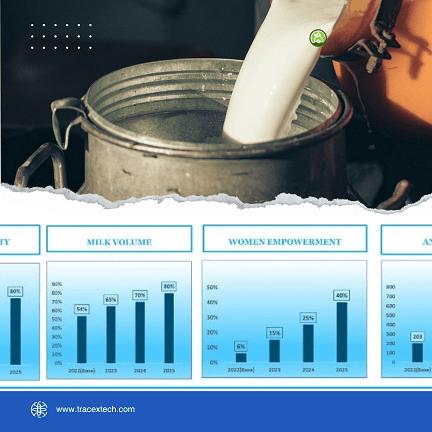
This project is a collaborative effort between 2 enterprises and 3 dairy partners spread across different states in India, aimed at empowering women dairy farmers and enhancing animal welfare standards within the dairy sector. The initiative focuses on strengthening milk traceability systems to ensure the procurement of quality milk while also building the capacity of farmers and entrepreneurs to drive sustainable dairy development. Through these efforts, the project strives to create a more inclusive and resilient dairy ecosystem that benefits both farmers and consumers alike.
Foundation – Non Profit Organization
India- Tamil Nadu, Maharashtra, Uttar Pradesh
Strengthening milk traceability with an objective covering animal welfare and women empowerment
India stands as a global leader in milk production, contributing significantly to the world’s dairy supply. The sector is a cornerstone of the rural economy, providing livelihoods to millions and ensuring food security. From empowering farmers to fuelling economic growth, the dairy industry plays a pivotal role in India’s development story.
TraceX streamlines organizational hierarchy, user levels, and role configurations to optimize operational efficiency and ensure seamless collaboration within the system. Through intuitive user interface design and customizable features, TraceX allows administrators to define hierarchical structures tailored to their organization’s specific needs. This includes setting up user levels with distinct roles and permissions, enabling granular control over access to sensitive information and functionalities.
Dairy Farmer Onboarding is a feature in TraceX designed to streamline the process of integrating dairy farmers into the system. Through this feature, farmers undergo comprehensive profiling, where detailed information such as their personal details, farm IDs, pour IDs, and associated Bulk Milk Chiller (BMC) details are recorded. Additionally, the system categorizes farmers based on their adherence to animal welfare practices, distinguishing between those compliant with welfare standards and those who are not.
The dairy operations begin at the grassroots level with individual farmers supplying milk to Bulk Milk Chillers (BMCs) located within their respective villages. At these centers, milk undergoes rigorous quality testing to ensure compliance with established standards. BMCs play a crucial role in maintaining milk quality and ensuring efficient storage and transportation. Following thorough testing at BMCs, the milk is forwarded to the Factory Raw Milk Reception Dock (FRMRD) located at the factory site.
Outward route vehicles facilitate the transportation of milk from BMCs to the factory, ensuring safe and hygienic delivery. These vehicles are equipped with insulated compartments to preserve milk quality during transit. Additionally, quality inspectors conduct final tests before the milk is accepted for processing.
Throughout this process, various key callouts shape the dairy operations, including the association of farmers with multiple BMCs, the optimization of collection routes to serve multiple BMCs efficiently, the affiliation of each BMC with multiple villages to expand the collection network, and the strategic quarterly profiling of BMCs to facilitate controlled expansion. This intricate network ensures the seamless flow of milk from farm to factory, maintaining quality standards at every step of the journey.
The creation of a Dairy Master with TraceX solutions involves several key steps to ensure comprehensive management of dairy operations:
1. BMC Profiler: TraceX enables the profiling of Bulk Milk Chillers (BMCs), capturing essential details such as location, capacity, and operational status. This information forms the foundation of the Dairy Master, providing insights into the infrastructure available for milk collection and processing.
2. Daily Pouring Data: The system collects and records daily pouring data from BMCs, capturing metrics such as milk quantity, quality parameters, and source farms. This data is crucial for monitoring daily operations and assessing overall performance.
3. Route Testing: TraceX facilitates daily route testing to ensure the quality and safety of milk during transportation. This involves conducting tests along collection routes to verify compliance with quality standards and identify any potential issues or deviations.
4. Lab Report: The system generates daily lab reports based on testing conducted at BMCs and along collection routes. These reports provide detailed insights into milk quality, allowing for prompt action in case of any abnormalities or discrepancies.
5. Input Distribution: TraceX facilitates monthly input distribution, ensuring that essential resources such as feed, supplements, and veterinary services are allocated efficiently to support dairy farming operations. This helps optimize productivity and ensure the well-being of dairy animals.
To ensure a smooth data flow, the platform integrates seamlessly with the Dairy Partner systems via robust APIs. This integration enables the real-time transfer of critical data points, including daily pouring and lab testing reports, from the source system to the platform.
Explore our Traceability Platform
What is food traceability | Types of traceability in supply chains | Food traceability best practices | Traceability in the food industry | Digital traceability system | Blockchain food traceability solutions | QR code traceability for consumer trust | ERP integration for traceability | Conscious consumerism through traceability | Food system transformation with traceability | Coffee supply chain guide | Coffee traceability from bean to cup | Sustainable coffee supply chain | Regenerative agriculture for coffee | Agroforestry in the coffee value chain | Rainforest Alliance certified coffee | Single origin coffee explained | Cocoa supply chain traceability | Child labour in cocoa supply chains | Child labour monitoring and remediation systems | Fairtrade cocoa sourcing | Agroforestry in cocoa supply chains | Tea supply chain transformation | Sustainability in the tea value chain | Seed supply chain traceability | Seed supply chain basics | Forward traceability in seed industry | Seed supply chain challenges | Seed procurement process | Livestock traceability for meat safety | Blockchain traceability in livestock | Carbon traceability on blockchain | Maize value chain traceability | Farm to fork journey of millets | Millet value chain overview | Millets for a sustainable future | Pulse value chain traceability | Fruit and vegetable supply chain traceability | Banana supply chain traceability | Carbon footprint of banana production | Grape traceability for exports | Digital procurement for fruits and vegetables | Mango supply chain transparency | Tomato value chain challenges | Reducing post-harvest losses in potatoes | Sugarcane supply chain traceability | Sustainable sugarcane farming practices | Flower traceability from seed to scent | Orris root traceability in fragrance | Fair trade in fragrance oil supply chains | Hive to honey traceability | Cannabis supply chain traceability | Wine traceability grape to glass | Nutraceuticals and herbal supplements traceability | Rice supply chain traceability | Mill level rice traceability | Sustainable rice farming | Direct seeded rice cultivation | Sustainable rice platform standards | System of rice intensification | Alternate wetting and drying rice cultivation | Cotton supply chain traceability | Sustainability in the cotton industry | Organic cotton traceability | Fashion supply chain explained | Mapping the textile value chain | Traceability in the fashion industry | Traceability in waste management | Plastic value chain explained | Traceability for GI tagged products | Traceability for organic food brands | Spice supply chain traceability | Pepper traceability farm to table | Chilli value chain overview | Turmeric value chain | Batch level traceability for spice exports | Batch traceability in spice manufacturing | Sustainable spice sourcing technology | Sustainable farming practices for spices | Grocery supply chain challenges | Dairy supply chain guide | Real-time milk collection tracking | Dairy supply chain risk and issues | Batch level traceability in dairy | Ghee adulteration prevention | Sustainable dairy farming | Seafood supply chain ocean to plate | Sustainable fishing through supply chain transparency | Poultry value chain chicken to nugget | Tobacco supply chain overview | Digitizing tobacco farming | Tobacco traceability for compliance | Sustainable tobacco production | Sustainable tobacco programs | Digitizing the paper supply chain | Sustainable soy supply chains | RTRS certification in soy | Sustainable rubber from tree to tyre | FSC certified rubber solutions | Palm oil supply chain insights | RSPO certification with EUDR compliance | Seed oils traceability farm to refinery | Aggregation risk in oilseed supply chains | Digital traceability for cold pressed oils | Timber value chain from forest to product | Sustainable cashew production traceability | Arecanut value chain traceability | Essential guide to food supply chains | Factors influencing food supply chain management | Food supply chain in India | Blockchain for food supply chain | Agriculture and food supply chain factors | Traceability in food safety | Supply chain transparency for food safety | Understanding food recalls | Product recall in the food industry | Food waste in supply chains | Food waste recycling and composting | Food waste upcycling solutions | Supply chain traceability framework | Complete guide to supply chain traceability | Product traceability in supply chains | Material traceability in supply chains | Elements of supply chain provenance | Chain of custody in agriculture | Supplier mapping for traceability | Real-time supply chain visibility | Traceability for ESG compliance | Supply chain due diligence | Examples of food supply chain traceability | Supply chain traceability challenges | Multi-tier supply chain transparency | Traceability for supply chain managers | Mitigating supply chain risks for exporters | CTOs driving digital transformation with traceability | Digital transformation for licensed cocoa buyers | Bulk food product traceability | Automated farm input distribution | Supplier onboarding challenges | Digital process configuration in food production | Bulk GRN processing in procurement | Batch IDs in food traceability systems | Inventory management in the food industry




We use cookies on our website to give you the most relevant experience by remembering your preferences and repeat visits. By clicking “Accept All”, you consent to the use of ALL the cookies. However, you may visit "Cookie Settings" to provide a controlled consent.
| Cookie | Duration | Description |
|---|---|---|
| cookielawinfo-checkbox-analytics | 11 months | This cookie is set by GDPR Cookie Consent plugin. The cookie is used to store the user consent for the cookies in the category "Analytics". |
| cookielawinfo-checkbox-functional | 11 months | The cookie is set by GDPR cookie consent to record the user consent for the cookies in the category "Functional". |
| cookielawinfo-checkbox-necessary | 11 months | This cookie is set by GDPR Cookie Consent plugin. The cookies is used to store the user consent for the cookies in the category "Necessary". |
| cookielawinfo-checkbox-others | 11 months | This cookie is set by GDPR Cookie Consent plugin. The cookie is used to store the user consent for the cookies in the category "Other. |
| cookielawinfo-checkbox-performance | 11 months | This cookie is set by GDPR Cookie Consent plugin. The cookie is used to store the user consent for the cookies in the category "Performance". |
| viewed_cookie_policy | 11 months | The cookie is set by the GDPR Cookie Consent plugin and is used to store whether or not user has consented to the use of cookies. It does not store any personal data. |
WhatsApp us

Get the free TraceX Playbook — 10 traceability failures to fix before your next audit, a 10-point maturity scorecard.

Don’t miss out on your chance to grab access to our early bird offer!

Your essential compliance guide