
Quick summary: The timber value chain explained: understand how timber moves from forest to finished product, key risks, regulations, and why traceability and compliance determine market access.
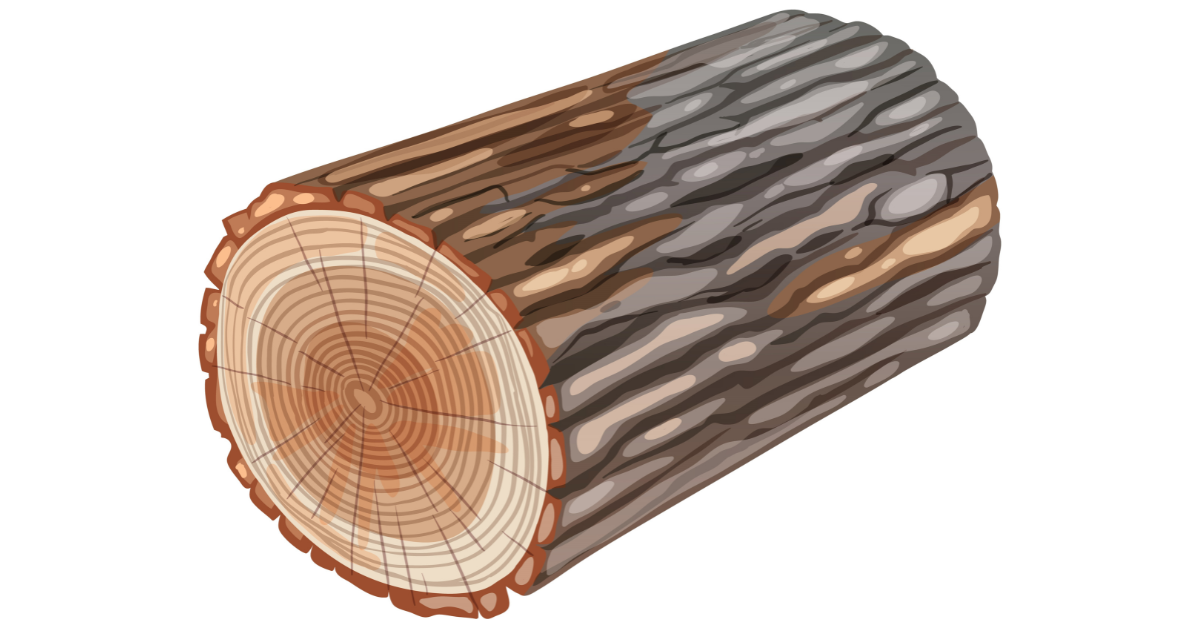
Timber often passes through multiple countries, intermediaries, and processing stages, making it easy for origin data to be lost and illegal or non-compliant wood to enter legitimate markets The timber value chain connects forests to finished products through harvesting, transport, processing, manufacturing, and global trade, but it is also one of the most complex and high-risk supply chains in the world..
Today, that complexity has become a critical pain point: tightening regulations, deforestation controls, and buyer due diligence requirements mean companies must prove where timber comes from and how it was sourced. In the modern timber value chain, traceability and compliance are no longer optional; they are the gatekeepers to market access, trade continuity, and brand credibility.
The timber value chain is the end-to-end sequence of activities, actors, and transactions involved in moving timber from forest resources to finished wood products sold in domestic and international markets. It includes both the physical flow of wood from harvesting to processing and manufacturing and the commercial flow of ownership, contracts, and trade that accompanies it.
Physically, the timber value chain begins with forest management and harvesting, where trees are legally (or illegally) felled in concessions, plantations, or community forests. Logs are then transported to primary processing facilities such as sawmills, where they are cut and graded. From there, timber may pass through secondary processing, for example, into panels, furniture components, pulp, or paper before reaching manufacturers, distributors, and retailers.
Commercially, ownership and responsibility for timber often change hands multiple times. Traders, exporters, importers, processors, and manufacturers may each take custody of the material, sometimes without ever physically handling it. Each transaction introduces documentation, aggregation, and contractual complexity, increasing the risk of data loss and compliance gaps.
The global timber value chain encompasses harvesting, processing, manufacturing, and distribution of wood products, with a market size estimated at $266-992 billion in 2025, projected to reach $279-1,251 billion by 2026-2030 (CAGR 3.4-4.8%) driven by construction (50%+ share) and sustainable demand
| Segment | 2025 Size (USD Bn) | CAGR to 2030+ |
| Timber/Wood Products | 266-992 | 4.7% |
| Sawn Timber | ~188 (2024) | 3.4% |
| Construction | 214 | Stable |
Timber value chains are inherently multi-country and multi-actor because different stages specialize in different regions. Timber may be harvested in one country, processed in another, manufactured elsewhere, and sold in high-value consumer markets far from the forest of origin. Cost structures, labour availability, processing capacity, and trade routes all contribute to this geographic spread.
This fragmentation, combined with the involvement of forest owners, loggers, transporters, mills, traders, manufacturers, exporters, and importers, makes the timber value chain difficult to monitor. It also explains why traceability, legality verification, and regulatory compliance have become central requirements for companies operating in today’s global timber markets.
Global sawnwood trade ~$100B (2023), led by Europe (Sweden/Finland 20%+), Canada, Russia/Asia; top destinations: China, US, EU amid EUDR traceability mandates boosting certified FSC/PEFC volumes from Africa/LATAM.
The timber value chain is made up of several interconnected stages, each introducing specific operational, legal, and compliance risks. Understanding where these risks arise is critical for managing traceability and meeting regulatory requirements.
The timber value chain begins with forest management and harvesting, where trees are sourced from natural forests, plantations, or community-managed lands. At this stage, compliance depends on clear land tenure, valid concessions, and legal harvesting permits issued by competent authorities. Forest management plans define which areas can be logged, what species may be harvested, and under what conditions.
This stage carries the highest risk of illegal logging. Weak governance, unclear land rights, harvesting outside permitted areas, or exceeding authorized volumes can all result in timber being illegally sourced from the outset. If legality is not established at the forest level, compliance cannot be restored downstream making origin verification essential.
After harvesting, logs are transported to log yards, collection points, and sawmills for primary processing. Here, timber is typically cut, sorted, and graded into rough-sawn wood or basic products. This stage often involves aggregation, where logs from multiple harvest sites are combined.
Aggregation introduces a major risk: loss of origin and mixing of compliant and non-compliant timber. Without robust tracking systems, it becomes difficult to link processed wood back to specific forests or permits. Transport documentation, weighbridge records, and mill intake logs are critical at this stage to maintain traceability and prevent laundering of illegal timber.
In the secondary processing stage, timber is transformed into higher-value products such as panels, furniture, flooring, veneer, pulp, and paper. Processing may take place in different facilities or even different countries from where the logs were harvested.
Chain-of-custody challenges intensify here. Timber from multiple sources is often combined, cut, or reprocessed, making it harder to preserve a clear link to forest origin. Manufacturers must rely on batch-level traceability, material balance controls, and documented supplier declarations to demonstrate that finished products are made from legally sourced timber.
The final stage involves distribution, export, and retail, where timber products enter domestic or international markets through traders, exporters, importers, and retailers. This is the point of highest regulatory exposure, as authorities typically enforce timber regulations when products are placed on the market.
Importing countries, particularly in the EU, UK, US, and Australia, require companies to demonstrate legal origin and due diligence. If documentation, traceability, or risk assessments are insufficient, shipments can be delayed, rejected, or penalized. For many companies, this stage determines whether timber products can legally be sold at all.
Across every stage of the timber value chain, traceability and compliance must be maintained continuously. Breakdowns at any point, especially during aggregation or processing, can invalidate legality claims and block market access.
Understand what illegal logging is, why it persists, and how it impacts global timber supply chains.
Learn how timber traceability supports EUDR compliance from forest to finished product.
The timber value chain is considered one of the highest-risk global supply chains due to a combination of environmental, governance, and structural factors. These risks are not isolated to a single stage they accumulate and compound as timber moves from forest to market.
Illegal logging remains a persistent issue in many timber-producing regions, driving deforestation, biodiversity loss, and climate impacts. Timber harvested without valid permits, outside authorized areas, or from protected forests can easily enter supply chains if controls at origin are weak. Once illegally sourced wood is mixed with legal material downstream, it becomes extremely difficult to detect making early-stage verification critical.
In several timber-producing countries, governance challenges such as unclear land tenure, limited enforcement capacity, corruption, or inconsistent permitting systems increase compliance risk. Overlapping concessions, disputed land rights, or outdated forest maps can result in timber being harvested legally on paper but illegally in practice. These governance gaps create uncertainty for downstream buyers who must prove legality and deforestation-free sourcing.
The timber value chain involves multiple tiers of suppliers, including forest owners, loggers, transporters, mills, traders, manufacturers, and exporters. Companies sourcing timber often have visibility only into their direct (tier-one) suppliers, with limited insight into upstream harvesting practices. This fragmentation makes it difficult to assess risk, verify origin, and maintain consistent traceability across all tiers.
Many timber supply chains still rely on paper-based permits, transport documents, and declarations. These systems are vulnerable to loss, duplication, alteration, and fraud. Illegally harvested timber is often laundered using forged or recycled documents, making it appear compliant during inspections. Without digital verification and cross-checking, paper documentation provides limited assurance under modern regulatory scrutiny.
The timber value chain is regulated by a growing set of national and international laws designed to prevent illegal logging, deforestation, and trade in unlawfully sourced wood. While these frameworks differ in scope and enforcement, they share a common set of compliance expectations that timber companies must meet to access global markets.
The EUDR introduces the most stringent requirements to date for timber placed on the EU market. It requires companies to prove that timber and timber-derived products are deforestation-free (not linked to deforestation after 31 December 2020) and legally produced according to the laws of the country of origin. Compliance depends on plot-level geolocation, risk assessment, and the submission of a Due Diligence Statement (DDS) before products can be sold in the EU.
The EU and UK Timber Regulations prohibit the placing of illegally harvested timber on the market. They require operators to implement a due diligence system that includes information collection, risk assessment, and risk mitigation. While these regulations focus on legality rather than deforestation, they establish the foundation for traceability, documentation, and audit readiness across the timber value chain.
The Lacey Act makes it illegal to import, trade, or sell timber harvested in violation of foreign or domestic laws. It places legal liability on companies even if they were unaware of illegality creating strong incentives for robust supplier due diligence. Declarations on species and country of harvest are required, and enforcement has included significant penalties and seizures.
Australia’s Illegal Logging Prohibition Act bans the import and processing of illegally logged timber and timber products. It requires regulated entities to conduct due diligence to assess and mitigate the risk of illegal logging, aligning closely with EU and UK approaches while reinforcing the global shift toward legality verification.
FLEGT VPAs are bilateral agreements between the EU and timber-producing countries to ensure that timber exports to the EU are legally produced. Licensed FLEGT timber is considered compliant under EU rules, supporting governance reform and transparency at the source while simplifying market access for verified producers.
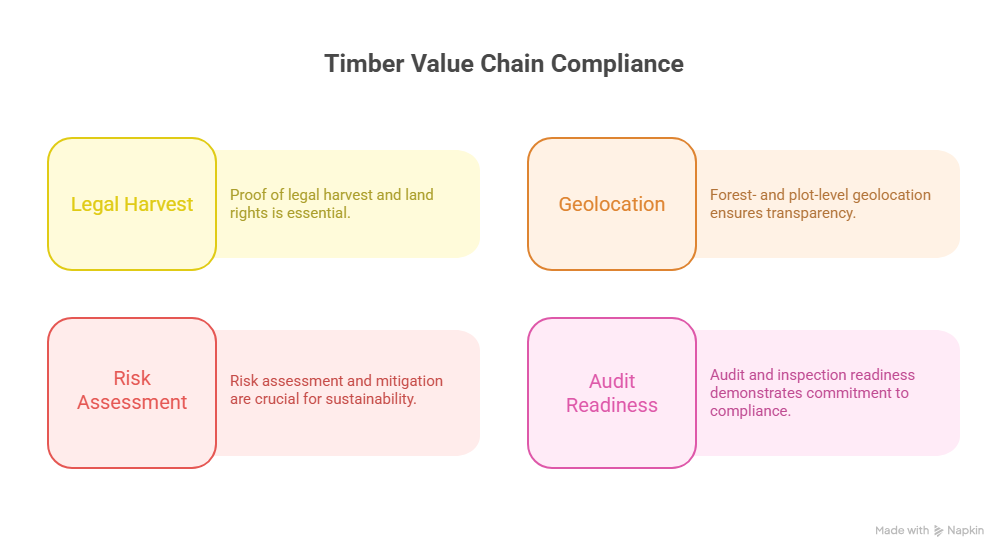
Traceability is the backbone of compliance and risk management in the timber value chain, enabling companies to demonstrate legal sourcing, deforestation-free origin, and regulatory compliance as timber moves from forest to market.
Forest-to-product traceability links timber back to specific forests, concessions, or plots, ensuring that legality and deforestation checks can be verified at the point of harvest and carried through processing and manufacturing stages.
Managing aggregation and batch mixing is critical, as timber from multiple sources is often combined during transport and processing. Batch-level traceability and volume controls help prevent compliant timber from being mixed with non-compliant material.
Chain-of-custody documentation provides the auditable record needed to prove how timber moved through each stage of the supply chain, supporting inspections, audits, and due diligence under global regulations.
Finally, traceability systems must balance transparency with commercial confidentiality, sharing the data that regulators and buyers require while protecting sensitive supplier relationships and pricing information.
Despite increasing regulation, several structural gaps continue to undermine traceability and compliance in the timber value chain, allowing illegal or high-risk timber to enter legitimate markets.
To meet EUDR and global legality requirements, timber companies are moving away from fragmented, manual processes toward integrated digital traceability systems. This is where TraceX EUDR Traceability Solutions play a central role, connecting forest-level data, risk intelligence, and compliance workflows into a single operating model.
Digital timber traceability platforms like TraceX create an end-to-end digital record that links timber back to its forest of origin and carries that identity through aggregation, processing, manufacturing, and export. By assigning batch- or lot-level digital IDs, TraceX preserves origin even when timber moves across multiple actors and geographies, eliminating one of the biggest causes of EUDR failure.
Satellite monitoring for deforestation detection is embedded into TraceX workflows to validate forest and plot-level geolocation data. Satellite imagery and change-detection algorithms are used to assess whether sourcing areas overlap with deforestation events or protected zones after the EUDR cut-off date. This allows companies to identify deforestation risk early, before timber is placed on the EU market.
Blockchain for an immutable chain-of-custody strengthens data integrity across the timber value chain. TraceX uses tamper-resistant records to ensure that once harvesting, transport, processing, or transferring data is recorded, it cannot be altered without detection. This creates a trusted audit trail that regulators and buyers can rely on, without exposing commercially sensitive information.
AI-driven risk screening and anomaly detection enable continuous due diligence at scale. TraceX applies AI models to flag inconsistencies in supplier data, unusual volume patterns, geolocation anomalies, and documentation gaps that may indicate illegal logging or data manipulation. Risk scoring helps teams prioritize high-risk suppliers and shipments before compliance issues surface at customs or during audits.
Together, these digital capabilities transform timber traceability from a reactive, document-heavy exercise into a proactive, EUDR-ready compliance system, one that protects market access, reduces audit risk, and enables responsible sourcing across the modern timber value chain.
| Category | EU Market (EUDR/EUTR) | UK Market (UKTR) | US Market (Lacey Act) |
| Buyer Expectations | Zero-Deforestation: Buyers demand proof that timber was produced on land not deforested after Dec 31, 2020. | Legality First: Focus on preventing illegal logging; alignment with EU standards but requires separate UK risk assessments. | Due Care: Importers must prove they took “due care” to ensure timber was legally harvested under the laws of the source country. |
| Primary Requirement | Due Diligence Statement (DDS): Must include GeoJSON polygons for the harvest plot. | Due Diligence System: Mirroring the EUTR, requiring information gathering, risk assessment, and mitigation. | PPQ Form 505: Mandatory declaration of genus, species, and value for every shipment. |
| Certification Role | Supportive only: FSC/PEFC are “risk mitigation” tools but do not grant “Green Lane” access; geolocation is still mandatory. | High-Value Evidence: Certification is heavily used as a primary evidence of “negligible risk” in risk assessments. | Compliance Indicator: Helps prove “Due Care,” but a certified shipment can still be seized if the harvest was illegal in the country of origin. |
| Traceability Type | Batch-Level Geospatial: Linking the physical timber batch to the exact forest coordinates. | Supply Chain Chain-of-Custody: Tracking the transfer of ownership from forest to port. | Species & Origin Tracking: Focusing on the botanical identity and the specific country of harvest. |
| Non-Compliance Risk | 4% Global Turnover Fine: Plus product confiscation and temporary exclusion from public tenders. | Criminal Prosecution: Fines and potential imprisonment for directors of companies placing illegal timber. | Forfeiture & Felony Charges: Strict liability for the importer; the wood is confiscated regardless of “intent” if found illegal. |
Compliance in the timber value chain depends on maintaining a complete, verifiable data trail from forest to market. Regulators and buyers expect the following core data elements to be available and auditable.
Forest geolocation and harvesting permits establish where timber was harvested and whether logging occurred within authorized areas. Accurate geolocation links timber to specific concessions or plots, while valid permits confirm legal harvesting rights.
Land tenure and legal rights documentation demonstrate that the entity harvesting timber has lawful access to the land. This helps address risks linked to disputed ownership, indigenous rights, or unauthorized use of forest areas.
Transport and processing records track how timber moves from forest to mills and through processing facilities. These records help maintain continuity between harvested volumes and processed outputs, reducing the risk of illegal timber being introduced during aggregation.
Chain-of-custody evidence documents each transfer of ownership or custody across the supply chain, creating an auditable trail that supports due diligence and inspections.
ESG and legality declarations provide formal supplier attestations on legal compliance, environmental protection, and social safeguards, supporting broader regulatory, buyer, and sustainability requirements.
The global timber value chain has reached a point where traditional, manual compliance approaches are no longer sufficient. Increasing regulation, heightened enforcement, and rising buyer expectations mean companies must be able to prove quickly and consistently where timber comes from, how it was sourced, and whether it complies with legality and deforestation requirements.
Digital traceability turns compliance from a reactive, document-heavy exercise into core infrastructure. By preserving forest-level origin, maintaining chain-of-custody through aggregation and processing, and ensuring data integrity across multiple actors and countries, digital systems reduce the risk of illegal timber entering supply chains. They also enable faster audits, real-time risk assessment, and credible due diligence under regulations such as EUDR, the Lacey Act, and the UK and Australian timber laws.
Explore the biggest wood and timber challenges companies face under EUDR and how to address them.
Learn what deforestation-free supply chains mean under EUDR and how to build them.
Understand how EUTR works and what it requires from timber operators and traders.
The timber value chain is the end-to-end process through which timber moves from forest management and harvesting through transport, processing, manufacturing, and finally distribution to domestic and international markets.
The timber value chain is high risk due to illegal logging, deforestation, weak governance in some sourcing regions, fragmented multi-tier supply chains, and reliance on paper-based permits that are vulnerable to fraud.
Global regulations such as EUDR, the EU and UK Timber Regulations, the Lacey Act, and Australia’s Illegal Logging Prohibition Act require companies to prove legal origin, conduct due diligence, and maintain traceability across the timber value chain.
Traceability links timber products back to their forest of origin, preserves the chain-of-custody through aggregation and processing, and provides auditable evidence needed for compliance, inspections, and buyer requirements.
Key data includes forest geolocation, harvesting permits, land tenure documentation, transport and processing records, chain-of-custody evidence, and ESG and legality declarations.