Quick summary: Global spice exports ($15–20B) are led by India and Vietnam, driven by scale, specialization, and processing strength. Future competitiveness depends on premiumization, sustainability, digital traceability, and climate-resilient, compliant supply chains.
The top 10 global spice exporters are led by India and Vietnam, which together dominate world markets for black pepper, chili, and other key spices. They are followed by Indonesia, China, Bangladesh, Sri Lanka, Pakistan, Turkey, Germany, and the Netherlands. India remains the largest exporter of spices such as chili, turmeric, and cumin, with annual exports exceeding $3.5 billion (2023). Vietnam specializes in pepper and cinnamon, while Indonesia exports nutmeg and cloves. These countries combine large-scale production, favorable agro-climatic conditions, and robust processing capabilities, making them central players in the $10+ billion global spice trade.
Key Takeaways – Global Spice Export Market
The global spice market is valued at over $15–16B and is growing ~5–6% annually, fuelled by demand for specialty, organic, and certified spices. Shifts in consumer preferences in the EU, USA, and Middle East, combined with climate variability, are creating both opportunities and risks.
Projected market growth is driven by premiumization, traceability requirements, and rising demand for ethically sourced spices.
Challenges include climate-induced yield fluctuations, smallholder fragmentation, low farmer income, traceability gaps, rising ESG and compliance pressures, and logistics bottlenecks.
Here are the top 5 trading companies in the world for spices — by estimated export volume (tons/year): AVT Natural Products Ltd — India ~250,000 tons/year, Indo Spice Exports — India ~210,000 tons/year, Vietnam Spice Company — Vietnam ~180,000 tons/year, Olam Spices — Singapore ~170,000 tons/year, and McCormick & Company — USA ~160,000 tons/year. These companies lead global spice trade through extensive sourcing networks, quality control systems, and compliance with international certifications such as Organic, Fairtrade, and Rainforest Alliance.
Leading spice trading companies leverage digital traceability, quality control, and multi-tier sourcing to meet compliance and buyer expectations.
Exporters investing in farm-level mapping, blockchain-backed traceability, and certification-ready systems will secure premium markets, reduce regulatory risk, and strengthen global competitiveness.
Overview of the $15–20 Billion Global Spice Export Market
The global spice trade, including whole, ground, and processed spices, is valued at roughly $15–20 billion annually, with India and Vietnam leading production and export volumes. Key spices traded include black pepper, chili, turmeric, cinnamon, nutmeg, and cloves. In 2023, global spice exports exceeded ~4 million metric tons, highlighting the scale of the sector.
Premiumization and sustainability are driving industry trends, with Organic, Fairtrade, and Rainforest Alliance certifications increasingly demanded by buyers in the EU, USA, and Middle East. This shift is pushing exporters to adopt rigorous quality, traceability, and compliance protocols.
Climate variability including irregular rainfall, temperature shifts, and pest outbreaks affects spice yields, particularly for rainfed crops like black pepper and nutmeg. Exporters with digitally traceable, climate-resilient, and sustainably sourced supply chains gain a competitive edge. Future success depends on combining volume with provenance credibility, certification, and transparent, compliant trade practices.
Top 10 Global Spice Exporters
Rank
Country
Export Value (Est. USD)
Primary Specializations
1
India
$4.72 Billion
Chili, Cumin, Turmeric, Mint Products
2
Vietnam
$2.12 Billion
Black Pepper (Global Leader), Cinnamon
3
Indonesia
$1.05 Billion
Nutmeg, Cloves, White/Black Pepper
4
Netherlands*
$780 Million
Processing Hub, Re-exports, Blends
5
Germany*
$680 Million
Organic, Fairtrade, Premium Blends
6
Sri Lanka
$540 Million
Ceylon Cinnamon, Cardamom, Cloves
7
Turkey
$490 Million
Paprika, Red Pepper, Herbs (Oregano)
8
Egypt
$420 Million
Cumin, Coriander, Dried Herbs
9
USA*
$380 Million
Value-Added Blends, Organic Seasonings
10
Thailand
$330 Million
Pepper, Chili, Galangal, Specialty Herbs
India — The World’s Leading Spice Exporter India dominates global spice exports with over $3–3.5 billion annually, producing black pepper, chili, turmeric, cardamom, and cumin. Strengths include diverse agroclimates, large-scale and smallholder integration, and strong processing infrastructure. Challenges involve climate variability, price volatility, and labor shortages. Key exporters include AVT Natural, Synthite, and VVF.
Vietnam — Pepper and Cinnamon Specialist Vietnam exports roughly $1–1.2 billion in spices, especially black pepper and cinnamon. Strengths are high yields, modern drying/processing, and export-oriented supply chains. Challenges include climate impacts, soil degradation, and dependency on a few crops. Major exporters include Hoang Gia and Viet Spice.
Indonesia — Nutmeg, Cloves, and Pepper Hub Indonesia exports $900 million–$1 billion in spices, specializing in nutmeg, cloves, and pepper. Strengths include rich biodiversity and traditional expertise. Challenges include inconsistent quality, transport bottlenecks, and smallholder fragmentation. Key exporters include PT Indofood, PT Sinar Mas, and local cooperatives.
Netherlands — Re-Exporter & Processing Leader With $700–800 million in spice exports, the Netherlands excels in value-added processing, blending, and EU redistribution. Strengths are port infrastructure, logistics, and advanced packaging. Challenges include reliance on imported raw spices and maintaining traceability. Key players include Euroma, Verstegen, and Olam Netherlands.
Germany — Specialty & Organic Spice Exporter Germany exports $600–700 million annually, focusing on organic, fairtrade, and premium blends. Strengths include quality control and EU market access. Challenges involve sourcing sustainably and rising raw-material costs. Key exporters include Fuchs Gewürze and Ostmann Gewürze.
Sri Lanka — Ceylon Cinnamon Authority Sri Lanka exports $500–550 million, led by Ceylon cinnamon, pepper, and cloves. Strengths include brand recognition, high quality, and cooperative networks. Challenges include labor-intensive cultivation and weather vulnerability. Key exporters are Ceylon Spice Board-affiliated firms.
Turkey — Paprika & Pepper Exporter Turkey exports $450–500 million, focusing on paprika, red pepper, and herbs. Strengths include consistent quality, irrigation systems, and regional branding. Challenges involve drought risk and smallholder coordination. Major players include local cooperatives and private processors.
Egypt — Herb and Spice Exporter Egypt exports $400–450 million, specializing in cumin, coriander, and dried herbs. Strengths include fertile Nile Delta production and export infrastructure. Challenges include irrigation dependency, climate risks, and supply consistency. Key exporters include Egyptian Spice & Herb Co.
USA — Specialty and Organic Spice Hub The US exports $350–400 million in spices, particularly organic, dried, and value-added products. Strengths include branding, technology, and compliance with global standards. Challenges involve high production costs and import dependency for raw spices. Key players include McCormick & Company and Frontier Co-op.
Thailand — Pepper and Chili Specialist Thailand exports $300–350 million, focusing on white/black pepper, dried chili, and paprika. Strengths include efficient processing and strong Asian and EU demand. Challenges include smallholder fragmentation and climate sensitivity. Key exporters include Thai Pepper Co., A.D. Spices, and regional cooperatives.
This ranking underscores how spice export leadership combines high-quality production, value addition, and supply-chain traceability to remain competitive globally.
Key Challenges Facing Major Spice Exporters
Climate Instability (Droughts, Floods, Pest Outbreaks)
Spice-producing nations like India, Vietnam, Indonesia, and Sri Lanka face rising climate volatility. Erratic rainfall, prolonged droughts, and floods reduce yields of key crops such as chili, black pepper, cinnamon, and turmeric. Pest infestations (e.g., aphids, mealybugs, fungal infections) are exacerbated under changing climatic conditions, leading to crop losses, quality degradation, and export volume fluctuations.
Smallholder Fragmentation & Low Farmer Incomes
Most spice production relies on smallholder farmers with fragmented plots. Limited mechanization, poor access to credit, and low margins hinder investments in quality, sustainability, and productivity. Inconsistent supply and variable spice quality create challenges for exporters meeting global buyer specifications.
Rising Compliance & Sustainability Pressure
Global buyers increasingly demand ESG compliance, certifications (Organic, Fairtrade, Rainforest Alliance), and traceable, deforestation-free sourcing. Regulations require geolocation, farm-level verification, and documented chain-of-custody, increasing operational complexity for exporters.
Traceability Gaps in Supply Chains
Spices often pass through multiple intermediaries, creating risks of origin misrepresentation and quality inconsistencies. Paper-based or informal tracking systems make it difficult to provide audit-ready traceability data required by premium international markets.
Logistics & Export Constraints
High freight costs, port congestion, inadequate storage, and poor inland infrastructure delay shipments. Seasonal harvest surges in India and Vietnam exacerbate bottlenecks, while geopolitical tensions and global container shortages increase lead times, raising costs and reducing competitiveness.
These factors collectively pressure spice exporters to adopt digital traceability, risk management, and sustainability practices to remain competitive in global markets.
Explore our deep-dives ondigital traceability, farm mapping, and end-to-end visibilityfor spices sourced from smallholders worldwide.
Understand howtraceability platforms help meet ESG and compliance requirementswhile protecting market access for spice exporters and buyers.
Explore our blog on compliant and ethical spice sourcing
Key Insights From the 2025 Global Spice Export Rankings
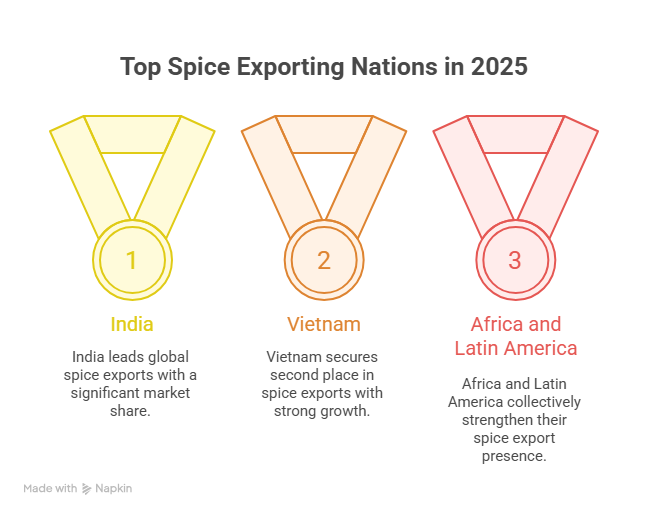
India and Vietnam Dominate Global Spice Exports The 2025 rankings confirm India and Vietnam as the world’s top spice exporters, together accounting for over 50% of global spice trade. India leads in chili, turmeric, and cumin, while Vietnam dominates black pepper and cinnamon. Their scale, mechanized processing, and export-ready logistics give them pricing leverage and reliability for international buyers.
Africa and Latin America Strengthen Their Presence Origins such as Indonesia, Sri Lanka, Madagascar, and Peru are expanding specialty spice exports. Madagascar’s vanilla, Sri Lanka’s cinnamon, and Peru’s chili exports are increasingly sought in high-value markets, reflecting rising global demand for unique flavor profiles and traceable products.
Certified and Specialty Spices Capture Premium Segments Demand for Organic, Fairtrade, Rainforest Alliance, and non-GMO certified spices continues to grow, particularly in the EU, US, and Japan. Exporters with certification-ready supply chains capture premium pricing and long-term buyer relationships.
Traceability as a Market Differentiator Buyers increasingly require farm-to-export transparency. Digital traceability, geolocation, and documented supply chains for spices like pepper, vanilla, and chili are essential to access regulated markets and premium contracts.
Climate-Resilient and Diversified Sourcing Gains Importance Global buyers are diversifying supply to mitigate climate risks, favoring drought-tolerant crops, agroforestry-grown spices, and emerging origins in Africa and Latin America. Exporters investing in sustainable, climate-resilient production secure consistent export volumes and market reliability.
Major Global Players in the Spice Export Ecosystem
Multinational Exporters & Traders Global spice trade is dominated by multinational exporters that manage sourcing, processing, logistics, and quality control across Asia, Africa, and Latin America. They connect smallholder farmers with international buyers, ensuring consistent supply and compliance with certifications.
Olam Agri – Operates extensive spice sourcing networks, supporting farmers with traceability, sustainable cultivation, and climate-smart practices.
McCormick & Company – Global spice supplier with integrated sourcing, processing, and quality assurance systems.
Archer Daniels Midland (ADM) – Handles large-scale spice procurement, logistics, and export, particularly in pepper and herbs.
Louis Dreyfus Company (LDC) – Major exporter specializing in black pepper, cinnamon, and nutmeg, with sustainability programs.
Cargill – Provides sourcing, processing, and certified supply chains for multiple spices globally.
Country-Level Cooperatives & Export Boards National cooperatives and boards regulate spice quality, support farmer training, and stabilize export markets.
India – Spices Board of India – Oversees certification, quality control, and global marketing for chili, turmeric, cumin, and other spices.
Sri Lanka – Ceylon Spice Board – Governs cinnamon and clove exports, supporting smallholders and premium branding.
Indonesia – Spice Export Associations – Promote nutmeg, cloves, and vanilla exports, ensuring origin authenticity.
Specialty Importers & Global Buyers High-value spice importers and brands shape quality standards and traceability expectations.
McCormick Gourmet Division – Drives premium spice demand with certified and traceable sourcing.
Frontier Co-op – Focuses on Organic, Fairtrade, and sustainable spices from smallholder networks.
Whole Foods & Specialty Retailers – Demand high-quality, certified, and traceable spices, influencing global sourcing practices.
Nestlé & Givaudan – Source flavour ingredients like vanilla, pepper, and cinnamon with strict sustainability compliance.
These players ensure global spice supply reliability, premium quality, and compliance with sustainability and traceability standards, directly influencing market trends and smallholder practices.
The Future of Global Spice Exporters
The global spice industry, valued at over $12–15 billion annually, is poised for transformative growth, driven by evolving consumer preferences, sustainability mandates, and technological adoption. Key trends shaping the future include:
Rising Demand for Premium & Specialty Spices Consumers in North America, Europe, and the Middle East increasingly seek high-quality, ethically sourced, and unique-origin spices. Organic, Fairtrade, and single-origin labels are becoming premium differentiators, creating opportunities for smallholder-inclusive supply chains.
Sustainability and Regulatory Compliance Exporters face growing pressure to comply with sustainability and traceability regulations, including EU due diligence laws and pesticide residue limits. Provenance verification, deforestation-free sourcing, and ESG-aligned practices will become critical for market access.
Digital Traceability & Farm Mapping Technologies like blockchain, GIS mapping, and IoT-enabled supply chains are revolutionizing how spices are sourced, tracked, and certified. Exporters using digital traceability will gain competitive advantages in securing buyers and commanding premium prices.
Climate Resilience & Adaptation Climate change impacts—erratic rainfall, drought, and pest outbreaks—threaten key spice-growing regions in India, Vietnam, Sri Lanka, and Indonesia. Exporters investing in climate-smart agriculture, crop diversification, and adaptive farming techniques will better protect yields and stabilize supply.
Emerging Origins & Market Diversification New spice-producing regions in Africa, Latin America, and Southeast Asia are gaining prominence, offering alternative supply sources. Diversification of origins will help mitigate risk from climate shocks, geopolitical disruptions, and price volatility.
Integration with Global Food & Flavour Industries The spice sector will increasingly align with food processing, beverage, and flavor industries. Value addition through grinding, blending, and standardized packaging will enhance profitability and reduce dependency on raw commodity exports.
Global spice exporters who integrate sustainability, digital traceability, climate-smart practices, and quality-focused supply chains will thrive in the coming decade. Those unable to meet premium market expectations or regulatory requirements risk losing access to high-value markets and sustainable growth opportunities.
How TraceX Solutions Strengthen Global Spice Exports
TraceX empowers spice exporters with a full-stack digital traceability and supply chain management platform, providing complete visibility from farm to shipment. By digitizing farmer profiles, geolocation-mapped plots, harvest records, processing steps, and chain-of-custody data, TraceX enables exporters to meet international transparency and compliance requirements, including Organic, Fairtrade, Rainforest Alliance, and EU due diligence standards. Exporters can verify origin, monitor quality across pepper, cinnamon, turmeric, and other spice lots, and generate audit-ready documentation for buyers in the EU, USA, and Asia. Blockchain-secured data ensures tamper-proof records, reducing compliance risks and enhancing market trust.
Digitize Your Spice Supply Chain
Explore how farm mapping, real-time traceability, and compliance automation can boost competitiveness and unlock premium global markets for your spice exports.
The top 10 global spice exporters, led by India, Vietnam, Indonesia, China, and others, dominate international markets through scale, specialization, and established supply chains. While they benefit from cost advantages and rich agro-climatic diversity, challenges such as climate variability, compliance with sustainability standards, and traceability requirements are reshaping competitiveness. Exporters that invest in digital farm mapping, end-to-end supply chain visibility, and certification-ready traceability will strengthen market access, reduce regulatory risks, and capture growing demand for premium, ethically sourced spices. Future success hinges on combining quality production with transparent, resilient, and compliant supply networks.
Start using TraceX
Transparency, Trust, & Success for your Climate Journey.
We use cookies on our website to give you the most relevant experience by remembering your preferences and repeat visits. By clicking “Accept All”, you consent to the use of ALL the cookies. However, you may visit "Cookie Settings" to provide a controlled consent.
This website uses cookies to improve your experience while you navigate through the website. Out of these, the cookies that are categorized as necessary are stored on your browser as they are essential for the working of basic functionalities of the website. We also use third-party cookies that help us analyze and understand how you use this website. These cookies will be stored in your browser only with your consent. You also have the option to opt-out of these cookies. But opting out of some of these cookies may affect your browsing experience.
Necessary cookies are absolutely essential for the website to function properly. These cookies ensure basic functionalities and security features of the website, anonymously.
Cookie
Duration
Description
cookielawinfo-checkbox-analytics
11 months
This cookie is set by GDPR Cookie Consent plugin. The cookie is used to store the user consent for the cookies in the category "Analytics".
cookielawinfo-checkbox-functional
11 months
The cookie is set by GDPR cookie consent to record the user consent for the cookies in the category "Functional".
cookielawinfo-checkbox-necessary
11 months
This cookie is set by GDPR Cookie Consent plugin. The cookies is used to store the user consent for the cookies in the category "Necessary".
cookielawinfo-checkbox-others
11 months
This cookie is set by GDPR Cookie Consent plugin. The cookie is used to store the user consent for the cookies in the category "Other.
cookielawinfo-checkbox-performance
11 months
This cookie is set by GDPR Cookie Consent plugin. The cookie is used to store the user consent for the cookies in the category "Performance".
viewed_cookie_policy
11 months
The cookie is set by the GDPR Cookie Consent plugin and is used to store whether or not user has consented to the use of cookies. It does not store any personal data.
Functional cookies help to perform certain functionalities like sharing the content of the website on social media platforms, collect feedbacks, and other third-party features.
Performance cookies are used to understand and analyze the key performance indexes of the website which helps in delivering a better user experience for the visitors.
Analytical cookies are used to understand how visitors interact with the website. These cookies help provide information on metrics the number of visitors, bounce rate, traffic source, etc.
Advertisement cookies are used to provide visitors with relevant ads and marketing campaigns. These cookies track visitors across websites and collect information to provide customized ads.