
Quick summary: Discover why traceability in waste management is critical for a circular economy. Learn how digital systems improve visibility, ensure regulatory compliance, enhance recycling rates, and create measurable sustainability outcomes across industries.

As economies move away from the traditional take–make–dispose model, one question is becoming impossible to ignore: where does our waste actually go? Traceability in waste management refers to the ability to digitally track waste materials from the point of generation through collection, treatment, recycling, or final disposal using verified, auditable data rather than assumptions.
In a circular economy, this visibility is no longer optional. When waste flows are invisible, recyclable materials end up in landfills, recovery claims go unverified, and sustainability efforts risk becoming greenwashing. Regulators are responding with stricter EPR, ESG, and recycling mandates, while brands face growing exposure to compliance failures and reputational damage.
The core pain point is simple but costly: without traceability, there is no proof of circularity. Waste traceability closes this gap by turning waste into a measurable, accountable resource enabling real recycling outcomes, regulatory compliance, and credible circular economy performance.
Traceability in Waste Management is critical to enabling a circular economy because it provides verified visibility into how waste is collected, processed, recycled, or recovered across its entire lifecycle. By tracking waste flows with accurate, auditable data, organizations can prevent landfill leakage, eliminate greenwashing, and prove compliance with EPR, ESG, and recycling regulations. Traceability ensures materials re-enter value chains rather than being lost, supports accountability across stakeholders, and enables measurable circularity outcomes making it a foundational requirement for effective, data-driven circular economy systems.
Key Takeaways
Traceability in waste management refers to the systematic ability to track, record, and verify the movement and treatment of waste materials across their entire lifecycle from the point of generation to collection, transport, processing, recycling, recovery, or final disposal. It ensures that every waste stream is documented with verifiable data rather than estimates or manual declarations.
At its core, waste traceability captures key data points, including waste type and classification, quantity or weight, origin and location, authorized handlers and transporters, and the treatment method applied (recycling, composting, energy recovery, or landfill). Advanced systems may also record timestamps, chain-of-custody transfers, compliance certificates, and emissions data linked to treatment outcomes.
Traditional waste tracking relies heavily on paper manifests, periodic reports, and self-declared data, which are often fragmented, delayed, and prone to errors or manipulation. In contrast, digital traceability systems use technologies such as QR codes, IoT sensors, GPS tracking, and centralized data platforms to provide real-time, auditable visibility across waste flows.
This shift from manual tracking to digital traceability is critical for circular economy implementation, regulatory compliance, and ESG reporting because it transforms waste from an opaque liability into a measurable, accountable, and recoverable resource.
Discover how circular economy practices are transforming supply chains and reducing waste.
Read the Blog
Turn Waste into Opportunity – Learn strategies to minimize food loss and boost sustainability across your supply chain.
Explore Now
Traceability is the foundation of a functioning circular economy because circular systems depend on verified material flows, not assumptions. To keep materials in use, businesses and regulators must know exactly what materials exist, where they are, and how they are recovered after use.
First, traceability closes material loops by confirming that waste is actually recycled, reused, or recovered rather than merely reported as such. Verified data on collection, sorting, and treatment enables manufacturers to reintegrate secondary raw materials back into production, reducing dependence on virgin resources and supporting circular design targets.
Second, traceability helps prevent waste leakage into landfills, incineration, or informal disposal channels. Without end-to-end visibility, waste can easily be diverted, misclassified, or illegally dumped undermining recycling goals and creating environmental and regulatory risks. Digital traceability creates accountability at every handover point, making diversion easier to detect and correct.
Third, traceability enables circularity at scale. Large-scale reuse, recycling, and resource recovery systems require consistent, reliable data across suppliers, waste operators, and geographies. Traceable waste streams allow recyclers to plan capacity, brands to meet recycled-content commitments, and regulators to verify outcomes.
In short, a circular economy cannot function on trust alone. Traceability turns circular ambition into measurable, enforceable, and scalable reality.
Without traceability, waste management systems operate largely in the dark, relying on fragmented records, manual reporting, and assumptions rather than verified data. This lack of visibility creates multiple operational, regulatory, and reputational risks.
First, there is limited visibility across collection, sorting, and processing stages. Once waste leaves a facility, companies often lose sight of how it is handled, where it goes, and whether it is treated as intended. This makes it difficult to ensure that waste streams follow approved recycling or recovery pathways rather than ending up in landfills or informal disposal sites.
Second, reporting becomes inaccurate and unverifiable. Self-reported recycling rates and recovery volumes cannot be independently validated without traceable data. This leads to inconsistent metrics, audit challenges, and weak confidence from regulators, investors, and customers.
Third, organizations face difficulty proving regulatory compliance and ESG performance. Regulations increasingly require evidence not estimates of waste treatment outcomes. Without traceability, companies struggle to demonstrate compliance with EPR, recycling targets, and sustainability disclosures.
Finally, the absence of traceability increases the risk of greenwashing and reputational damage. Claims about recycling or circularity that cannot be backed by data expose brands to regulatory penalties, loss of trust, and public scrutiny.
In essence, without traceability, waste management lacks accountability, credibility, and the data needed to support a true circular economy.
Traceability creates end-to-end visibility by tracking waste from the point of generation through collection, transport, sorting, and final treatment. Each handoff is recorded, making it possible to verify whether waste is recycled, composted, recovered, or disposed of as claimed. This transparency replaces assumptions with evidence, ensuring that reported waste outcomes reflect actual treatment and reducing the risk of landfill leakage or improper disposal.
With reliable, real-time data, organizations can identify inefficiencies across the waste value chain. Traceability highlights where losses occur such as contamination during sorting or bottlenecks in processing, allowing targeted interventions. Over time, these insights help improve material recovery rates, optimize waste segregation, and prioritize investments in recycling or recovery infrastructure that deliver the greatest circular impact.
Traceability assigns clear responsibility to every actor involved, from waste generators and logistics providers to recyclers and treatment facilities. This shared accountability strengthens compliance under Extended Producer Responsibility (EPR) and similar regulations by providing verifiable proof of performance. As a result, stakeholders are incentivized to meet standards, improve practices, and collaborate more effectively, driving measurable improvements in waste management outcomes.
Digital traceability is a foundational enabler of circular waste systems, replacing fragmented, manual tracking with verifiable, end-to-end data flows. Technologies such as digital IDs, QR codes, IoT sensors, and blockchain allow waste streams to be uniquely identified and tracked as they move through collection, sorting, recycling, and recovery. Each batch or material type can be linked to its origin, composition, handler, and treatment method, creating a secure and tamper-resistant record.
Real-time data capture is a key advantage. IoT-enabled weighing systems, GPS-tracked logistics, and mobile data entry provide continuous visibility into waste quantities, locations, and processing status. This enables faster issue detection, supports performance monitoring, and generates audit-ready documentation without relying on retrospective manual reports. Regulators and auditors can verify outcomes based on time-stamped, traceable data rather than self-declared claims.
Digital traceability systems also integrate seamlessly with ESG, EPR, and sustainability reporting frameworks. Waste and recycling data can feed directly into compliance dashboards, carbon accounting tools, and circularity metrics, reducing reporting effort and improving accuracy. By connecting operational waste data with regulatory and sustainability requirements, digital traceability ensures that circular economy goals are measurable, credible, and scalable.
Waste traceability is increasingly becoming a regulatory requirement rather than a best practice, driven by stricter environmental policies and accountability frameworks worldwide. One of the strongest drivers is Extended Producer Responsibility (EPR), which places legal responsibility on producers for the post-consumer phase of their products. To comply, companies must accurately track how much waste is collected, recycled, recovered, or disposed of making traceability essential for reporting and verification.
Governments are also setting recycling and landfill diversion targets to reduce environmental impact and resource loss. Meeting these targets requires require verifiable data on waste flows and treatment outcomes, which cannot be reliably achieved through manual or fragmented systems. Digital traceability enables authorities to monitor progress and enforce compliance.
In parallel, ESG disclosures and due diligence requirements are expanding globally. Regulations increasingly require companies to substantiate environmental claims with auditable data, including waste generation, recycling rates, and circularity performance. Poor traceability increases the risk of misreporting, greenwashing, and regulatory penalties.
Finally, waste traceability aligns with global circular economy policies, such as the EU Circular Economy Action Plan, which emphasize transparency, material recovery, and lifecycle accountability. Together, these regulatory drivers are making end-to-end waste traceability a non-negotiable foundation for compliant, circular waste management.
In packaging and fast-moving consumer goods, traceability is essential to meet EPR obligations and recycling targets. It enables brands to track packaging materials from market placement to collection, sorting, and recycling, ensuring accurate reporting of recovery rates. Material-level traceability also supports design-for-recyclability decisions and prevents leakage of plastic and multilayer packaging into landfills or informal waste streams.
E-waste contains valuable materials and hazardous substances, making traceability critical for environmental and human health protection. Digital tracking helps monitor electronic products from end-of-life collection through authorized dismantling and recycling, ensuring compliance with e-waste regulations. It also prevents illegal dumping, informal processing, and cross-border waste trafficking while enabling verified material recovery.
For batteries and electric vehicles, traceability supports safe handling, recycling, and second-life use. Regulations increasingly require tracking battery chemistry, ownership, and end-of-life pathways. Digital traceability ensures responsible collection, compliance with hazardous waste rules, and recovery of critical minerals like lithium, cobalt, and nickel key to a circular battery economy.
In food and organic waste streams, traceability helps measure waste generation, diversion to composting or anaerobic digestion, and reduction outcomes. It supports compliance with food waste reduction targets, enables accurate carbon accounting, and ensures organic waste is treated through approved recovery processes rather than landfilled.
Across industries, waste traceability transforms fragmented disposal systems into accountable, circular value chains.
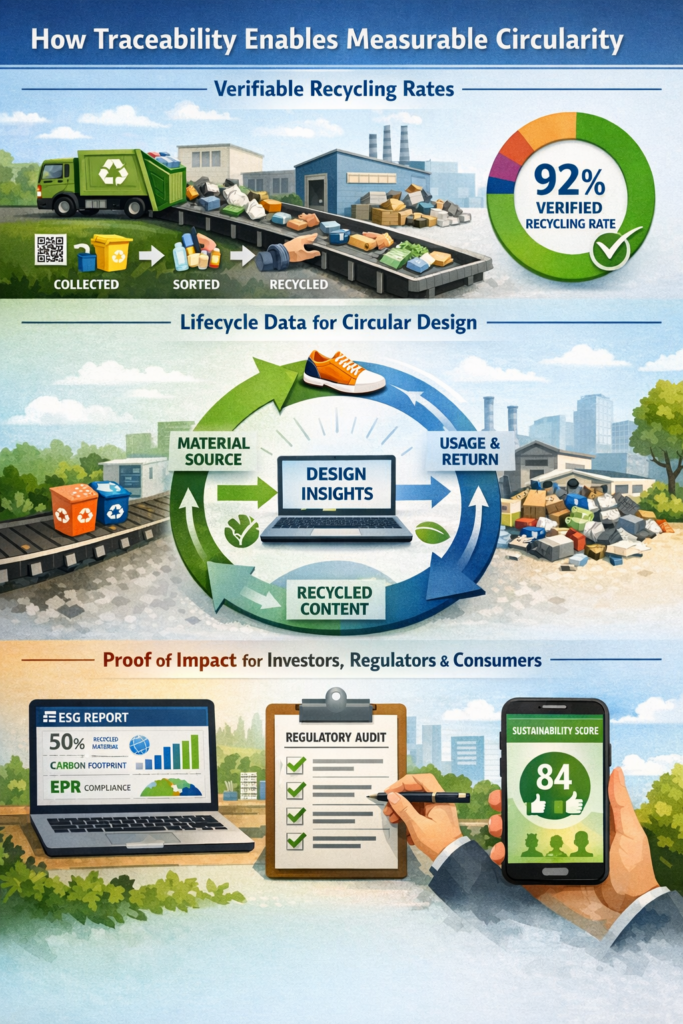
Digital platforms are transforming waste management by making traceability faster, more accurate, and auditable. Here’s how:
In short, digital platforms bridge gaps across stakeholders, streamline compliance, and ensure that waste management operations are transparent, accountable, and aligned with circular economy goals.
Traceability is no longer optional it is the foundation of effective, responsible, and circular waste management. By providing complete visibility across the waste lifecycle, it ensures regulatory compliance, strengthens ESG reporting, and protects brands from reputational risk. Beyond compliance, traceability enables data-driven insights that optimize recycling, recovery, and resource efficiency, turning waste into measurable value. As industries embrace digital solutions and real-time monitoring, traceability will increasingly serve as a strategic enabler, powering truly data-led circular economies where sustainability, accountability, and profitability go hand in hand.
Discover how DPPs support reuse, recycling, compliance, and sustainable sourcing, and why they are rapidly becoming essential for businesses operating in regulated markets.
Read the blog: How Digital Product Passports Power the Circular Economy
Digital Product Passports Explained – Learn how DPPs drive transparency, traceability, and consumer trust in circular supply chains.
Transform Your Supply Chain Digitally – See how digital solutions are helping companies meet ESG goals and enhance sustainability.
Traceability in waste management is the process of tracking waste from its point of generation through collection, transportation, processing, and final disposal or recovery. It ensures accurate reporting, accountability, and compliance with environmental regulations.
Waste traceability closes material loops, prevents landfill leakage, and enables verified reuse, recycling, and recovery at scale, supporting sustainable, circular business practices.
Digital tools like QR codes, IoT sensors, and blockchain provide real-time data capture, audit-ready reporting, and end-to-end visibility, improving compliance, efficiency, and stakeholder accountability.
Industries such as packaging & FMCG, electronics & e-waste, batteries & EVs, and food & organic waste all benefit from traceability to meet recycling targets and regulatory requirements.
Traceability supports compliance with EPR regulations, recycling targets, ESG disclosures, and global circular economy policies by providing verifiable, transparent records of waste handling and recovery.