
Quick summary: Learn what businesses must know about Traceability Regulations, global compliance rules, recall readiness, and digital traceability solutions.

Food recalls are increasing worldwide, and regulators are responding with stricter Traceability Regulations across global food supply chains. From the U.S. to the EU and Asia, authorities now demand faster access to traceability data, detailed lot-level documentation, and the ability to execute recalls within hours, not days.
For food manufacturers, exporters, and retailers, the stakes have never been higher. Non-compliance with Traceability Regulations can result in heavy fines, product seizures, import bans, retailer delisting, and irreversible brand damage. In today’s regulatory climate, “one step forward, one step back” tracking is no longer enough.
At the same time, consumers are demanding complete farm-to-fork transparency. They want to know where their food was grown, processed, and transported and they expect instant answers. Regulatory bodies now share that expectation.
This shift makes one reality clear: digital traceability is no longer optional. Businesses relying on manual records, siloed systems, or delayed reporting are exposed to compliance risks and operational vulnerabilities.
In this guide, we break down what modern Traceability Regulations require, who is most affected, and how digital traceability systems are transforming compliance from a regulatory burden into a competitive advantage.
Key takeaways
Traceability regulations are government-mandated requirements that require food businesses to track and document the movement of products across the supply chain from raw materials to final sale, enabling rapid recalls, safety verification, and regulatory compliance.
Discover how distributed ledger technology strengthens compliance, prevents data tampering, and enables real-time supply chain transparency.
Read our guide to Blockchain Traceability in Food Supply Chains
Stay ahead of global compliance requirements and understand how regulations like FSMA 204 and EU mandates impact your business.
Read our complete guide to Food Safety Regulations
Modern Traceability Regulations are designed to ensure that food businesses can quickly identify, isolate, and remove unsafe products from the market. Below is a breakdown of the core compliance components and what they mean in practice.
This foundational requirement means every food business must:
This creates a traceable chain across the supply network. In the event of contamination, regulators can quickly identify the source and affected distribution points.
Why it matters:
Without clear supplier and customer traceability, recalls become slow, expensive, and legally risky.
Each production run must be assigned a unique lot or batch code that travels with the product through the supply chain.
This enables businesses to:
Compliance risk:
If lot coding is inconsistent or manually recorded, affected products may not be accurately identified during an investigation.
Traceability Regulations mandate that records must be:
Some regulations require records to be produced within 24 hours or even faster for high-risk foods.
Operational impact:
Paper-based systems or scattered spreadsheets often fail to meet rapid retrieval requirements.
Modern regulatory frameworks increasingly require:
Digital accessibility ensures regulators can quickly access critical tracking events (CTEs) and key data elements (KDEs) during audits or investigations.
Why this is critical:
Manual systems struggle with real-time traceability, especially in complex, multi-tier supply chains.
Beyond tracking, businesses must demonstrate they are recall-ready. This includes:
Regulators expect companies to execute recalls efficiently and limit public health impact.
Key insight:
Traceability is not just about data collection; it’s about rapid response capability.
Together, these elements ensure that Traceability Regulations go beyond basic tracking. They demand structured data, digital readiness, and proactive risk management.
Organizations that implement integrated digital traceability systems not only meet compliance requirements, but they also reduce recall costs, protect brand reputation, and strengthen supply chain resilience.
Global food supply chains are more complex, cross-border, and digitized than ever before. As a result, governments are tightening traceability regulations to reduce food safety risks, improve recall speed, and increase transparency.
Several factors are driving this shift:
Below is how major regions are strengthening traceability requirements.
The U.S. Food and Drug Administration introduced Section 204 (Food Traceability Rule) to improve tracking of high-risk foods. This marks one of the most significant expansions of traceability enforcement in U.S. history.
Key components include:
Businesses must capture specific data at critical tracking events (CTEs), such as:
These structured data points must be standardized and shareable across the supply chain.
Each product must carry a unique Traceability Lot Code (TLC) that connects it to production and handling records.
This ensures regulators can identify the precise source of contamination.
Companies must provide traceability records to the FDA within 24 hours (or faster if required).
Impact:
Manual or fragmented systems are unlikely to meet these rapid response requirements.
The EU has long required “one step forward, one step back” traceability under its General Food Law. However, regulations are evolving toward deeper digital integration.
Emerging requirements include:
The upcoming Digital Product Passport (DPP) initiative under the EU Green Deal is pushing traceability beyond safety into sustainability, ESG, and lifecycle transparency.
Strategic shift:
In the EU, traceability is no longer about recalls it is becoming a tool for circular economy accountability.
India’s food regulator has strengthened traceability requirements, particularly for:
FSSAI is increasingly promoting digital compliance systems and QR-based traceability for transparency.
Why it matters:
India’s expanding export market means suppliers must meet both domestic and international traceability expectations.
Across the Asia-Pacific, governments are increasing enforcement to address food fraud, contamination incidents, and cross-border trade risks.
Notable trends include:
China has tightened oversight following past food safety crises, placing greater accountability on manufacturers and distributors.
Across all regions, traceability regulations are moving in the same direction:
For food businesses operating internationally, compliance is no longer local it is global and interconnected.
| Risk Category | Business Impact | Long-Term Consequence |
| Regulatory Penalties | Fines up to 4% of annual EU turnover (EUDR) or criminal charges (FSMA). | Permanent loss of capital and increased regulatory “red flagging.” |
| Product Recalls | Direct costs of retrieval, testing, and disposal of non-compliant goods. | Immediate drain on cash flow and operational disruption. |
| Brand Damage | Public exposure of unethical or unsafe sourcing practices. | Eroded consumer trust that can take decades to rebuild. |
| Lost Export Opportunities | Immediate ban from high-value markets (EU, USA) for non-compliant batches. | Diversion of goods to lower-priced markets, hurting margins. |
| Retailer Delisting | Major retailers (e.g., Walmart, Carrefour) dropping suppliers who lack digital data. | Sudden loss of primary sales channels and market share. |
Not Sure Where You Stand?
Get a personalized Traceability Regulations readiness assessment.
✔ Identify compliance gaps
✔ Reduce recall risk
✔ Prepare for audits
✔ Improve supply chain transparency
Modern traceability regulations go far beyond basic recordkeeping. Regulators now expect structured, digital, and rapid-response traceability systems that provide real-time supply chain intelligence. Below are the core compliance requirements businesses must meet.
Regulations increasingly require visibility across the entire food value chain from raw material sourcing to final retail distribution.
This means businesses must be able to:
Partial visibility creates blind spots. If even one supply chain node lacks documentation, the entire traceability chain weakens increasing recall scope and regulatory exposure.
Modern traceability laws demand rapid access to accurate data. Delayed or batch-updated records are no longer sufficient.
Businesses must capture:
Compliance expectation:
Data should be digitally recorded at the point of activity, minimizing manual entry errors and ensuring immediate accessibility.
Lot-level traceability is now a standard regulatory requirement especially for high-risk foods.
Each production batch must:
Operational benefit:
Lot-level tracking reduces recall scope. Instead of recalling entire product lines, businesses can isolate affected batches saving millions in potential losses.
See how custom Batch ID management transformed crop traceability.
Discover how this leading agribusiness eliminated manual errors, strengthened compliance, and achieved end-to-end visibility from planting to market.
Read the Full Case Study
Paper-based documentation is increasingly viewed as insufficient under modern traceability regulations.
Regulators now expect:
Risk factor:
Fragmented spreadsheets and manual filing systems often fail audit timelines and increase non-compliance risk.
Compliance is not just about tracking it is about response capability.
Businesses must demonstrate:
Regulators frequently evaluate how quickly and accurately a company can trace affected products during an inspection.
Key insight:
Traceability without recall readiness is incomplete compliance.
See how our traceability platform ensures compliance in under 90 days.
As traceability regulations become stricter and more data-driven, manual systems are no longer sustainable. Digital traceability platforms transform compliance from a reactive documentation exercise into a proactive, automated process.
Here’s how modern technologies simplify regulatory adherence:
Blockchain technology creates a secure, tamper-resistant ledger of supply chain transactions.
Every critical tracking event harvest, processing, packaging, shipping is recorded in an immutable chain of data blocks.
Compliance advantages:
For high-risk categories like seafood, dairy, and fresh produce, blockchain significantly reduces traceability disputes.
Modern traceability systems integrate directly with Enterprise Resource Planning (ERP) platforms.
This allows:
Compliance impact:
ERP integration ensures that traceability data is embedded within daily operations not maintained as a separate compliance spreadsheet.
QR codes placed on packaging allow both regulators and consumers to instantly access product origin and journey data.
This supports:
In many markets, QR-enabled traceability is becoming an expectation rather than a differentiator.
Digital platforms can automatically generate:
Instead of manually compiling records during inspections, businesses can retrieve structured data within minutes.
Major benefit:
Reduces regulatory response time from days to hours a critical factor under modern traceability regulations
TraceX Traceability Solutions enables end-to-end digital traceability across complex food supply chains, helping businesses comply with evolving Traceability Regulations with speed and confidence. The platform delivers real-time lot-level tracking, automated compliance reporting, and seamless ERP integration, ensuring audit readiness and rapid recall response.
With blockchain-backed transparency, supplier data standardization, and AI-powered risk monitoring, TraceX transforms regulatory compliance from a manual burden into a strategic advantage.
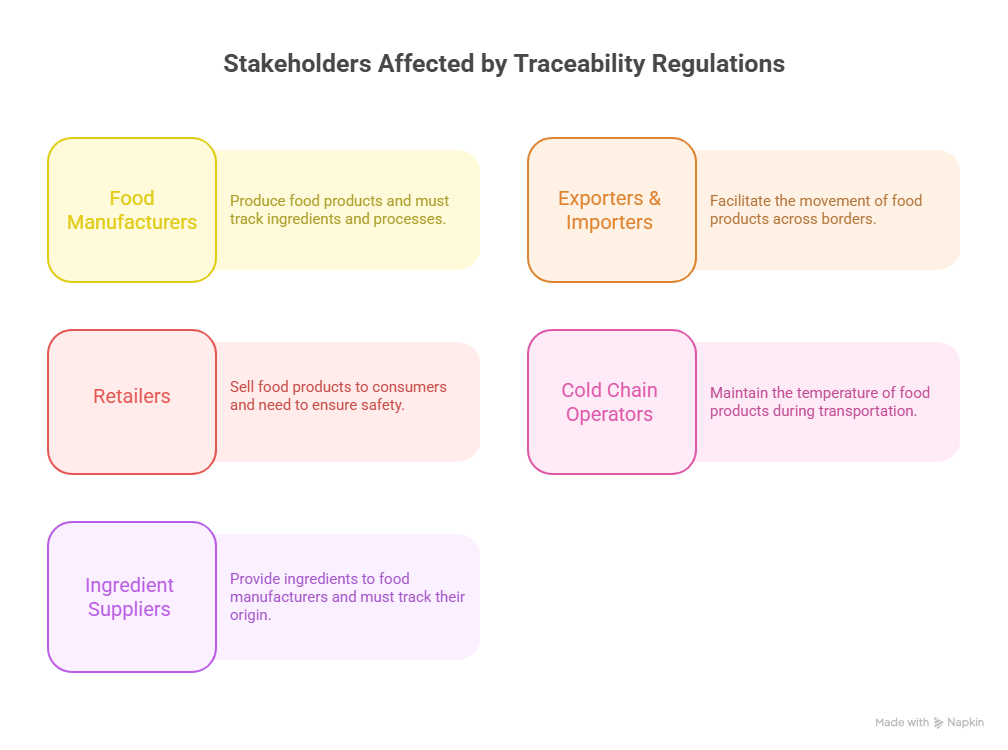
Designed for food manufacturers, exporters, retailers, and ingredient suppliers, TraceX helps organizations reduce recall costs, strengthen supplier accountability, and meet global traceability mandates efficiently.
While many businesses view traceability regulations as a compliance burden, forward-thinking organizations are turning them into a strategic differentiator. Retailers increasingly prefer suppliers who can provide instant, verifiable traceability data, reducing their own risk exposure. Consumers reward brands that offer transparent, farm-to-fork visibility, strengthening loyalty and long-term trust.
Robust traceability systems also unlock export opportunities by meeting stringent international regulatory standards, enabling smoother cross-border trade. At the same time, structured traceability data supports ESG reporting, sustainability disclosures, and responsible sourcing commitments areas that investors and regulators are scrutinizing more closely than ever.
Explore how leading food businesses are strengthening end-to-end supply chain compliance to reduce regulatory risk and improve transparency.
Read our complete guide to Supply Chain Compliance
Understand what FSMA 204 means for your operations, key data elements you must capture, and how to meet 24-hour record retrieval mandates.
Dive into our FSMA Compliance Guide
Learn how digital traceability systems simplify deforestation risk assessments, supplier verification, and due diligence reporting.
Explore our guide to Digital Traceability for EUDR
Under the Food Safety Modernization Act Section 204, traceability requirements apply to foods listed on the FDA’s Food Traceability List (FTL). These include high-risk items such as leafy greens, tomatoes, fresh-cut fruits and vegetables, soft cheeses, shell eggs, nut butters, fresh herbs, and certain seafood products.
Under FSMA 204, traceability records must be maintained for at least two years from the date they were created. However, retention periods may vary depending on jurisdiction and product category. Businesses must ensure records are accessible, accurate, and retrievable within required regulatory timelines.
Paper-based systems are not automatically non-compliant, but they present significant risk under modern TRACEABILITY REGULATIONS. Regulations like FSMA 204 require records to be provided within 24 hours. Manual systems often struggle with rapid retrieval, data standardization, and scalability increasing audit and recall vulnerability.
A traceability lot code (TLC) is a unique identifier assigned to a specific production batch. It links the finished product to key data elements such as source ingredients, processing events, and distribution records. Lot codes enable precise recall containment and regulatory verification during investigations.
Under FSMA 204, companies must provide required traceability records to the FDA within 24 hours of request, or sooner if specified. Rapid digital retrieval is critical, as delayed responses can trigger enforcement actions, expanded inspections, or compliance penalties.