
Quick summary: Traceability in the sesame supply chain in Benin ensures verified origin, quality control, and regulatory compliance, helping exporters meet global buyer standards and secure sustainable market access.

Traceability in the Sesame Supply Chain in Benin is critical for ensuring quality, compliance, and market access. Benin’s sesame sector is dominated by smallholder farmers whose production is aggregated through multi-tiered networks involving local collectors, cooperatives, and processors. Limited farm-level documentation, informal handling, and mixed sourcing create significant traceability gaps, hindering verification of origin and quality. Implementing digital traceability solutions covering GPS farm mapping, batch-level tracking, and audit-ready records enables exporters to meet international sustainability standards, secure premium markets, and strengthen competitiveness, while promoting transparency, farmer inclusion, and sustainable sesame production across Benin.
Benin is a notable sesame producer in West Africa, with production concentrated in regions such as Atacora, Borgou, and Alibori, primarily driven by smallholder farmers cultivating scattered, low-input plots. The country produces an estimated 70,000–100,000 metric tons of raw sesame annually, largely exported to markets in China, India, Europe, and the Middle East for oil extraction, tahini, and snack processing. The sesame supply chain in Benin typically follows a multi-tiered structure: smallholders → local collectors → cooperatives/aggregators → processors → exporters.
Benin’s sesame export landscape, though modest compared to regional giants like Nigeria ($323M), saw values plummet 84.77% from $1.72 million in 2019 to just $261,165 in 2023 amid global competition in the $3.9 billion sesame trade (2.4M tonnes exported worldwide), with Benin holding <0.1% share via smallholder production in savanna zones. Exports target China, Europe, and UAE through multi-tier chains (farmers → aggregators → processors → ports), with 1,772 hulled sesame shipments tracked recently, projecting mixed growth to 2029 under AfCFTA amid West Africa’s surge (Nigeria/Burkina Faso/Mali leading).
Despite growing export volumes, Benin faces significant traceability and quality challenges. Informal aggregation, limited farm-level documentation, and manual handling often result in mixed or unverified batches, complicating origin verification and compliance with international sustainability standards. Smallholders frequently lack digital records, GPS farm mapping, and land documentation, limiting visibility into production practices and yields. To access premium and regulated markets, Benin’s sesame sector must adopt digitized, end-to-end traceability solutions, ensuring verified origin, consistent quality, and sustainable production.
Explore the full guide to Traceability in Sesame Supply Chains
From farm mapping to blockchain traceability, our Guide to Food Traceability breaks it all down. Read it now.
Benin is a growing sesame producer in West Africa, yet its sector faces structural, operational, and sustainability challenges affecting quality, traceability, and export competitiveness:
The TraceX Traceability Platform offers a scalable digital solution to enhance visibility, compliance, and trust across Benin’s sesame supply chain. By digitizing each step from farm production to aggregation, processing, and export, TraceX enables exporters, cooperatives, and processors to verify origin, monitor quality, and meet international sustainability standards.
TraceX platform connects all actors smallholders, local collectors, cooperatives, aggregators, processors, and exporters into one ecosystem, enabling:
Mobile-enabled tools register farmers with authenticated data including:
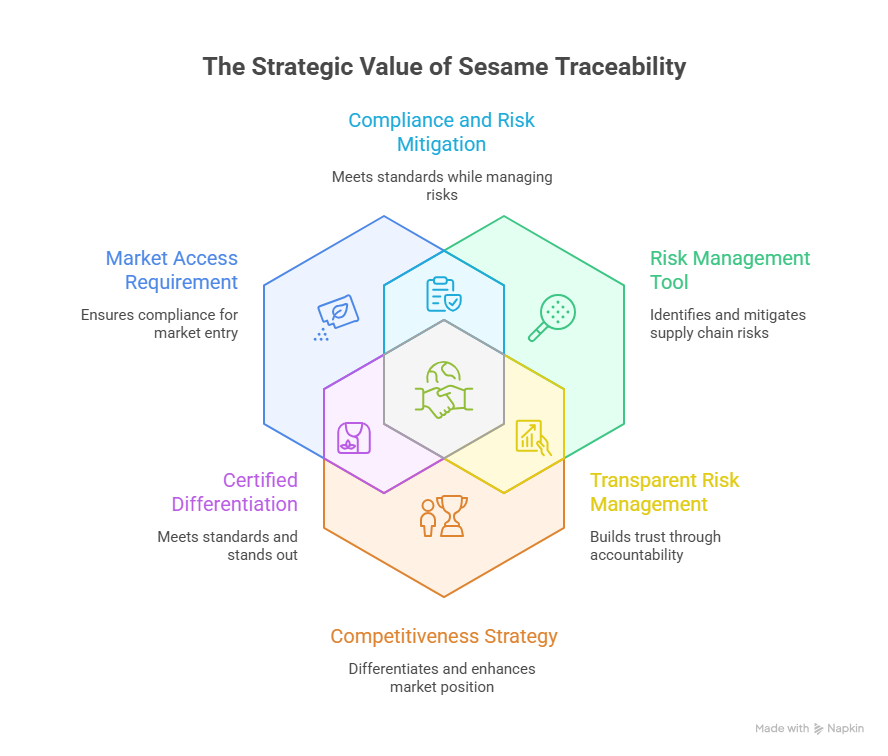
Benin is a key sesame producer in West Africa, and global regulatory shifts combined with evolving buyer expectations are reshaping how sesame must be cultivated, documented, and exported. Market access now depends not just on volume and price but increasingly on traceability, compliance, and verified sustainability.
International buyers, especially in the EU, UK, and North America, are enforcing stricter due-diligence and sustainability rules:
Global buyers — processors, food brands, and traders — now prioritise transparency and risk management. Expectations include:
Benin’s sesame sector largely relies on:
Digitally traceable sesame enables:
At the national level, traceable sesame supply chains:
Traceability is no longer optional for Benin’s sesame sector—it is a strategic imperative. By adopting digital farm mapping, batch-level tracking, and verifiable chain-of-custody systems, exporters can meet global regulatory requirements, satisfy buyer expectations, and access premium markets. Strengthening traceability enhances product quality, supports sustainable farming practices, empowers smallholder farmers, and positions Benin as a reliable, compliant supplier in the international sesame trade. Investing in traceable, transparent supply chains today ensures long-term competitiveness, resilience, and credibility for the country’s sesame industry.
Struggling with visibility gaps? Discover how traceability can fix them in our Supply Chain Traceability Blog.
Transform your food supply chain with digital tools—explore the Digital Traceability for Food Systems Blog.
See how blockchain improves trust, transparency, and auditability—start with our Blockchain Traceability Blog.