

Traceability in the Sesame Supply Chain in Ghana is increasingly critical as global markets demand verifiable origin, quality, and sustainability. Ghana’s sesame sector is dominated by smallholder farmers and multi-tiered aggregation, which creates gaps in farm-level visibility and chain-of-custody records. Without digital traceability such as GPS farm mapping, batch-level tracking, and standardized data capture exporters face compliance risks and limited access to premium markets. Strengthening traceability systems is essential for meeting international regulations, improving buyer confidence, and supporting sustainable export growth.
Ghana’s Sesame Export Landscape
Ghana is an emerging sesame producer in West Africa, with production concentrated in the northern regions including Northern, Upper East, Upper West, Savannah, and parts of North East Region. Sesame is cultivated mainly by smallholder farmers on rain-fed, low-input plots, often intercropped with other staples. While total national output is significantly lower than Nigeria’s, Ghana’s sesame sector has grown steadily in response to rising regional and international demand. Exports are primarily destined for markets in Asia (especially China and Japan), the Middle East, and selectively the EU, where sesame is used in oil extraction, tahini, bakery, and snack products. Ghana’s sesame supply chain typically follows a multi-tiered structure: smallholder farmers → village collectors → aggregators/traders → processors/exporters.
Ghana’s sesame export landscape remains nascent but holds massive potential, with current volumes at a low 510.86 metric tonnes valued at $278,900–$753,000 in 2023 (down 93.28% from $4.15 million in 2018), positioning it far behind regional leaders like Nigeria ($323 million). GIRSAL targets a transformative $500 million annually over the next three years through pilot projects scaling from 10 acres to 50,000 acres by 2028, focusing on standardized protocols in Volta Region and northern belts to capture <1% of the $5.6 billion global market demand. Amid global sesame exports hitting $3.9 billion in 2024 (projected $5 billion in 2025 at $1,772/tonne avg.), Ghana leverages West African advantages for China/Europe/UAE buyers, with average export prices at $1,840/tonne in 2024 (-10.9% YoY) and 59 shipments tracked recently via 45 buyers.
Ghana’s favorable agro-ecological conditions, relative political stability, and proximity to export ports provide a competitive foundation for sesame exports. However, the sector remains largely informal and under-documented. Production volumes are fragmented across thousands of smallholders, with limited use of certified seeds, structured extension services, or standardized post-harvest practices. As export volumes rise, inconsistencies in quality and documentation have become more visible to international buyers.
Reliance on informal aggregation results in mixed sourcing and weak farm-level visibility. Most farmers lack digital farm records, GPS-based field mapping, or formal land-use documentation, making it difficult to verify origin, production practices, or compliance with sustainability requirements. These constraints create traceability gaps across the supply chain, including weak chain-of-custody controls and limited verification of environmental and social standards. As global buyers increasingly demand traceable, ethically sourced, and compliant sesame, Ghana’s sesame sector must strengthen digital traceability, quality management, and data transparency to secure long-term export growth and maintain access to premium markets.
Ready to Build a Fully Transparent Sesame Supply Chain?
Discover how digital tools can streamline documentation, verify origin, and strengthen buyer confidence.
Explore the full guide to Traceability in Sesame Supply Chains
From farm mapping to blockchain traceability, our Guide to Food Traceability breaks it all down. Read it now.
What Are the Key Challenges for Ghana’s Sesame Sector
Ghana’s sesame sector is growing steadily, but it faces several structural, operational, and sustainability challenges that affect productivity, quality, traceability, and export competitiveness.
1. Fragmented Smallholder Farming Systems
• Sesame production is dominated by smallholder farmers cultivating small, scattered, low-input plots, primarily in northern Ghana.
• Fragmentation limits standardization of farming practices and makes yield estimation and quality consistency difficult.
• Limited access to improved seed varieties, extension services, fertilizers, and pest management suppresses productivity.
2. Informal and Multi-Tiered Supply Chains
• The supply chain typically involves farmers → village collectors → aggregators/traders → exporters.
• Heavy reliance on informal intermediaries leads to mixed sourcing, loss of origin data, and inconsistent quality.
• Tracking individual farmer contributions is difficult, limiting traceability and accountability.
3. Lack of Digital Records and Traceability
• Most farmers rely on paper-based or informal record keeping, with little to no documentation of farm size, production volumes, or practices.
• Weak adoption of digital tools prevents farm-to-export traceability required by international buyers and regulators.
4. Quality and Post-Harvest Handling Constraints
• Inadequate drying, cleaning, and storage practices increase risks of contamination, mold, and quality deterioration.
• Variable quality reduces buyer confidence and restricts access to premium or regulated markets.
5. Limited Land and Environmental Documentation
• Sesame is often cultivated on customary or undocumented land, creating uncertainty around land tenure and legality.
• Lack of environmental and land-use documentation complicates compliance with deforestation-free and responsible sourcing requirements.
6. Socio-Economic and Capacity Barriers
• Women and youth play important roles in harvesting and post-harvest handling but face limited access to finance, training, and organized market structures.
• Low organizational capacity among farmer groups limits scaling and adoption of improved practices.
7. Climate and Environmental Vulnerability
• Sesame production is highly dependent on rainfall and is vulnerable to drought, erratic weather, and soil degradation.
• Climate variability increases yield volatility and income uncertainty for farmers.
8. Export and Market Access Challenges
• Global buyers increasingly require traceable, ethically sourced, and food-safe sesame.
• Weak traceability systems expose exporters to rejection risks, buyer penalties, and exclusion from high-value markets.
• Limited compliance with certifications and sustainability standards reduces competitiveness.
9. Limited Access to Finance and Processing Infrastructure
• Smallholders and local traders often lack access to capital for improved storage, cleaning, grading, and mechanization.
• Infrastructure gaps increase post-harvest losses and constrain export scalability.
Ghana’s sesame sector faces interconnected challenges that undermine traceability, quality, and export readiness. Addressing these gaps through digital traceability, supply chain formalization, and farmer capacity building is essential for sustainable growth and global market access.
How a Digital Traceability Platform Like TraceX Can Work for Ghana’s Sesame Sector
The TraceX Traceability Platform provides the digital foundation needed to improve transparency, compliance, and trust in Ghana’s sesame supply chain. By digitizing every stage from farm-level production to aggregation and export TraceX enables exporters, traders, cooperatives, and buyers to verify origin, manage quality, and meet international regulatory and sustainability requirements.
End-to-End Digital Visibility Across the Sesame Value Chain
TraceX platform connects all supply chain actors smallholder farmers, village collectors, aggregators, traders, and exporters into one digital ecosystem, enabling:
• Real-time visibility of product movement
• Seamless data exchange across supply chain nodes
• Centralized oversight of production, aggregation, and export
This ensures only verified and compliant sesame seeds move into export channels.
Farm-Level GPS & Polygon Mapping
TraceX platform captures precise GPS coordinates or polygon maps for sesame farms, enabling exporters to:
• Verify farm locations and production areas
• Demonstrate legal land use and responsible sourcing
• Support deforestation-free and sustainability claims
• Maintain geospatial records for buyer audits and regulatory checks
Digital Onboarding of Smallholder Farmers
Using mobile-enabled tools, farmers are digitally registered with structured and verifiable data, including:
• Farmer identity and contact details
• GPS-linked farm locations
• Available land-use or access documentation
• Planting, harvest, and yield records
• Collector or cooperative affiliations
This creates a trusted digital farmer registry and strengthens data quality at the source.
Batch-Level Digital IDs for Complete Traceability
Each sesame batch receives a unique digital ID, enabling full chain-of-custody tracking across:
• Farm harvesting
• Collection points
• Aggregation and storage facilities
• Export documentation
Exporters can trace shipments back to specific farms, seasons, and handling stages.
Blockchain-Backed Data Integrity
All traceability records are secured on blockchain infrastructure, ensuring data is:
• Immutable and tamper-proof
• Time-stamped and audit-ready
• Transparently accessible to authorized stakeholders
This provides buyers with credible proof of origin, compliance, and risk management.
Automated Reports & Compliance Documentation
TraceX solution automatically generates:
• Chain-of-custody and origin reports
• Sustainability and ESG documentation
• Buyer-specific compliance and due diligence files
• Full digital audit trails
This reduces manual workloads and ensures exporters remain market- and audit-ready.
What Global Regulation & Market Demand Imply for Ghana’s Sesame — Why Traceability Matters
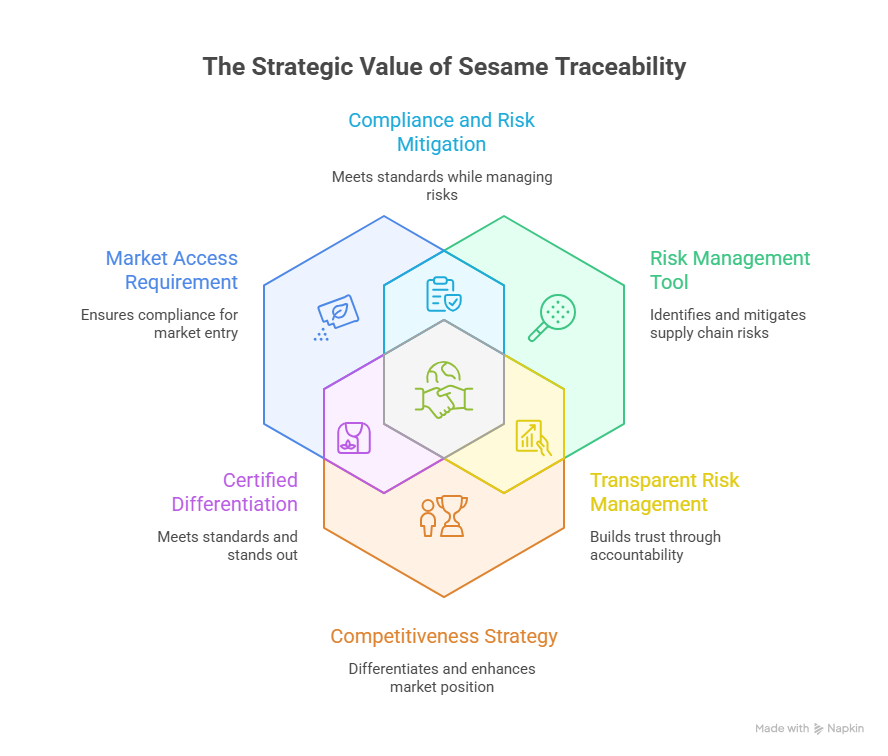
Ghana’s sesame sector is gaining international attention, but global regulatory tightening and shifting buyer expectations mean that traceability is no longer optional. Market access, pricing, and long-term growth increasingly depend on Ghana’s ability to prove where sesame comes from, how it is produced, and whether it complies with environmental and social standards.
1. Global Regulations Are Making Traceability Mandatory
Key import markets particularly the EU and UK, with influence extending to Asia and the Middle East are enforcing stricter due-diligence rules for agricultural commodities. Regulations such as the EU Deforestation Regulation (EUDR) and emerging human-rights and environmental due-diligence laws require exporters and importers to demonstrate legal land use, deforestation-free production, and full chain-of-custody traceability.
For Ghanaian sesame exporters, this implies:
- Farm-level origin verification (GPS or polygon mapping)
- Clear batch segregation and documentation
- Digital records that can withstand audits and inspections
Without these, even compliant sesame risks rejection due to lack of proof.
2. Buyer Expectations Now Go Beyond Price and Volume
International buyers especially large food manufacturers, processors, and traders are under pressure to manage supply-chain risk. As a result, they increasingly prioritize:
- Verified farm-level origin
- Digital chain-of-custody records
- Evidence of ethical labor and legal land use
- Reliable quality and food-safety documentation
For sesame, which is widely used in food products and sensitive to contamination risks, traceability is central to food safety, recall management, and brand protection. Buyers are therefore shifting toward suppliers who can provide transparent and auditable data, not just competitive pricing.
3. Informal Supply Chains Are a Growing Risk
Ghana’s sesame supply chain is largely informal, with multiple layers of aggregation and limited documentation. While this supports smallholder inclusion, it also creates risks:
- Mixed sourcing that obscures origin
- Inability to isolate problems during quality or food-safety incidents
- Weak proof during buyer or regulatory audits
As regulatory scrutiny increases, exporters relying on manual or paper-based systems face higher rejection risk, longer clearance times, and loss of buyer confidence.
4. Traceability Enables Market Access and Differentiation
Robust traceability allows Ghana’s sesame exporters to:
- Maintain access to regulated and premium markets
- Meet buyer due-diligence and sustainability requirements
- Differentiate Ghanaian sesame as a reliable, low-risk origin
- Negotiate longer-term contracts and more stable pricing
Instead of competing solely on volume, Ghana can compete on credibility, compliance, and consistency.
5. National Competitiveness Depends on Transparency
At a broader level, traceable sesame supply chains strengthen Ghana’s export reputation, reduce shipment rejections, and align the sector with global trade norms. Countries that digitize and formalize agricultural supply chains early will capture future growth; those that do not risk being sidelined as buyers consolidate sourcing to fewer, more transparent origins.
Why Traceability Matters for Ghana’s Sesame Sector
Traceability is not merely a technical upgrade it is a market access strategy, a risk-management tool, and a foundation for sustainable export growth. For Ghana’s sesame sector, investing in digital, end-to-end traceability is essential to protect emerging export gains, attract serious international buyers, and ensure long-term competitiveness in an increasingly regulated global market.
Building a Transparent and Export-Ready Sesame Supply Chain in Ghana
Traceability in the sesame supply chain in Ghana is essential for ensuring market access, regulatory compliance, and long-term sector growth. As global buyers and regulators demand verifiable origin, food safety assurance, and sustainable sourcing, Ghana must move beyond informal, paper-based systems. Implementing digital, end-to-end traceability strengthens chain-of-custody control, improves quality management, and builds buyer confidence. By embedding traceability at farm, aggregation, and export levels, Ghana can position its sesame sector as reliable, compliant, and competitive in both premium and regulated international markets.
Struggling with visibility gaps? Discover how traceability can fix them in our Supply Chain Traceability Blog.
Transform your food supply chain with digital tools—explore the Digital Traceability for Food Systems Blog.
See how blockchain improves trust, transparency, and auditability—start with our Blockchain Traceability Blog.
Frequently Asked Questions (FAQ’)
What is traceability in the sesame supply chain in Ghana?
Traceability in the sesame supply chain in Ghana refers to the ability to track sesame seeds from farm-level production through aggregation, processing, and export using digital records, batch identification, and chain-of-custody systems.
Why is traceability important for Ghana’s sesame exports?
Traceability helps Ghana exporters meet international regulations, manage food safety and quality risks, and satisfy buyer requirements for ethical, non-GMO, and responsibly sourced sesame.
What challenges limit traceability in Ghana’s sesame sector?
Key challenges include fragmented smallholder farming, multi-tiered informal aggregation, lack of digital farm records, poor post-harvest handling, and limited land-use documentation.
How can digital traceability improve Ghana’s sesame supply chain?
Digital traceability enables GPS farm mapping, digital farmer onboarding, batch-level tracking, and automated compliance reporting, improving transparency, efficiency, and export readiness.
Does traceability help Ghana sesame access premium markets?
Yes. Buyers in the EU, Asia, and the Middle East increasingly prefer traceable sesame. Verified origin and compliance allow Ghana exporters to reduce rejection risk and access premium or long-term contracts.