

Traceability in the Sesame Supply Chain in Kenya is increasingly important as global markets demand verified origins, quality assurance, and compliance with sustainability standards. Kenya’s sesame sector—driven by smallholder farmers in regions such as Turkana, Tana River, Garissa, and Lamu—faces challenges including limited farm documentation, fragmented first-mile data, and multi-tiered aggregation. These gaps hinder origin verification and chain-of-custody transparency. Implementing digital traceability systems enables accurate farm mapping, batch-level tracking, and compliance with regulations like EUDR, strengthening buyer confidence and enhancing Kenya’s competitiveness in regional and international sesame markets.
Kenya’s Sesame Export Landscape
Kenya’s sesame export landscape positions it as an emerging East African player, producing 80,000–120,000 metric tons annually (11.55 million kg in 2022, up 0.3% YoY from marginal zones like Turkana, Tana River, Lamu, Garissa, Kitui, and coastal areas dominated by smallholders on low-input plots averaging 449 kg/ha yields). The domestic market hit $4.2M in 2024 (+30% YoY after prior slumps), with exports (down from 2015 peaks) targeting China (primary), Middle East, and EU for oil/tahini via multi-tier chains: smallholders → aggregators → traders/processors → exporters, amid global demand projecting $17.77B by 2025
While Kenya’s sesame sector shows strong growth potential, it faces significant traceability and quality-control challenges. Heavy dependence on informal aggregators leads to mixed sourcing, making it difficult to identify farm-level origins. Most farmers lack digital records, GPS field mapping, or verifiable land documentation, limiting visibility into cultivation practices, seed varieties, and yield data.
These systemic gaps create weak chain-of-custody tracking, inconsistent quality documentation, and limited verification of environmental and social compliance. With global buyers increasingly demanding non-GMO, ethically sourced, and fully traceable sesame especially under tightening regulations such as EUDR traditional manual systems cannot meet evolving market requirements. To remain competitive and expand access to premium markets, Kenya’s sesame industry must adopt digitized, transparent, and verifiable supply-chain systems that ensure full origin traceability, quality assurance, and sustainable market access.
Ready to Build a Fully Transparent Sesame Supply Chain?
Discover how digital tools can streamline documentation, verify origin, and strengthen buyer confidence.
Explore the full guide to Traceability in Sesame Supply Chains
From farm mapping to blockchain traceability, our Guide to Food Traceability breaks it all down. Read it now.
What Are the Key Challenges for Kenya’s Sesame Sector?
Kenya is an emerging sesame producer with strong export potential, but the sector faces structural and operational constraints that affect productivity, quality, and global competitiveness.
1. Fragmented, Low-Input Smallholder Farming
- Sesame is primarily grown by smallholder farmers across Turkana, Lamu, Tana River, Garissa, Kitui, and coastal regions.
- Scattered plots and traditional farming methods limit yield consistency and quality.
- Limited access to improved seeds, irrigation, fertilizers, and extension services restricts productivity.
2. Informal, Multi-Tiered Supply Chains
- Kenya’s sesame typically moves through farmers → village aggregators → regional traders → processors/exporters.
- Multiple intermediaries cause loss of origin data, seed mixing, and quality inconsistencies.
- Difficulty tracing sesame to individual farms hampers compliance.
3. Lack of Digital Traceability and Record-Keeping
- Most farmers have no digital records of planting dates, land size, inputs, or yields.
- Absence of GPS-based farm mapping reduces transparency for export buyers.
- Manual systems cannot meet tightening international due-diligence requirements.
4. Post-Harvest Handling & Quality Issues
- Poor drying, threshing, and storage lead to contamination, mold, foreign matter, or discoloration.
- Lack of modern cleaning and grading limits access to premium markets.
- Quality fluctuations reduce buyer confidence.
5. Limited Land Documentation & Compliance Barriers
- Many sesame farms lie on community, pastoral, or unregistered land.
- Weak land documentation complicates legality verification under emerging global regulations (e.g., EUDR).
- Environmental compliance data is often unavailable.
6. Gender and Livelihood Constraints
- Women play major roles in harvesting and post-harvest processing but have limited access to training, finance, and market linkages.
- This restricts inclusive sector growth and adoption of best practices.
7. Climate Vulnerability and Environmental Risks
- Sesame production in arid and semi-arid areas is highly vulnerable to drought, erratic rainfall, and shifting climate patterns.
- Soil degradation and water scarcity threaten production stability.
8. Export & Market Competitiveness Challenges
- Global buyers increasingly demand traceable, ethically sourced, non-GMO sesame.
- Kenya’s largely manual supply chain risks:
- Export rejections
- Price penalties
- Loss of access to regulated markets
- Lack of certification (organic, sustainability, Fairtrade) reduces competitiveness.
9. Limited Access to Finance and Processing Infrastructure
- Smallholders often lack credit for improved seeds, irrigation, or mechanization.
- Limited modern cleaning, sorting, and storage capacity elevates post-harvest losses and affects export quality.
Overall, Kenya’s sesame sector faces systemic traceability, quality, and compliance challenges. Digitization, improved post-harvest infrastructure, and farmer-level data systems are essential for capturing premium markets and ensuring sustainable, scalable growth.
How a Digital Traceability Platform Like TraceX Can Transform Kenya’s Sesame Value Chain
TraceX Traceability Platform provides the digital infrastructure needed to create transparent, compliant, and reliable sesame supply chains in Kenya. By digitizing every step from farm production to aggregation, processing, and export the platform enables exporters, traders, and cooperatives to verify origin, meet regulatory requirements, and build buyer trust.
End-to-End Digital Visibility Across the Sesame Supply Chain
The TraceX platform connects farmers, aggregators, cooperatives, processors, and exporters into one unified ecosystem, enabling:
- Real-time visibility of sesame movement
- Seamless data exchange between supply-chain actors
- Centralized monitoring of production, aggregation, processing, and export flows
This transparency reduces inefficiencies and ensures only verified, compliant sesame enters export channels.
Accurate Farm-Level GPS & Polygon Mapping
TraceX platform captures precise farm geolocation and polygon mapping, allowing exporters to:
- Verify farm boundaries and production visibility
- Confirm land-use legality on communal or pastoral land
- Provide deforestation-free and responsible sourcing evidence
- Maintain geospatial records for audits and buyer requirements
Such mapping strengthens Kenya’s credibility in regulated markets.
Digital Onboarding of Smallholder Farmers
Using mobile-based field tools, farmers are digitally enrolled with structured, verifiable data:
- Farmer identity and contact details
- GPS-linked farm locations
- Land-use documentation (where available)
- Planting, harvest, and yield histories
- Links with cooperatives, aggregators, or traders
This establishes a transparent, verified first-mile network.
Batch-Level Digital IDs for Complete Traceability
Each sesame batch receives a tamper-proof digital identity tracked through:
- Farm-level harvest
- Village aggregation
- Cleaning, grading, or processing
- Export preparation and documentation
Exporters can trace every shipment back to specific farms, production seasons, and handling points.
Blockchain-Backed Data Integrity
TraceX platform secures all supply chain records on blockchain, ensuring:
- Immutable, tamper-proof data
- Time-stamped audit trails
- Transparent buyer verification
- Trustworthy compliance documentation
This is critical for EU, Middle Eastern, and Asian markets demanding verified sourcing.
Automated Reports & Global Compliance Documentation
TraceX platform auto-generates export-ready documentation, including:
- Chain-of-custody and origin reports
- Environmental and sustainability records
- Buyer-specific data packages
- Compliance files aligned with international regulations (EUDR, food safety, ESG)
- Complete digital audit trails
This reduces administrative overhead and enhances market readiness.
What Global Regulation & Market Demand Imply for Kenya’s Sesame — Why Traceability Matters
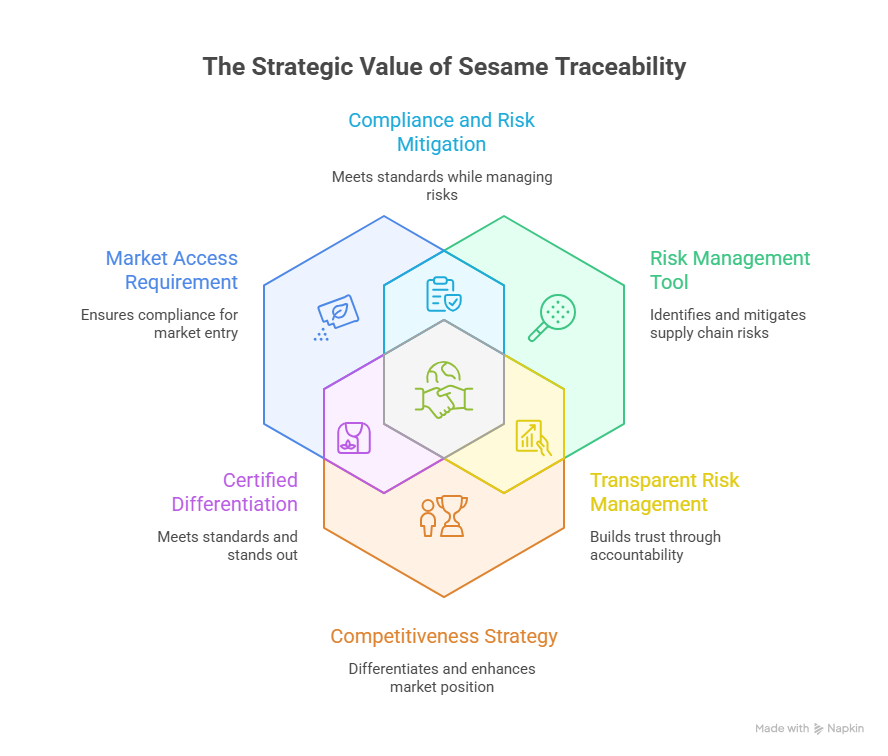
Kenya’s sesame sector is expanding, but global regulatory changes and evolving buyer expectations are transforming how sesame must be grown, verified, and traded. Market access is no longer determined by price and volume alone traceability, compliance, and sustainability verification are now critical competitive factors.
1. Global Regulations Are Moving Toward Mandatory Traceability
Key export markets EU, UK, Middle East, and North America are introducing stricter due-diligence, sustainability, and food-safety requirements that directly impact Kenya’s agricultural exports.
Major regulatory trends include:
- EU Deforestation Regulation (EUDR): Requires geolocation data (GPS/polygons), proof of deforestation-free production, and legal land use.
- Human Rights & Environmental Due-Diligence Laws: Buyers must ensure products are not linked to labor risks, illegal land use, or environmental harm.
- Food Safety & Contamination Controls: Traceability is essential for managing aflatoxin risks, foreign matter, and recalls.
For Kenyan sesame exporters, this means farm-level mapping, batch-level digital identities, and verified chain-of-custody data are becoming mandatory.
Without credible traceability, Kenya risks:
- Export rejections
- Delayed shipments
- Buyer disengagement
- Loss of access to high-value regulated markets
2. Buyer Preferences Are Shifting Beyond Price
Global processors, food brands, and traders increasingly prioritize risk management, sustainability, and transparency.
Buyers now expect:
- Verified farm-level origin
- Digital chain-of-custody documentation
- Proof of responsible and non-GMO sourcing
- Evidence of ethical labor and land-use practices
- Readiness for ESG and sustainability reporting
Even in price-driven markets such as China, India, and the Middle East, demand is rising for:
- Consistent quality
- Cleaner, better-graded sesame
- Documentation that protects brand and regulatory risk
Traceability is shifting from a “nice to have” to a core requirement for supplier approval.
3. Manual Systems Can No Longer Support Export Growth
Kenya’s sesame sector still relies heavily on:
- Paper-based documentation
- Informal intermediaries
- Aggregated sourcing without origin visibility
- Minimal farm-level data or mapping
These systems cannot:
- Meet digital regulatory requirements
- Provide rapid, verifiable audits
- Demonstrate sustainability or compliance
- Trace contamination or quality issues back to source
As due-diligence expectations grow, exporters using manual systems face higher compliance costs, slower audit responses, and increased rejection risk.
4. Traceability Enables Market Differentiation & Better Prices
Digitally traceable sesame unlocks:
- Access to premium and regulated markets (EU, Japan, GCC, US)
- Eligibility for certification and preferred-supplier programs
- Stronger, longer-term buyer partnerships
- Better price stability and bargaining power
With traceability, Kenya can move from competing on commodity volume to competing on verified origin, reliability, and compliance.
5. Traceability Strengthens National Competitiveness
At a sector level, transparent and traceable sesame supply chains:
- Increase Kenya’s global export credibility
- Reduce rejection and contamination risk
- Boost sustainability and smallholder inclusion
- Align Kenya with emerging global trade norms
Countries that digitize agricultural supply chains will lead future export markets. Those that don’t may face market exclusion as global rules tighten.
Strengthening Kenya’s Sesame Competitiveness Through Traceability
Traceability in the Sesame Supply Chain in Kenya is no longer optional it is essential for maintaining export credibility, meeting rising global compliance standards, and securing access to premium markets. By adopting digital traceability systems that verify origin, document farm practices, and ensure chain-of-custody integrity, Kenya can reduce quality risks, build stronger buyer confidence, and position its sesame sector for sustainable long-term growth in an increasingly regulated global marketplace.
Struggling with visibility gaps? Discover how traceability can fix them in our Supply Chain Traceability Blog.
Transform your food supply chain with digital tools—explore the Digital Traceability for Food Systems Blog.
See how blockchain improves trust, transparency, and auditability—start with our Blockchain Traceability Blog.
Frequently Asked Questions
What is traceability in the sesame supply chain in Kenya?
Traceability in the sesame supply chain in Kenya refers to the ability to track sesame seeds from farm-level production through aggregation, processing, and export using digital records, batch identification, and chain-of-custody systems.
Why is traceability important for Kenya’s sesame exports?
Traceability helps Kenyan exporters meet international regulations, manage food safety and quality risks, and satisfy buyer requirements for ethical, non-GMO, and responsibly sourced sesame.
What challenges limit traceability in Kenya’s sesame sector?
Key challenges include fragmented smallholder farming, multi-tiered informal aggregation, lack of digital farm records, poor post-harvest handling, and limited land-use documentation.
How can digital traceability improve Kenya’s sesame supply chain?
Digital traceability enables GPS farm mapping, digital farmer onboarding, batch-level tracking, and automated compliance reporting, improving transparency, efficiency, and export readiness.
Does traceability help Kenyan sesame access premium markets?
Yes. Buyers in the EU, Asia, and the Middle East increasingly prefer traceable sesame. Verified origin and compliance allow Kenyan exporters to reduce rejection risk and access premium or long-term contracts