

Traceability in the Sesame Supply Chain in Tanzania is increasingly critical as global buyers demand verified origins, quality assurance, and compliance with sustainability and market standards. Tanzania’s sesame sector dominated by smallholder farmers across regions like Lindi, Mtwara, Morogoro, and Dodoma faces challenges such as fragmented first-mile data, limited farm mapping, and multi-layered aggregation. These gaps hinder batch-level tracking and transparency. Implementing digital traceability systems enables accurate origin verification, chain-of-custody visibility, and compliance with regulations like EUDR, strengthening buyer confidence and enhancing Tanzania’s sesame export competitiveness.
Tanzania’s Sesame Export Landscape
Tanzania is one of East Africa’s leading sesame producers, contributing significantly to regional and global supply. Key production regions such as Lindi, Mtwara, Ruvuma, Morogoro, Singida, and Dodoma are dominated by smallholder farmers cultivating sesame on fragmented, rain-fed plots. Annual production typically ranges between 200,000 – 250,000 metric tons, with major exports directed to China, Japan, Turkey, the Middle East, and the EU for oil processing, tahini, and food manufacturing. The sesame supply chain commonly follows a multi-tiered flow: smallholder farmers → village traders → primary aggregators → processors/traders → exporters.
Tanzania’s strong export performance has positioned it among Africa’s top sesame exporters, benefiting from rising global demand for high-oil-content East African sesame. Export volumes and values have grown steadily over the past decade, supported by expanding smallholder participation and favorable southern corridor growing conditions. With tighter global supply and premium prices, Tanzania is poised for continued export growth as markets increasingly seek high-quality, reliably sourced sesame.
However, the existing system presents significant traceability and quality-control challenges. Heavy dependence on informal intermediaries often leads to bulked or mixed sourcing, making farm-level origin tracking difficult. Most smallholders lack digital records, geolocation mapping, or land documentation, limiting visibility into production practices, seed varieties, and yield data.
These structural limitations create traceability gaps, including weak chain-of-custody tracking, inconsistent quality documentation, and limited verification of environmental, social, or sustainability compliance. As global buyers demand ethically sourced, non-GMO, transparent, and EUDR-ready sesame, traditional manual processes are no longer adequate. To maintain export competitiveness and meet rising compliance standards, Tanzania’s sesame sector must move toward digitized, transparent, and verifiable supply chains that ensure full origin traceability and long-term sustainable market access.
Ready to Build a Fully Transparent Sesame Supply Chain?
Discover how digital tools can streamline documentation, verify origin, and strengthen buyer confidence.
Explore the full guide to Traceability in Sesame Supply Chains
From farm mapping to blockchain traceability, our Guide to Food Traceability breaks it all down. Read it now.
What Are the Key Challenges for Tanzania’s Sesame Sector
Tanzania is a major sesame producer in East Africa, yet the sector faces structural, operational, and compliance challenges that limit its full export potential.
1. Fragmented Smallholder Farming Systems
- Sesame is predominantly grown by smallholders on scattered, low-input, rain-fed plots in regions like Lindi, Mtwara, Ruvuma, Morogoro, Singida, and Dodoma.
- Fragmentation makes it difficult to standardize agronomic practices or track production reliably.
- Limited access to improved seeds, fertilizers, and training reduces productivity and consistency.
2. Multi-Tiered, Informal Supply Chains
- The typical chain involves farmers → village traders → primary aggregators → processors → exporters.
- Reliance on multiple intermediaries leads to bulk mixing of sesame and loss of origin identity.
- Weak coordination limits transparency and reduces traceability accuracy.
3. Lack of Digital Records and Farm-Level Visibility
- Most farmers do not maintain documented land boundaries, output records, or farming practices.
- Low adoption of digital tools constrains farm-to-export traceability, which is now essential for global markets.
- Exporters lack reliable data to demonstrate sustainability and compliance.
4. Quality and Post-Harvest Handling Issues
- Poor drying, storage, and handling conditions expose sesame to contamination, mold, or moisture-related damage.
- Inconsistent quality reduces competitiveness and restricts access to premium buyers.
- Limited mechanized cleaning and grading infrastructure affects export quality.
5. Limited Land Documentation and Environmental Data
- Many sesame farms operate on customary or unregistered lands, complicating verification of land legality.
- Lack of environmental due diligence and mapping makes compliance with emerging regulations more difficult.
6. Gender and Socio-Economic Barriers
- Women contribute heavily to planting, harvesting, and processing but have limited access to finance and training.
- Inequities reduce productivity, slow modernization, and limit sector-wide transformation.
7. Climate and Environmental Vulnerabilities
- Sesame yields fluctuate due to drought, erratic rainfall, and soil degradation in key producing regions.
- Climate variability threatens both household incomes and national export volumes.
8. Export and Market Challenges
- Buyers in China, Japan, Turkey, the EU, and the Middle East increasingly demand fully traceable, ethically sourced, and non-GMO sesame.
- Lack of digital traceability risks market rejection, price deductions, or failure to meet EUDR-style requirements.
- Limited certification adoption (organic, Fairtrade, sustainable sourcing) impacts competitiveness.
9. Limited Access to Finance & Modern Processing
- Smallholders and local processors often lack capital for improved storage, cleaning, and grading facilities.
- Poor infrastructure increases post-harvest losses and limits access to high-value markets.
Tanzania’s sesame sector faces interconnected challenges traceability gaps, inconsistent quality, and weak documentation that affect competitiveness in global markets. Digitization, structured supply chain management, and farmer inclusion are essential to unlock long-term export growth.
How a Digital Traceability Platform Like TraceX Can Work for Tanzania’s Sesame Sector
The TraceX Traceability Platform provides the digital infrastructure needed to bring visibility, efficiency, and compliance to Tanzania’s sesame value chain. By digitizing every stage from farm to village trader to aggregator, processor, and exporter TraceX helps stakeholders verify origin, monitor quality, and meet global buyer requirements.
End-to-End Digital Visibility Across Tanzania’s Sesame Supply Chain
TraceX platform connects all actors farmers, village traders, cooperatives, aggregators, processors, and exporters into a unified digital ecosystem enabling:
- Real-time visibility of sesame movement
- Seamless data flow across supply chain nodes
- Centralized monitoring of production, aggregation, processing, and export
This eliminates transparency gaps and ensures only verified, compliant sesame reaches export channels.
Farm-Level GPS & Polygon Mapping
TraceX platform captures precise GPS coordinates or field polygons for each sesame farm, enabling:
- Verification of farm boundaries and production zones
- Confirmation of land-use legality
- Compliance with deforestation-free sourcing requirements
- Geospatial documentation for audits and international buyers
Accurate mapping is fundamental to building credible and compliant sesame supply chains.
Digital Onboarding of Smallholder Farmers
With mobile tools, TraceX platform creates verified digital profiles for each farmer, capturing:
- Identity and demographic data
- Farm location linked to GPS mapping
- Land tenure or customary land-use details
- Planting, harvest, and yield records
- Village trader/cooperative linkages
This strengthens first-mile data integrity and forms a trusted farmer network.
Batch-Level Digital IDs for Complete Traceability
Every sesame batch receives a unique digital identity across:
- Harvesting
- Village collection centers
- Aggregation points
- Processing and cleaning units
- Export shipping documentation
Exporters can trace each consignment back to specific farms, production clusters, and handling nodes.
Blockchain-Backed Data Integrity
TraceX secures all data on blockchain infrastructure, ensuring it is:
- Immutable and tamper-proof
- Time-stamped and audit-ready
- Accessible to authorized buyers and regulators
This builds trust with premium and regulated markets that require verified traceability.
Automated Reports & Compliance Documentation
TraceX platform generates essential documents automatically, including:
- Origin and chain-of-custody reports
- ESG and sustainability records
- Due diligence files for regulations (e.g., EUDR-style requirements)
- Buyer-specific compliance summaries
- End-to-end digital audit trails
This reduces manual paperwork and ensures Tanzania’s sesame exports remain compliant, credible, and competitive.
What Global Regulation & Market Demand Imply for Tanzania’s Sesame — Why Traceability Matters
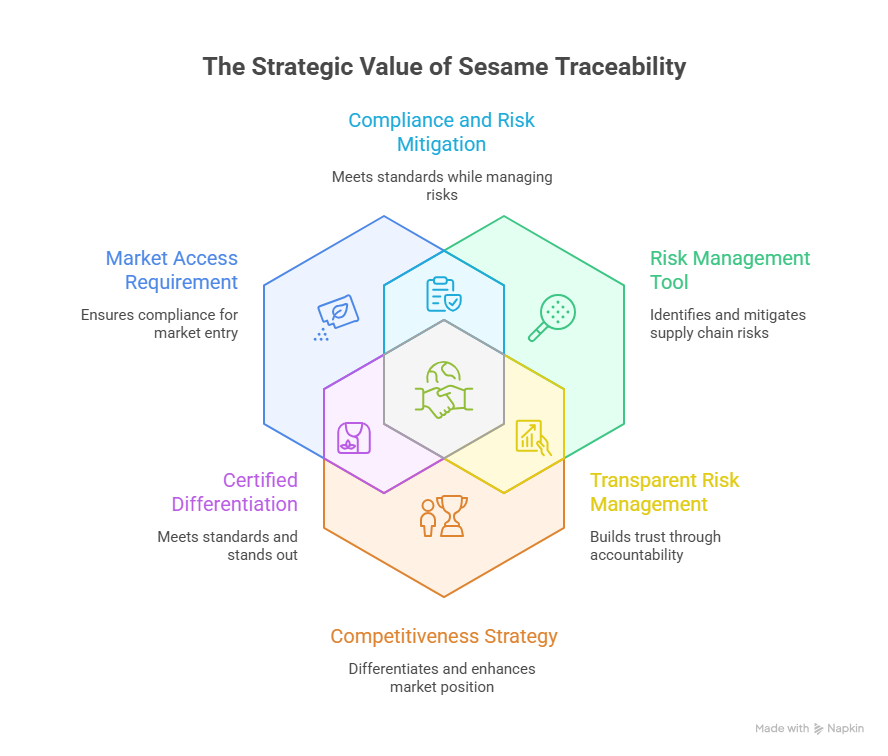
Tanzania is one of East Africa’s top sesame exporters, but global regulatory shifts and evolving buyer expectations are reshaping the requirements for exporting agricultural commodities. Export success is no longer driven only by volume traceability, compliance, and verified sustainability now determine who gains long-term market access.
1. Global Regulations Are Moving Toward Mandatory Traceability
Major export markets including the EU, UK, Middle East, Japan, and North America are tightening sustainability and due-diligence rules that directly impact Tanzania’s sesame exports.
Key regulatory trends include:
- EU Deforestation Regulation (EUDR): Requires sesame to be deforestation-free, legally produced, and fully traceable to mapped farm locations.
- Mandatory Human Rights & Environmental Due Diligence Laws: Buyers must ensure products are not linked to illegal land use, labor issues, or environmental harm.
- Food safety and contamination controls: Traceability is essential for managing moisture, mold, and aflatoxin risks.
For Tanzania’s exporters, this means farm-level GPS/polygon mapping, batch-level traceability, and digital audit trails are becoming unavoidable requirements.
Without credible traceability, Tanzanian sesame faces:
- Export delays or rejections
- Loss of access to high-value markets
- Buyer downgrades or blacklisting
- Reduced competitiveness as regulations tighten
2. Buyer Preferences Are Shifting Beyond Price
Global buyers from processors to food brands are reconfiguring procurement toward risk reduction, transparency, and verified sourcing.
Buyers increasingly expect:
- Verified farm-level origin
- Digital chain-of-custody documentation
- Proof of ethical and responsible sourcing
- ESG and sustainability reporting capabilities
- Non-GMO and contamination-free assurances
Even in price-driven destinations like China, Turkey, and the Middle East, buyers now demand:
- More uniform quality
- Better documentation
- Traceable sourcing to protect brand and regulatory exposure
Traceability is becoming a risk-mitigation tool, not just a compliance checkbox.
3. Manual Systems Can No Longer Support Export Growth
Tanzania’s sesame sector still depends heavily on:
- Paper-based or undocumented records
- Multi-layered, informal intermediaries
- Aggregated, mixed sourcing
- Limited land and farmer documentation
These systems cannot:
- Meet digital due-diligence requirements
- Enable fast or transparent audits
- Manage contamination or quality incidents effectively
- Support compliance with EUDR and similar regulations
As regulatory scrutiny grows, exporters relying on manual systems face higher compliance costs, delayed shipments, and greater exposure to market penalties.
4. Traceability Unlocks Market Differentiation and Premium Opportunities
Digitally traceable sesame enables Tanzania to access:
- Premium and regulated global markets
- Preferred supplier programs
- Stable long-term buyer relationships
- Higher margins through verified quality and origin
With traceability, Tanzania can shift from selling bulk commodities to offering verified, compliant, and premium-grade sesame, strengthening pricing power and reducing dependence on volatile commodity markets.
5. Traceability Strengthens Tanzania’s National Competitiveness
At a national level, traceable sesame supply chains:
- Enhance Tanzania’s export credibility
- Reduce rejection risks and strengthen reputation
- Support farmer inclusion through digital onboarding
- Align the country with emerging global trade norms
- Build long-term sustainability and market resilience
Countries that digitize their supply chains early will dominate future agricultural trade those that lag risk losing market share as compliance barriers rise.
Strengthening Tanzania’s Sesame Competitiveness Through Digital Traceability
Traceability in the Sesame Supply Chain in Tanzania is no longer just a compliance requirement it is a strategic advantage. By embracing digital tools for farm mapping, batch-level tracking, and verified chain-of-custody, Tanzania can overcome long-standing challenges in data gaps, quality inconsistencies, and informal market structures. Digital traceability strengthens buyer confidence, ensures alignment with emerging regulations like EUDR, and opens access to premium global markets. Investing in transparent and verifiable supply chains will position Tanzania as a trusted, future-ready exporter and unlock sustainable growth for farmers, processors, and exporters across the sesame ecosystem.
Struggling with visibility gaps? Discover how traceability can fix them in our Supply Chain Traceability Blog.
Transform your food supply chain with digital tools—explore the Digital Traceability for Food Systems Blog.
See how blockchain improves trust, transparency, and auditability—start with our Blockchain Traceability Blog.
Frequently Asked Questions
What is traceability in the sesame supply chain in Tanzania?
Traceability in the sesame supply chain in Tanzania refers to the ability to track sesame seeds from farm-level production through aggregation, processing, and export using digital records, batch identification, and chain-of-custody systems.
Why is traceability important for Tanzania’s sesame exports?
Traceability helps Tanzanian exporters meet international regulations, manage food safety and quality risks, and satisfy buyer requirements for ethical, non-GMO, and responsibly sourced sesame.
What challenges limit traceability in Tanzania’s sesame sector?
Key challenges include fragmented smallholder farming, multi-tiered informal aggregation, lack of digital farm records, poor post-harvest handling, and limited land-use documentation.
How can digital traceability improve Tanzania’s sesame supply chain?
Digital traceability enables GPS farm mapping, digital farmer onboarding, batch-level tracking, and automated compliance reporting, improving transparency, efficiency, and export readiness.
Does traceability help Tanzanian sesame access premium markets?
Yes. Buyers in the EU, Asia, and the Middle East increasingly prefer traceable sesame. Verified origin and compliance allow Tanzanian exporters to reduce rejection risk and access premium or long-term contracts.