

Traceability in the Sesame Supply Chain in Uganda refers to the ability to digitally track sesame from smallholder farms through aggregation, processing, and export. Uganda’s sesame sector is dominated by smallholders and informal intermediaries, creating gaps in origin verification, quality control, and compliance. Implementing farm-level GPS mapping, digital farmer records, and batch-level chain-of-custody systems enables exporters to verify origin, manage food safety risks, and meet growing international requirements for sustainability, non-GMO status, and regulatory due diligence.
Uganda’s Sesame Export Landscape
Uganda is an important sesame producer in East Africa, supplying growing volumes to regional and international markets. Sesame production is concentrated in the Northern and Eastern regions particularly Lira, Apac, Gulu, Kitgum, Soroti, and Kaberamaido where smallholder farmers cultivate sesame on rainfed, low-input plots. Uganda produces an estimated 250,000–300,000 metric tons of raw sesame annually, with exports mainly destined for China, India, the Middle East, and emerging EU buyers for oil processing, tahini, and food ingredients. The supply chain follows a multi-tiered structure: smallholder farmers → village traders → aggregators → processors/traders → exporters.
Sesame is one of Uganda’s top non-coffee agricultural exports, generating hundreds of millions of dollars in foreign exchange annually and supporting rural livelihoods across the north. However, the export system is heavily intermediated and largely informal. Aggregated sourcing, limited farm documentation, and manual recordkeeping make it difficult to verify farm-level origin, manage food safety risks, or demonstrate sustainability attributes.
These structural limitations create traceability gaps, weak chain-of-custody controls, and inconsistent quality documentation. As global buyers increasingly require non-GMO, ethically sourced, and fully traceable sesame especially for regulated markets Uganda’s sesame sector must transition toward digitized farm mapping, batch-level t traceability, and verifiable supply-chain data to remain competitive and sustain export growth.
Ready to Build a Fully Transparent Sesame Supply Chain?
Discover how digital tools can streamline documentation, verify origin, and strengthen buyer confidence.
Explore the full guide to Traceability in Sesame Supply Chains
From farm mapping to blockchain traceability, our Guide to Food Traceability breaks it all down. Read it now.
What Are the Key Challenges for Uganda’s Sesame Sector
Uganda is a significant sesame producer in East Africa, yet the sector faces structural, operational, and sustainability challenges that constrain productivity, quality, and export competitiveness.
1. Fragmented Smallholder Farming Systems
- Sesame production is dominated by smallholders cultivating low-input, rainfed plots, mainly in Northern and Eastern Uganda.
- Fragmentation limits standardization, yield forecasting, and consistent quality supply.
- Access to improved seed varieties, extension services, and crop protection remains limited.
2. Complex, Multi-Tiered Supply Chains
- Typical flow: farmers → village traders → aggregators → processors/traders → exporters.
- Multiple intermediaries cause loss of farm-level origin data and frequent mixing of sesame lots.
- This makes individual farmer traceability and compliance verification difficult.
3. Lack of Digital Records and Traceability
- Most farmers rely on paper-based or informal records, with no mapped farm boundaries or digital IDs.
- Absence of digital tools prevents farm-to-export traceability required by international buyers.
4. Quality and Post-Harvest Handling Challenges
- Inadequate drying, storage, and handling increase risks of moisture damage, contamination, and inconsistent seed quality.
- Quality variability limits access to premium and regulated markets.
5. Limited Land and Environmental Documentation
- Many farms operate on customary or communal land without formal tenure records.
- This complicates proof of legal land use and sustainability compliance.
6. Gender and Socio-Economic Barriers
- Women play key roles in harvesting and post-harvest handling but face constraints in finance, training, and market access.
- These barriers slow modernization and adoption of improved practices.
7. Climate and Environmental Vulnerabilities
- Sesame production is sensitive to erratic rainfall, prolonged dry spells, and soil degradation.
- Climate variability threatens yields, supply consistency, and farmer incomes.
8. Export and Market Access Challenges
- Global buyers increasingly require traceable, non-GMO, and ethically sourced sesame.
- Weak traceability exposes exporters to shipment delays, price discounts, or exclusion from regulated markets such as the EU.
9. Limited Access to Finance and Processing Infrastructure
- Smallholders and local traders lack capital for mechanization, cleaning, sorting, and proper storage.
- Infrastructure gaps increase post-harvest losses and constrain scale.
Uganda’s sesame sector must address these challenges through stronger supply-chain organization, improved post-harvest practices, and digital traceability to sustain export growth and meet global buyer expectations.
How a Digital Traceability Platform Like TraceX Can Work for Uganda’s Sesame Sector
The TraceX Farm management platform provides the digital infrastructure needed to bring visibility, compliance, and trust into Uganda’s sesame supply chains. By digitizing every step—from farm-level production to aggregation, processing, and export—TraceX enables exporters, traders, cooperatives, and buyers to verify origin, manage quality, and meet international regulatory and sustainability standards.
End-to-End Digital Visibility Across the Sesame Value Chain
TraceX connects farmers, local traders, aggregators, processors, and exporters into one digital ecosystem, enabling:
- Real-time visibility of sesame movement
- Seamless data exchange across supply-chain nodes
- Centralized monitoring of production, aggregation, and export
This eliminates blind spots and ensures only verified sesame enters export channels.
Farm-Level GPS & Polygon Mapping
TraceX captures precise GPS points or polygon maps for each sesame farm, enabling:
- Verification of farm boundaries and production areas
- Proof of legal land use and responsible sourcing
- Geospatial records for audits and buyer due diligence
Farm mapping forms the foundation of credible, origin-verified sesame exports.
Digital Onboarding of Smallholder Farmers
Using mobile tools, farmers are registered with structured data including:
- Farmer identity and contact details
- GPS-linked farm locations
- Land-use records where available
- Planting, harvest, and yield data
- Trader or cooperative affiliations
This builds a verified digital farmer network at the root of Uganda’s sesame supply chain.
Batch-Level Digital IDs for Full Traceability
Each sesame batch receives a unique digital identity from harvest to export, covering:
- Farm-level harvesting
- Collection and aggregation points
- Cleaning and processing facilities
- Export and shipment documentation
Exporters can trace every shipment back to specific farms and seasons.
Blockchain-Backed Data Integrity
All traceability data is secured on blockchain, ensuring records are:
- Immutable and tamper-proof
- Time-stamped and audit-ready
- Transparent to authorized stakeholders
This provides buyers with trusted proof of origin and compliance.
Automated Reports & Compliance Documentation
TraceX automatically generates:
- Origin and chain-of-custody reports
- Sustainability and ESG documentation
- Regulatory due-diligence files
- Buyer-specific compliance reports
This reduces manual paperwork and ensures Uganda’s sesame exports remain market-ready.
What Global Regulation & Market Demand Imply for Uganda’s Sesame — Why Traceability Matters
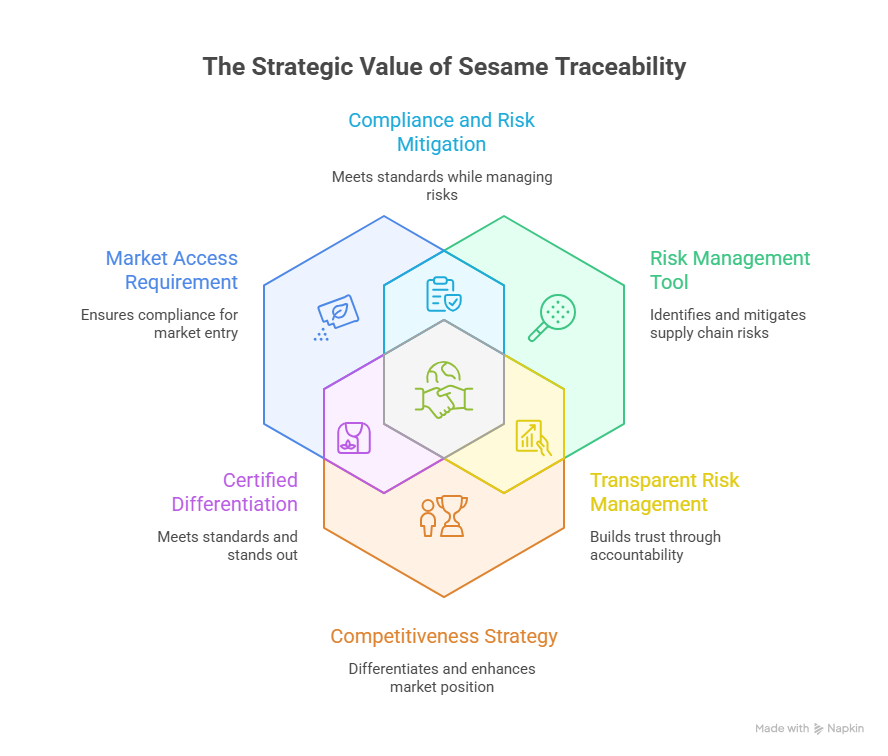
Uganda is an important sesame (simsim) supplier in East Africa, but global regulatory shifts and changing buyer expectations are reshaping how sesame must be produced, documented, and exported. Market access is no longer driven by price and volume alone—traceability, compliance, and verified sustainability are becoming decisive.
1. Global Regulations Are Moving Toward Mandatory Traceability
Key export markets—particularly the EU, UK, and North America—are tightening due-diligence and sustainability rules for agricultural imports.
Key regulatory trends include:
- EU Deforestation Regulation (EUDR):
Requires proof that sesame is deforestation-free, produced on legally used land, and traceable to farm level.
- Human Rights & Environmental Due Diligence laws (CSDDD-style):
Buyers must verify products are not linked to illegal land use, labor abuses, or environmental harm.
- Food safety and contamination controls:
Traceability is critical for managing aflatoxin risks, recalls, and exporter liability.
For Uganda’s sesame exporters, batch-level traceability, GPS or polygon farm data, and digital audit trails are becoming minimum requirements, not optional add-ons.
Without credible traceability, Ugandan sesame risks:
- Export rejections
- Shipment delays
- Buyer blacklisting
- Loss of access to regulated markets
2. Buyer Preferences Are Shifting Beyond Price
Global processors, traders, and food brands are restructuring procurement to reduce regulatory and reputational risk.
Buyer expectations increasingly include:
- Verifiable farm-level origin
- Digital chain-of-custody records
- Non-GMO and responsible sourcing verification
- Evidence of ethical labor and legal land use
- ESG and sustainability reporting readiness
Even price-sensitive markets are beginning to demand consistent quality, better documentation, and traceable sourcing. Traceability is now viewed as risk insurance, not just compliance.
3. Manual Systems Can No Longer Support Export Growth
Much of Uganda’s sesame trade still relies on:
- Paper-based or informal records
- Aggregated sourcing by multiple traders
- Limited farm documentation
- Weak chain-of-custody controls
These systems cannot:
- Meet digital due-diligence requirements
- Support rapid audits
- Isolate quality or contamination issues
- Substantiate sustainability claims
As buyer scrutiny increases, exporters relying on manual systems face higher costs, slower responses, and greater exposure to rejection or penalties.
4. Traceability Enables Market Differentiation and Price Upside
Digitally traceable sesame enables:
- Access to premium and regulated markets
- Qualification for preferred or long-term supplier programs
- Stronger buyer relationships
- Improved pricing stability and negotiating power
Rather than competing solely on volume, Uganda can compete on verified origin, compliance, and reliability, shifting exporters from commodity sellers to trusted suppliers.
5. Traceability Strengthens National Competitiveness
At a national level, traceable sesame supply chains:
- Enhance Uganda’s export credibility
- Reduce shipment rejections and reputational risk
- Support farmer inclusion and sustainability goals
- Align the sector with emerging global trade norms
Countries that digitize agricultural supply chains early will lead future exports. Those that do not risk being sidelined in increasingly regulated global markets.
From Market Access to Long-Term Competitiveness
Traceability in the Sesame Supply Chain in Uganda has shifted from a compliance requirement to a strategic necessity. As global regulations tighten and buyers demand verifiable origin, quality, and sustainability, Uganda’s sesame sector must move beyond manual, aggregated trading models. Digitized, farm-to-export traceability enables regulatory compliance, reduces rejection risk, strengthens buyer trust, and unlocks access to premium markets. By investing in transparent and verifiable supply chains, Uganda can protect its sesame exports, improve farmer inclusion, and secure long-term competitiveness in global agricultural trade.
Frequently Asked Questions
What is traceability in the sesame supply chain in Uganda?
Traceability in the sesame supply chain in Uganda refers to the ability to track sesame seeds from farm-level production through aggregation, processing, and export using digital records, batch identification, and chain-of-custody systems.
Why is traceability important for Uganda’s sesame exports?
Traceability helps Ugandan exporters meet international regulations, manage food safety and quality risks, and satisfy buyer requirements for ethical, non-GMO, and responsibly sourced sesame.
What challenges limit traceability in Uganda’s sesame sector?
Key challenges include fragmented smallholder farming, multi-tiered informal aggregation, lack of digital farm records, poor post-harvest handling, and limited land-use documentation.
How can digital traceability improve Uganda’s sesame supply chain?
Digital traceability enables GPS farm mapping, digital farmer onboarding, batch-level tracking, and automated compliance reporting, improving transparency, efficiency, and export readiness.
Does traceability help Ugandan sesame access premium markets?
Yes. Buyers in the EU, Asia, and the Middle East increasingly prefer traceable sesame. Verified origin and compliance allow Ugandan exporters to reduce rejection risk and access premium or long-term contracts.