

Traceability in the shea supply chain in Benin is increasingly essential as global buyers demand verified origin, quality assurance, and compliance with sustainability regulations. Benin’s supply chain dominated by dispersed parkland collection, informal intermediaries, and limited digital documentation makes it difficult to track shea nuts from rural women collectors to exporters. Strengthening traceability improves product integrity, supports compliance with emerging due-diligence frameworks, and enhances market access for EU and U.S. buyers. For Benin, digital traceability systems that capture geolocation, batch-level data, and chain-of-custody records are now critical to remain competitive in the global shea market.
Benin’s Shea Export Landscape
Benin stands out among West Africa’s shea-producing countries shea nuts are gathered from naturally occurring parklands, mainly across northern departments such as Atacora, Donga, Borgou and Alibori. As one of the region’s top shea producers, Benin reportedly collects around 50,000 tons of raw shea nuts per year, of which about 35,000 tons are exported annually; smaller volumes are processed into butter for export or domestic use.
Exports go chiefly to the EU, India, and global cosmetic/food markets in the Americas and Asia. However, like many West-African origins, Benin’s multi-tier supply chain — from rural women collectors → village traders → aggregators → processors → exporters — introduces major traceability challenges. Frequent hand-overs and informal trade make it difficult to track exact farm or parkland origin, quality consistency, or compliance with sustainability requirements.
Most collectors lack digital records, plot-level geolocation, or formal documentation of harvesting and land-use rights, limiting visibility for buyers and regulators. Given rising global demand for ethically-sourced, deforestation-free, origin-verified shea, these gaps threaten long-term export competitiveness. Moving toward digitized, transparent, traceable supply chains is now critical for Benin’s shea sector to safeguard livelihoods, meet international standards, and maintain its place in global markets.
Ready to Build a Fully Transparent Shea Supply Chain?
Discover how digital tools can streamline documentation, verify origin, and strengthen buyer confidence.
Explore the full guide to Forestry-to-Factory Traceability in Shea Supply Chains
From farm mapping to blockchain traceability, our Guide to Food Traceability breaks it all down. Read it now.
What are the Key Challenges Facing Benin’s Shea Sector
1. Highly Informal and Fragmented Supply Chains
Benin’s shea economy is dominated by rural women collectors, village traders, and informal aggregators. The absence of structured procurement systems leads to frequent mixing of nuts from different communities, making it extremely difficult to determine origin, quality, or sustainability practices.
2. Limited Traceability and Documentation
Most collectors lack digital records, GPS-mapped parklands, harvest logs, or land-use documentation. This weak data foundation creates major obstacles for exporters trying to meet rising global requirements for origin verification, legality assurance, and deforestation-free sourcing.
3. Quality Inconsistencies and Post-Harvest Losses
Traditional drying, storage, and handling practices often result in high moisture levels, contamination, or smoke-affected kernels. Without standardized quality controls at the village level, Benin struggles to consistently supply premium-grade shea nuts and butter demanded by EU and cosmetic buyers.
4. Pressure from Global Sustainability Regulations
New regulations such as EUDR (EU Deforestation Regulation), corporate ESG commitments, and stricter buyer due-diligence requirements require geolocation, traceability, and proof of sustainable harvesting. Benin’s predominantly wild-harvested, informal system lacks the readiness to meet these expectations at scale.
5. Weak Processing Capacity and Limited Value Addition
Despite being a major nut exporter, Benin processes only a small portion of its shea domestically. Limited modern processing infrastructure restricts the ability to move up the value chain into refined butter, specialty fats, and cosmetic ingredients — areas with significantly higher margins.
6. Land-Use Pressures and Parkland Degradation
Shea trees face threats from charcoal production, farmland expansion, and slow natural regeneration. Without systematic parkland management or replanting programs, long-term supply sustainability is at risk.
7. Financing Gaps for Collectors and Cooperatives
Women’s groups and cooperatives often lack working capital to buy and store nuts during peak harvest. This forces early sales at low prices and weakens their negotiating power, perpetuating income instability and limiting investment in improved practices.
8. Limited Market Information and Price Transparency
Collectors rarely have access to real-time price data or market trends, resulting in information asymmetry that favors intermediaries. This undermines equitable trade and discourages adoption of quality-improvement practices.
How a Digital Traceability Platform Like TraceX Can Work for Benin’s Shea Sector
The TraceX Traceability Platform provides the digital backbone needed to strengthen transparency, compliance, and operational efficiency across Benin’s shea supply chain. By digitizing every stage from parkland nut collection to aggregation, processing, and export TraceX helps exporters, cooperatives, processors, and global buyers verify origin, ensure quality, and meet rapidly evolving international sustainability and regulatory standards.
End-to-End Digital Visibility Across the Entire Chain
The TraceX platform connects all Benin’s shea supply-chain actors women collectors, local traders, cooperatives, aggregators, community-based enterprises, processors, and exporters—into one integrated digital ecosystem. This enables:
- Real-time tracking of nut movement
- Secure, tamper-proof data flow across all nodes
- Centralized visibility of collection, aggregation, processing, and export
This seamless data continuity eliminates information gaps and ensures that only verified and compliant shea enters the export pipeline.
Parkland GPS & Polygon Mapping
TraceX platform captures geolocation coordinates and polygon maps for Benin’s shea parklands especially across Atacora, Donga, Borgou, and Alibori allowing exporters to:
- Authenticate collection zones
- Validate land-use and community-access rights
- Prove deforestation-free, sustainable sourcing
- Maintain audit-ready geo-referenced records
This geospatial transparency is essential for markets increasingly enforcing deforestation-free supply chains.
Digital Onboarding of Women Collectors
Using mobile data-capture tools, TraceX digitizes and verifies the profiles of women collectors and producer groups by recording:
- Collector identity and demographics
- GPS-linked parkland or collection areas
- Community-rights or access documentation
- Harvest volumes and seasonal yield patterns
- Cooperative or aggregator affiliations
This brings thousands of informal collectors into a transparent, documented supply chain, strengthening their market visibility and bargaining power.
Batch-Level Digital IDs for Full Traceability
Every shea batch receives a unique digital identity from collection to export. This ensures a verifiable, unbroken chain-of-custody across:
- Parkland harvesting
- First-mile aggregation
- Cooperatives and intermediate trading points
- Processing centers
- Export packaging and documentation
This batch granularity helps exporters meet buyer requirements for origin verification and sustainability claims.
Blockchain-Backed Data Integrity
All supply-chain records captured on TraceX platform are secured by blockchain, ensuring:
- Immutable, tamper-proof data
- Time-stamped entries for audit trails
- Controlled visibility for authorized stakeholders
- Trustworthy, third-party-verifiable history of each batch
This strengthens Benin’s credibility in global markets where traceability integrity is non-negotiable.
Automated Reports & Compliance Documentation
TraceX solution automates the generation of critical compliance and due-diligence documents, including:
- Traceability and origin verification reports
- Sustainability and ESG documentation
- Land-use and deforestation-free compliance records
- Buyer-specific due-diligence reports
- Complete digital audit trails for certifiers and regulators
This reduces administrative burden and ensures Benin’s exporters remain market-ready for tightening global sustainability regulations.
Ready to Build a Fully Transparent Shea Supply Chain?
Discover how digital tools can streamline documentation, verify origin, and strengthen buyer confidence.
Explore the full guide to Forestry-to-Factory Traceability in Shea Supply Chains
From farm mapping to blockchain traceability, our Guide to Food Traceability breaks it all down. Read it now.
What are the Key Challenges Facing Benin’s Shea Sector
1. Highly Informal and Fragmented Supply Chains
Benin’s shea economy is dominated by rural women collectors, village traders, and informal aggregators. The absence of structured procurement systems leads to frequent mixing of nuts from different communities, making it extremely difficult to determine origin, quality, or sustainability practices.
2. Limited Traceability and Documentation
Most collectors lack digital records, GPS-mapped parklands, harvest logs, or land-use documentation. This weak data foundation creates major obstacles for exporters trying to meet rising global requirements for origin verification, legality assurance, and deforestation-free sourcing.
3. Quality Inconsistencies and Post-Harvest Losses
Traditional drying, storage, and handling practices often result in high moisture levels, contamination, or smoke-affected kernels. Without standardized quality controls at the village level, Benin struggles to consistently supply premium-grade shea nuts and butter demanded by EU and cosmetic buyers.
4. Pressure from Global Sustainability Regulations
New regulations such as EUDR (EU Deforestation Regulation), corporate ESG commitments, and stricter buyer due-diligence requirements require geolocation, traceability, and proof of sustainable harvesting. Benin’s predominantly wild-harvested, informal system lacks the readiness to meet these expectations at scale.
5. Weak Processing Capacity and Limited Value Addition
Despite being a major nut exporter, Benin processes only a small portion of its shea domestically. Limited modern processing infrastructure restricts the ability to move up the value chain into refined butter, specialty fats, and cosmetic ingredients — areas with significantly higher margins.
6. Land-Use Pressures and Parkland Degradation
Shea trees face threats from charcoal production, farmland expansion, and slow natural regeneration. Without systematic parkland management or replanting programs, long-term supply sustainability is at risk.
7. Financing Gaps for Collectors and Cooperatives
Women’s groups and cooperatives often lack working capital to buy and store nuts during peak harvest. This forces early sales at low prices and weakens their negotiating power, perpetuating income instability and limiting investment in improved practices.
8. Limited Market Information and Price Transparency
Collectors rarely have access to real-time price data or market trends, resulting in information asymmetry that favors intermediaries. This undermines equitable trade and discourages adoption of quality-improvement practices.
How a Digital Traceability Platform Like TraceX Can Work for Benin’s Shea Sector
The TraceX Traceability Platform provides the digital backbone needed to strengthen transparency, compliance, and operational efficiency across Benin’s shea supply chain. By digitizing every stage from parkland nut collection to aggregation, processing, and export TraceX helps exporters, cooperatives, processors, and global buyers verify origin, ensure quality, and meet rapidly evolving international sustainability and regulatory standards.
End-to-End Digital Visibility Across the Entire Chain
The TraceX platform connects all Benin’s shea supply-chain actors women collectors, local traders, cooperatives, aggregators, community-based enterprises, processors, and exporters—into one integrated digital ecosystem. This enables:
- Real-time tracking of nut movement
- Secure, tamper-proof data flow across all nodes
- Centralized visibility of collection, aggregation, processing, and export
This seamless data continuity eliminates information gaps and ensures that only verified and compliant shea enters the export pipeline.
Parkland GPS & Polygon Mapping
TraceX platform captures geolocation coordinates and polygon maps for Benin’s shea parklands especially across Atacora, Donga, Borgou, and Alibori allowing exporters to:
- Authenticate collection zones
- Validate land-use and community-access rights
- Prove deforestation-free, sustainable sourcing
- Maintain audit-ready geo-referenced records
This geospatial transparency is essential for markets increasingly enforcing deforestation-free supply chains.
Digital Onboarding of Women Collectors
Using mobile data-capture tools, TraceX digitizes and verifies the profiles of women collectors and producer groups by recording:
- Collector identity and demographics
- GPS-linked parkland or collection areas
- Community-rights or access documentation
- Harvest volumes and seasonal yield patterns
- Cooperative or aggregator affiliations
This brings thousands of informal collectors into a transparent, documented supply chain, strengthening their market visibility and bargaining power.
Batch-Level Digital IDs for Full Traceability
Every shea batch receives a unique digital identity from collection to export. This ensures a verifiable, unbroken chain-of-custody across:
- Parkland harvesting
- First-mile aggregation
- Cooperatives and intermediate trading points
- Processing centers
- Export packaging and documentation
This batch granularity helps exporters meet buyer requirements for origin verification and sustainability claims.
Blockchain-Backed Data Integrity
All supply-chain records captured on TraceX platform are secured by blockchain, ensuring:
- Immutable, tamper-proof data
- Time-stamped entries for audit trails
- Controlled visibility for authorized stakeholders
- Trustworthy, third-party-verifiable history of each batch
This strengthens Benin’s credibility in global markets where traceability integrity is non-negotiable.
Automated Reports & Compliance Documentation
TraceX solution automates the generation of critical compliance and due-diligence documents, including:
- Traceability and origin verification reports
- Sustainability and ESG documentation
- Land-use and deforestation-free compliance records
- Buyer-specific due-diligence reports
- Complete digital audit trails for certifiers and regulators
This reduces administrative burden and ensures Benin’s exporters remain market-ready for tightening global sustainability regulations.
What Global Regulation & Market Demand Imply for Benin’s Shea — Why Traceability Matters
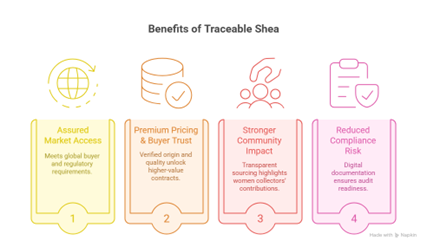
Global regulations and evolving buyer expectations are rapidly reshaping the shea trade, and Benin one of West Africa’s top shea producers must now meet higher transparency, sustainability, and documentation standards to remain competitive.
Rising Global Compliance Pressure (EU, US, Asia)
Major importing markets the EU, the U.S., and Asia are moving toward strict due-diligence rules covering:
Regulations such as the EU Deforestation Regulation (EUDR) and due-diligence laws in Germany, France, and the Netherlands require plot-level geolocation, farmer identification, and proof of sustainable production. Although shea is not deforestation-linked like palm oil or cocoa, parkland ecosystems and land-use data must still be validated, especially when shea is used in cosmetics, food, and pharmaceuticals entering regulated markets.
Buyers Increasingly Demand Verified, High-Integrity Shea
Global brands particularly in cosmetics and personal care are shifting their sourcing toward:
Major companies (L’Oréal, L’Occitane, Unilever) now prioritize full transparency from parkland to processing, pushing exporters to adopt traceability systems.
Market Premiums Favor Traceable Shea
Traceable and ethically sourced shea commands better margins in:
Benin’s exporters who can demonstrate origin authenticity, ethical sourcing, and environmentally sound practices gain access to premium buyer segments that are rapidly expanding.
Risk of Market Loss for Non-Compliant Supply Chains
Without traceability, exporters face:
Buyers increasingly avoid “anonymous” or mixed-origin shea due to compliance risk.
Shift Toward Digital & Data-Driven Shea Supply Chains
Global supply chains are moving from manual records to digital traceability platforms capturing:
Benin’s shea sector dominated by smallholders and women collectors must integrate digital systems to maintain inclusion in regulated markets.
ESG, Ethical Sourcing & Women-Led Value Chains Gaining Priority
Benin has a strong reputation for women-led cooperatives; however, buyers now require evidence, not narratives. Traceability helps document:
This documentation is increasingly tied to ESG reporting, affecting the purchasing decisions of global brands.
Why Traceability Matters for Benin’s Shea
Traceability is no longer optional it is now a strategic necessity. It ensures Benin can:
- Maintain access to the EU, U.S., and high-value cosmetic markets
- Provide verified, compliant shea to multinational buyers
- Reduce sourcing risks and improve supply resilience
- Capture premiums for ethically and sustainably sourced shea
- Strengthen the livelihoods of women collectors through transparent, inclusive value chains
As global markets become more regulated and sustainability-driven, Benin’s competitiveness will depend on its ability to deliver digitally verifiable, origin-traceable shea with complete chain-of-custody visibility.
Strengthening Traceability in the Shea Supply Chain in Benin
Traceability in the Shea Supply Chain in Benin is becoming a defining requirement for market access, quality assurance, and long-term sector competitiveness. As global buyers tighten sourcing standards and sustainability regulations expand, Benin’s shea industry must transition from largely informal, multi-tiered supply chains to digitally verifiable systems that document origin, quality, and sustainability at every step. Investing in digital mapping, collector onboarding, and batch-level tracking will not only improve compliance with international regulations but also unlock premium markets, enhance buyer confidence, and elevate the economic resilience of women-led shea communities across the country.
Struggling with visibility gaps? Discover how traceability can fix them in our Supply Chain Traceability Blog.
Transform your food supply chain with digital tools—explore the Digital Traceability for Food Systems Blog.
See how blockchain improves trust, transparency, and auditability—start with our Blockchain Traceability Blog.
Frequently Asked Questions (FAQ’s)
Why is traceability important for Benin’s shea exports?
Because global markets especially the EU, US, and Asia now demand verified origin, legal sourcing, and deforestation-free supply chains. Without traceability, shipments risk rejection.
What are the major traceability challenges in Benin’s shea sector?
Fragmented smallholder networks, lack of farm mapping, multi-tier aggregation, limited documentation, and poor data visibility across the supply chain.
Do Benin farmers need smartphones or internet access for traceability?
Not necessarily. Many solutions offer offline data capture, cooperative-based data entry, and low-tech mobile tools that work even in low-connectivity regions.
How does traceability benefit Benin shea farmers?
It provides better access to formal markets, potential price premiums, stronger buyer relationships, reduced exploitation, and inclusion in certified and compliant export value chains.