
Quick summary: Traceability in the Shea Supply Chain in Nigeria is essential for global market access. Learn how digital tools enable transparent, compliant, and premium cashew exports.

Traceability in the Shea Supply Chain in Nigeria ensures that every step from shea nut collection by farmers to processing and export is documented and verifiable. Effective traceability captures farmer demographics, harvest volumes, storage, and quality data, while linking suppliers to processors through digital systems. It enables verification of ethical sourcing, compliance with sustainability standards, and prevention of adulteration or fraud. By implementing end-to-end traceability, Nigerian shea stakeholders can improve supply chain transparency, strengthen farmer accountability, enhance product quality, and meet both domestic and international market requirements.
Nigeria is a leading shea producer in West Africa, contributing significantly to global shea butter and kernel supply. Key production regions such as Niger, Kebbi, Yobe, Zamfara, and Bauchi are dominated by smallholder farmers cultivating shea on scattered, often fragmented plots. Nigeria produces approximately 350,000 – 400,000 metric tons of raw shea nuts annually, with major exports directed to the EU, USA, and Asia for processing into shea butter, cosmetics, and food products. The Nigerian shea supply chain typically follows a multi-tiered structure: smallholder farmers → local collectors → regional aggregators → processors/traders → exporters.
While this system supports broad participation, it poses significant traceability and quality-control challenges. Heavy reliance on informal intermediaries often leads to mixed or aggregated sourcing, making it difficult to track farm-level origins. Most farmers lack digital records, field mapping, or land documentation, limiting visibility into tree locations, production practices, and yield.
These structural constraints result in major traceability gaps, including weak chain-of-custody tracking, inconsistent quality documentation, and minimal verification of environmental or social compliance. With global buyers increasingly demanding ethically sourced, deforestation-free, and fully traceable shea, traditional manual systems are insufficient. To maintain export competitiveness and meet rising compliance standards, Nigeria’s shea industry must shift toward digitized, transparent, and verifiable supply chains that ensure full origin traceability and sustainable market access.
Ready to Build a Fully Transparent Shea Supply Chain?
Discover how digital tools can streamline documentation, verify origin, and strengthen buyer confidence.
Explore the full guide to Forestry-to-Factory Traceability in Shea Supply Chains
From farm mapping to blockchain traceability, our Guide to Food Traceability breaks it all down. Read it now.
Nigeria is one of the world’s largest shea producers, yet the sector faces multiple structural, operational, and sustainability challenges that affect productivity, quality, and market competitiveness.
Nigeria’s shea sector faces a combination of structural, operational, and sustainability challenges that affect traceability, quality, and market competitiveness. Addressing these issues through digital traceability, better supply chain management, improved post-harvest handling, and farmer empowerment is essential for unlocking export potential, ensuring sustainable production, and meeting global buyer standards.
The TraceX Traceability Platform provides the digital backbone needed to bring visibility, compliance, and trust into Nigeria’s shea supply chain. By digitizing every step from farm-level nut collection to processing and export the platform helps exporters, processors, cooperatives, and buyers verify origin, monitor quality, and meet international regulatory and sustainability standards.
TraceX platform connects all supply chain actors smallholder farmers, local collectors, cooperatives, aggregators, processors, and exporters into a single digital ecosystem, enabling:
This integrated system eliminates blind spots, ensuring only compliant, verified shea nuts enter the value chain.
The platform captures precise GPS coordinates or polygon maps for each shea collection site, allowing exporters to:
Accurate farm mapping is key to building credible, origin-verified shea supply chains.
Using mobile tools, farmers are registered with structured, authenticated data, including:
This creates a verified digital farmer network and reduces data gaps.
Each shea batch receives a unique digital identity from the farm to export, ensuring full chain-of-custody through:
Exporters can trace every shipment back to specific farms and harvest periods.
TraceX secures all records on blockchain, making them:
Buyers gain reliable proof of origin, critical for premium markets.
Digitized data enables TraceX to automatically generate:
This reduces administrative burden and ensures export readiness at all times.
Nigeria is one of the world’s largest producers of shea, but global buyers are rapidly tightening requirements on sustainability, origin verification, and ethical sourcing. Regulations such as the EU Deforestation Regulation (EUDR), international ESG disclosure norms, and brand commitments to transparency are reshaping what the market expects from shea exporters.
For Nigeria, this means that traditional, informal sourcing systems are no longer sufficient. Global buyers now expect:
Failure to meet these expectations can result in rejected shipments, loss of premium buyers, and exclusion from key export markets especially the EU.
This is why traceability has become a strategic requirement for Nigeria’s shea value chain. A digital traceability system ensures:
As global demand grows for responsibly sourced shea, Nigeria’s competitiveness now depends on adopting transparent, technology-enabled supply chains that prove authenticity, quality, and ethical impact.
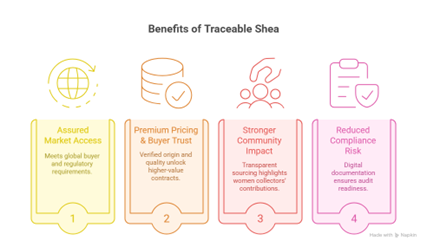
Traceability in the shea supply chain in Nigeria is no longer optional it is a strategic necessity for maintaining global market access and meeting the rising expectations of buyers, regulators, and sustainability-conscious consumers. By digitizing collection zones, documenting farmer networks, and creating verifiable chain-of-custody records, Nigeria’s shea exporters can confidently prove origin, quality, and compliance. Strengthening traceability not only reduces regulatory and reputational risks but also unlocks premium markets, enhances the livelihoods of women collectors, and positions Nigeria as a trusted, future-ready supplier in the global shea industry.
Struggling with visibility gaps? Discover how traceability can fix them in our Supply Chain Traceability Blog.
Transform your food supply chain with digital tools—explore the Digital Traceability for Food Systems Blog.
See how blockchain improves trust, transparency, and auditability—start with our Blockchain Traceability Blog.
Because global markets especially the EU, US, and Asia now demand verified origin, legal sourcing, and deforestation-free supply chains. Without traceability, shipments risk rejection.
Fragmented smallholder networks, lack of farm mapping, multi-tier aggregation, limited documentation, and poor data visibility across the supply chain.
Digital platforms enable farmer onboarding, plantation mapping, batch-level tracking, blockchain proof of origin, and automated compliance reporting.
Not necessarily. Many solutions offer offline data capture, cooperative-based data entry, and low-tech mobile tools that work even in low-connectivity regions.
It provides better access to formal markets, potential price premiums, stronger buyer relationships, reduced exploitation, and inclusion in certified and compliant export value chains.