
Quick summary: Traceability in the Spice Supply Chain in Nigeria: understand key challenges, data requirements, benefits, and how digital traceability improves compliance, quality, and export market access.

Traceability in the Spice Supply Chain in Nigeria refers to the ability to track spices such as ginger, chili, and black pepper from farm to export through verifiable data. It involves collecting supplier identities, farm-level information, batch and lot records, and processing details to ensure product quality, food safety, and regulatory compliance. As Nigeria’s spice exports grow, traceability is becoming essential to meet international buyer requirements, reduce contamination risks, and improve access to premium EU and global markets through transparent, auditable supply chains.
Nigeria is one of West Africa’s most important spice-producing countries, with a diverse agro-ecological landscape that supports multiple high-value spice crops. Ginger, largely grown in Kaduna State, is Nigeria’s flagship spice export and one of the most traded in international markets. Chili peppers are widely cultivated in Kano, Katsina, and other northern states, supplying both regional and export demand. Black pepper production is concentrated in Cross River and parts of southern Nigeria, while other spices such as turmeric, garlic, and nutmeg are produced at smaller scales.
Nigeria’s spice sector is a vital agricultural segment, producing ~256.5 thousand metric tons in 2023 (projected 261.8k MT by 2028, +0.58% YoY growth), led by ginger, chili peppers, garlic, and turmeric amid rising domestic demand in sauces/spices market ($5.81M revenue 2025, +15.46% CAGR to 2030).
Nigeria exports spices primarily to Europe, Asia, and North America, both in raw and semi-processed forms. While export volumes fluctuate due to quality and compliance challenges, spices remain a critical source of foreign exchange, rural employment, and smallholder income, supporting hundreds of thousands of farming households and local aggregators.
Global spice markets are increasingly driven by responsible sourcing, transparency, and compliance. Buyers now expect clear visibility into where spices are grown, how they are handled, and whether they meet food safety and sustainability standards. This is reinforced by stricter requirements related to contamination control, pesticide residues, labor practices, and environmental impact.
For Nigerian exporters, traceability in the spice supply chain in Nigeria is becoming a commercial necessity. Traceability enables exporters to:
By linking spices to verified farms, batches, and processes, traceability strengthens buyer trust and positions Nigerian spices as reliable, compliant, and competitive in global trade.
Read our blog on Spice Traceability to learn how exporters track spices from farm to market, reduce compliance risk, and meet global buyer expectations.
Explore our guide on Sustainable Sourcing in Spices to understand environmental, social, and ethical requirements—and how to meet them with confidence.
Traceability in the spice supply chain refers to the ability to track spices from the farm through processing, export, and onward to the importer using verifiable data at each stage. This farm → processor → exporter → importer linkage ensures that every batch of spice can be traced back to its origin and production conditions.
Effective traceability supports:
Without traceability, exporters cannot reliably prove origin, quality, or compliance exposing them to market access and reputational risks.
Implementing traceability requires structured, reliable data collected across the supply chain, including:
Together, these data elements create a transparent, auditable trail that allows Nigerian spice exporters to meet international requirements, reduce compliance risk, and compete in global markets.
Nigeria’s spice supply chains are highly fragmented, with production dominated by smallholder farmers cultivating small plots of land. These farmers typically sell to local collectors, aggregators, or middlemen, often through informal transactions. As spices move through multiple intermediaries before reaching processors or exporters, visibility into origin and handling practices becomes increasingly limited.
This fragmentation makes it difficult to maintain consistent records, assign responsibility, or trace products back to individual farms especially at scale.
Traceability efforts are further constrained by weak data collection systems. Many suppliers still rely on:
As a result, critical information such as farm identifiers, harvest dates, and volumes is often missing or inconsistent. The absence of unique farm IDs or standardized supplier records prevents reliable data aggregation and digital traceability.
Traceability frequently breaks down during aggregation and processing stages. Spices from multiple farms are often mixed without:
Without systematic farm-to-export mapping, exporters cannot reconstruct the supply chain path when buyers or regulators request proof of origin or compliance.
These traceability gaps translate directly into commercial and regulatory risk. International markets particularly the EU and the US enforce strict food safety standards covering contamination, pesticide residues, and hygiene. At the same time, buyers are increasingly demanding evidence of environmental sustainability, legal production, and responsible sourcing.
Without robust traceability, Nigerian spice exporters face higher risks of:
Addressing these challenges is essential for maintaining competitiveness in global spice trade.
Traceability enables Nigerian spice exporters to consistently meet EU and US food safety and quality standards, which are among the strictest globally. By linking spices to verified farms, batches, and processing records, exporters can demonstrate control over contamination risks, pesticide residues, and handling practices. This level of assurance is often a prerequisite for accessing premium buyers, long-term contracts, and higher-value export markets.
As global buyers increasingly demand proof of responsible sourcing, traceability provides the data backbone required for organic, fair trade, and environmental certifications. Farm-level records, geolocation, and production data make it easier to verify sustainability claims and respond to certification audits. For Nigerian exporters, this reduces the cost and complexity of certification while improving credibility with sustainability-focused buyers.
Robust traceability significantly lowers compliance friction across the export process. Digitally traceable supply chains enable:
Instead of scrambling to reconstruct supply chain histories, exporters can respond quickly and confidently to regulatory or buyer requests.
In increasingly crowded global spice markets, transparency is a differentiator. Exporters that can clearly show where their spices come from, how they are produced, and how quality is managed stand out from competitors relying on opaque or informal systems. Traceability strengthens buyer trust and positions Nigerian spices as reliable, compliant, and future-ready.
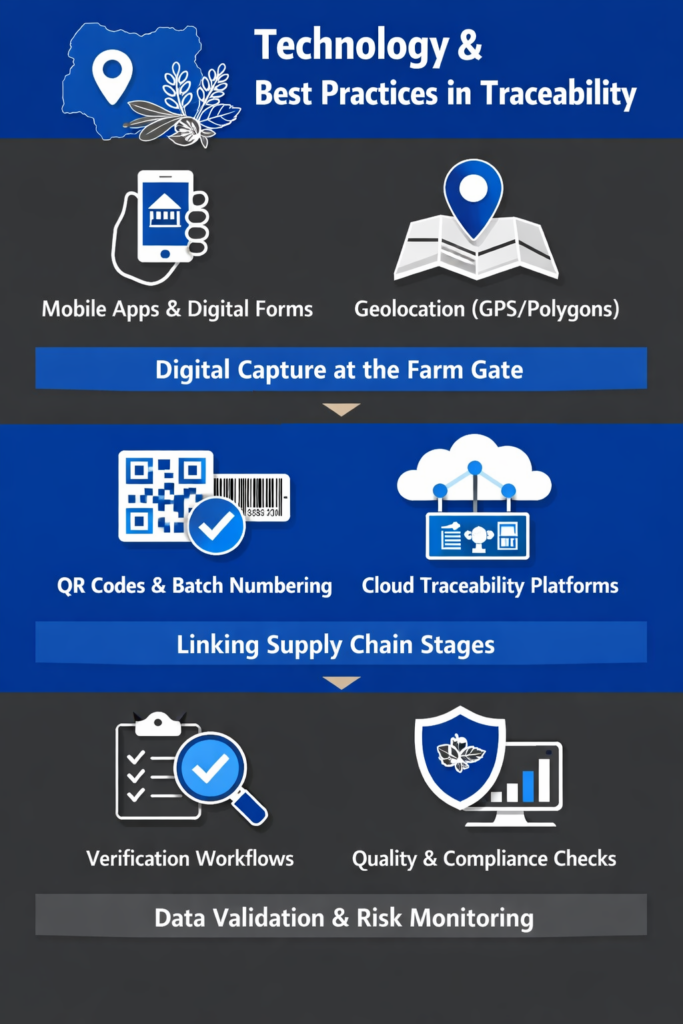
TraceX traceability solutions help Nigerian spice exporters move from fragmented, paper-based systems to digital, end-to-end traceability. TraceX enables the capture of supplier and farm data, GPS-based geolocation, batch and lot tracking, and compliance documentation within a single platform. By validating data and linking farms to export shipments, TraceX helps exporters meet international food safety and sustainability requirements, reduce compliance risk, and scale access to premium global markets without disrupting existing sourcing operations.
Traceability in the Spice Supply Chain in Nigeria is no longer optional it is a critical enabler of market access, compliance, and competitiveness. As global buyers and regulators demand greater transparency, Nigerian spice exporters must move beyond fragmented, paper-based systems toward digital, farm-to-export traceability. By capturing reliable supplier data, linking farms to batches, and validating quality and compliance records, exporters can reduce risk, meet international standards, and position Nigerian spices as trusted, high-quality products in EU, US, and global markets.
Read our blog on Blockchain Traceability to see how immutable records strengthen transparency, traceability, and buyer confidence in spices.
Explore our guide to Digital Traceability Systems and learn how exporters track spices end to end with real-time, auditable data.
Discover best practices for Sustainable Farming in Spices, including soil health, responsible inputs, and data-driven sustainability reporting.
Traceability is the ability to track spices from farm to processor, exporter, and importer using verifiable data on origin, batches, and handling practices.
It helps exporters meet food safety and quality standards, reduce shipment rejections, pass audits, and access premium international markets.
Key data includes supplier details, farm or plot geolocation, batch and lot records, production and processing information, and compliance documentation.
Fragmented smallholder supply chains, paper-based records, aggregation without lot linkage, and limited digital infrastructure.
By adopting digital traceability systems that capture farm-level data, link batches across the supply chain, and provide auditable records for buyers and regulators.