
Quick summary: Agroforestry succeeds when climate commitments become operating models. Learn how digital tools help agribusinesses scale, future-proof, and measure long-term impact beyond year one.
Tree planting in agroforestry is everywhere in corporate climate commitments, but far less common in day-to-day agricultural reality. Many agribusinesses pledge millions of trees, yet struggle to answer basic questions a year later: Where were they planted? Are they surviving? And are they actually delivering value for farmers and supply chains? This gap between ambition and execution is where most tree planting initiatives quietly fail.
The core problem is not intent, it’s scale. Tree planting in agroforestry cannot succeed as a one-off project, a CSR initiative, or a counting exercise. When trees are planted without integrated nursery planning, mapped farm plots, farmer incentives, and long-term monitoring, survival rates drop, data fragments, and impact become impossible to prove. What looks like climate action on paper often collapses under the complexity of real farming systems.
To turn climate commitments into durable outcomes, agribusinesses must treat tree planting in agroforestry as an operating model, not a promise. That means designing systems that connect seedlings to farms, farms to farmers, and planting events to measurable outcomes over time. Only when tree planting is embedded into how supply chains operate digitally, operationally, and commercially does agroforestry deliver scalable, credible impact.
Key takeaways
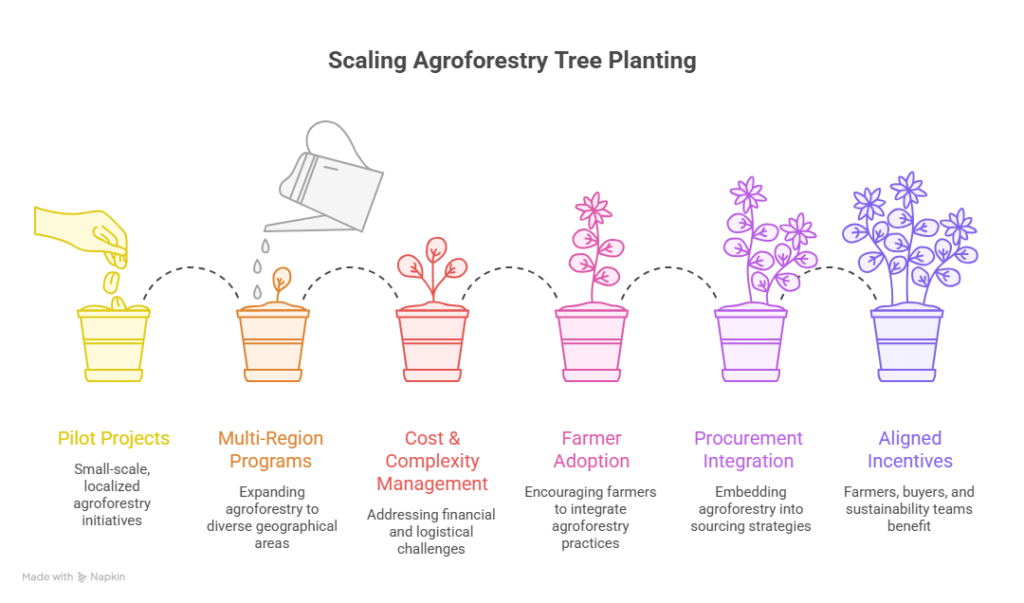
Tree planting in agroforestry consistently struggles to move beyond pilots because most programs are designed as projects time-bound, donor-style initiatives rather than as systems that can operate year after year within real agricultural supply chains. This structural mismatch is the root cause of why so many well-intended efforts fail to scale.
Conventional tree-planting programs focus on short-term outputs such as the number of seedlings distributed or trees planted in a single season. They rarely account for long-term survival, farmer adoption, or integration with cropping systems. Once project funding ends or attention shifts, nurseries wind down, monitoring stops, and trees are left without follow-up care. Scale breaks because success is measured at planting not over time.
Climate commitments are made at corporate or executive level, but execution happens across thousands of farms with varying conditions, incentives, and constraints. Without a system that translates targets into nursery planning, plot-level designs, planting schedules, and farmer engagement, commitments remain abstract. The result is a persistent gap between what is promised publicly and what can be verified in the field.
Pilots are useful for learning, but they are not built to run at supply-chain scale. Agribusinesses require repeatable operating models that define roles, workflows, data requirements, and accountability across regions and seasons. An operating model ensures that tree planting is planned, executed, monitored, and improved continuously just like procurement, quality control, or logistics.
Digital systems are what turn agroforestry from an initiative into infrastructure. They link nurseries to demand, map farm plots, track planting events, monitor tree survival, and consolidate data into a single source of truth. By standardizing data and workflows, digital tools reduce dependency on manual coordination and enable programs to scale without losing visibility or credibility. With TraceX DMRV (Digital Monitoring, Reporting, and Verification) solutions, this infrastructure becomes measurable and audit-ready.
In short, tree planting in agroforestry succeeds only when it is treated as a systemic capability designed to operate continuously, adapt over time, and deliver measurable impact across entire supply chains, not just during the life of a project.
Read why agroforestry is emerging as a long-term carbon solution for agriculture →
Explore why farm digitization is foundational to scalable agroforestry →
For agribusinesses, tree planting in agroforestry is not an end in itself. The real job-to-be-done is to deliver climate and sustainability outcomes without undermining farmer productivity or supply-chain reliability. When tree planting fails to do that, it becomes a cost centre, a reputational risk, or both.
At its core, agribusinesses need tree planting to strengthen the systems they already depend on. That means improving farm resilience to climate stress, stabilizing yields over time, supporting long-term sourcing relationships, and contributing to credible environmental commitments. Tree planting that only delivers headline numbers without operational value does not solve the agribusiness problem.
Agroforestry succeeds when trees work for farmers, not against them. If trees reduce yields, complicate farm management, or delay income, adoption will stall. Agribusinesses therefore need agroforestry models that enhance soil health, shade crops appropriately, diversify farmer income, and fit within existing production cycles. Climate benefits emerge as a result of good farm economics not in opposition to them.
Counting trees planted says nothing about whether supply chains are more resilient, compliant, or sustainable. Agribusinesses need impact that can be linked to real sourcing areas, specific farmer groups, and long-term production zones. That requires shifting focus from one-off planting events to outcomes such as survival rates, canopy development, productivity effects, and continuity of supply.
Without traceability, tree planting claims cannot be tied back to actual farms or sourcing regions. Without survival monitoring, planted trees quickly become assumed rather than real. And without credible data, agribusinesses face growing scrutiny from buyers, regulators, and investors. Survival rates, mapped plots, and verifiable records are what turn tree planting in agroforestry from a narrative into a defensible, supply-chain-relevant capability.
Most agroforestry programs struggle because nurseries operate in isolation disconnected from real farm demand, planting timelines, and species requirements. When nursery data is manual or fragmented, programs face shortages, poor-quality seedlings, or the wrong species arriving at the wrong time.
Digital nursery management creates visibility from the start. By digitizing seedlings, species, and batch records, agribusinesses can track seed provenance, germination rates, and readiness for field planting. This ensures only healthy, appropriate seedlings move downstream.
When nursery outputs are aligned with mapped farm plots and planting plans, supply matches demand: the right species, in the right quantities, at the right time. Digital controls also reduce leakage, duplication, and last-minute substitutions that undermine survival rates.
Key outcome: a predictable, quality-controlled seedling supply that supports scalable, successful tree planting in agroforestry systems.
Farm plot digitization is the foundation that turns tree planting in agroforestry from an activity into a verifiable system. Without mapped plots, trees exist only as numbers detached from land, farmers, and long-term outcomes.
Agroforestry happens within complex, mixed-use farms. Digitizing plots makes it possible to understand where trees are planted, how they interact with crops, and who is responsible for managing them over time. It provides the spatial context needed for planning, monitoring, and credibility.
Clear digital boundaries prevent ambiguity. Mapping whole farms and defining agroforestry zones within them such as shade areas, buffer strips, or intercropped rows—ensures trees are planted where they add value rather than disrupt production.
Digitized plots connect trees to real farmers, crop systems, and historical land use. This linkage supports better planting decisions, respects land tenure realities, and enables traceability over time especially as farms change hands or expand.
Plot-level data allows agribusinesses to design agroforestry systems deliberately, balancing tree density, species choice, and spacing to support yields, resilience, and farmer adoption.
Without digitization, the same land can be counted twice, planting areas can overlap, and claims become impossible to verify. Digital plots create a single source of truth that prevents overclaiming and builds trust with buyers and stakeholders.
Key outcome: every tree planted in agroforestry is anchored to a specific, mapped plot of land making impact measurable, traceable, and credible at scale.
Planting design is where agroforestry strategy either becomes reality or breaks down in the field. Even the best digital plans fail if they cannot be executed consistently across farms, seasons, and field teams.
Digital planting plans must be simple, clear, and actionable for field teams and farmers. This means converting maps, species lists, and spacing rules into practical field instructions that can be followed without guesswork.
Correct placement and spacing determine whether trees support or compete with crops. Thoughtful intercropping design ensures trees provide shade, soil benefits, or wind protection without reducing yields making farmer adoption more likely.
Trees must be planted at the right time relative to crop planting, rainfall, and labor availability. Aligning tree planting with existing crop cycles reduces disruption and increases survival rates.
Standardized training ensures everyone understands how and why trees are planted in specific ways. Consistency across teams and regions is critical for scaling agroforestry programs without quality loss.
Digitally recording planting events creates an auditable record that links trees to specific plots, farmers, and dates. This data supports monitoring, learning, and credible reporting over time.
Key outcome: planting happens as designed deliberate, repeatable, and aligned with agroforestry goals, rather than improvised in the field.
Tree monitoring is what separates tree planting activities from lasting agroforestry impact. Without monitoring, planted trees quickly become assumptions counted once and never verified again.
A tree only delivers climate, productivity, and resilience benefits if it survives and grows. High planting numbers mean little if mortality is high or growth is stunted. Monitoring shifts the focus from effort to outcomes.
Early-stage monitoring focuses on establishment and survival, while mature systems require tracking canopy development, health, and interaction with crops. Each phase needs different indicators and methods.
No single data source is sufficient. Field observations and farmer inputs provide ground truth, while remote sensing offers scalable oversight. Together, they create a reliable picture of tree performance over time.
Ongoing monitoring helps identify problems early whether tree loss, pest pressure, or changes in land use so corrective action can be taken before impact is lost.
Monitoring is not just about reporting; it is a feedback loop. Insights from survival and growth data inform better species selection, planting design, and nursery planning in future cycles.
Key outcome: clear visibility into which trees survive, how they grow, and how they deliver long-term value within agroforestry systems.
Agroforestry programs often fail not because of poor execution in the field, but because data is fragmented across stages. Nursery records, farm maps, planting logs, and monitoring results live in separate tools or spreadsheets, making it impossible to see the full picture.
When each stage of tree planting uses its own system or worse, manual spreadsheets information is lost, duplicated, or misinterpreted. Integration replaces handoffs and reconciliations with continuous data flow.
By linking nursery batches to specific plots, planting events, and monitored trees, agribusinesses create a unified record of what was planted, where, and how it performs over time. This single source of truth supports consistency, accountability, and learning.
Integrated data allows different teams to use the same underlying information for different purposes climate reporting, biodiversity assessments, farmer engagement, or supply chain planning without conflicting numbers or assumptions.
Key outcome: true end-to-end traceability from seed to canopy, turning agroforestry from a collection of activities into a transparent, scalable system.
Counting trees planted is easy but it says little about whether agroforestry is actually working. Meaningful impact measurement focuses on outcomes over time, not one-time activities.
Survival rates show whether trees establish successfully, while canopy development indicates long-term ecological function. When combined with productivity indicators, these metrics reveal whether trees are supporting or undermining farm performance.
Agroforestry only scales if it works for farmers. Measuring yield stability, diversified income streams, and reduced climate risk ensures tree planting contributes to livelihoods, not just environmental targets.
Agroforestry delivers climate and biodiversity benefits, but these must be reported carefully. Using conservative, evidence-based indicators avoids inflated claims and builds long-term credibility with stakeholders.
Buyers and regulators increasingly expect verifiable, consistent data. Impact reporting must be traceable to real plots, farmers, and monitoring records able to withstand audits, reviews, and evolving regulatory standards.
Explore the case study: driving climate action through large-scale tree planting →
DMRV – Digital Monitoring, Reporting, and Verification provides the infrastructure agroforestry programs need to move from claimed impact to provable impact. In tree planting for agroforestry, DMRV ensures that what is planted, monitored, and reported can be verified over time, at scale, and across supply chains.
DMRV systems digitally track the full lifecycle of trees from nursery batches to farm plots and planting events, through survival and growth monitoring. By combining field data, farmer inputs, and remote sensing, digital monitoring captures both early-stage establishment and long-term canopy development. This continuous visibility replaces one-off inspections with ongoing oversight.
Integrated DMRV platforms consolidate data into standardized reports that serve multiple needs: climate disclosures, biodiversity reporting, supply chain sustainability metrics, and internal decision-making. Because reporting draws from a single, connected dataset, numbers stay consistent across teams and over time reducing reconciliation work and audit risk.
Verification is built into the system rather than added later. Plot-level digitization, timestamped planting records, and satellite-based land-use monitoring allow independent checks of survival, land integrity, and ongoing management. This reduces reliance on assumptions, self-reported claims, or infrequent audits.
Tree planting in agroforestry spans years, not seasons. DMRV supports this long timeline by maintaining traceability, detecting issues early (such as mortality or land-use change), and ensuring claims remain defensible as expectations from buyers and regulators rise.
TraceX DMRV Solutions extends DMRV from a concept into an operational system by connecting nursery management, plot digitization, planting events, and long-term monitoring on a single digital platform. Seedlings are tracked from nursery batches to mapped farm plots, planting activities are captured with time- and location-stamped records, and tree performance is monitored using a combination of field data and satellite-based insights. This creates an end-to-end audit trail from seed to canopy that supports credible reporting across climate, biodiversity, and sustainable sourcing programs. By embedding verification directly into everyday workflows, TraceX enables agribusinesses to scale tree planting in agroforestry with confidence, consistency, and proof that stands up to buyer and regulatory scrutiny.
Agroforestry delivers lasting value only when it is treated as infrastructure, not as a time-bound sustainability initiative. Like procurement systems or quality controls, successful agroforestry programs rely on repeatable processes, clear ownership, and durable digital foundations. Digital tools make this possible by standardizing execution across nurseries, farms, and monitoring cycles ensuring consistency as programs scale. When agribusinesses invest in agroforestry as an operating model, they future-proof their climate strategies against rising regulatory scrutiny, climate volatility, and buyer expectations. Real success is not measured in the first planting season, but five years on when trees are thriving, farmers are benefitting, supply chains are more resilient, and impact can still be proven with confidence.
Explore how agroforestry supports sustainable agriculture at scale →
Read why digital MRV is critical for credible agroforestry programs →
Explore why tree monitoring matters more than trees planted →
Because agroforestry delivers value over decades, not seasons. Treating it as infrastructure ensures long-term planning, maintenance, monitoring, and accountability just like any core supply chain system.
Digital tools connect nurseries, farm plots, planting events, and monitoring data into standardized workflows. This reduces manual effort, prevents data loss, and enables consistent execution across regions and years.
Operating models adapt over time. They allow agribusinesses to respond to climate shocks, regulatory changes, and sourcing shifts without rebuilding programs from scratch.
After five years, success means high tree survival, established canopy, improved farm resilience, stable farmer participation, and credible data that still supports sustainability and sourcing claims.
Yes. When designed as an operating model, agroforestry strengthens farmer livelihoods, stabilizes production, and delivers credible climate and biodiversity outcomes aligning sustainability with core business objectives.