
Quick summary: Learn the types of traceability in food supply chains forward, backward, and internal traceability and how they support food safety, regulatory compliance, faster recalls, and supply chain resilience.

Food recalls are becoming more frequent, more expensive, and more public. In today’s hyper-connected market, a single contamination incident can trigger nationwide withdrawals, regulatory scrutiny, lost retailer contracts, and long-term brand damage. This is where understanding the types of traceability becomes critical. Traceability is no longer just a compliance checkbox; it is a strategic capability that protects revenue, reduces recall costs, strengthens buyer confidence, and builds consumer trust
At the same time, regulatory expectations are tightening, particularly under the U.S. Food and Drug Administration’s Food Safety Modernization Act (FSMA), including Section 204, which requires enhanced traceability records for high-risk foods. For many food businesses, the real pain point isn’t just meeting compliance deadlines, it’s knowing whether their current systems can actually trace products quickly, accurately, and defensibly when it matters most.
. In this guide, we break down the three core types of traceability in food supply chains internal traceability, chain traceability, and full end-to-end traceability and explain why each plays a distinct role in risk management and operational resilience.
Key Takeaways
Food traceability is the ability to track and trace food products and ingredients through every stage of the supply chain, from sourcing and processing to distribution and retail, using documented records and digital tracking systems.
In simple terms, traceability answers two critical questions at any moment:
Most food safety regulations, including those under the U.S. Food and Drug Administration (FSMA) are built around the “one step forward, one step back” principle.
This means every food business must be able to:
For example:
While this approach establishes minimum compliance, it does not always guarantee rapid, precise traceability during recalls especially in complex, multi-ingredient products.
New to food traceability? Start here.
Read our complete Guide to Food Traceability and understand the fundamentals.
Already have a system? Optimize it.
Discover Best Practices in Food Traceability.
Imagine a contamination issue linked to fresh spinach.
Through traceability records, investigators are able to:
Instead of recalling all spinach nationwide, only the affected lots are removed reducing financial damage and protecting unaffected growers.
See how Green Earth Fresh Produce transformed iceberg lettuce traceability from farm to shelf.
Read the Full Traceability Case Study
In dairy processing:
If contamination is detected, the processor can trace:
Without batch-level tracking, entire production days or weeks may need to be recalled.

As food supply chains become more global and regulatory expectations tighten, traceability is no longer just about recordkeeping it is about speed, precision, and resilience. Businesses that invest in structured, digital traceability systems are better equipped to reduce recall impact, meet regulatory requirements, and build trust across the supply chain.
See how traceability connects every stage of the food value chain.
Understanding the three main types of traceability is essential for building a resilient, recall-ready food supply chain. While they work together, each type serves a distinct operational and regulatory purpose.
Definition:
Forward traceability is the ability to track a product from its origin through every downstream stage of the supply chain until it reaches its final destination whether that’s a distributor, retailer, or foodservice outlet.
In simple terms, it answers the question:
“Where did this product go?”
Example:
A contamination issue is discovered in a processing plant. Using forward traceability, the company can track the affected batch from:
Processing plant → Distributor → Regional warehouse → Specific retail stores
This allows the company to identify exactly which locations received the contaminated lot.
Business Benefits:
Forward traceability is critical during active recall situations where speed determines cost and brand impact.
Definition:
Backward traceability is the ability to trace a finished product back through the supply chain to its source ingredients and suppliers.
It answers the question:
“Where did this product come from?”
Example:
A retailer reports contamination in packaged salad. Backward traceability allows the processor to identify:
Finished salad batch → Ingredient lot → Supplier → Specific farm and harvest date
This enables precise identification of the contamination source.
Business Benefits:
Backward traceability is essential for identifying the origin of food safety incidents and preventing recurrence.
Definition:
Internal traceability tracks the movement, transformation, and handling of ingredients and products within a single facility or production site.
It answers the question:
“What happened to this product inside our operation?”
Example:
A dairy processor receives milk from multiple farms. Internal traceability allows the company to:
If an issue arises, the company can pinpoint which internal process or batch was affected.
Business Benefits:
Internal traceability forms the foundation of both forward and backward traceability. Without strong internal controls, external supply chain tracking becomes unreliable.
Forward, backward, and internal traceability work together to create full end-to-end visibility. Businesses that implement all three are better positioned to:
Traceability is no longer just about compliance it is a strategic capability that strengthens the entire food supply chain.
Food traceability is no longer a “nice-to-have” system it is a foundational safeguard for public health, regulatory compliance, and business continuity. In an increasingly complex and global food supply chain, the ability to track and trace products in real time determines how effectively a company can respond to risk.
When contamination is detected, time equals cost.
Without structured traceability, companies may be forced to recall entire production runs or even nationwide inventories simply because they cannot isolate affected lots.
With robust traceability systems, businesses can:
Faster containment protects revenue, limits brand damage, and strengthens retailer relationships. In many cases, strong traceability can mean the difference between a targeted recall and a catastrophic one.
Food safety regulations are becoming more data-driven and traceability-focused.
Under the U.S. Food and Drug Administration’s Food Safety Modernization Act (FSMA), particularly Rule 204 (Food Traceability Final Rule), companies handling certain high-risk foods must maintain enhanced traceability records and provide Key Data Elements (KDEs) during investigations.
Failure to produce accurate records can result in:
Traceability is no longer optional documentation it is a legal requirement. Businesses that invest in digital traceability systems are better positioned to meet evolving regulatory expectations without operational disruption.
Modern consumers expect transparency.
When food safety incidents occur, customers want to know:
Companies with strong traceability systems can respond with confidence and clarity. Transparent communication builds trust, demonstrates accountability, and reinforces brand credibility.
Food safety risks extend beyond accidental contamination. They include:
Traceability systems create visibility across suppliers, batches, and production processes. This visibility helps businesses:
Ultimately, traceability shifts food safety from reactive crisis management to proactive risk prevention.
Food traceability is not just about compliance it is about protecting public health, safeguarding brand reputation, reducing financial exposure, and building long-term trust. Companies that treat traceability as a strategic capability rather than a regulatory burden gain resilience in an increasingly regulated and risk-sensitive food environment.
| Feature | Food Traceability | Food Transparency |
| Definition | An operational tracking system used to follow a product’s path. | The act of sharing consumer-facing information about a product. |
| Primary Focus | Compliance-focused: Meeting regulatory and safety standards. | Trust & brand-focused: Building emotional and ethical connections. |
| Target Audience | Internal + regulatory use: Supply chain partners and government auditors. | Marketing & customer engagement: Shoppers, investors, and NGOs. |
| Key Function | Identifying specific batches for recalls or quality control. | Providing “the story” behind the product (e.g., carbon footprint, fair trade). |
The terms traceability and track and trace are often used interchangeably but they serve distinct functions within food supply chains and digital compliance systems. Understanding the difference is critical when evaluating technology solutions.
Definition:
Tracking refers to monitoring a product’s current location and movement in real time as it flows through the supply chain.
It answers the question:
“Where is the product right now?”
Tracking typically includes:
For example, a distributor may track a pallet of frozen food from the processing facility to a regional warehouse, and then to a retail store with live updates at each stage.
Tracking is forward-looking and operational. It focuses on movement visibility.
Definition:
Tracing refers to reconstructing a product’s historical journey and transformation through the supply chain.
It answers the question:
“Where did this product come from, and what happened to it?”
Tracing includes:
For example, if contamination is discovered in packaged lettuce, tracing allows investigators to identify:
Finished batch → Processing line → Ingredient lot → Supplier → Specific farm and harvest date
Tracing is retrospective and investigative. It focuses on history and root cause analysis.
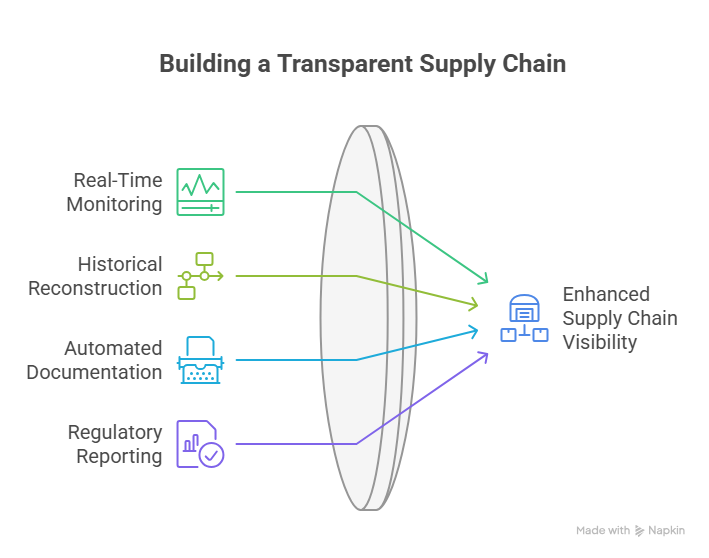
Selecting a traceability system is no longer just an IT decision it is a strategic risk management choice. In today’s regulatory and recall-sensitive environment, food businesses need a platform that delivers full operational visibility, compliance readiness, and scalability. Here’s how to evaluate the right solution and how TraceX Traceability Solutions align with those requirements.
A complete traceability system must support:
Many systems handle only logistics tracking or basic recordkeeping. TraceX provides end-to-end, lot-level traceability, enabling businesses to:
This integrated visibility ensures recall precision and regulatory defensibility.
A traceability system must integrate seamlessly with existing enterprise infrastructure, including:
Without ERP integration, teams rely on manual uploads and duplicate data entry increasing error risk.
TraceX is designed with API-based ERP integration, allowing automated data flow between procurement, production, and compliance systems. This reduces manual effort, improves data accuracy, and ensures traceability becomes part of daily operations not a parallel process.
Traceability systems must align with evolving regulations such as:
TraceX structures traceability data around regulatory Key Data Elements (KDEs) and compliance reporting formats, enabling:
Compliance is embedded into the workflow not retrofitted after the fact.
As businesses expand across geographies and product lines, traceability systems must scale without becoming fragmented.
Key questions to ask:
TraceX is built as a cloud-based, multi-enterprise platform, enabling traceability across:
This scalability ensures companies can standardize traceability globally while maintaining local compliance.
Understanding the types of traceability in food supply chains, forward traceability, backward traceability, and internal traceability is essential for modern food businesses operating in a high-risk, highly regulated environment. Each type serves a distinct purpose: forward traceability enables rapid recall containment, backward traceability supports root cause analysis and supplier accountability, and internal traceability ensures production control and quality management. Together, they form the foundation of a fully integrated track-and-trace system. Companies that implement all three not only meet regulatory requirements such as FSMA 204 but also reduce recall costs, strengthen audit readiness, and build consumer trust. In today’s market, traceability is no longer just about compliance it is a strategic capability that protects public health, brand reputation, and long-term business resilience.
Preparing for EUDR enforcement?
Learn how traceability under EUDR impacts your supply chain.
Is your food business ready for FSMA 204?
Discover how traceability supports FSMA compliance.
Standardization is the backbone of modern traceability.
Learn how GS1 standards power global supply chains.
Yes. Regulations like FSMA 204 (U.S.) require enhanced traceability records for certain high-risk foods.
It enables faster recalls, quicker root cause identification, and reduced contamination impact.
Barcodes, QR codes, RFID, ERP systems, cloud platforms, blockchain, and IoT sensors.









