
Quick summary: A practical guide to verification standards for agroforestry carbon projects - covering major standards, data requirements, digital MRV, verification costs, and best practices to ensure credibility and faster credit issuance.

As buyers demand higher integrity and regulators tighten oversight, agroforestry projects face growing pressure to prove that claimed carbon benefits are real, additional, and permanent. Verification Standards for Agroforestry Carbon Projects are no longer a technical formality; they are the gatekeeper to whether carbon credits can be issued, sold, and trusted in the market
Weak or inconsistent verification doesn’t just delay credit issuance; it can lead to rejected audits, credit invalidation, price discounts, or even full project reversals. In a market increasingly shaped by scrutiny and transparency, robust verification standards are the difference between bankable, premium credits and projects that struggle to find buyers.
Key Takeaways
Verification standards in agroforestry carbon projects are formal rules and procedures used to measure, verify, and certify carbon sequestration from tree–crop–livestock systems. They ensure that reported carbon benefits are real, additional, measurable, and durable, allowing projects to issue credible carbon credits trusted by buyers and regulators.
Although often used interchangeably, these terms play distinct and complementary roles in the carbon market:
Methodologies define how carbon is quantified in agroforestry systems. They specify:
Methodologies are the scientific rulebooks for measuring carbon.
Registries oversee the entire lifecycle of a carbon credit, including project approval, credit issuance, and public tracking. Major registries relevant to agroforestry include:
Registries:
Registries provide oversight, transparency, and market legitimacy.
Verification bodies are third-party auditors accredited by registries to validate and verify projects. Examples include:
Their role is to:
Verification bodies ensure no one is “grading their own homework.”
Struggling with verification delays or data gaps? Discover how digital MRV solves common agroforestry carbon challenges.
Understand the data and traceability foundations behind high-quality agroforestry carbon projects.

Standards require proof that carbon benefits would not occur without carbon finance. This is tested through:
This prevents crediting “business-as-usual” tree planting.
Agroforestry carbon must be stored for decades, despite risks like fire, pests, or land-use change. Standards address this by:
This ensures climate benefits persist beyond short project cycles.
Verification standards enhance credibility through:
Together, these measures reduce risks of over-crediting, greenwashing, and double counting.
Agroforestry systems are biologically complex and spatially diverse, making rigorous verification essential. Strong standards allow these projects to:
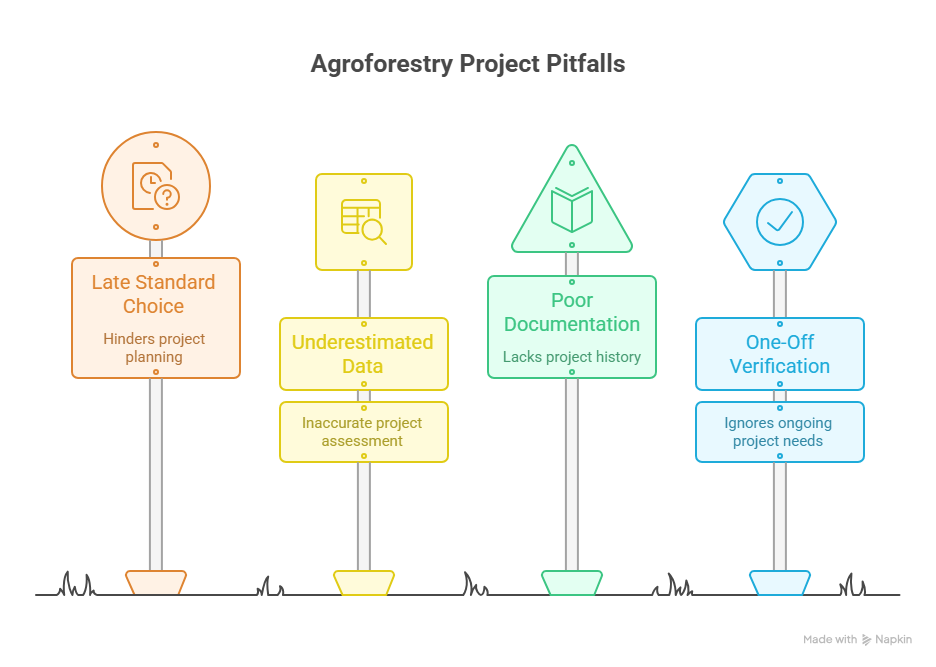
Agroforestry carbon projects rely on a small set of leading verification standards that define how carbon benefits are measured, verified, and issued as credits. Each standard reflects a different philosophy, scale, and target market, making them suitable for different project types and developer profiles.
Verra’s Verified Carbon Standard (VCS) is the most widely used carbon standard globally, including for agroforestry and Afforestation, Reforestation, and Revegetation (ARR) projects. It dominates the voluntary carbon market in terms of issued credits and buyer recognition.
Suitable Project Types
Verra is highly flexible and supports:
This makes it attractive for commercial-scale developers and governments aiming for scale.
Best suited for: Large-scale, investment-backed agroforestry programs prioritizing volume and market access.
Gold Standard was created to ensure carbon projects deliver both climate mitigation and measurable sustainable development benefits. In agroforestry, it is widely viewed as a high-integrity, premium standard.
Focus on Climate + Sustainable Development
Gold Standard requires projects to demonstrate:
Stakeholder consultation and social safeguards are mandatory, not optional.
Alignment with Corporate Buyers
Gold Standard is especially popular with:
Credits often command a price premium due to perceived integrity.
Best suited for: High-integrity projects targeting premium buyers rather than mass credit issuance.
Plan Vivo was specifically designed for smallholder and community-led land-use projects, including agroforestry, restoration, and sustainable agriculture. It prioritizes people-first climate action.
Design for Smallholders and Communities
Key characteristics include:
Carbon revenue flows directly to participating farmers, not just developers.
Participatory Monitoring and Livelihood Focus
Plan Vivo emphasizes:
This approach reduces upfront financial barriers for poor or remote communities.
Lower Entry Barriers
Compared to Verra or Gold Standard:
Best suited for: Projects prioritizing equity, livelihoods, and accessibility over maximum carbon volume.
| Feature | Verra (VCS) | Gold Standard (GS) | Plan Vivo |
| Primary Driver | Scalability & Flexibility | SDG Impact & Integrity | Community & Livelihoods |
| Minimum Area | No limit, but >5k ha preferred | Medium-scale (>500 ha) | Smallholder clusters |
| Target Geography | Global (Strong in LatAm/Asia) | Global (Strong in Africa) | Global (Smallholder focus) |
| Co-benefit Rules | Optional (via CCB/SD VISta) | Mandatory (Min. 3 SDGs) | Mandated (60% to community) |
| Development Cost | High (High VVB fees) | Very High (Strict auditing) | Moderate (Accessible entry) |
| Average Timeline | 12–24 months | 18–30 months | 12–18 months |
| Audit Frequency | Every 1–5 years | Every 3–5 years | Annual Reporting / 5yr VVB |
Robust, well-structured data is the single most important determinant of whether an agroforestry carbon project passes verification on time. Verification standards require traceable, consistent, and auditable datasets that demonstrate carbon impact, risk management, and social integrity across the full project lifecycle.
Accurate geospatial data is the foundation of verification.
What verifiers require:
Why it matters:
Best practice: Polygon mapping (not single GPS points) using mobile GIS tools.
Boundary overlap is one of the most common red flags during carbon project validation, especially in aggregated agroforestry and smallholder programs
See how boundary overlap detection streamlined validation and reduced audit friction in this real-world case study using TraceX DMRV.
Read the case study to see boundary overlap detection in action and how it accelerates carbon project validation without adding operational complexity.
Carbon accounting depends heavily on what trees are planted, how many, and when.
Required data includes:
Why it matters:
Best practice: Standardized species lists and periodic survival counts.
Verification standards demand proof of additionality, which hinges on baseline land use.
Typical evidence includes:
Why it matters:
Best practice: Combine remote sensing with farmer interviews for triangulation.
MRV data proves that project activities match what was promised.
Core MRV components:
Why it matters:
Best practice: Digitized MRV systems with time-stamped records.
Agroforestry projects must address carbon reversal and displacement risks.
Required documentation:
Why it matters:
Best practice: Landscape-level risk assessment updated periodically.
Verification standards increasingly emphasize do-no-harm and co-benefits.
Common requirements:
Why it matters:
Best practice: Maintain signed records and dated meeting logs.
1. Incomplete Geospatial Data
2. Inconsistent Farmer Records
3. Weak Monitoring Protocols
4. Manual or Paper-Based Data Collection
Digital MRV (Monitoring, Reporting, and Verification) and end-to-end traceability are increasingly becoming the default infrastructure for high-quality agroforestry carbon projects. By digitizing field data, linking it directly to carbon accounting, and maintaining a transparent audit trail, projects can move from reactive verification to continuous verification readiness.
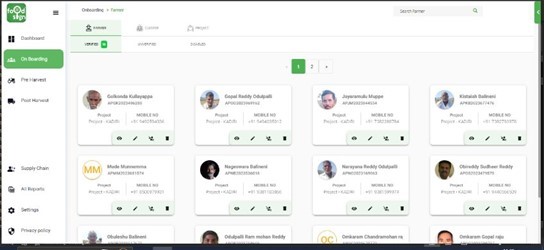
One of the biggest verification challenges in agroforestry is connecting what happens on individual farms to project-level carbon claims.
Digital MRV systems enable:
Why this matters for verification
Auditors can trace every carbon calculation to a verifiable physical activity on the ground, reducing follow-up questions, rechecks, and manual reconciliation.
Traditional MRV relies on infrequent field surveys, often conducted just before verification. This creates data gaps, surprises, and last-minute fixes.
Digital MRV shifts the model:
Verification advantage
By the time verification begins, most data issues are already resolved, significantly reducing audit friction.
Verifiers don’t just check numbers they check data lineage.
Digital traceability systems provide:
Why auditors care
This allows third-party verifiers to replicate results quickly, boosting confidence and shortening verification cycles.
Poor data quality is one of the main drivers of high verification costs.
Digital MRV helps reduce costs by:
Result
Projects move faster from monitoring to issuance, improving cash flow predictability and buyer confidence.
At a certain scale, MRV stops being just a compliance requirement and becomes a strategic asset:
Digital MRV solutions from TraceX are designed to operationalize these principles across complex agroforestry programs. By integrating farm-level traceability, geospatial mapping, MRV workflows, and audit-ready reporting into a single system, such platforms help projects stay continuously verification-ready rather than scrambling at audit time.
Rather than replacing standards or verifiers, digital MRV tools complement existing verification frameworks, translating methodology requirements into day-to-day operational workflows. For project developers, NGOs, and aggregators, this often means fewer delays, lower risk, and a smoother path from field activity to verified carbon credits without changing the underlying standard or methodology.
Verification standards are the trust backbone of agroforestry carbon projects. They translate complex, farm-level climate actions into credible, market-accepted carbon credits by enforcing rigorous rules on data quality, additionality, permanence, and transparency. In practice, projects that align the right standard with robust digital MRV and traceability move faster through verification, reduce risk, and are better positioned to attract high-integrity buyers in an increasingly scrutiny-driven carbon market.
Learn how agroforestry carbon credits are created—from farm practices to verified climate impact.
Learn how standards like Verra, Gold Standard, and Plan Vivo shape carbon project credibility.
Understand how carbon offset verification works—and why data quality matters more than ever.
Verification standards are formal frameworks that define how carbon sequestration from agroforestry systems is measured, monitored, independently verified, and issued as carbon credits. They ensure credits are real, additional, permanent, and transparent.
There is no single “best” standard. Large, scalable projects often use Verra (VCS), impact-driven projects may prefer Gold Standard, and smallholder or community-led initiatives are well-suited to Plan Vivo. The right choice depends on project scale, funding, and target buyers.
High-quality data enables auditors to trace carbon claims back to real farms, trees, and practices. Poor geospatial data, weak baselines, or inconsistent monitoring records are the most common causes of verification delays and increased costs.
Digital MRV links farm-level data directly to carbon accounting, enables continuous monitoring, maintains audit-ready records, and reduces manual errors. This shortens verification timelines, lowers costs, and improves credibility with registries and buyers.
Verification timelines vary by standard and data readiness. Well-prepared projects using digital MRV may complete verification in a few months, while data gaps or manual systems can extend timelines by six months or more.